












High-Index Lens Options: A Guide to 1.67 vs. 1.74
Understand the key differences between 1.67 and 1.74 high-index lenses. This guide breaks down the benefits in terms of thickness, weight, and cost, helping you make the smartest choice for your strong prescription.
TL;DR: 1.67 vs. 1.74 at a Glance
For those with strong prescriptions, choosing the right lens material is the most critical decision after getting the numbers right. It directly impacts how your glasses look, feel, and perform. Here’s a quick comparison:
| Feature | 1.67 High-Index | 1.74 High-Index |
|---|---|---|
| Recommended Rx | Myopia: -4.00 to -8.00 D | Myopia: Above -8.00 D |
| Hyperopia: +3.00 to +6.00 D | Hyperopia: Above +6.00 D | |
| Thickness | ~20-30% thinner than standard 1.50 index | Up to 15% thinner than 1.67; thinnest plastic available |
| Aesthetics | Excellent for full-rim or semi-rimless frames | The ultimate choice for rimless or thin metal frames |
| Optical Clarity | Better optical clarity (higher Abbe value) | More prone to chromatic aberration (color fringing) |
| Cost | More affordable high-index option | Premium price point |
What Exactly Are High-Index Lenses?
Before we compare 1.67 and 1.74, let's clarify what "high-index" means. The "index"—or refractive index—is a number that indicates how efficiently a material bends light. Standard plastic lenses have a refractive index of around 1.50. High-index lenses, as defined by materials studied at institutions like Ferris State University, have a higher refractive index, typically ranging from 1.53 to 1.74.
Why does this matter to you? A higher index material can bend light more sharply. This means that for the same prescription, a high-index lens can be made much thinner and with a flatter curve than a standard lens. The result is a lighter, more comfortable, and more cosmetically appealing pair of glasses, eliminating the "coke-bottle" effect often associated with strong prescriptions.
A Closer Look at 1.67 High-Index Lenses
The 1.67 high-index lens is a popular and effective choice for a wide range of prescriptions. It serves as the workhorse of high-index materials, offering a significant aesthetic and comfort upgrade over standard lenses without the premium cost of the highest-index options.
Who Should Choose 1.67 Lenses?
In practice, we typically recommend 1.67 index lenses for individuals with prescriptions falling in these ranges:
Myopia (Nearsightedness): Prescriptions between -4.00 and -8.00 spherical equivalent.
Hyperopia (Farsightedness): Prescriptions between +3.00 and +6.00 spherical equivalent.
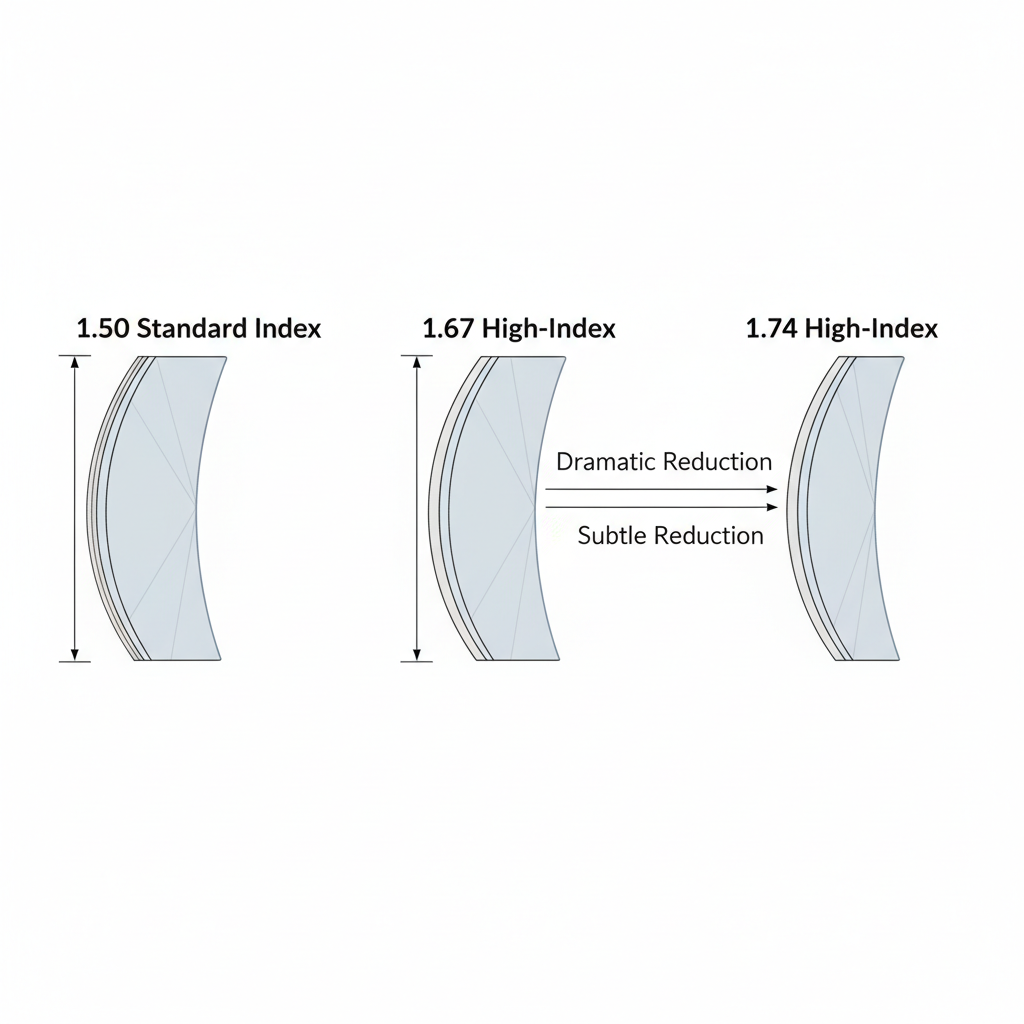
Within this range, a 1.67 lens provides a noticeable reduction in edge thickness (for myopia) or center thickness (for hyperopia) compared to a standard 1.50 lens—often around 20-30%. This makes them an excellent fit for most full-rim plastic or metal frames and even many semi-rimless styles.
Benefits and Limitations
The primary benefit of 1.67 is achieving a great balance. You get a significantly thinner and lighter lens that feels more comfortable on your face and looks better from the side, all at a more accessible price point than 1.74. However, for those with prescriptions exceeding -8.00 D, a 1.67 lens may still have a visible edge thickness, especially if paired with a very thin or rimless frame.
The Ultimate Choice: 1.74 High-Index Lenses
When only the thinnest and lightest lens will do, 1.74 is the answer. This is currently the highest refractive index available for a plastic lens material, offering the maximum reduction in thickness and weight.
Who Needs 1.74 Lenses?
We reserve the 1.74 index for those with very strong prescriptions, as this is where its benefits are most apparent and justify the cost. The ideal candidates are:
High Myopia: Prescriptions stronger than -8.00 D.
High Hyperopia: Prescriptions stronger than +4.00 D.
For these prescriptions, moving from a 1.67 to a 1.74 lens can yield an additional 8-15% reduction in thickness. While this sounds small, it can be the difference-maker that allows someone to wear a minimalist rimless or thin wireframe without feeling self-conscious about lens protrusion. If you’re considering thin, stylish frames with a high prescription, 1.74 lenses are often the key to making it work.
The Critical Trade-Off: Cost and Chromatic Aberration
The superior thinness of 1.74 lenses comes with two main trade-offs. The first is cost; they are the most expensive lens material. The second is optical. High-index materials inherently have a lower "Abbe value," which is a measure of how much they disperse light into its component colors. This dispersion can cause "chromatic aberration," which you might perceive as faint color fringing around high-contrast objects (like black text on a white background), especially in your peripheral vision.
While 1.67 lenses have a better Abbe value than 1.74, this effect can be present in both. For this reason, an Anti-Reflective (AR) coating is considered essential for all high-index lenses, especially 1.74. An AR coating allows more light to pass through the lens (up to 99.5%), which sharpens vision and significantly mitigates the visual distractions caused by aberrations and reflections.
Expert Warning: Debunking the "Highest Index is Best" Myth
A common misconception is that you should always choose the highest index lens you can afford. This is not true. The best choice is a holistic one that balances your prescription, frame, and budget.
For someone with a -3.00 D prescription, a 1.74 lens offers almost no cosmetic benefit over a 1.61 or even a 1.50 index lens, but it will cost significantly more and may introduce perceptible chromatic aberration. The frame choice is equally important. I often see people select a wide, fashionable frame and then expect a high-index lens to completely hide the edge thickness. In reality, choosing a smaller, rounder frame that keeps your eye centered is far more effective at minimizing thickness than simply upgrading the index.
Furthermore, accurate measurements are non-negotiable. An error in the Pupillary Distance (PD) can be problematic even for low prescriptions, but as you can learn in our guide on whether a small PD error matters, the issue is magnified with high-index lenses, leading to induced prism and eye strain. For high prescriptions, other measurements like vertex distance—the distance from the back of the lens to your cornea—also become critical for accurate vision.
Making the Right Choice: A Decision Framework
Choosing between 1.67 and 1.74 isn't just about your prescription numbers. It’s about how those numbers interact with your frame choice and personal priorities. Use this table as a guide.
| Your Primary Goal | Your Prescription (Spherical Equivalent) | Your Frame Style | Our Recommendation |
|---|---|---|---|
| Balanced Performance & Value | -4.00 D to -8.00 D | Any full-rim or semi-rimless style | 1.67 High-Index |
| Maximum Thinness & Aesthetics | Stronger than -8.00 D | Thin metal, minimalist, or rimless | 1.74 High-Index |
| Center Thickness Reduction | Stronger than +4.00 D | Any style, especially larger frames | 1.74 High-Index |
| Budget-Conscious Choice | Weaker than -4.00 D | A smaller, well-fitting frame | 1.59 Polycarbonate or 1.61 High-Index |
Remember to start with your prescription, which you have a right to receive from your eye doctor immediately after an exam, as mandated by the FTC's Eyeglass Rule. You can learn more in our simple guide to reading your eyeglass prescription. Once you have it, you can take control of your eyewear purchasing decisions.
Ensuring Safety and Quality in Your Online Purchase
It’s understandable to have concerns about ordering high-prescription glasses online. A widely cited study published in the journal Optometry found that a significant percentage of online glasses failed to meet safety or optical standards. However, this highlights the importance of choosing a reputable vendor that prioritizes quality control.
In the United States, all prescription lenses, regardless of material, must comply with the FDA's regulations on impact resistance, specifically 21 CFR 801.410. This ensures a baseline level of safety. A trustworthy online retailer will go further by verifying the finished lens power, checking the uniformity of coatings, and ensuring the fit and finish meet professional standards. For more details, review our checklist on buying prescription glasses online safely.
Wrapping Up: Your Smartest Choice
Choosing between 1.67 and 1.74 high-index lenses comes down to a careful evaluation of your needs.
Choose 1.67 if you have a moderate-to-strong prescription (up to ~-8.00 D) and want a significant upgrade in thinness and comfort without the premium price. It is the versatile workhorse for the majority of high-prescription wearers.
Choose 1.74 if you have a very strong prescription (above -8.00 D) and your primary goal is achieving the thinnest, lightest, most cosmetically appealing result possible, especially for rimless or minimalist frames.
The final decision is a partnership between the lens material, the frame style, and critically, a set of precise measurements. By understanding these trade-offs, you can make an informed choice that delivers clear vision and confidence.
Frequently Asked Questions (FAQ)
Do I absolutely need an Anti-Reflective (AR) coating with high-index lenses?Yes, it is highly recommended. High-index materials reflect more light than standard plastic. An AR coating minimizes these reflections, improving night vision, reducing eye strain, and making your lenses appear nearly invisible. For 1.74 lenses, we consider it essential to counteract optical trade-offs like chromatic aberration.
Can I put high-index lenses in any frame?While you technically can, it often defeats the purpose. The primary benefit of high-index lenses is to reduce thickness in frames that would otherwise expose the lens edge (like rimless or thin metal styles). Putting a 1.74 lens in a thick, chunky acetate frame is unnecessary, as the frame itself will hide the edge.
Will 1.74 lenses completely get rid of the "coke bottle" look?They will significantly reduce it more than any other plastic material. However, for extremely high prescriptions, some edge thickness or center bulk will always be present. The "minification" or "magnification" effect (eyes looking smaller or larger) is also reduced but not entirely eliminated.
Disclaimer: This article is for informational purposes only and does not constitute medical advice. Always consult with a qualified eye care professional for any questions regarding your vision or prescription. They can provide personalized recommendations based on a full eye health examination.


