












Maximizing the 20-20-20 Rule for Prescription Lens Wearers
TL;DR: The Prescription Wearer's 20-20-20 Upgrade
The standard 20-20-20 rule—look at something 20 feet away for 20 seconds every 20 minutes—is a good start for fighting digital eye strain. However, for those who wear prescription glasses, especially for nearsightedness or with progressive lenses, applying it correctly requires extra steps. Simply looking away isn't enough; you must ensure you are using the correct part of your lens and truly allowing your eye's focusing muscle to relax. This guide details an enhanced routine tailored to the physics of your specific eyewear.
Why the Standard 20-20-20 Rule Often Fails
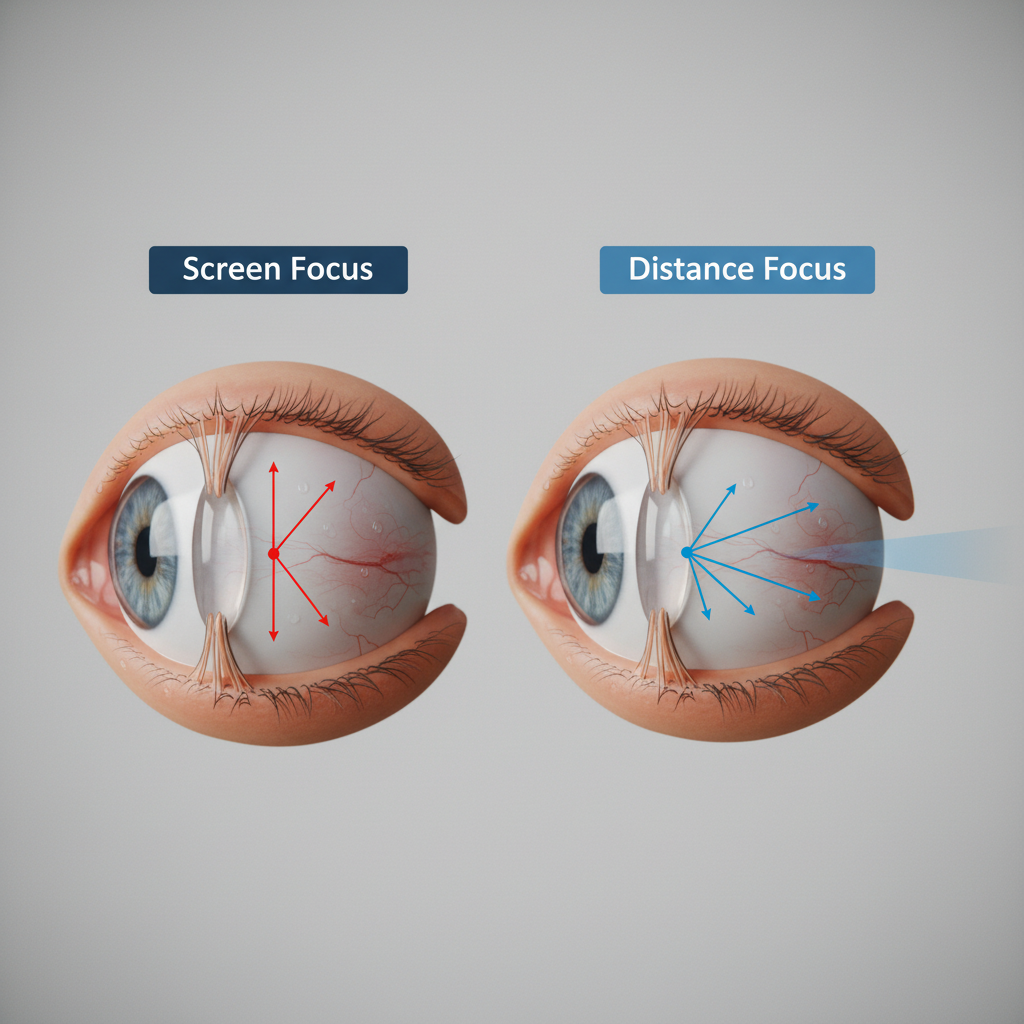
The 20-20-20 rule is designed to combat one primary problem: accommodative stress. When you stare at a screen, a tiny muscle in your eye, the ciliary muscle, remains contracted to keep your focus sharp. Holding this tension for hours is like holding a weight; eventually, the muscle fatigues, leading to strain, headaches, and blurry vision. Furthermore, as the American Academy of Ophthalmology (AAO) notes, our blink rate plummets from a normal 15 times per minute to just 5-7 times while using digital devices, leading to dryness and irritation.
The rule aims to force a "reset" by shifting your gaze to "optical infinity" (about 20 feet or 6 meters), the distance at which the ciliary muscle can fully relax.
However, many people perform the rule incorrectly:
- Choosing the Wrong Target: Looking at a wall 10 feet away doesn't provide enough distance for the muscle to completely release.
- Not Holding it Long Enough: A quick glance isn't sufficient; the 20-second duration is necessary for the muscle to disengage.
- Ignoring the Lens: For prescription wearers, the glasses themselves introduce a new layer of complexity.
The Prescription Lens Challenge: Why Your Glasses Change the Game
Your prescription lenses are precision tools designed to bend light in a specific way. This interaction is why a one-size-fits-all approach to the 20-20-20 rule is ineffective.
Expert Observation: Practitioners consistently find that the rule's success depends on the wearer's prescription and lens design. Common failure points are directly related to not accounting for the optics of the lenses themselves.
For High Myopia (Nearsightedness)
If you are nearsighted, your glasses are corrected for clear distance vision. A common mistake is assuming that just looking at a 20-foot target through your lenses automatically relaxes your focus. In reality, your brain and eyes are so accustomed to the accommodative effort of near work that a conscious effort is required to let go. You must actively relax your focus when looking into the distance, a step many people miss.
For Progressive or Multifocal Lenses
Progressive lenses are a marvel of optical engineering, but they have distinct zones. The top portion is for distance, the middle for intermediate, and the bottom for reading. Your desk setup naturally encourages a downward gaze through the bottom (near) portion of the lens. If you simply turn your head to look at a distant object without adjusting your posture, you're still looking through a near-vision zone, completely defeating the purpose of the break. The rule only works if you consciously lift your chin and use the distance portion of the lens.

The Impact of Anti-Reflective (AR) Coatings
Even your lens coatings play a role. When you look up and away from your screen, poor-quality AR coatings can catch distracting reflections from overhead office lighting. According to research on visual ergonomics, glare is a primary cause of visual fatigue. If taking a visual break introduces new, annoying glare, you are less likely to do it. This highlights the importance of multi-layered, high-quality AR coatings that minimize reflections from all angles.
The Enhanced 20-20-20 Routine: A Step-by-Step Guide
To make the rule effective, you need a more structured approach. Follow these steps to create a routine that works with your prescription glasses, not against them.
Step 1: Optimize Your Environment
- Identify Your Target: Before you start your workday, find a true 20-foot (or more) focal point. The ideal target is through a window, as this provides true optical infinity and natural light. An interior wall is a poor substitute as it still provides some accommodative stimulus.
- Control Glare: Position your screen to avoid glare from windows or overhead lights. If you can't move your desk, consider an anti-glare screen filter.
Step 2: Set a Timer Don't rely on memory. Use a simple app or a physical timer on your desk to remind you every 20 minutes. Consistency is key to preventing fatigue from building up.
Step 3: Execute the "Focus Reset" When the timer goes off, don't just glance away. Perform the following for a full 20 seconds:
- If you are nearsighted: Look at your distant target and consciously relax your eyes. Feel the focusing muscles let go. It’s a sensation of "releasing" rather than "looking."
- If you wear progressives: Lift your chin slightly, ensuring you are looking through the top third of your lenses. Find the "sweet spot" for distance and hold your head position there.
Step 4: Add a "Blink Break" During your 20-second focus reset, make 3-4 slow, deliberate, full blinks. This fully rewets the surface of your eyes, combating the dryness caused by a reduced blink rate during screen time. The AAO also suggests that for contact lens wearers, switching to glasses during long screen sessions can help reduce dryness.
Step 5: Incorporate Micro-Movements Digital eye strain is part of a larger problem of static posture. As the Mayo Clinic warns, prolonged sitting is harmful even with perfect posture. During your 20-second break, roll your neck, shrug your shoulders, or stand up and stretch. This "dynamic work" approach helps release tension in your neck and back, which is often linked to tension headaches associated with eye strain.
Frequently Asked Questions (FAQ)
Q: Can I just close my eyes for 20 seconds instead? A: While resting your eyes is good, it doesn’t achieve the primary goal of the 20-20-20 rule, which is to relax the ciliary muscle by changing your focal distance. You need to look at a distant object to force that specific muscular reset.
Q: My office has no windows. What should I do? A: Find the longest possible line of sight available, such as down a long hallway. While not perfect, a target that is at least 20 feet away is significantly better than simply looking up at the ceiling a few feet above you.
Q: I wear contact lenses. Does this advice still apply? A: Absolutely. In fact, it's even more critical. Contact lenses can exacerbate dryness, so the "Blink Break" (Step 4) is especially important for you. The accommodative stress mechanism is the same whether you wear contacts or glasses.
Q: I follow the rule, but my eyes still feel strained. What now? A: Consistent eye strain despite these measures could indicate another issue. It might be an outdated prescription, an incorrect pupillary distance (PD) measurement on your glasses, or an underlying condition like Dry Eye Disease. It may be beneficial to explore other topics, such as whether drugstore reading glasses are a safe bet for your needs or if you have uncorrected astigmatism.
Making the 20-20-20 rule a consistent habit is one of the most effective, no-cost ways to protect your visual comfort in the digital age. By understanding how your prescription lenses interact with the rule, you can transform it from a simple reminder into a powerful, personalized tool for ending the cycle of digital eye strain.
Disclaimer: This article is for informational purposes only and does not constitute professional medical advice. Consult with a qualified optometrist or ophthalmologist for any health concerns or before making any decisions related to your eye health.
References
- American Academy of Ophthalmology (AAO) - Computer Usage and Eyestrain
- Sage Journals - Impact of Glare on Performance
- Mayo Clinic - The "Sitting Disease" Risk
- American Academy of Ophthalmology (AAO) - Digital Devices and Your Eyes


