










Abbe Value Explained: Why Thinner Lenses Aren’t Always Clearer
TL;DR: The Clarity vs. Thickness Trade-Off
When you have a strong prescription, you want the thinnest, lightest lenses possible. But sometimes, these ultra-thin, high-index lenses come with a hidden compromise: distracting rainbow-like halos around lights and sharp edges. This phenomenon is called chromatic aberration, and it's measured by a specification called the Abbe value. A lower Abbe value means more color fringing, while a higher value means crisper, clearer vision. Understanding this trade-off is the key to choosing a lens that looks great and provides excellent optical quality.
What Is Chromatic Aberration? The "Color Fringing" Effect
Have you ever looked through a simple prism and seen white light split into a rainbow? That's the basic principle behind chromatic aberration. When light passes through any lens material, it gets bent, or refracted, to focus it correctly for your eye. However, different colors (wavelengths) of light bend at slightly different angles.
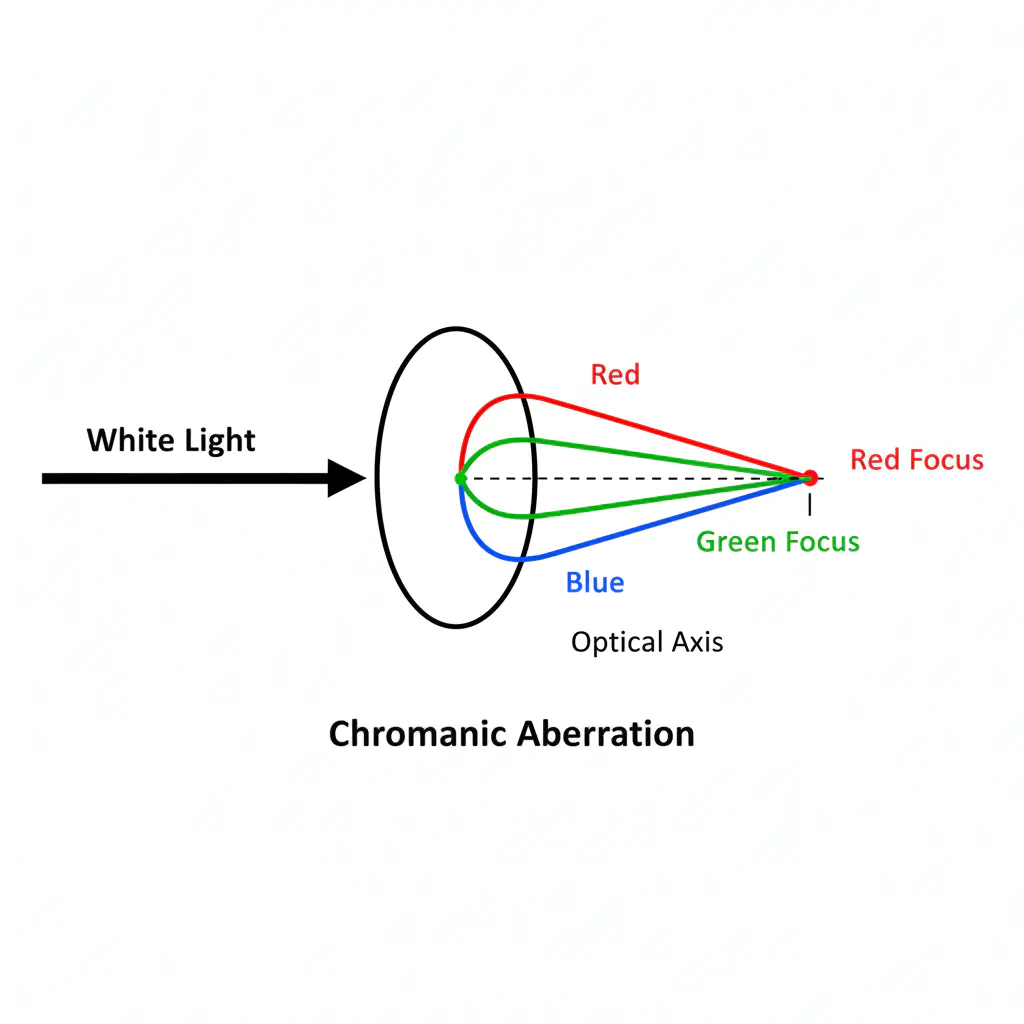
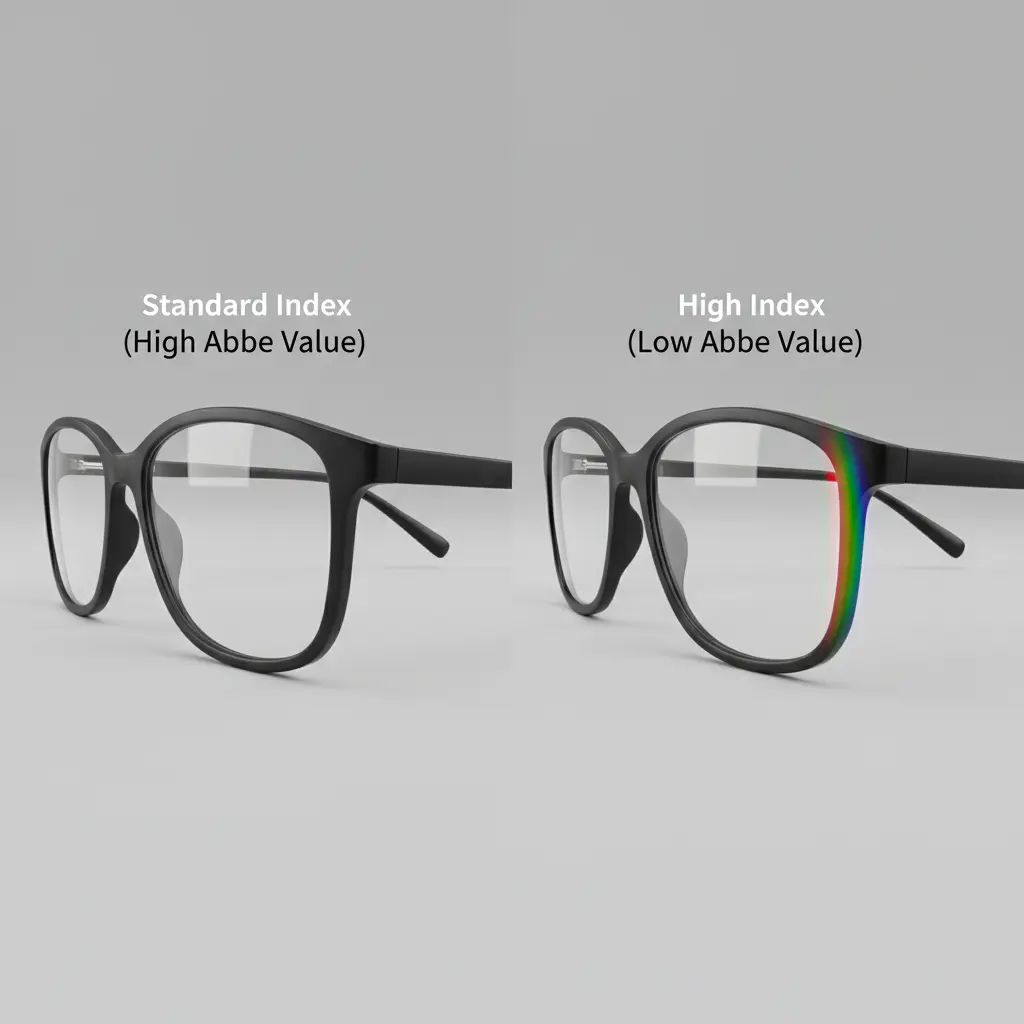
When a lens material can't bring all these color wavelengths back to a single, sharp focal point, it results in dispersion. For the wearer, this dispersion manifests as faint, colored halos around high-contrast objects. You might notice it most when looking at black text on a white background, headlights at night, or the edges of a bright screen. This effect is often most pronounced in your peripheral vision, away from the direct center of the lens.
According to an analysis of lens material properties from IOT, the formula for the Abbe value directly relates to the refractive indices of different light wavelengths, confirming it as the industry standard for measuring this dispersion. This isn't a defect in your prescription; it's a fundamental property of the lens material itself.
The Abbe Value: A Number for Optical Purity
Think of the Abbe value as a rating for the optical clarity of a lens material, specifically its ability to resist splitting light into a rainbow. The scale is simple:
- A High Abbe Value (e.g., 45 or greater): This indicates low dispersion and minimal chromatic aberration. Materials with a high Abbe value deliver sharper, more comfortable vision with truer color perception.
- A Low Abbe Value (e.g., 35 or less): This indicates high dispersion and more noticeable chromatic aberration. While these lenses can be made much thinner, it comes at the cost of some optical purity.
The Critical Trade-Off: Lens Thickness vs. Visual Clarity
The central challenge in lens selection, especially for stronger prescriptions, is balancing the cosmetic benefit of a thin lens with the optical benefit of a high Abbe value. As a rule, these two characteristics have an inverse relationship.
- Standard-Index Lenses (like CR-39 plastic): These materials are thicker but boast a very high Abbe value (around 58), offering superior, distortion-free optics.
- High-Index Lenses (like 1.67 or 1.74): These materials are remarkably thin and light, but as the refractive index increases to bend light more efficiently, the Abbe value naturally decreases (typically into the low 30s). This makes chromatic aberration a more common experience.
As experts at Ferris State University note, the primary benefit of high-index lenses is their ability to be thinner and lighter, which is a significant cosmetic and comfort advantage for those with high-power prescriptions.
Material Comparison: Index vs. Abbe Value
This table shows the typical relationship between common lens materials, their thinness (refractive index), and their optical clarity (Abbe value).
| Lens Material | Refractive Index | Abbe Value | Key Characteristics |
|---|---|---|---|
| CR-39 Plastic | 1.50 | 58 | Best Optical Clarity, thickest material |
| Trivex | 1.53 | 43-45 | Excellent optics, lightweight, high impact resistance |
| Polycarbonate | 1.59 | 30 | Best Impact Resistance, but very poor optical clarity |
| High-Index 1.60 | 1.60 | 40-42 | Good balance of thinness and clarity |
| High-Index 1.67 | 1.67 | 32 | Very thin and light, noticeable color fringing |
| High-Index 1.74 | 1.74 | 33 | Thinnest Material Available, most noticeable color fringing |
Who Is Most Likely to Notice Chromatic Aberration?
Not everyone will be bothered by the effects of a low Abbe value. The phenomenon is most apparent under specific conditions and for certain individuals.
- People with Strong Prescriptions: In practice, opticians observe that individuals with prescriptions above +/-4.00 diopters are the most likely to perceive chromatic aberration. The stronger the prescription, the more the lens has to bend light, which amplifies the dispersion effect.
- Wearers of Large Frames: Fashionable, oversized frames force your eyes to use more of the lens's periphery, where aberrations are always more pronounced compared to the optically pure center.
- Visually Sensitive Individuals: Some people are simply more attuned to optical imperfections and may find the color fringing distracting even with a moderate prescription.
- Night Drivers: The high contrast of headlights and street signs against a dark background makes color fringing much more obvious.
How to Choose the Right Lens Material for Your Prescription
Armed with an understanding of the Abbe value, you can make an informed choice based on your specific needs.
-
For Mild Prescriptions (+/- 0.25 to +/- 2.00): You have the most flexibility. Standard CR-39 plastic will offer the absolute best optical clarity. You are unlikely to notice a significant difference in thickness, and the Abbe value of polycarbonate (around 30) is generally not an issue at this power.
-
For Moderate Prescriptions (+/- 2.25 to +/- 4.00): This is where the balance becomes important. A material like Trivex (Abbe value ~43-45) is an excellent choice, offering a great combination of clear optics, high impact resistance, and a lighter profile than CR-39. You could also consider a 1.60 high-index lens, which maintains a respectable Abbe value around 40.
-
For Strong Prescriptions (above +/- 4.00): This requires a careful decision based on your personal priorities.
- If you prioritize visual clarity above all: Choose a material with the highest Abbe value you can get, such as Trivex or a 1.60 high-index lens. The lenses will be thicker than other high-index options, but your vision will be sharper.
- If you prioritize aesthetics and thinness: Select a 1.67 or 1.74 high-index lens. You will get the thinnest profile possible, but you must be prepared for the possibility of noticing chromatic aberration, especially when you first adapt to the lenses.
A Note on Coatings and Fit: It's crucial to understand that no lens coating can fix chromatic aberration. Anti-reflective (AR) coatings are essential for reducing glare and surface reflections, but they do not alter the inherent dispersive properties of the lens material itself. Furthermore, ensuring your glasses are perfectly fitted—with the optical center of the lens aligned directly in front of your pupil—is the best way to minimize your view through the more distorted periphery.
This article is for informational purposes only and does not constitute professional medical advice. Consult with a qualified eye care professional to determine the best lens options for your specific vision needs and health conditions.
Frequently Asked Questions
1. Can special coatings get rid of the rainbow effect? No. The rainbow effect, or chromatic aberration, is an inherent property of the lens material itself. Anti-reflective (AR) coatings are highly recommended as they reduce surface reflections and glare, improving overall visual comfort, but they cannot correct for light dispersion within the lens.
2. Is a low Abbe value harmful to my eyes? No, it is not harmful. Chromatic aberration is a purely optical issue that can affect visual comfort and sharpness, but it does not cause any physical damage to your eyes.
3. Why didn't I notice color fringing on my old glasses? There could be several reasons. Your prescription may have been weaker, you might have worn a lens material with a higher Abbe value, or your previous frames could have been smaller, keeping your line of sight more consistently in the central, clearest part of the lens.
4. Is polycarbonate a bad choice for prescription lenses? Not necessarily, but it's a choice with a significant trade-off. Polycarbonate has an extremely low Abbe value (around 30), resulting in poor optical clarity. However, its primary benefit is superior impact resistance, making it a mandated choice for children's eyewear and safety glasses. For most adults who don't require safety-rated lenses, materials like Trivex or other high-index options offer a better balance of features.


