















Accommodative Insufficiency: When Your Eyes Struggle to Focus Up Close
The Blurry Truth: Is It Just Eye Strain or Accommodative Insufficiency?
TL;DR: If your vision gets blurry after a few minutes of reading or screen time, but clears up when you look away, it might not be simple eye strain. You could be experiencing Accommodative Insufficiency (AI), a condition where your eyes’ focusing muscles fatigue quickly. While common in students and office workers, it requires a different approach than just standard glasses. Management often involves vision therapy, better work habits, and specialized supportive lenses designed to reduce focusing effort without weakening your eyes.
It’s a familiar story for many of us. You’re deep into a project, reading a textbook, or analyzing a spreadsheet, and the words start to swim. You blink, rub your eyes, and look away for a moment. Things clear up, but as soon as you return to your task, the blurriness creeps back in. You might dismiss it as digital eye strain or needing a stronger prescription, but what if it’s something more?
This guide explores Accommodative Insufficiency, a specific type of functional vision problem that causes these exact symptoms. We will break down what it is, how it differs from other conditions, and what you can do to manage it effectively. Understanding this condition is the first step toward finding real relief and maintaining clear, comfortable vision during demanding near-work.

What Is Accommodative Insufficiency?
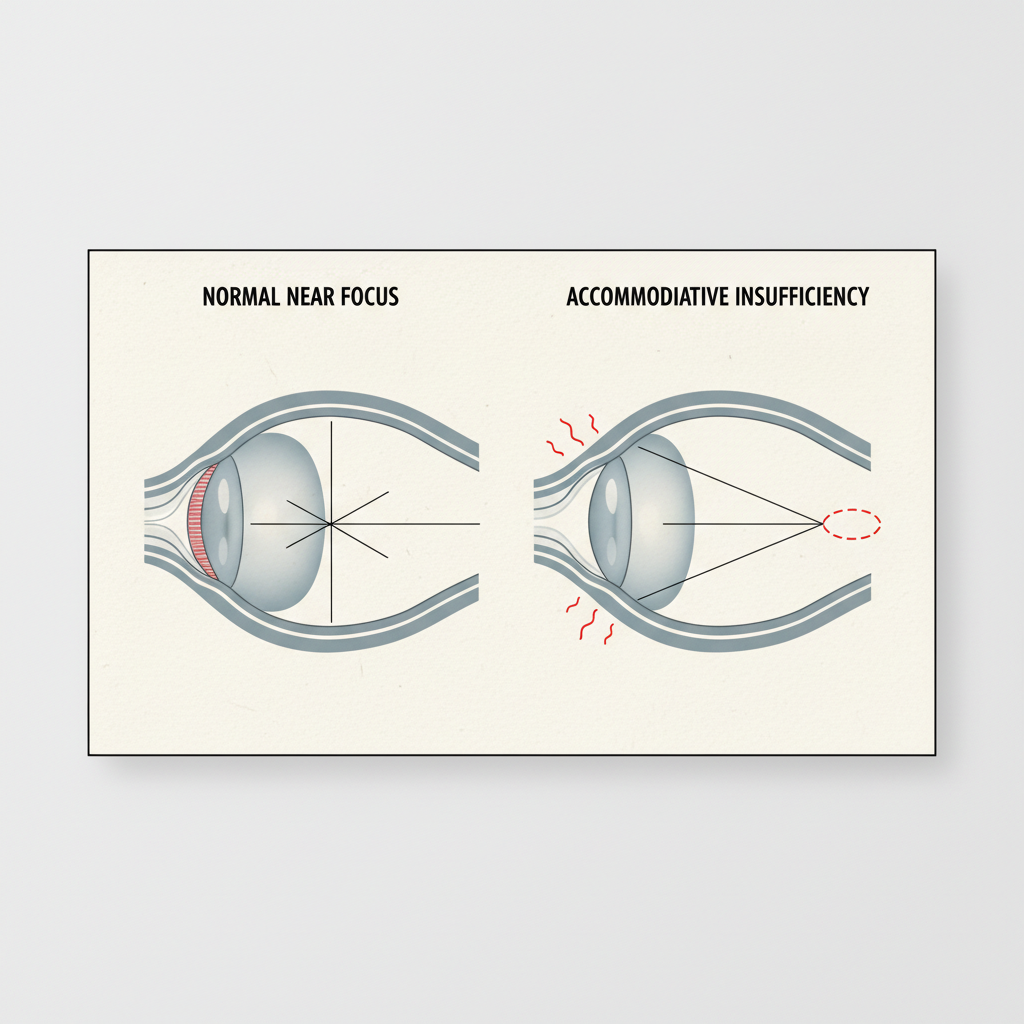
Accommodative Insufficiency is a condition where the ciliary muscle—the tiny muscle inside your eye responsible for changing the shape of the lens to focus on near objects—lacks the stamina to hold focus for extended periods. Think of it like a muscle in your arm that gets tired after holding a heavy book for too long. Your eye's focusing muscle can experience the same kind of fatigue.
According to clinical guidelines published in StatPearls, AI is a common issue, affecting up to 10% of the non-presbyopic population. It's not a disease, but a functional problem with the eye's focusing system.
Key Symptoms That Set AI Apart
The hallmark of AI is variable blur. Unlike a stable refractive error (like nearsightedness or farsightedness) that causes constant blurriness at a specific distance, the blur from AI comes and goes with activity.
Common signs include:
- Blurry Vision After Short Periods of Near Work: Your vision is clear initially but deteriorates the longer you read or use a computer.
- Eye Strain and Fatigue: A feeling of tiredness or aching around the eyes, especially in the afternoon.
- Headaches: Often located in the brow or temples, these headaches are triggered by near tasks.
- Difficulty Sustaining Attention: When your eyes struggle to focus, your brain has to work harder, which can make it difficult to concentrate on reading material.
- Skipping Lines or Losing Your Place: As the focusing system fatigues, it can become difficult to track text smoothly.
- Symptoms Worsen with Fatigue or Stress: When you're tired, your body's muscles, including your eye muscles, have less endurance.
A crucial diagnostic clue is that the blurriness often clears temporarily after you blink hard or look at something far away. This gives the ciliary muscle a momentary break, allowing it to "reset" before it fatigues again.
How Is Accommodative Insufficiency Diagnosed?
A standard vision screening that only checks your ability to read an eye chart (visual acuity) will likely miss AI. This is because you can probably force your eyes to see 20/20 for the few seconds the test requires. A proper diagnosis requires a comprehensive functional vision exam.
An eye doctor will perform specific tests to measure the stamina and flexibility of your focusing system. These may include:
- Measuring Accommodative Amplitude: This determines the maximum focusing power you can generate. In AI, this is often below the normal range for your age.
- Assessing Accommodative Facility: This tests how quickly and accurately you can shift focus between near and far targets. Individuals with AI often struggle with this, showing slow or hesitant responses.
- Checking for Lag of Accommodation: Using a technique called retinoscopy, the doctor can objectively measure how accurately your eyes are focusing on a near target. A significant "lag," where the focus falls short of the target, is a key sign of AI.
It is vital to describe your symptoms in detail to your optometrist. Explaining that the blur is intermittent and task-dependent is the most important information you can provide.
Management Strategies: Building Visual Stamina
The goal of managing AI is not just to correct vision but to improve the endurance and efficiency of the focusing system. Treatment typically involves a multi-faceted approach.
1. Vision Therapy
For many, vision therapy is the most effective long-term solution. It’s like physical therapy for your eyes. A series of prescribed exercises helps to build strength, stamina, and flexibility in the ciliary muscle and improve the brain-eye coordination required for sustained focus. Research on related binocular conditions has shown that office-based vision therapy can be significantly more effective than home-based exercises alone, as noted in a study on Convergence Insufficiency published in the journal Ophthalmology.
2. Ergonomics and Behavioral Changes
Creating a visually comfortable environment can significantly reduce the strain on your focusing system.
- The 30-10-30 Rule: While the 20-20-20 rule is a great start, for true accommodative fatigue, more frequent breaks are better. Try looking at a distant object (at least 20 feet away) for 30 seconds every 10 minutes of intense near work. This allows the ciliary muscle to fully relax and reset more often.
- Proper Lighting: Ensure your workspace is well-lit, with task lighting directed at your papers or keyboard, not shining in your eyes.
- Working Distance: Maintain a healthy distance from your screen or book. The Harmon distance (the distance from your elbow to your first knuckle) is a good rule of thumb.
3. Supportive Lenses
For students and office workers who cannot take frequent breaks, specialized lenses can provide significant relief. It's critical to understand that these are not the same as over-the-counter reading glasses.
A common pitfall is prescribing a standard reading power for AI. This acts like a crutch, doing all the work for the focusing muscle and potentially weakening it further over time.
Instead, an optometrist may prescribe:
- Low-Plus Lenses: These are very low-powered lenses that provide just enough support to reduce the demand on the ciliary muscle without taking over its job completely. They help the muscle work more efficiently without fatiguing.
- Anti-Fatigue or Accommodative Support Lenses: These advanced lenses have a subtle power boost in the lower portion of the lens. This design provides support exactly where you need it for reading and computer work, while the top of the lens remains clear for distance vision. This allows you to wear them all day and get relief during near tasks without interfering with your distance sight.
These lenses are designed to be part of a broader management strategy, helping to control symptoms and improve comfort while you build your focusing stamina through therapy and better habits.

Is It AI or Something Else?
Several other conditions can mimic the symptoms of Accommodative Insufficiency. A proper diagnosis is key to effective treatment.
- Presbyopia: This is the age-related loss of focusing ability that typically starts around age 40. While the symptoms are similar, the cause is different—the lens inside the eye becomes stiff, not a muscle weakness.
- Convergence Insufficiency (CI): This is an eye-teaming problem where the eyes struggle to turn inward together to focus on a near object. AI and CI often occur together and share symptoms like eye strain and headaches.
- Pseudomyopia: Also known as "focusing spasm," this is the opposite of AI. The ciliary muscle gets locked in a state of contraction and cannot relax to see clearly in the distance after prolonged near work. A recent study highlights that pseudomyopia can be a risk factor for developing true myopia.
- Uncorrected Refractive Error: Simple farsightedness (hyperopia) or astigmatism can also cause eye strain and blurry vision up close, as the eye has to work harder to compensate.
Taking Control of Your Focus
Accommodative Insufficiency can be a frustrating condition, impacting productivity and comfort for students and professionals alike. However, it is highly manageable. The key is recognizing that the variable, task-related blur you experience is a specific clinical sign that warrants a deeper look beyond a standard eye exam.
By seeking a functional vision assessment, you can get a correct diagnosis and a personalized management plan. Whether through vision therapy to build your focusing endurance, smarter work habits, or the use of specialized supportive lenses, you can regain comfortable, clear near vision and get back to focusing on your work, not on your eyes.
Frequently Asked Questions
1. Can accommodative insufficiency be cured or does it go away on its own? With treatment, primarily vision therapy, the symptoms of AI can be resolved, and normal accommodative function can be restored. It rarely goes away on its own, especially if the visual demands (like heavy screen use) that trigger it continue.
2. Is accommodative insufficiency the same as being farsighted (hyperopia)? No. Farsightedness is a refractive error caused by the shape of the eye, where distant objects are clear but near objects are blurry. AI is a muscle stamina problem. However, uncorrected farsightedness can force the focusing system to work harder, which can contribute to developing AI.
3. Can children and teenagers have accommodative insufficiency? Yes. AI is quite common in school-aged children and adolescents due to the heavy reading and screen time demands of modern education. It can often be misdiagnosed as a learning disability or attention problem.
4. Why do I feel dizzy or "off" with my new supportive lenses? Any new prescription, even a very low-powered one, requires a short adaptation period as your brain gets used to the new visual input. If the feeling persists for more than a week, consult your optometrist to ensure the lens power and fit are correct.
Disclaimer: This article is for informational purposes only and does not constitute professional medical advice. If you are experiencing symptoms of eye strain, blurry vision, or headaches, please consult with a qualified optometrist or ophthalmologist for a comprehensive eye examination and diagnosis.
References
- Gaier, E. (2023). "Accommodative Insufficiency." StatPearls [Internet]. https://www.ncbi.nlm.nih.gov/books/NBK587363/
- Scheiman, M., et al. (2008). "A Randomized Clinical Trial of Treatments for Convergence Insufficiency in Children." Archives of Ophthalmology.
- Bao, J., et al. (2024). "Pseudomyopia as an Independent Risk Factor for Myopia Development." Investigative Ophthalmology & Visual Science. https://pmc.ncbi.nlm.nih.gov/articles/PMC11137461/


