










Accommodative Lag: Why Your Eyes Feel Tired After Laser Surgery.
The 20/20 Paradox: When Perfect Vision Still Feels Tiring
Laser vision correction procedures like LASIK and SMILE have remarkably high success rates. Millions of people now experience life with clear distance vision, free from the daily hassle of glasses or contact lenses. Studies consistently show high patient satisfaction, with many achieving 20/20 vision or better. A comprehensive 20-year retrospective study found that 97.4% of patients remained satisfied with their results two decades later.
Yet, a small but significant group of patients encounters a confusing paradox. Their distance vision is sharp, the surgical charts read "perfect," but their eyes feel... tired. After just 30 minutes of reading, answering emails, or scrolling on a phone, a familiar strain, blur, and even headaches can set in. This experience is often different from well-known post-op symptoms like temporary dry eye or halos around lights, which are reported by 17.5% to 19.7% of patients in the initial months, according to FDA trial data analyzed by Bailey and Zadnik.
If you have sharp distance vision but find near tasks exhausting, you may be experiencing a common but rarely discussed side effect: accommodative lag.
What is Accommodative Lag? A Look at Your Eye's "Autofocus" System
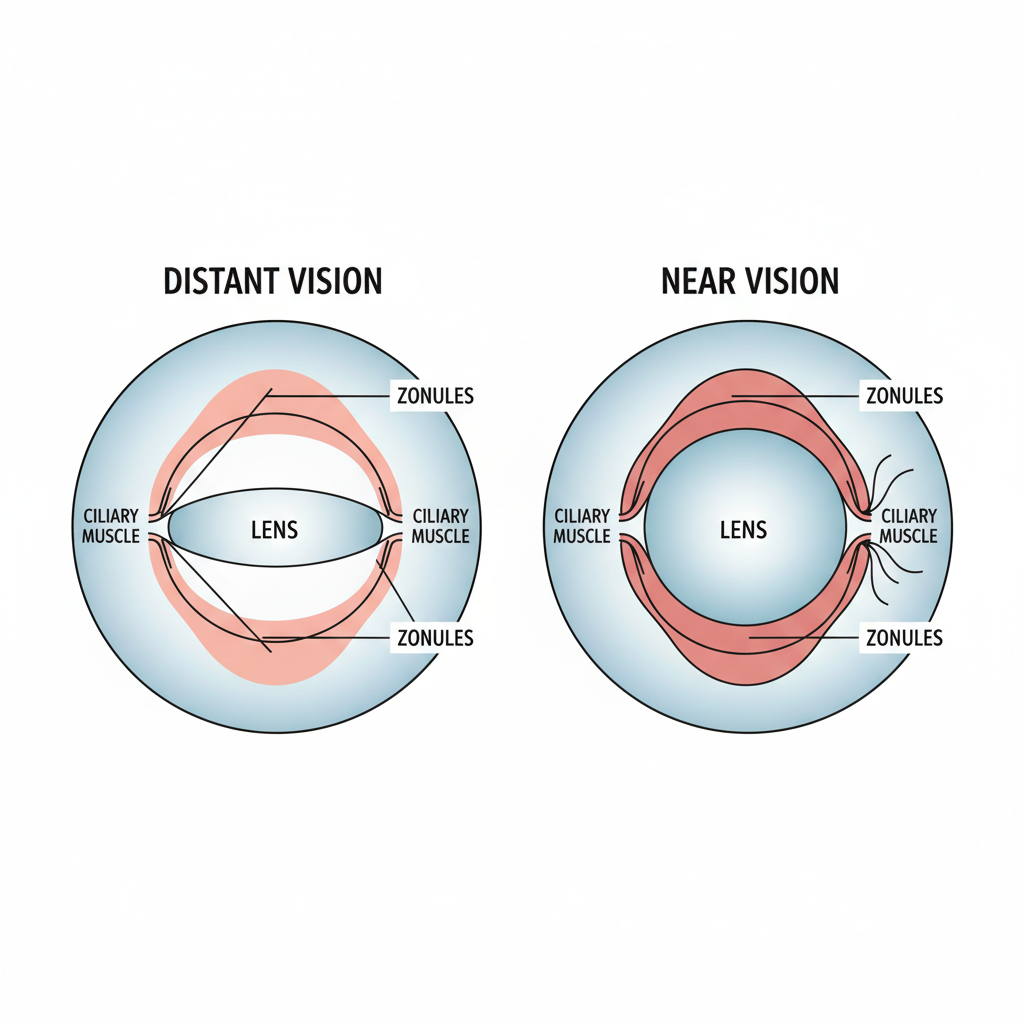
Think of your eye's natural lens as a sophisticated autofocus system. When you look at something far away, a tiny muscle inside your eye—the ciliary muscle—is relaxed. This allows the lens to be in its flattest, least powerful state. When you shift your gaze to a nearby object like a book or a smartphone, the ciliary muscle contracts. This contraction allows the flexible lens to curve and become more powerful, bringing the near object into sharp focus. This process is called accommodation.
Accommodative lag occurs when this autofocus system struggles to engage or sustain its focus for near tasks. The ciliary muscle may be slow to contract, or it may not contract sufficiently, causing a slight but meaningful blur that your brain works overtime to correct. This constant, subconscious effort to "clear up" the image is what leads to the profound feeling of eye strain and fatigue.
Why Laser Eye Surgery Can Trigger Focusing Issues
For years, your prescription glasses or contact lenses did the heavy lifting for your eyes' focusing system. Your ciliary muscle grew accustomed to working within the framework of that external correction. For individuals with higher prescriptions (e.g., over -4.00 D of myopia), the muscle developed strong compensatory habits tailored to that specific refractive error.
Laser eye surgery fundamentally changes the starting point. The laser reshapes the cornea, correcting the refractive error at the front of the eye. Suddenly, the internal focusing system—the lens and ciliary muscle—has to operate from a completely new baseline without its old "crutch."
This is a bit like an athlete who has trained with weights for years and suddenly has to perform the same movements without them. The muscles are strong but conditioned for a different load. They need time to recalibrate their coordination and effort. Similarly, your ciliary muscle has to relearn how much effort is needed to focus on near objects. This period of neural and muscular re-adaptation is when accommodative lag is most common, particularly for patients over 35 whose natural lens is already becoming less flexible.
Is It Accommodative Lag or Something Else?
It's crucial to differentiate accommodative lag from other post-operative issues, most notably dry eye disease. While both can cause discomfort, their root causes and symptoms have key differences.
The 30-Minute Rule: A Practical Self-Check A key heuristic used in clinical practice is the "30-minute rule." If your eye strain, near-vision blur, and fatigue consistently begin or worsen after about 30 minutes of sustained near work, accommodative dysfunction is a likely culprit. Symptoms of dry eye tend to be more constant or related to environmental factors like wind or air conditioning.
Here’s a simple breakdown of the symptoms:
| Symptom Profile | Accommodative Lag (Muscle Fatigue) | Dry Eye Disease (Surface Issue) |
|---|---|---|
| Primary Sensation | A deep, dull ache or "pulling" feeling inside the eye. | A gritty, sandy, or burning sensation on the surface of the eye. |
| Onset | Worsens progressively with sustained near tasks (reading, computer). | Can be constant or fluctuate with blink rate and environment. |
| Vision Changes | Difficulty shifting focus from near to far; temporary blur after reading. | Fluctuating blur that often clears temporarily with blinking. |
| Associated Signs | Forehead headaches, brow ache. | Redness, excessive tearing, light sensitivity. |
If your symptoms align more with dry eye, it's important to follow your surgeon's recommendations for lubricating drops, as post-surgical dryness is common and can impact visual quality.
The Solution: Retraining Your Eyes for Effortless Focus
Experiencing accommodative lag is not a sign of surgical failure. It is a temporary and manageable part of the healing and adaptation process. The goal is to support your eyes as they retrain, rather than forcing them to struggle.
-
The "Training Wheels" Approach: Low-Power Readers For many patients, the most immediate relief comes from a counterintuitive solution: a temporary pair of low-power reading glasses. A very mild "add" power, typically between +0.50 and +0.75, can act as "training wheels" for your focusing system. These glasses reduce the amount of work the ciliary muscle has to do during near tasks, preventing it from becoming fatigued. This allows you to work comfortably while your brain and eyes gradually adapt to their new normal. Think of it as a recovery aid, not a permanent crutch.

-
Active Vision Therapy: The 20-20-20 Rule Consciously relaxing your focusing muscle is critical. The best way to do this is by strictly adhering to the 20-20-20 rule. As we've detailed in our guide on Maximizing the 20-20-20 Rule for Prescription Lens Wearers, this simple exercise provides a necessary "reset" for the ciliary muscle. Every 20 minutes, look at something at least 20 feet away for at least 20 seconds. This forces the muscle to relax completely, releasing the built-up strain from near work.
-
Patience and Communication The neuro-adaptation process takes time. For most people, accommodative lag resolves within a few weeks to a few months as the visual system fully recalibrates. It is essential to communicate with your eye doctor about your symptoms. They can confirm the diagnosis, rule out other issues, and provide the correct, low-power prescription for temporary reading glasses if needed.
Frequently Asked Questions
Is accommodative lag a sign my laser surgery failed? No. It is a normal and temporary part of the eye's adaptation process. The surgery successfully corrected your cornea's shape; now, your internal focusing muscles are just catching up.
How long does this "eye tiredness" last? While it varies by individual, most patients find their symptoms significantly improve and resolve within 3 to 6 months of surgery as their visual system completes its neural adaptation.
Will I become dependent on reading glasses? It is highly unlikely. The low-power readers are intended as a temporary tool to ease strain during the adaptation phase. As your eye's natural focusing ability improves, you will likely find you need them less and less.
Should I tell my surgeon about my eye strain? Absolutely. Always discuss any post-operative symptoms with your eye care team. They can provide a proper diagnosis, prescribe the correct training aids if necessary, and ensure your recovery is proceeding as expected.
Disclaimer: This article is for informational purposes only and does not constitute professional medical advice. The information provided should not be used for diagnosing or treating a health problem or disease. It is not a substitute for professional care. If you have or suspect you may have a health problem, you should consult your health care provider. Never disregard professional medical advice or delay in seeking it because of something you have read in this article.
References
- Kandel, H., et al. (2024). Long-term safety results of LASIK refractive surgery: a twenty-year retrospective study. Fortune Journals.
- Bailey, M. D., & Zadnik, K. (2007). Outcomes of LASIK for myopia with FDA-approved lasers. Cornea, 26(3), 246–254.
- Eydelman, M., et al. (2016). Patient-Reported Outcomes and Visual Symptoms After LASIK. JAMA Ophthalmology, 134(11), 1222-1228.
- Sia, R. K., et al. (2020). Visual and refractive outcomes of small incision lenticule extraction and femtosecond laser-assisted laser in situ keratomileusis. Journal of Cataract & Refractive Surgery, 46(6), 875-883.


