














How Does 'ADD' on My Rx Translate to Reader Strength?
TL;DR: The Quick Answer
The "ADD" value on your prescription is the additional magnifying power you need for reading, a condition known as presbyopia. To find the correct power for a pair of single-vision reading glasses, you must add this ADD value to the "Sphere" (SPH) value of your distance prescription.
The Formula: Distance SPH + ADD = Reading Glass Power
For example, if your distance Sphere is -1.50 and your ADD is +2.00, your ideal reading power is +0.50.
Staring at an eyeglass prescription can feel like trying to decipher a secret code. You see a grid of numbers and abbreviations—OD, OS, SPH, CYL—and it’s easy to feel lost. But one of the most important yet misunderstood values, especially for anyone over 40, is "NV-ADD" or simply "ADD." This number is the key to unlocking clear, comfortable near vision.
This guide will demystify the ADD value. We will explain exactly what it means, how to use it to calculate your ideal reader strength, and why simply buying over-the-counter glasses based on the ADD value alone can lead to headaches and eye strain. Armed with this knowledge, you can confidently shop for reading glasses that are perfectly suited to your eyes.
What Exactly Is the 'ADD' Value?
The ADD value, short for "Near Vision Addition," is the specific magnifying power added to the bottom part of a multifocal lens (like bifocals or progressives) to help with reading. It directly addresses the effects of presbyopia.
According to the National Center for Biotechnology Information, presbyopia is a normal part of aging where the eye's natural lens gradually loses its flexibility, making it difficult to focus on close-up objects. As the Mayo Clinic notes, this is why you might find yourself holding menus or your phone farther away to see them clearly—a classic sign that you need some form of reading correction.
The ADD power is almost always a positive number (e.g., +1.50) and typically ranges from +0.75 to +3.00. It represents the "added" magnification needed on top of your distance prescription to bring your near vision back into sharp focus.

Expert Warning: When Simple Math Isn't Enough
A common mistake is assuming the ADD value is your reader power. This is only true if you have perfect distance vision (a Sphere value of 0.00). For everyone else, using the ADD value alone will result in glasses that are either too weak or too strong. The real issue, however, arises when other corrections are needed.
The Problem with Astigmatism (CYL): If your prescription includes a Cylinder (CYL) value greater than 0.75, you have astigmatism. Over-the-counter (OTC) readers do not correct for astigmatism. As the American Academy of Ophthalmology (AAO) points out, this mismatch is a primary cause of headaches, blur, and eye fatigue when using non-prescription readers.
The Problem with Anisometropia: If the Sphere (SPH) powers for your right and left eyes are significantly different (e.g., a difference of 1.50D or more), a single-power OTC reader will leave one eye under-corrected and the other over-corrected, making it impossible to achieve clear, balanced vision.
To make the right choice, it helps to see a direct comparison.
Comparison: OTC Readers vs. Custom Prescription Readers
| Feature | Over-the-Counter (OTC) Readers | Custom Prescription Readers |
|---|---|---|
| Power | Same strength for both eyes. | Calculated specifically for each eye. |
| Astigmatism (CYL) Correction | None. | Fully corrected to your prescription. |
| Optical Center (PD) | Based on a generic average. | Precisely aligned to your unique Pupillary Distance. |
| Best For | Individuals with no astigmatism and identical, mild prescriptions in both eyes. | Anyone with astigmatism, different powers per eye, or an existing distance prescription. |
| Typical Outcome | Can cause eye strain, blur, and headaches if your needs are complex. | Provides clear, comfortable, and balanced vision. |
How to Calculate Your True Reading Power
Now for the practical part. To find the correct power for a pair of single-vision reading glasses, you must perform a simple calculation. This combines your distance vision needs with your reading needs.
The Formula:
Distance Sphere (SPH) + ADD Value = Reading Glass Power
Let's walk through a few common scenarios:
-
Scenario 1: You are nearsighted.
- Your Prescription: SPH -2.00, ADD +2.25
- Calculation:
-2.00 + 2.25 = +0.25 - Your reading glasses power is +0.25.
-
Scenario 2: You are farsighted.
- Your Prescription: SPH +1.00, ADD +1.75
- Calculation:
+1.00 + 1.75 = +2.75 - Your reading glasses power is +2.75.
-
Scenario 3: You have no distance prescription.
- Your Prescription: SPH 0.00 (or "Plano"), ADD +1.50
- Calculation:
0.00 + 1.50 = +1.50 - Your reading glasses power is +1.50.
In each case, you would order single-vision lenses with the final calculated power. If you have astigmatism (a CYL value), that must also be included in your order for custom prescription readers.
Crucial Details for a Perfect Fit
Beyond the power calculation, a couple of other measurements are vital for comfortable reading glasses.
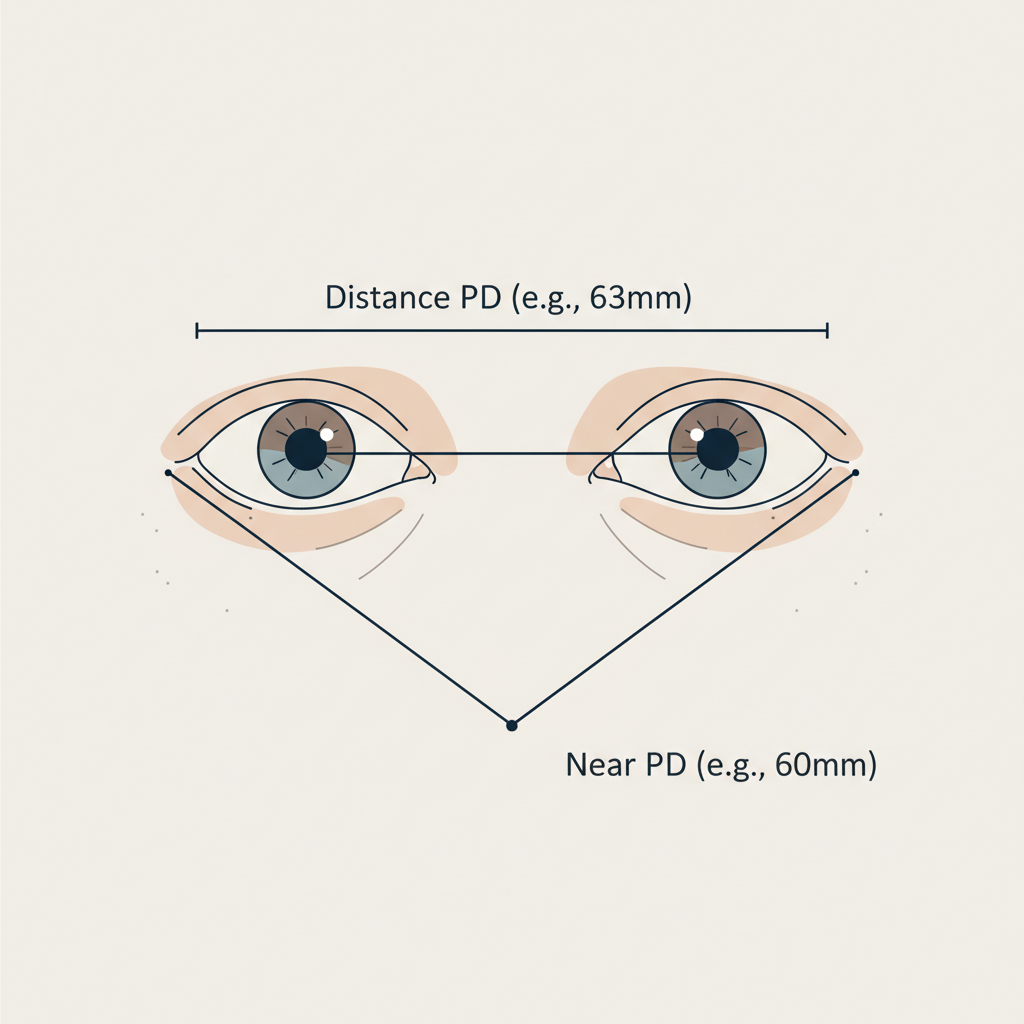
Why Your Near Pupillary Distance (PD) Matters
Pupillary Distance (PD) is the measurement between the centers of your pupils. It ensures the optical center of your lenses aligns correctly with your eyes. When you read, your eyes converge, or turn slightly inward. Because of this, your Near PD is always narrower than your Distance PD, typically by 2-4 millimeters.
Using a Distance PD for reading glasses forces your eyes to work harder to fuse two images, leading to eye strain. For the most comfortable vision, always use your Near PD when ordering readers. If you only have your Distance PD, you can learn how to measure your PD at home or subtract 3mm as a reliable estimate.
The "Two-Pair" Strategy for Different Distances
As guidance from AARP suggests, not all near tasks happen at the same distance. Your computer screen is usually farther away (20-28 inches) than a book in your lap (14-16 inches). Your full ADD power is calculated for that closer reading distance.
For computer use, this full power can feel too strong. A common and effective strategy is to use a second pair of "computer glasses" with a reduced power. A good starting point for computer glasses is to use half of your full ADD value in the calculation.
-
Example: SPH -1.00, ADD +2.00
- Full Readers: -1.00 + 2.00 = +1.00 (for books)
- Computer Readers: -1.00 + (+2.00 / 2) = 0.00 / Plano (for screen work)
Age-Based Estimates (When You Don't Have a Prescription)
If you don't have a prescription but feel the strain of presbyopia, you can use age as a general guideline to find a starting point for OTC readers. However, this is only an estimate and does not account for astigmatism or other individual needs.
| Age Range | Typical ADD Power Estimate |
|---|---|
| 40–45 | +0.75 to +1.25 |
| 45–50 | +1.00 to +1.75 |
| 50–55 | +1.50 to +2.25 |
| 55+ | +2.00 to +3.00 |
How to Use This: Find a reading material with standard-sized print and try on a few different powers in a store. The correct power will be the lowest one that allows you to read clearly and comfortably at a normal distance (about 16 inches).
Wrapping Up: Your Path to Clear Reading
Understanding your prescription is the first step toward visual freedom. The ADD value isn't just a random number; it's the precise correction you need to counteract presbyopia. By using the simple formula—Sphere + ADD = Reader Power—you can determine the exact strength for your single-vision reading glasses.
Remember:
- Always combine your distance Sphere power with the ADD value.
- If you have astigmatism (CYL) or different powers in each eye, custom prescription readers are the superior choice for comfort and clarity.
- Always use your Near PD for reading glasses to avoid unnecessary eye strain.
Frequently Asked Questions (FAQ)
Q1: Can I just buy readers with the same number as my ADD value? No, this is a common mistake. You should only do this if your distance vision is perfect (a Sphere power of 0.00 or "Plano"). Otherwise, you must add your Sphere power to your ADD value to find the correct reader strength.
Q2: My drugstore reading glasses give me a headache. Why? This is likely because the glasses do not correct for your astigmatism (CYL value) or because the optical centers are not aligned with your specific pupillary distance (PD). According to sources like the Cleveland Clinic, this mismatch is a common cause of eye strain and headaches.
Q3: What if I don't have an ADD value on my prescription? If your prescription doesn't have an ADD value, it is likely intended for distance vision only, or you may not have developed presbyopia at the time of your exam. You will need to see an eye care professional for a new exam to get an accurate reading correction.
Q4: Is it safe to buy reading glasses online? Yes, it is safe to order glasses online as long as you use a current, valid prescription from an eye doctor and purchase from a reputable vendor that adheres to quality standards. It is worth noting that one study published in PubMed found that a significant percentage of glasses ordered online had optical or safety failures, which underscores the importance of choosing a trusted supplier.
Disclaimer: This article is for informational purposes only and does not constitute professional medical advice. The information provided is not a substitute for a comprehensive eye exam by a qualified optometrist or ophthalmologist. Always consult with your eye care professional for any vision-related issues, especially if you experience sudden changes in vision, have pre-existing conditions, or require a complex prescription.
References
- NCBI Bookshelf: Presbyopia (StatPearls)
- Mayo Clinic: Presbyopia Symptoms & Causes
- American Academy of Ophthalmology (AAO): Tips for Choosing the Right Reading Glasses
- AARP: Drugstore Reading Glasses
- Cleveland Clinic: Are Drugstore 'Cheaters' as Good as Prescription Reading Glasses?
- PubMed: Online Eyewear Accuracy


