












Does Anti-Reflective Coating Affect Your Visual Clarity?
The TL;DR: Does Anti-Reflective Coating Really Matter?
Yes, it makes a significant difference. Anti-reflective (AR) coating doesn't change your prescription, but it fundamentally improves how your lenses perform. It allows more light to pass through to your eyes—up to 99.5%—resulting in sharper vision, less eye strain, and a dramatic reduction in distracting glare, especially at night. It's a functional upgrade that enhances visual comfort and clarity.
Unlocking a Clearer World: The Science Behind Reflections
Before we can appreciate what an anti-reflective coating does, we need to understand the problem it solves: reflections. Every standard lens, whether glass or plastic, acts like a faint mirror. When light hits the lens surface, a portion of it bounces off instead of passing through to your eye.
A typical uncoated plastic lens can reflect up to 8-10% of available light. This might not sound like much, but this light loss and reflection create two primary issues:
- Reduced Visual Information: Less light reaching your retina means the image you see is slightly dimmer and has less contrast. Details can appear less crisp, especially in low-light conditions.
- Visual Noise: The reflected light creates "ghost images," halos, and glare. Your brain has to work harder to filter out this visual noise, which can lead to headaches and eye fatigue over a long day.
Think of it like trying to look through a clean window versus one with a noticeable reflection of the room behind you. The AR coating effectively makes the window more transparent, giving you an unobstructed view.

How Does Anti-Reflective Coating Work?
The technology behind AR coating is a fascinating application of physics, specifically a principle called "destructive interference." It’s a process far more complex than a simple spray-on layer.
During manufacturing, lenses are placed inside a vacuum chamber. Here, multiple microscopic layers of metallic oxides are bonded to the front and back surfaces of the lens. Each layer is precisely calculated to be a specific thickness, designed to cancel out different wavelengths of light.
Here’s a simplified analogy: Imagine two sound waves. If you align them perfectly, they get louder. But if you shift one so its peak aligns with the other's trough, they cancel each other out, resulting in silence. AR coating layers do the same for light waves. As light tries to reflect off the lens, the coating layers create a second, opposing reflection that cancels the first one out.
This high-tech process, as detailed by industry organizations like The Vision Council, is what allows the lens to transmit up to 99.5% of light to your eye, providing a visibly clearer and more comfortable visual experience.
The Real-World Benefits: Seeing is Believing
While the science is impressive, the practical, day-to-day advantages are what truly matter. Applying an AR coating to your lenses delivers tangible improvements in four key areas.
1. Sharper Vision and Reduced Eye Strain
By eliminating reflections and ghost images, AR coating reduces the visual "clutter" your eyes have to process. This is especially noticeable when working on a computer or under fluorescent office lighting. With more light passing through the lens, contrast is enhanced, and your eyes can focus more effortlessly, leading to significantly less fatigue at the end of the day.
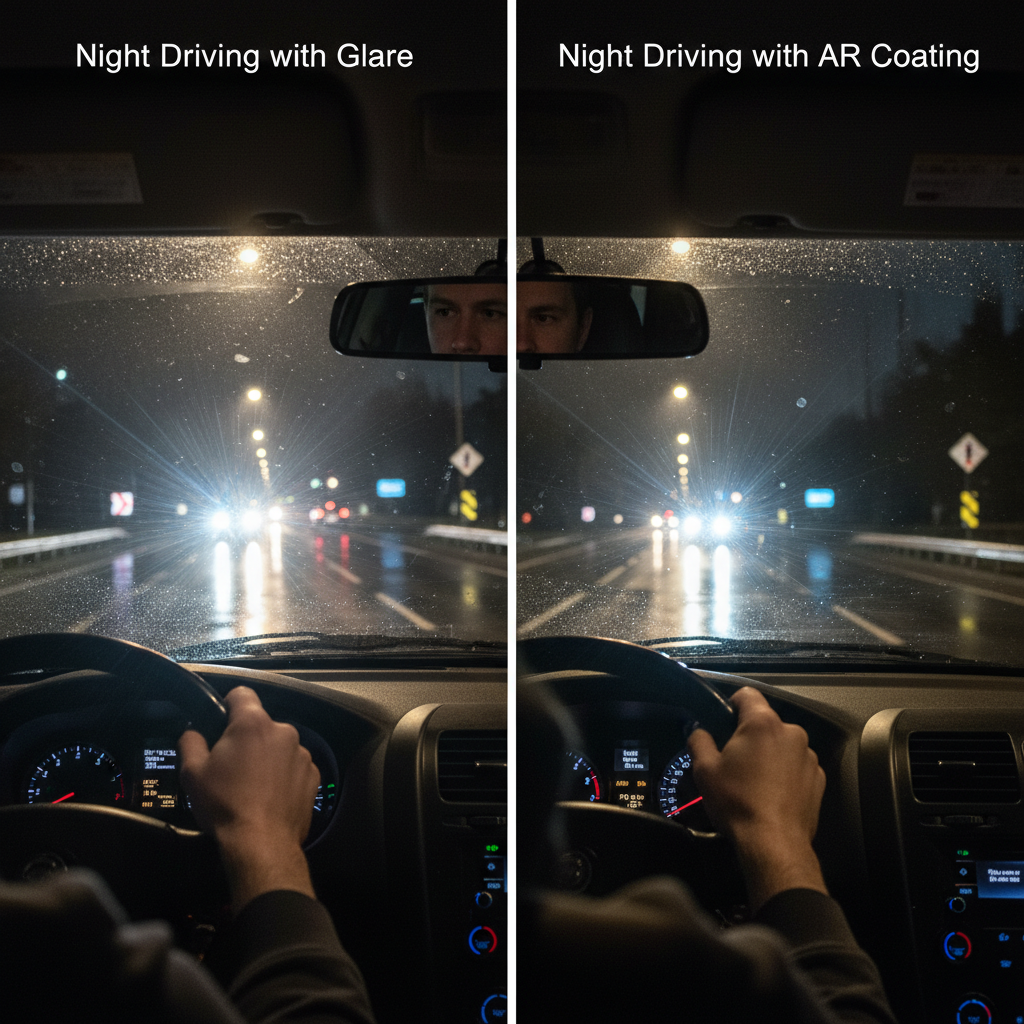
2. Superior Night Driving Clarity
This is one of the most celebrated benefits. Driving at night exposes your eyes to high-contrast glare from headlights, taillights, and streetlamps. Uncoated lenses amplify this glare, creating distracting starbursts and halos that can obscure your view and reduce reaction time. AR coating neutralizes these internal reflections, making light sources appear sharper and more defined, which is a critical safety and comfort enhancement for anyone behind the wheel after dark.
3. Better Aesthetics and Personal Connection
Reflections on your lenses create a barrier between you and the person you're speaking with. They can't see your eyes clearly, which can be distracting in photos, during video calls, or in face-to-face conversations. AR coating makes your lenses appear nearly invisible, allowing for more natural eye contact and ensuring your expressions are seen without hindrance.
4. Essential for High-Index Lenses
This is a critical point that is often overlooked. High-index lenses, which are used for stronger prescriptions to make them thinner and lighter, are made from denser materials. As a consequence, they reflect significantly more light than standard plastic lenses—sometimes up to 50% more.
According to experts at Ferris State University's College of Optometry, wearing high-index lenses without an AR coating can result in very noticeable and annoying reflections. For these wearers, an AR coating isn't just a nice-to-have; it's an essential component to achieve acceptable visual clarity and comfort. The perceived improvement is often dramatic, feeling like a 40-50% boost in visual quality compared to the uncoated version.
A Practical Guide to Caring for Your AR Lenses
An AR coating is a durable, high-performance surface, but it requires proper care to maintain its effectiveness. The biggest mistake users make is treating it like a simple piece of glass.
Methodology Note: The following advice is based on common patterns from optical lab technicians and customer support handling, not a controlled lab study. These are the most frequent, preventable causes of coating degradation we observe.
- AVOID: Household glass cleaners (like Windex), products with ammonia or alcohol, and abrasive paper products (paper towels, napkins). The harsh chemicals in these cleaners can degrade the porous outer layer of the coating over time, causing permanent smudges and reducing its anti-reflective properties.
- AVOID: Hot water, which can damage the coating and the lens itself.
The Correct Cleaning Method:
- Rinse First: Run your glasses under lukewarm tap water to wash away any dust or grit that could scratch the lenses.
- Apply a Tiny Drop: Use a small amount of lotion-free dish soap on your fingertips and gently lather both sides of the lenses.
- Rinse Thoroughly: Rinse the lenses again with lukewarm water until all soap is gone.
- Dry with Microfiber: Gently dry the lenses with a clean, dedicated microfiber cloth.
Following this simple routine can extend the effective life of your AR coating by two to three years, protecting your investment and ensuring you continue to enjoy the benefits of clear, comfortable vision.
Is Anti-Reflective Coating Worth the Investment?
For the vast majority of eyeglass wearers, the answer is a resounding yes. While it adds to the initial cost, the functional benefits translate directly into a better quality of vision and daily comfort.
Consider an AR coating a necessary investment if you:
- Drive frequently at night.
- Work long hours on a computer or under artificial lighting.
- Have a high-index prescription.
- Are often in photos or on video calls.
- Are sensitive to glare and reflections.
It’s a technology that, once experienced, is difficult to go without. It transforms your glasses from a simple tool for correction into a high-performance lens for optimal clarity.
Frequently Asked Questions (FAQ)
Q1: Can I add an anti-reflective coating to my existing glasses? Generally, no. AR coating is applied in a vacuum chamber during the lens manufacturing process and is bonded to the surface. It cannot be effectively applied to lenses that have already been cut and fitted into a frame.
Q2: Is anti-reflective coating the same as a scratch-resistant coating? They are different technologies, but they are almost always bundled together. Modern high-quality AR coatings include a hard, scratch-resistant top layer to improve durability. However, no lens is completely scratch-proof, so proper care is still essential.
Q3: Why do my AR-coated lenses have a faint green or purple tint at certain angles? This is normal and a sign that the coating is working. No AR coating can eliminate 100% of reflections across the entire light spectrum. The faint residual color you see is the wavelength of light that the specific coating stack is least effective at canceling out. It's typically unnoticeable when you're wearing the glasses.
Q4: How is anti-reflective coating different from polarized lenses? They solve two different problems. Anti-reflective coating reduces the reflections on the front and back surfaces of your eyeglass lenses. Polarized lenses are primarily for sunglasses and contain a special filter that blocks intense, horizontally reflected glare coming from external surfaces like a wet road, a body of water, or the hood of a car.
Q5: Do I need AR coating on my sunglasses? It is highly recommended for the back surface of sunglass lenses. This prevents sunlight from coming from behind you and reflecting off the back of the lens into your eye, which can be very distracting.
Disclaimer: This article is for informational purposes only and does not constitute professional medical advice. Please consult with a qualified optometrist or ophthalmologist to determine the best lens options for your specific vision needs.
References
- The Vision Council. (n.d.). "How Prescription Glasses and Contact Lenses Are Made." The Vision Council Foundation.
- Western Michigan University. (n.d.). "About Lenses." WMU Unified Clinics.
- Ferris State University. (n.d.). "High Index Lenses." College of Optometry.
- Cui, G., et al. (2018). "Ultraviolet protection by clear lenses." Photochemical & Photobiological Sciences. (Referenced for back-surface reflection concepts).


