








Do I Need Special Lenses for Astigmatism in Sunglasses?
The Non-Negotiable Need for Special Sunglass Lenses
If you have astigmatism, you’ve likely wondered if your regular prescription sunglasses are truly giving you the best vision possible. You might notice that while they cut the glare, the world still doesn’t feel perfectly sharp. This isn't your imagination. For clear, comfortable vision in bright light, standard sunglass lenses are not enough. You need lenses specifically designed to correct the unique curvature of your eye—a technology known as toric lenses.
Choosing the right sunglasses with astigmatism isn't just about style; it's a critical vision and safety issue. The wrong lenses in the wrong frames can lead to eye strain, headaches, and distorted vision, which is especially risky when driving or playing sports. This guide will explain what toric lenses are, why the frame you choose is just as important as your prescription, and how to ensure your sunglasses provide the crispest vision possible.
TL;DR: Your Guide to Astigmatism and Sunglasses
- Yes, you need special lenses. If your prescription has a CYL (Cylinder) value, you need "toric" sunglass lenses to see clearly.
- The "Axis" is everything. This number on your prescription must be perfectly aligned in the frame. Even a slight rotation can cause significant blur.
- Frame shape is critical. High-wrap or heavily curved frames can rotate the lens, compromising the axis alignment and distorting your vision. Flatter frames are generally a safer choice.
- Accurate measurements are key. Your pupillary distance (PD) must be precise to properly center the optics of the lens.
- UV protection is a must. Ensure your lenses are labeled "UV400" or "100% UV Protection" to safeguard your eye health.
Understanding Astigmatism: Why Your Eyes See Differently
Before we dive into lenses, it's essential to understand what astigmatism is. A normal cornea (the clear front part of the eye) has a spherical shape, like a basketball. This allows light to bend evenly and focus on a single point on the retina, creating a sharp image.
When you have astigmatism, your cornea is shaped more like a football or the back of a spoon. This irregular shape causes light to bend unevenly, creating two focal points instead of one. As a result, you experience blurry or distorted vision at all distances.
Your eye prescription reflects this with three main numbers:
- Sphere (SPH): Corrects for nearsightedness (-) or farsightedness (+).
- Cylinder (CYL): This measures the degree of astigmatism. If this box is empty, you don't have astigmatism.
- Axis: This number, from 1 to 180, indicates the orientation or angle of the astigmatism. It tells the lab exactly where to place the cylindrical correction in the lens.
Standard sunglasses might correct for the SPH value, but they do nothing for the CYL and Axis. This is why you can still experience blur and eye strain even when wearing a prescription.
The Solution: Toric Lenses and the Critical Role of the Axis
The specific solution for astigmatism is a toric lens. Unlike a standard spherical lens, a toric lens has different corrective powers on its vertical and horizontal axes, mirroring the unique shape of your eye. It's a highly sophisticated piece of optics designed to redirect the scattered light rays onto a single focal point, restoring clear vision.

However, creating the lens is only half the battle. For it to work, the axis of the correction in the lens must be perfectly aligned with the axis of your astigmatism. Think of it like a key in a lock; if the key is tilted even a few degrees, it won't open the door. In the same way, if the lens axis is rotated in the frame, your vision will become blurry. An axis rotation of more than 5 to 10 degrees can render an otherwise perfect prescription useless. This is the single biggest challenge when fitting astigmatism correction into sunglass frames.
Why Frame Choice is Crucial for Astigmatism
Many people assume that any prescription can be put into any frame, but this is a common and costly misconception. For those with astigmatism, the geometry of the sunglass frame is a critical factor that directly impacts visual clarity.
The Problem with Wraparound and Curved Frames
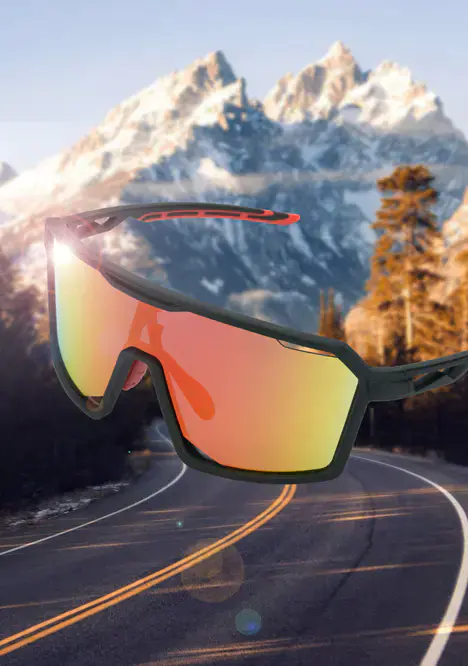
High-fashion and sport sunglasses often feature a "high-wrap" design that curves significantly to follow the contour of the face. While stylish and great for blocking peripheral light, this curvature presents two major problems for astigmatism correction:
- Axis Rotation: The physical curve of the frame can twist the lens slightly, rotating the carefully calibrated axis. As we've discussed, even a minor rotation can cause significant blur.
- Increased Vertex Distance: Vertex distance is the space between the back of the lens and the front of your eye. Curved frames sit farther from your eyes than flat frames, increasing this distance. For stronger prescriptions, this change can alter the effective power of the lens, a concept further explored in guides on how lens curvature affects high prescription vision.
This is why a prescription that feels perfect in your flat everyday glasses can feel "off" or blurry in a new pair of curved sunglasses.
Frame Suitability for Astigmatism: A Quick Guide
To minimize these issues, choosing a suitable frame style is your first line of defense.
| Frame Style | Suitability for Astigmatism | Key Considerations |
|---|---|---|
| Flat / Low Curve | High | The safest and easiest option. This style minimizes the risk of axis rotation and optical distortion. |
| Moderate Curve | Good | Can work well but requires extremely precise measurements and may need digitally compensated lenses to adjust for the curve. |
| High-Wrap / Sport | Challenging | Poses the highest risk of distortion. This style demands specialized, digitally surfaced lenses and expert fitting to be successful. |
| Aviators / Wayfarers | Good | These classic styles are typically flatter and provide a stable base for toric lenses. |
Your Step-by-Step Guide to Ordering Sunglasses for Astigmatism
Ordering the right sunglasses online is entirely possible when you follow a careful process. Here’s a checklist to ensure you get the clear, comfortable vision you need.
Step 1: Secure Your Full, Current Prescription
You have a legal right to a complete copy of your prescription. According to the Federal Trade Commission's Eyeglass Rule, your eye doctor must give you your prescription immediately following your exam, whether you ask for it or not. Ensure it includes your SPH, CYL, Axis, and Pupillary Distance (PD).
Step 2: Prioritize an Accurate Pupillary Distance (PD)
Pupillary Distance (PD) is the measurement between the centers of your pupils. This measurement is used to align the optical center of your lenses with your eyes. An incorrect PD can induce eye strain and headaches. For sunglasses, it's best to have a "monocular PD," which measures the distance from each pupil to the center of your nose separately, as this is more accurate for larger frames.
Step 3: Select the Right Lens Material
All sunglasses sold in the U.S. must meet the FDA's standards for impact resistance, often referred to as the "Drop Ball Test."
- Polycarbonate: This is the go-to material for sunglasses. It's lightweight and has superior impact resistance, making it an excellent choice for active lifestyles and general safety.
- High-Index (1.61, 1.67, 1.74): If your prescription is strong (typically over ±4.00 SPH), high-index lenses are a worthwhile upgrade. They are denser and bend light more efficiently, resulting in significantly thinner and lighter lenses. This helps manage the "bug-eye" look that can sometimes result from strong prescription lenses distorting your eyes.
Step 4: Choose Your Tints and Coatings Wisely
Lens features are about both performance and protection.
- UV Protection: This is non-negotiable. Look for a label that says "UV400" or "100% UVA/UVB Protection." As experts at MD Anderson Cancer Center warn, wearing dark lenses without proper UV filtering is more dangerous than wearing no sunglasses at all. The dark tint causes your pupils to dilate, allowing even more harmful UV radiation to enter your eye.
- Polarization: Polarized lenses contain a special filter that blocks horizontal glare reflected off surfaces like water, roads, and snow. This dramatically reduces eye strain and improves visual comfort. However, they can make it difficult to see LCD screens, a detail noted by Harvard Health Publishing.

Wrapping Up: Clarity and Comfort Are Achievable
Having astigmatism doesn’t mean you have to compromise on clear vision when you’re out in the sun. By understanding the need for toric lenses and the critical importance of a proper frame fit, you can confidently select sunglasses that offer both style and optical perfection.
Remember the key takeaways: your astigmatism requires a special toric lens, the axis alignment is paramount, and a flatter frame is always a safer bet than a high-wrap design. By paying close attention to your prescription, PD, and frame choice, you can enjoy the outdoors with the sharp, comfortable vision you deserve.
Frequently Asked Questions (FAQ)
1. Can I wear non-prescription sunglasses if my astigmatism is low? For very mild astigmatism (a CYL of -0.75 or less), some people may tolerate non-prescription sunglasses for casual wear. However, for any activities that require sharp vision, like driving, a custom toric lens will always provide superior clarity and reduce eye strain.
2. Why are prescription sunglasses for astigmatism more expensive? The manufacturing process for toric lenses is significantly more complex than for standard spherical lenses. It involves precisely grinding the unique curvature into the lens and ensuring the axis is perfectly oriented, which requires specialized equipment and additional quality checks.
3. Do polarized lenses correct astigmatism? No. Polarization and astigmatism correction are two separate functions. Polarization is a filter that reduces glare, while a toric lens is a custom shape that corrects your vision. You can, and should, get sunglasses that are both polarized and have toric correction.
4. How can I be sure my sunglasses have UV protection? Always purchase from a reputable eyewear provider that can verify its lens specifications. Look for a "UV400" or "100% UV Protection" label. A study published in PubMed found that while price doesn't always correlate with protection, buying from unverified sources increases the risk of getting non-compliant lenses that could harm your eyes.
Disclaimer: This article is for informational purposes only and does not constitute professional medical advice. Please consult with a qualified optometrist or ophthalmologist to discuss your specific vision needs and to receive a comprehensive eye examination.
References
- Federal Trade Commission. (n.d.). Buying Prescription Glasses or Contact Lenses: Your Rights. FTC Consumer Advice. Retrieved from https://consumer.ftc.gov/buying-prescription-glasses-or-contact-lenses-your-rights
- U.S. Food and Drug Administration. (2023). Impact-Resistant Lenses: Questions and Answers. FDA.gov. Retrieved from https://www.fda.gov/regulatory-information/search-fda-guidance-documents/impact-resistant-lenses-questions-and-answers
- MD Anderson Cancer Center. (2023). 9 things to know about sunglasses, eye protection and cancer. Retrieved from https://www.mdanderson.org/cancerwise/9-things-to-know-about-sunglasses--eye-protection-and-cancer.h00-159699123.html
- Harvard Health Publishing. (2020). Polarized sunglasses: Protecting your eyes from harmful glare. Harvard Medical School. Retrieved from https://www.health.harvard.edu/staying-healthy/polarized-sunglasses-protecting-your-eyes-from-harmful-glare


