









Bifocal vs Progressive Glasses: What's the Difference?
The Great Debate: Bifocals vs. Progressives
For anyone who’s ever had to juggle two pairs of glasses—one for seeing across the room and another for reading a menu—the promise of a single, all-in-one solution is a game-changer. For decades, that solution has come in two primary forms: traditional bifocals and modern progressive lenses.
Choosing between them can feel daunting. One is a time-tested classic, while the other offers advanced technology with its own learning curve. This guide will break down the optical science, functional differences, and lifestyle considerations to help you decide which lens is the perfect fit for your eyes.
TL;DR: The Key Differences
- Bifocal Lenses have two distinct, separate powers for distance and near vision, separated by a visible line. They offer a very wide and stable reading zone but have no intermediate correction, creating a "blur zone" for things like computer screens.
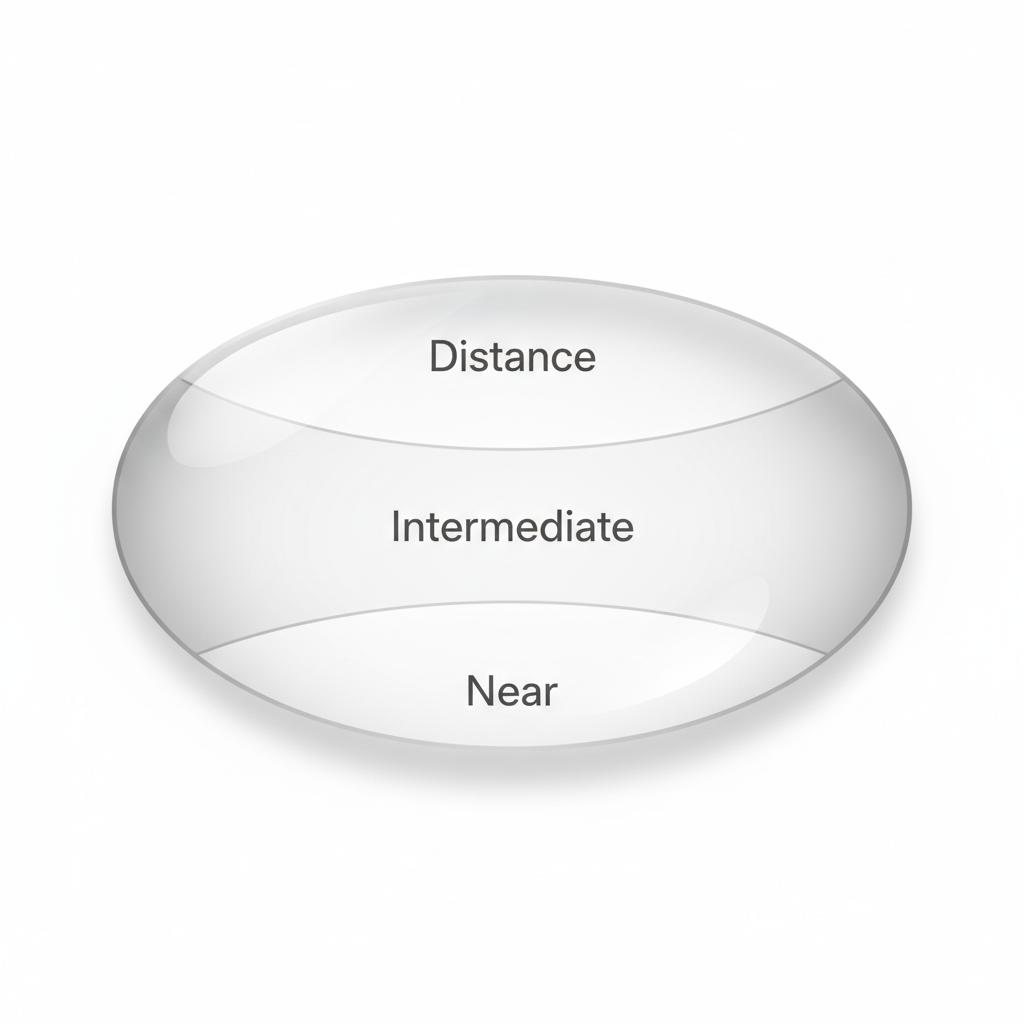
- Progressive Lenses offer a seamless, gradual transition between distance, intermediate, and near vision with no visible lines. They provide more natural vision for a dynamic lifestyle but have peripheral distortions that require a brain-training adaptation period.

What Are Bifocal Lenses? The Tried-and-True Solution
Bifocals are the original multifocal lens. Their design is simple, effective, and has remained largely unchanged for a reason.
How They Work: A Tale of Two Lenses
Imagine your primary eyeglass lens provides your distance prescription. Now, a small, half-moon-shaped segment containing your reading prescription is fused into the bottom portion. This creates two distinct viewing zones separated by a visible line. When you look straight ahead, you’re looking through the distance portion. When you drop your gaze to read, your eyes look through the powerful reading segment at the bottom.
The Pros: Why Bifocals Still Have a Place
- Wide, Stable Reading Area: The reading segment provides a broad, clear field of view for near tasks. Because there's no power gradient, the entire segment is distortion-free, making it ideal for reading books, crafting, or other static close-up work for extended periods.
- No "Swim Effect": The visual experience is straightforward and binary. There is no peripheral distortion to contend with, which means no "swim" or "rock and roll" sensation that can make some new progressive wearers feel off-balance. Adaptation is nearly instantaneous.
- Cost-Effective: Due to their simpler manufacturing process, bifocal lenses are typically more affordable than their progressive counterparts.
The Cons: Where Bifocals Fall Short
The primary drawbacks of bifocals stem from their two-zone design.
- The "Image Jump": As your eye moves across the dividing line, there is an abrupt change in power. This causes images to appear to "jump," which can be disorienting.
- The Missing Middle Ground: Bifocals have no correction for intermediate distances (roughly arm's length). This creates a functional blind spot for crucial everyday tasks like viewing a computer monitor, seeing a car's dashboard clearly, or reading prices on a grocery store shelf. Research shows that most presbyopes hold their smartphones at around 39 cm, a distance that often falls right into this bifocal blur zone.
- Aesthetic Appearance: The visible line across the lens is often seen as dated and can be a cosmetic concern for many wearers.

What Are Progressive Lenses? Seamless Vision for a Modern World
Invented in 1959, progressive lenses—often called "no-line bifocals"—are the modern technological answer to the limitations of bifocals. They are designed to provide clear, continuous vision at all distances.
How They Work: A Gradient of Power
Instead of a sudden jump, a progressive lens features a smooth, seamless gradient of power. The top of the lens is calibrated for distance vision, and the power gradually increases as you move down the lens. This creates a narrow central "corridor" that transitions through your intermediate vision before reaching the full reading power at the bottom. This allows you to see clearly at any distance simply by adjusting your head and eye position.
The Pros: The Clear Advantages of Modern Optics
- Natural, All-Distance Vision: The single greatest benefit is having one pair of glasses for everything. You can look up to see a street sign, glance ahead at your computer, and then look down to read a text message, all with clear, uninterrupted vision.
- Aesthetically Superior: With no visible lines, progressive lenses look identical to single-vision glasses, offering a more youthful and modern appearance.
- Functionally Dynamic: They are built for the way we live today, constantly shifting our focus between different tasks and distances.
The Cons & The Truth About Adaptation
The sophisticated design of progressives is not without its trade-offs, which are the source of most user concerns.
- Peripheral Distortion (The "Swim Effect"): The laws of optics dictate that the smooth power transition must go somewhere. This unavoidable distortion is pushed to the lower peripheral edges of the lens. When you first wear progressives, turning your head can make your peripheral vision seem to swim or sway. This is the single biggest hurdle in adaptation.
- The Narrow "Corridor": The clear viewing zones for intermediate and near vision are narrower than in a bifocal. This requires a new behavior: you must learn to point your nose directly at what you want to see clearly, rather than just shifting your eyes. Studies on wearers show they develop a specific "Head Gain" strategy, learning to move their head more to keep their gaze within the clear corridor.
- The Adaptation Period: Your brain needs time to learn to ignore the peripheral distortions and master the "point your nose" technique. This neuroadaptation can take anywhere from a few days to a few weeks.
- Higher Cost: The advanced, digitally surfaced "free-form" manufacturing required for modern progressives makes them more expensive. However, clinical trials confirm that customized free-form lenses provide significantly wider clear fields of view, justifying the investment.
Head-to-Head Comparison: Which Lens is Right for Your Lifestyle?
Your daily activities are the best indicator of which lens will serve you better.
| Feature | Bifocal Lenses | Progressive Lenses |
|---|---|---|
| Vision Zones | 2 (Distance, Near) | 3 (Distance, Intermediate, Near) |
| Transition | Abrupt "Image Jump" | Smooth, Seamless Gradient |
| Aesthetics | Visible Line | No Visible Line |
| Peripheral Vision | Clear Edge-to-Edge | Soft Distortions on Lower Edges |
| Adaptation | Nearly Instant | Learning Curve (Days to Weeks) |
| Best For... | Static, prolonged near tasks | Dynamic, multi-distance lifestyles |
| Cost | Lower | Higher |
Choose Bifocals If...
- You spend most of your day on static tasks at one distance (e.g., hours of reading, detailed craftwork, assembly line inspection).
- You are extremely sensitive to motion or have previously failed to adapt to progressive lenses.
- Your primary decision factor is budget.
Choose Progressives If...
- You live a dynamic life, constantly switching your focus between near, far, and in-between.
- You work in an office and need clear vision for your monitor, paperwork, and colleagues across the room.
- You want the most natural visual experience and dislike the appearance of lined bifocals.
Pro Tips for Success with Progressive Lenses
Adapting to progressives can be challenging, but success is almost guaranteed if you follow a few expert tips. This is where managing the known issues with distortion is key.
1. It's All in the Fit: The Most Critical Factor
In practice, the single biggest factor for successful adaptation is not the lens brand, but the precision of the fitting measurements. The monocular Pupillary Distance (PD) and the fitting height must be measured for each eye individually. An error of just 2 millimeters can render the corridor unusable. This is why a skilled, experienced optician is invaluable.
2. Frame Selection Matters
The frame you choose directly impacts the performance of your progressive lenses.
- Go Taller: The frame needs to be tall enough to accommodate the full range of the power gradient. A very short, narrow frame will compress the corridor, especially the reading zone.
- Minimize Wrap: For higher prescriptions, a frame that is smaller, rounder, and sits closer to the face will have significantly less peripheral distortion than a large, curved, wraparound-style frame. You can learn more about how lens curvature affects vision in our guide to aspheric lenses.
- Get it Adjusted: A simple professional frame adjustment can solve many adaptation issues. Increasing the "pantoscopic tilt"—tilting the bottom of the frame closer to your cheek—can dramatically improve clarity in the reading zone by aligning your eye correctly with the lens corridor.
3. Train Your Brain: How to Adapt Faster
- Point Your Nose: This is the golden rule. Point your nose, not just your eyes, at what you want to see. Look at a book by dropping your chin slightly, not just your eyes.
- Mind Your Step: The lower portion of the lens blurs the ground. New wearers have a higher risk of falls. Until you adapt, make a conscious effort to tuck your chin and look through the top of the lenses when walking down stairs or stepping off curbs.
- Commit Fully: Wear your new progressives full-time. Switching back and forth with your old glasses will confuse your brain and prolong the adaptation period.
Frequently Asked Questions (FAQ)
Can I use my progressive glasses for computer work? Yes, but they aren't ideal for long hours. A general-purpose progressive has a narrow intermediate zone. If you spend more than four hours a day on a computer, an "occupational" or "office" progressive lens is a far better choice, as it dedicates a much larger portion of the lens to intermediate and near vision.
Why do I feel dizzy with my new progressives? This sensation of dizziness or motion is the "swim effect" caused by the unavoidable distortions in your peripheral vision. It is a normal part of the adaptation process. If it doesn't improve significantly after two weeks, visit your optician to have the fit and measurements re-checked.
Are progressive lenses the same as "no-line bifocals"? Yes, "no-line bifocal" is a common, non-technical term for progressive lenses.
Can children wear progressive lenses? While sometimes prescribed for specific childhood vision disorders, a major study (the COMET trial) found that for the general purpose of slowing myopia (nearsightedness), progressive lenses were not significantly more effective than standard single-vision lenses.
Making the Right Choice for Your Eyes
The decision between bifocals and progressives is a choice between simplicity and technology.
Bifocals offer a wide, comfortable reading zone and an easy adaptation, making them a solid choice for those with static visual needs. Progressives, however, provide a far more natural and versatile visual experience that aligns with the demands of modern life, freeing you from the limitations of a two-zone world.
Ultimately, the best lens is the one that seamlessly integrates with your daily routine. By understanding the core trade-offs and prioritizing a high-quality fitting, you can confidently select the technology that will bring your world into perfect focus.
Disclaimer: This article is for informational purposes only and does not constitute professional medical advice. Please consult with a qualified optometrist or ophthalmologist to determine the best vision correction solution for your individual needs, especially if you have pre-existing medical conditions.
References
- Holden, B. A., et al. (2024). Global Prevalence of Presbyopia and Its Impact on Quality of Life. Ophthalmology.
- Lord, S. R., et al. (2023). The effect of multifocal and bifocal glasses on falls in older people: a randomised controlled trial. The Lancet.
- Golebiowski, B., et al. (2020). The Impact of Progressive Addition Lenses on Computer Vision Syndrome Symptoms. International Journal of Environmental Research and Public Health.
- Han, Y., et al. (2011). Clinical assessment of a new customized free-form progressive lens. Optometry and Vision Science.
- Correction of Myopia Evaluation Trial 2 Study Group for the Pediatric Eye Disease Investigator Group. (2011). Progressive-addition lenses versus single-vision lenses for slowing progression of myopia in children with high accommodative lag and near esophoria. Investigative ophthalmology & visual science.


