














From Bifocals to Readers: A Conversion Guide
TL;DR: Your Quick Conversion Guide
If you wear progressive or bifocal lenses, your prescription contains a value called "ADD" (short for Addition). This is the extra magnification you need for reading. To get the power for a dedicated pair of single-vision reading glasses, you generally add the ADD value to the "Sphere" (SPH) value of your prescription. However, for true clarity and comfort, you must also include your astigmatism correction (CYL and Axis) and use your near pupillary distance (PD), which is different from your standard distance PD.
For many, progressive or bifocal lenses are a fantastic all-in-one solution for clear vision at every distance. You can glance up to see across the room and look down to read a text message without ever changing your glasses. But what about those times when you want a dedicated pair of glasses just for reading? Perhaps for your nightstand, for long reading sessions, or simply to have a stylish backup pair.
If you've ever looked at your complex progressive prescription and felt puzzled about how to order a simple pair of readers, you're not alone. It’s a common point of confusion. The good news is that the information is all there—you just need to know how to interpret it. This guide will walk you through, step-by-step, how to convert your existing prescription into one for single-vision reading glasses, ensuring you get the sharp, comfortable vision you need.
Section 1: Decoding Your Multifocal Prescription
Before you can convert your prescription, you first need to understand its components. An eyeglass prescription can look like a secret code, but each part has a specific and important meaning for your vision. According to the Cleveland Clinic, understanding these terms is the first step to taking control of your eye health.
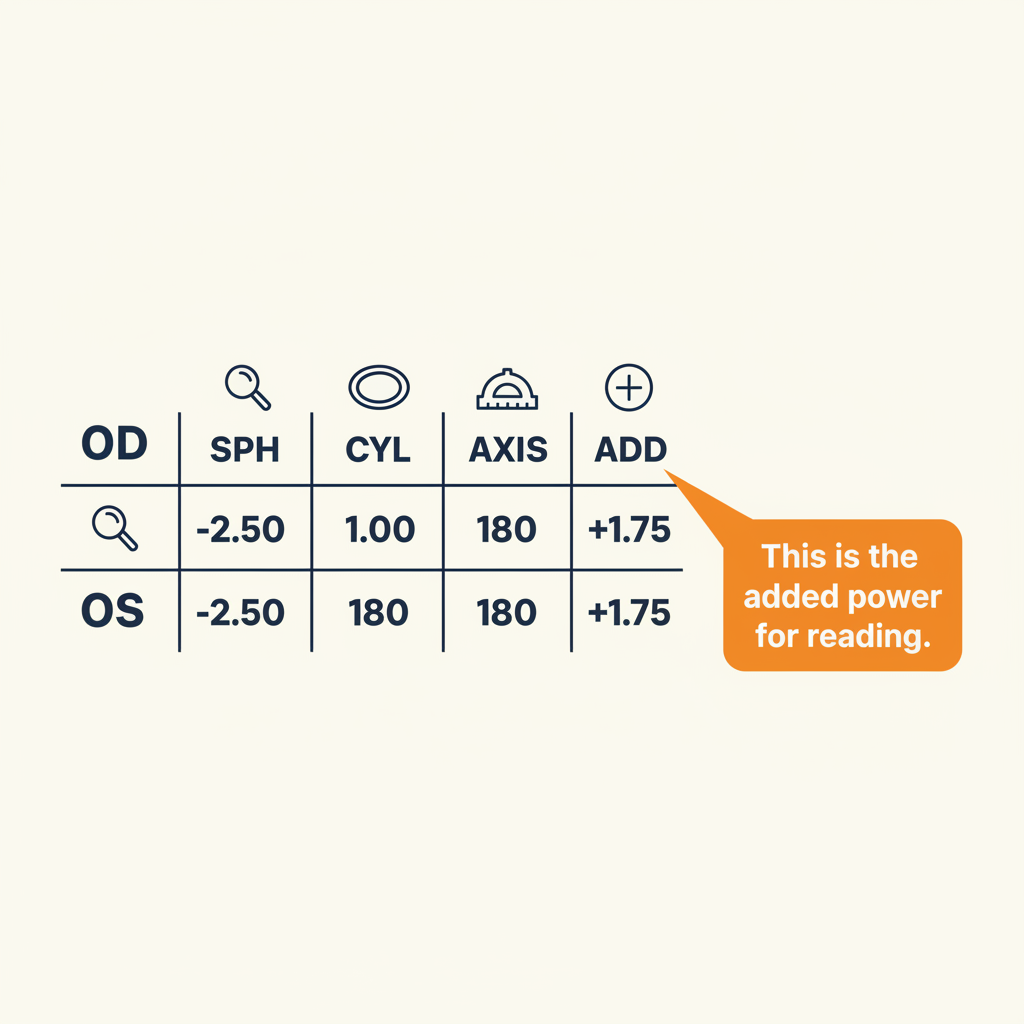
Here’s a quick breakdown:
- OD (Oculus Dexter): This refers to your right eye.
- OS (Oculus Sinister): This refers to your left eye.
- Sphere (SPH): This indicates the main lens power, measured in diopters (D), to correct for nearsightedness (a minus value) or farsightedness (a plus value).
- Cylinder (CYL) & Axis: These values correct for astigmatism, which is an imperfection in the curvature of your eye that causes blurred vision at all distances. The CYL is the power needed, and the Axis is the orientation of that power (from 1 to 180 degrees).
- ADD (Addition): This is the star of our show. The ADD power is the additional magnifying power placed in the lower part of a multifocal lens to help with reading and other near tasks. This value is the key to calculating your reading-only prescription.
The Myth of "Readers-Only" Power
A common misconception is that you can simply take your ADD value—say, +2.00—and buy an over-the-counter (OTC) pair of "+2.00" readers from a drugstore. While this might work for a small number of people, it’s often a recipe for headaches and eye strain. The American Academy of Ophthalmology (AAO) notes that ready-made readers have the same power in both lenses and do not correct for astigmatism. If you have any astigmatism (a CYL value) or if your two eyes have different prescriptions, OTC readers will not provide the crisp, comfortable vision you get from a custom-made pair.
Section 2: How to Calculate Your Single-Vision Reading Prescription
Now that you understand the terms, we can perform the conversion. The process is a simple calculation, but it requires careful attention to each part of your prescription for both your right and left eyes.
The Core Formula: SPH + ADD
The fundamental step is to add your Sphere (SPH) power to your ADD power. You must do this separately for each eye.
Reading SPH = Original SPH + Original ADD
For your reading glasses, the Cylinder (CYL) and Axis values remain exactly the same as they are on your original prescription. Astigmatism affects your vision at all distances, so this correction is still essential for clear reading.
Step-by-Step Conversion Guide
- Isolate Each Eye's Prescription: Look at the rows for OD (right eye) and OS (left eye) on your prescription.
- Calculate the New Sphere (SPH): For each eye, take the number in the SPH column and add the number from the ADD column.
- Carry Over Astigmatism Correction: The CYL and Axis values do not change. Copy them directly to your new reading prescription.
- Assemble the New Prescription: You now have a complete single-vision prescription for reading glasses.
Pro Tip: Mind Your Reading Distance
As a long-time optician, I can tell you that the standard ADD power is calculated for a reading distance of about 16 inches (40 cm). This is perfect for holding a book or a tablet. However, if you want glasses specifically for computer use, your screen is likely farther away—typically 20-24 inches. In this case, the standard ADD power might be too strong. For computer glasses, a common practice is to use about half of your ADD power. For instance, if you have an ADD of +2.00, you would use +1.00 for your computer glasses calculation.
Conversion Examples
To make this clearer, let's look at a couple of examples in a table.
| Original Progressive Prescription | Calculation | Resulting Reading Prescription |
|---|---|---|
| OD: SPH -1.50, CYL -0.75, Axis 90, ADD +2.00 | SPH: -1.50 + 2.00 = +0.50 | OD: SPH +0.50, CYL -0.75, Axis 90 |
| OS: SPH -1.75, CYL -0.50, Axis 85, ADD +2.00 | SPH: -1.75 + 2.00 = +0.25 | OS: SPH +0.25, CYL -0.50, Axis 85 |
| OD: SPH +1.00, CYL -1.25, Axis 180, ADD +2.25 | SPH: +1.00 + 2.25 = +3.25 | OD: SPH +3.25, CYL -1.25, Axis 180 |
| OS: SPH +1.00, CYL -1.00, Axis 175, ADD +2.25 | SPH: +1.00 + 2.25 = +3.25 | OS: SPH +3.25, CYL -1.00, Axis 175 |
Section 3: Two Critical Adjustments for Perfect Clarity
Calculating the power is the biggest step, but two other measurements are crucial for avoiding eye strain and ensuring your new readers work perfectly: pupillary distance and vertex distance.

1. Pupillary Distance (PD): The Near vs. Distance Difference
Your Pupillary Distance (PD) is the distance between the centers of your pupils. This measurement ensures the optical center of each lens aligns perfectly with your eye. However, your eyes converge (turn inward slightly) when you look at something up close. Because of this, your near PD is narrower than your distance PD.
Expert Warning: Using your distance PD for a pair of reading glasses is one of the most common mistakes I see. It can cause eye strain and a feeling that the glasses just "aren't right." As a rule of thumb, your near PD is typically 2-3 millimeters smaller than your distance PD. If your prescription only lists one PD value, it's almost certainly your distance PD. For optimal comfort with reading glasses, you need to use your near PD. If you're unsure, you can use an online tool or follow a simple guide on how to measure your PD at home.
2. Vertex Distance: Why It Matters for Stronger Prescriptions
Vertex distance is the distance from the back surface of the eyeglass lens to the front of your cornea. For most mild prescriptions, small variations don't make a noticeable difference. However, for stronger prescriptions, this distance is critical.
Based on established optical principles, for prescriptions over ±4.00D, even a small change in how far the glasses sit from your eyes can materially alter their effective power. A shift of just a few millimeters can be enough to require a 0.25D power adjustment to compensate. This is why a frame that sits far down your nose can make your vision feel "off," even if the prescription is correct. When choosing frames for a stronger reading prescription, aim for a fit that keeps the lenses reasonably close to your eyes, similar to how your primary glasses fit. For those with high-power needs, understanding how factors like lens curvature affect vision can also be beneficial.
Section 4: At-Home Verification and Smart Ordering
Once you have your calculated prescription and measurements, you can proceed with confidence. However, a quick at-home test can provide final confirmation, and a smart ordering strategy can eliminate any remaining uncertainty.
The "Print Test" for Final Confirmation
Before placing your order, you can simulate the new power. A practical method used by technicians is to use a printed reading card or any standard text.
- Hold the text at your most natural reading distance.
- If you have an old pair of glasses with a known power, try them on to see how they feel at that distance. Does a +1.50 feel weak? Does a +2.50 feel overwhelmingly strong?
- This real-world check helps you confirm if your calculated power feels right for your specific habits. For instance, if your calculation resulted in +2.25, but you find you have to hold text uncomfortably close, you might be better suited to a +2.00.
Common Pitfalls to Avoid: A Checklist
To ensure a smooth process, double-check that you haven't fallen into one of these common traps.
- [ ] Myth: Assuming your progressive lens's near power is the same as a single-vision reader. (Reality: The focal plane is different and requires a dedicated lens).
- [ ] Mistake: Ignoring your occupational reading distance. (Fix: Measure the distance to your computer screen vs. a book and adjust power if needed).
- [ ] Error: Using your distance PD for reading glasses. (Fix: Use your near PD, which is 2-3mm narrower).
- [ ] Oversight: Not considering vertex distance for a high prescription. (Fix: Choose frames that sit properly and don't slide down your nose).
Following a clear plan is the best way to ensure a great outcome, a principle that applies to the entire process of buying prescription glasses online safely.
Frequently Asked Questions (FAQ)
Q: Can I just use my ADD power for over-the-counter (OTC) readers?
A: It's generally not recommended. As noted by experts at the Cleveland Clinic, OTC readers are "one-size-fits-all," meaning they don't correct for astigmatism and have the same power in both lenses. If your eyes have different needs, you won't get the sharpest vision.
Q: Why do my new reading glasses cause eye strain?
A: This is almost always due to one of three things: 1) The power is wrong for your preferred reading distance (e.g., too strong for computer use), 2) The pupillary distance (PD) used was for distance vision, not near vision, or 3) Your eyes simply need a few days to adapt to the new, dedicated field of vision.
Q: Do I need a separate pair of glasses for my computer?
A: Very likely, yes. As discussed, computer screens are at an "intermediate" distance, which often requires less power than the full ADD value used for close-up reading. Many people find that having a dedicated pair of "computer glasses" significantly reduces digital eye strain.
Q: What if my prescription is expired?
A: You should always use a current, valid prescription to order glasses. Your vision can change, and an outdated prescription may no longer be accurate. The FTC's Eyeglass Rule empowers you by mandating that your eye doctor must give you a copy of your prescription immediately after your exam, giving you the freedom to purchase glasses wherever you choose.
Wrapping Up: The Right Tool for the Right Task
While your progressive or bifocal glasses are excellent for all-day, multi-distance use, there is undeniable comfort and clarity in having a dedicated pair of single-vision reading glasses for specific tasks. By understanding your prescription and following a few simple steps, you can confidently convert your multifocal numbers into a perfect prescription for readers.
The key is to remember the formula (SPH + ADD), carry over your astigmatism correction, and—most importantly—use your near PD. By doing so, you can easily and affordably build an "eyewear wardrobe" that gives you the best possible vision for every situation.
Disclaimer: This article is for informational purposes only and does not constitute professional medical advice. The information provided is intended to help you understand your prescription, but you should always consult with a qualified optometrist or ophthalmologist regarding your eye health and before purchasing new eyewear. Always use a current, valid prescription from a licensed eye care professional.
References
- Cleveland Clinic: How to Read Your Eye Prescription
- American Academy of Ophthalmology (AAO): Tips for Choosing the Right Reading Glasses
- Cleveland Clinic: Are Drugstore 'Cheaters' as Good as Prescription Reading Glasses?
- FTC Consumer Advice: Buying Prescription Glasses or Contact Lenses: Your Rights
- Harvard Health Publishing: Focus on Easier Reading


