








How Are Blue Light Filtering Lenses Actually Made?
Behind the Lens: How Blue Light Filtering Glasses Are Made
You’ve seen them everywhere: glasses designed to filter blue light from digital screens. But what exactly is happening inside that seemingly clear lens? The technology is more than just a simple color tint; it’s a precise manufacturing process rooted in optical physics. Understanding how these lenses are made is the key to telling the difference between a genuine tool for managing your sleep cycle and a simple gimmick.
We're going behind the scenes to explore the two primary methods used in optical labs to create blue light filtering lenses: advanced material science and precision coating technology. You’ll learn how each method works, its specific pros and cons, and what quality control looks like on a factory floor.
TL;DR: How Blue Light Lenses Are Made
- Two Core Methods: Lenses are made by either infusing blue light filtering compounds directly into the lens material itself or by applying a highly precise, multi-layer coating to the lens surface.
- Material Infusion: This method "bakes" the filtering properties into the lens. It's extremely durable but offers less control over which specific wavelengths of light are blocked.
- Surface Coating: This high-tech process uses a vacuum chamber to apply multiple microscopic layers that reflect specific wavelengths of blue light. It allows for highly selective filtration but requires a quality hard coat to prevent scratches.
- Quality is Measurable: Reputable manufacturers use a device called a spectrophotometer to verify exactly how much of which light wavelengths a lens is blocking, ensuring it meets design specifications.
- It's a Sleep Tool, Not a Strain Cure: Scientific consensus, including research published in PubMed, shows that digital eye strain is caused by reduced blinking and focusing effort, not blue light. The primary, evidence-backed benefit of these lenses is helping regulate your circadian rhythm by blocking blue light in the evening.
The "Why" Before the "How": What Are We Filtering?
Before we step into the lab, it's crucial to understand what we are trying to achieve. The goal isn’t to block all blue light, which would be like wearing sunglasses indoors. The goal is to selectively manage our exposure to it.
Blue Light: A Signal, Not a Toxin
Sunlight is full of blue light. For millennia, it has acted as a key signal to our brains, telling us, "It's daytime; be alert!" As a comprehensive review in the journal PMC points out, blue light is not a toxin but a signal. The problem arises when we get that same strong signal from laptops, phones, and tablets long after the sun has set.
This evening exposure can trick our brains into thinking it's still daytime, suppressing the production of melatonin, the hormone that tells our body it's time to sleep. Research from Harvard Health Publishing suggests that wearing blue light filtering glasses in the evening can be a useful tool for improving sleep.
Myth Debunked: Digital Eye Strain vs. Circadian Health
A common misconception is that blue light filtering lenses are designed to cure digital eye strain. While marketing often makes this claim, the science doesn't support it. According to ophthalmologists like Dr. Nicole Bajic at the Cleveland Clinic, symptoms like tired eyes, headaches, and blurry vision are primarily caused by "digital eye strain"—a result of us blinking less and holding our eyes in a fixed focus for long periods.
The most effective remedies for eye strain are simple ergonomic habits, like the "20-20-20 rule" (every 20 minutes, look at something 20 feet away for 20 seconds) and using artificial tears. Blue light lenses are best understood as a tool for circadian rhythm management, not an ergonomic fix for eye fatigue.
Two Paths to Filtration: Material Infusion vs. Surface Coating
Every blue light filtering lens starts as a standard lens "blank" made from a material like polycarbonate or a high-index plastic. The magic happens in how this blank is transformed. There are two distinct manufacturing paths.
Method 1: Infusing the Material
In this method, the blue light filtering capability is built directly into the lens material. During the initial manufacturing stage, special polymers and photochromatic compounds that naturally absorb high-energy visible (HEV) blue-violet light are mixed into the liquid monomer that forms the lens.
This mixture is then poured into a mold and cured under UV light, solidifying into a lens blank with filtration properties "baked in."
- Pros: The primary advantage is durability. Since the filtration is part of the lens structure, it cannot be scratched off or worn away.
- Cons: This method typically offers less precise spectral control. It tends to block a broader range of light, which can sometimes result in a more noticeable color tint on the lens.
Method 2: Applying a Multi-Layer Dielectric Coating
The more common and technically advanced method is surface coating. This process takes a finished, clear prescription lens and adds the filtering properties to its surface in a vacuum deposition chamber.
Inside the chamber, an electron beam vaporizes a series of different metal oxides (like silicon dioxide and titanium dioxide) in a specific sequence. These vapors deposit onto the lens surface, creating a stack of microscopically thin layers. Each layer is engineered to a precise thickness—often just a fraction of a wavelength of light—to interfere with and reflect a very specific portion of the blue light spectrum through a principle called thin-film interference.
An essential part of this process is applying a hard coat to the lens before the blue light and anti-reflective coatings. This foundational layer protects the delicate layers above it from scratches and daily wear.
At a Glance: Coating vs. Infused Lenses
| Feature | Multi-Layer Coating | Material Infusion |
|---|---|---|
| Filtration Precision | High. Can be tuned to filter specific, narrow wavelengths (e.g., 400-455 nm). | Lower. Tends to absorb a broader spectrum of light. |
| Durability | Good. Dependent on the quality of the underlying hard coat. | Excellent. Filtration properties cannot be scratched off. |
| Clarity & Color | Typically has a fainter residual color and less color distortion. | Can have a more noticeable, often yellowish or brownish, tint. |
| Other Features | Easily combined with premium anti-reflective (AR) and oleophobic (anti-smudge) layers. | The base material is the primary feature. Coatings are still required for AR. |
| Best For | Users who want the most precise filtration with maximum clarity for color-sensitive work. | Users in harsh environments or those prioritizing ultimate scratch resistance. |
Quality Control: How Manufacturers Verify Performance
Creating a blue light lens is one thing; proving it works is another. In a professional optical lab, lenses undergo rigorous testing to ensure they meet both optical and filtration standards.
The Spectrophotometer Test
The gold standard for verifying a blue light claim is a spectrophotometer. This instrument shines a controlled beam of light through the lens and measures exactly how much light gets through at every single wavelength across the visible spectrum.
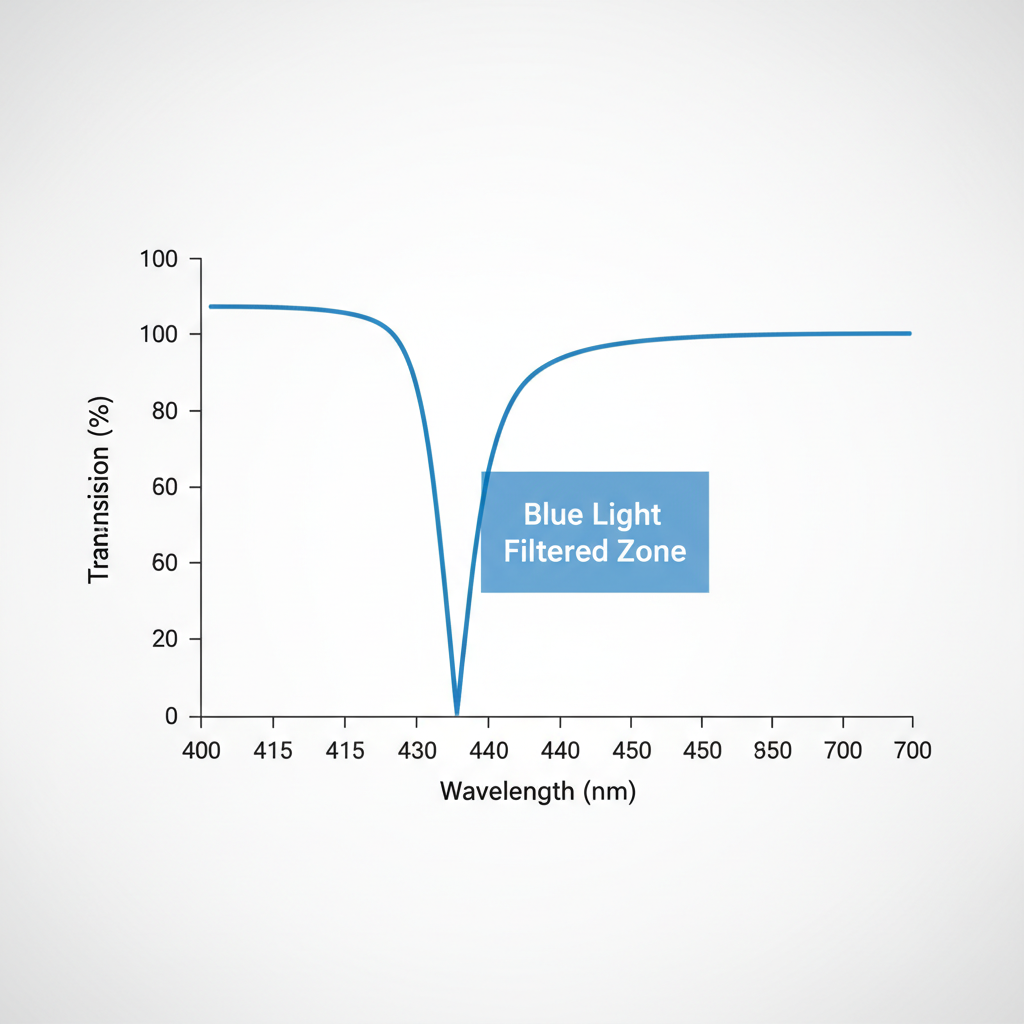
The output is a transmission graph. A high-quality lens will show a sharp dip in transmission in the target blue-violet range. According to optical physics analysis published in PMC, a well-designed filter can reduce hazardous blue light (400–455nm) by 25-40% while allowing the beneficial blue-turquoise light (455–500nm) needed for alertness to pass through. This graph is the lens's fingerprint, proving its performance.
Ensuring Prescription Accuracy
A blue light filter is useless if your vision through it is blurry. Before shipping, every lens is checked on a device called an automated lensmeter to verify that the prescription—the sphere, cylinder, and axis—is correct. The industry tolerance for this is extremely tight, typically within ±0.12 diopters of what your doctor prescribed.
Finally, technicians check the pupillary distance (PD) and optical center alignment. An improperly centered lens can cause eye strain and distortion. While single-vision lenses can tolerate a small PD error of 1-2 millimeters, more complex lenses like progressives require near-perfect alignment (within 0.5 mm) to function correctly.
Wrapping Up: From the Lab to Your Eyes
The journey of a blue light filtering lens from a liquid monomer to a finished product is a blend of material science, physics, and meticulous quality control. Whether the filtration is infused into the material or applied as a high-tech coating, the goal is the same: to selectively manage your exposure to light and support a healthy circadian rhythm. By understanding the manufacturing process, you can better appreciate the technology you rely on every day and make more informed choices about your eyewear.
Frequently Asked Questions (FAQ)
Do all blue light filtering glasses have a yellow tint? Most lenses have a very faint residual tint, which is a byproduct of filtering parts of the blue spectrum. Coated lenses often have a slight blue or green reflective color, while the view through them is nearly clear. Infused lenses may have a more noticeable, pale yellow or amber tint.
Should I wear my blue light glasses all day? It's generally not recommended. Blue light from the sun during the day is beneficial for alertness and mood. The primary benefit of these glasses is for evening use, typically two to three hours before bedtime, to prevent the suppression of melatonin.
Are blue light filtering glasses safe for children? The science here is still emerging, and caution is advised. Some theoretical research, such as a model discussed by the Mayo Clinic, explores whether chronically blocking blue light in developing eyes could interfere with normal vision development. For this reason, it's best to focus on managing a child's screen time and promoting outdoor activities rather than relying on filtering glasses, unless specifically recommended by an eye care professional.
How can I tell if my glasses are really working? You can't see the filtration working, and sometimes, the perceived benefit can be influenced by a placebo effect, as noted in a PubMed study. The true test is subjective: after wearing them consistently in the evenings for a week or two, do you feel like you are falling asleep more easily or getting better quality sleep? That is the intended outcome.
Disclaimer: This article is for informational purposes only and does not constitute medical advice. The information contained herein is not intended to be a substitute for professional medical advice, diagnosis, or treatment. Always seek the advice of your ophthalmologist or other qualified health provider with any questions you may have regarding a medical condition.
References
- Bajic, N. (Cleveland Clinic). "Do Blue-Light-Blocking Glasses Actually Work?". Retrieved from https://health.clevelandclinic.org/do-blue-light-blocking-glasses-actually-work
- Bigalke, J. A., et al. (PubMed). "The effect of blue-light filtering spectacle lenses on subjective and objective sleep in healthy adults". Retrieved from https://pubmed.ncbi.nlm.nih.gov/33707105/
- Harvard Health Publishing. "Can blue light blocking glasses improve your sleep?". Retrieved from https://www.health.harvard.edu/blog/can-blue-light-blocking-glasses-improve-your-sleep-202110262625
- Ostovari, J., et al. (Mayo Clinic). "The theoretical risk of blue light-blocking lenses in children". Retrieved from https://pmc.ncbi.nlm.nih.gov/articles/PMC12009466/
- Rahmani, E., et al. (PMC). "Blue-blocking lenses as a countermeasure for digital eye strain". Retrieved from https://pmc.ncbi.nlm.nih.gov/articles/PMC7431718/
- Rosenfield, M., et al. (PubMed). "Do blue-blocking lenses reduce symptoms of digital eye strain?". Retrieved from https://pubmed.ncbi.nlm.nih.gov/32007978/
- Tosini, G., et al. (PMC). "The effects of blue light on the circadian system and eye physiology". Retrieved from https://pmc.ncbi.nlm.nih.gov/articles/PMC8897255/


