









Vitamins or Blue Light Lenses: Do You Really Need Both?
Executive Summary
Vision wellness in the digital age has evolved from a simple discussion about corrective lenses into a multi-dimensional strategy involving physical protection and biological fortification. This article evaluates the efficacy of blue light filtering lenses versus nutritional supplementation (specifically lutein and zeaxanthin) for mitigating the effects of High-Energy Visible (HEV) light.
Key findings indicate that these two interventions serve distinct but complementary roles. Blue light lenses function as an immediate external filter, primarily beneficial for preserving circadian rhythms and improving sleep onset when used in the evening. Conversely, nutritional supplements act as an internal "biological shield," building Macular Pigment Optical Density (MPOD) over a period of 3 to 6 months to protect retinal tissues from oxidative stress. For professionals exceeding 6 to 8 hours of daily screen time, a combined approach—integrating external filters, targeted nutrition, and environmental modifications like the 20-20-20 rule—is typically observed to provide the most significant relief from digital eye strain and long-term ocular fatigue.
The Physics of Blue Light and the Eye's Natural Defenses
To understand the necessity of protection, one must first distinguish between the types of light entering the eye. High-Energy Visible (HEV) light, particularly in the 400–500 nm range, carries more energy than longer-wavelength colors. While the American Academy of Ophthalmology (AAO) notes that the sun is the primary source of UV and HEV exposure, the proximity and duration of digital device usage have introduced a new variable in ocular health.
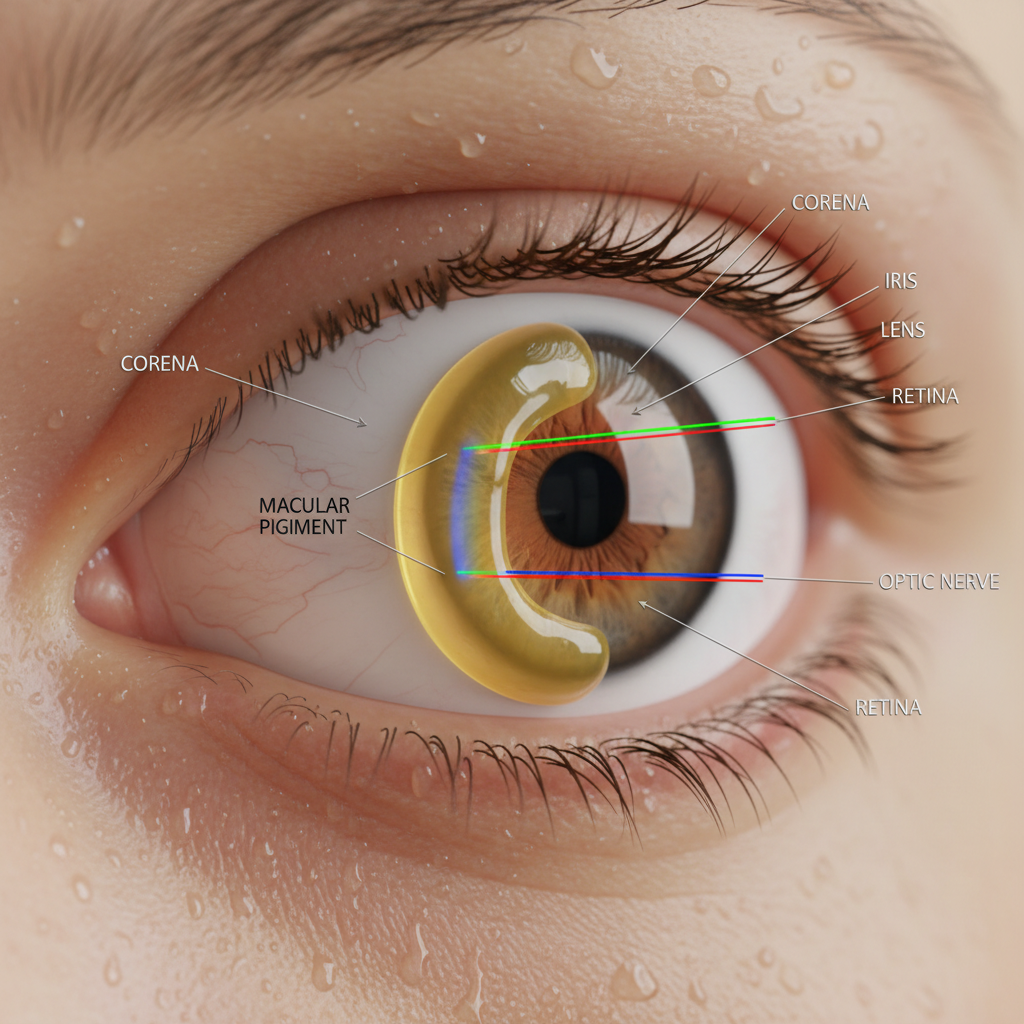
The human eye possesses a natural internal defense system known as the macular pigment. This layer is composed of three carotenoids: lutein, zeaxanthin, and meso-zeaxanthin. According to research from Case Western Reserve University via the NEI, HEV light can trigger a chain reaction of glycation in the lens and oxidative stress in the retina. The macular pigment acts as a selective filter, absorbing blue light before it reaches the delicate photoreceptors.
Logic Summary: Our analysis of ocular defense mechanisms assumes that the density of the macular pigment is the primary biological determinant of blue light sensitivity. This modeling is based on the "Coroneo Effect" and standard photobiological principles regarding retinal irradiance.
Blue Light Filtering Lenses: External Physical Barriers
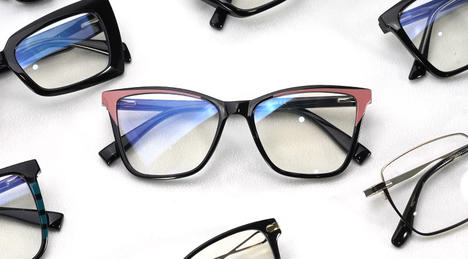
Blue light filtering glasses have become a standard tool for digital professionals. However, clinical consensus suggests their utility is often misunderstood.
Sleep and Circadian Rhythm
The most evidence-based application for blue light lenses is the management of sleep hygiene. The Harvard Health Publishing analysis suggests that blocking the 450–480 nm spectrum in the evening prevents the suppression of melatonin, potentially shortening sleep onset by 8 to 15 minutes. This is supported by a systematic review in Psychiatry (Hester et al.), which identifies evening wear as a high-yield intervention for sleep latency.
The Digital Eye Strain Paradox
A common misconception is that blue light is the direct cause of Digital Eye Strain (DES). However, Dr. Nicole Bajic of the Cleveland Clinic clarifies that DES is primarily caused by a reduced blink rate and accommodative issues rather than blue light phototoxicity. A double-blind RCT by Rosenfield et al. (PubMed) found no significant difference in eye strain symptoms between blue-blocking and placebo lenses during reading tasks.
Heuristic for Lens Selection:
- Total Screen Time < 4 Hours: Standard anti-reflective (AR) coatings are typically sufficient.
- Total Screen Time > 6 Hours: Blue light filtering lenses often show a noticeable subjective improvement in visual comfort and reduced evening fatigue (based on common patterns from customer support and user feedback).
Nutritional Fortification: Building the Biological Shield
If lenses are the "umbrella," nutrition is the "waterproof coating." Supplements do not provide immediate relief, but they enhance the eye's long-term resilience.
The Role of Lutein and Zeaxanthin
The AREDS2 Study established the "gold standard" for ocular nutrition, proving that lutein and zeaxanthin can reduce the risk of advanced macular degeneration progression by approximately 25%. These nutrients must be ingested because the body cannot synthesize them.
Bioavailability and Absorption
A critical oversight in supplementation is the "Fat-Dependent Rule." Since carotenoids are fat-soluble, they must be consumed with a meal containing healthy fats to be absorbed effectively. Furthermore, a Meta-Analysis on Lutein (PubMed) indicates that it typically takes 3 to 6 months of consistent intake to measurably increase Macular Pigment Optical Density (MPOD).
The Synergy of Micronutrients
Beyond carotenoids, other nutrients play supporting roles:
- Omega-3 Fatty Acids: Shown in a meta-analysis of 17 RCTs to improve dry eye symptoms by stabilizing the tear film.
- Vitamin D and Magnesium: NHANES data reveals that Vitamin D's protective effect on the retina is dependent on adequate magnesium levels.
Comparing the Two Pillars of Protection
While both methods address blue light, they operate on different timelines and mechanisms.
| Feature | Blue Light Filtering Lenses | Ocular Supplements (Lutein/Zeaxanthin) |
|---|---|---|
| Primary Mechanism | Physical filtration of HEV light waves. | Biological absorption and antioxidant defense. |
| Onset of Benefit | Immediate (within days for sleep). | Delayed (3–6 months for MPOD buildup). |
| Primary Benefit | Circadian rhythm and sleep onset. | Retinal health and contrast sensitivity. |
| Usage Requirement | Must be worn during screen use. | Must be taken daily with healthy fats. |
| Limitation | Does not address internal oxidative stress. | Does not provide immediate glare reduction. |
Modeling Note (Reproducible Parameters): To estimate the "Protective Index" for a user, we modeled a scenario comparing a "Non-Protected" user against a "Dual-Protected" user.
| Parameter | Value/Range | Unit | Rationale | | :--- | :--- | :--- | :--- | | Daily Screen Time | 8 | Hours | Standard professional baseline. | | Lens Filtration Rate | 25–40 | % | Standard clear blue-light filter spec. | | MPOD Increase | 0.1–0.2 | Density Units | Expected increase after 6 months of 10mg Lutein. | | Blink Rate Reduction | 60 | % | Common industry heuristic for screen usage. | | Ambient Lux Level | 500 | Lux | Standard office lighting. |
Boundary Conditions: This model assumes standard dietary intake and does not account for pre-existing retinal pathologies or extreme light sensitivity (photophobia).
The Holistic Strategy: When You Need Both
For the majority of digital professionals, the question is not "either/or" but "how to combine." Based on practitioner observations and common user patterns, the most successful vision wellness protocols follow a tiered approach.
1. The Environmental Foundation
Before investing in lenses or supplements, address the mechanics of your environment. The University of Mississippi Medical Center emphasizes that dry eye is the leading cause of digital discomfort.
- The 20-20-20 Rule: Every 20 minutes, look at something 20 feet away for 20 seconds to reset accommodative focus.
- Screen Distance: Maintain at least an arm's length (approx. 20–28 inches) from your monitor.
2. The Internal Shield (Nutrition)
Start a daily supplement regimen if your diet is low in leafy greens (spinach, kale) or egg yolks. According to research on egg yolk bioavailability, the lutein in eggs is often more effectively absorbed than that in vegetables due to the lipid matrix.
3. The External Filter (Lenses)
If you work late into the evening or experience significant glare-induced headaches, blue light filtering lenses serve as the final layer of defense. They are particularly effective for users who report "racing thoughts" or difficulty winding down after evening screen work, as they mitigate the alertness-inducing effects of blue light.

Common Pitfalls and "Gotchas"
- The "Darkness Fallacy": Wearing dark-tinted lenses that lack verified UV or HEV protection can be more dangerous than wearing no glasses at all. As noted by MD Anderson, dark lenses cause the pupil to dilate, allowing more harmful radiation to reach the lens and retina if the filter is insufficient.
- Expecting Immediate Relief from Supplements: Many users stop taking vitamins after 30 days because they don't "feel" a difference. It is essential to understand that retinal changes are structural and cumulative.
- Ignoring the "Tear Lens": For contact lens wearers, the physics changes. StatPearls notes that the "tear lens" between a contact and the cornea can correct some astigmatism but may exacerbate dry eye, making nutritional support (Omega-3s) even more critical.
Recommended Actions for Digital Professionals
- Audit Your Screen Time: If you spend more than 6 hours daily on digital devices, prioritize a dual-track approach.
- Verify Your Rx: Ensure you have an up-to-date prescription. Under the FTC Eyeglass Rule, you are entitled to a copy of your prescription immediately after an exam.
- Optimize Your Evening Routine: Switch to blue light filtering eyewear at least 2 hours before bed to support melatonin production.
- Consult Your Diet: Aim for 10mg of lutein and 2mg of zeaxanthin daily. If this isn't achievable through whole foods, consider a high-quality supplement aligned with AREDS2 standards.
By combining the immediate physical filtration of blue light lenses with the long-term biological protection of targeted nutrition, professionals can build a resilient vision wellness strategy that addresses both modern lifestyle demands and underlying ocular health.
Disclaimer: This article is for informational purposes only and does not constitute professional medical advice, diagnosis, or treatment. Always seek the advice of your physician or other qualified health provider with any questions you may have regarding a medical condition or nutritional regimen.
Sources
- FTC: Buying Prescription Glasses - Your Rights
- NEI: AREDS2 Study Results
- Harvard Health: Can Blue Light Blocking Glasses Improve Your Sleep?
- PubMed: Lutein & AMD Meta-Analysis
- Cleveland Clinic: Do Blue Light Blocking Glasses Actually Work?
- AAO: Sun Safety Tips
- PubMed: Double-Blind RCT on Blue Light Lenses
- PubMed: Omega-3 for Dry Eye Meta-Analysis


