










Is Buying Prescription Glasses Online Safe? A Checklist
Is It Safe to Buy Glasses Online? Your Definitive Checklist
The idea of ordering prescription glasses online is appealing. It offers convenience, a massive selection of styles, and often, significant savings. But a crucial question lingers for many: is it actually safe? Can a pair of glasses ordered from a website truly match the quality and accuracy of those from a traditional optician?
The answer is yes—but with a major caveat. It is only safe and effective if you are a well-informed consumer. The difference between a perfect pair and a prescription-induced headache lies in understanding the process, knowing your rights, and choosing a reputable retailer. My own experience in the optical field has shown me that the biggest issues often stem from small, avoidable errors in the ordering process.
This article is your comprehensive guide to navigating the world of online eyewear. We will provide a step-by-step checklist to ensure your vision, health, and wallet are all protected.
TL;DR: Your Quick Safety Checklist
Always use a current prescription. An old prescription won't reflect your current vision needs.
Your prescription is yours by law. Your eye doctor must give you a copy under the FTC's Eyeglass Rule.
Measure your Pupillary Distance (PD) accurately. This is the most critical measurement for lens alignment and is the number one cause of issues with online orders.
Vet the retailer. Look for clear quality control standards, transparent lens information, and a fair return policy.
Verify your glasses upon arrival. Ensure the fit is comfortable and your vision is clear and free of distortion.
Your Prescription: The Blueprint for Perfect Vision
Before you even browse for frames, your journey starts with a valid, comprehensive prescription from an eye care professional. This document is the single most important piece of information in the entire process.
You Have a Right to Your Prescription
Let's clear up a common point of friction. After an eye exam, your eye doctor is legally required to provide you with a copy of your prescription, whether you ask for it or not. This is mandated by the Federal Trade Commission's Eyeglass Rule. You are not obligated to purchase glasses from them. This prescription portability is what makes online competition possible and empowers you as a consumer.
Decoding the Numbers and Letters
An eyeglass prescription can look like a secret code, but it's straightforward once you know the terms. Understanding it helps you enter the information correctly online, avoiding simple but critical mistakes. A common error I've seen is someone entering an axis of "8" when it should be "080," which completely changes the lens.
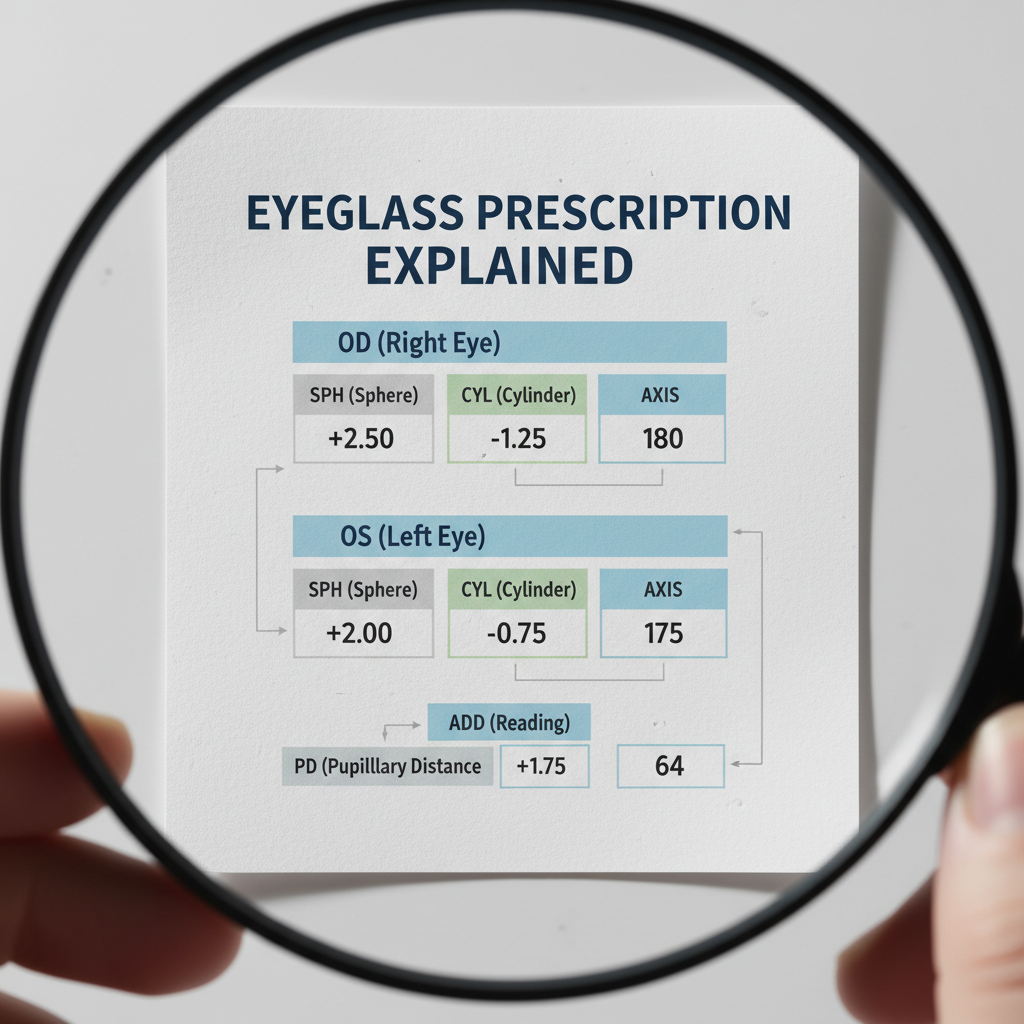
Here’s a quick breakdown based on guidance from the Cleveland Clinic on reading prescriptions:
| Abbreviation | Stands For | What It Means |
|---|---|---|
| OD (Oculus Dexter) | Right Eye | All the values in this row apply to your right eye. |
| OS (Oculus Sinister) | Left Eye | All the values in this row apply to your left eye. |
| SPH (Sphere) | Spherical Correction | This indicates the main lens power, measured in diopters, to correct for nearsightedness (a minus sign, -) or farsightedness (a plus sign, +). |
| CYL (Cylinder) | Cylindrical Correction | This value corrects for astigmatism, which is when the cornea is shaped more like a football than a sphere. If this box is empty, you don't have astigmatism. |
| Axis | Axis of Astigmatism | This is the orientation of the cylindrical correction, measured in degrees from 1 to 180. It's only present if you have a CYL value. |
| ADD | Addition | This is the added magnifying power in the lower part of multifocal lenses to correct for presbyopia (age-related difficulty with near vision). |
| Prism | Prismatic Power | This is used to correct for eye alignment issues. It's less common. |
The Critical Measurement: Pupillary Distance (PD)
Pupillary Distance (PD) is the distance in millimeters between the centers of your pupils. This measurement is essential because it tells the lab where to place the optical center of your lenses. If the optical center is misaligned, you can experience eye strain, headaches, or distorted vision.
This is the single biggest cause of perceived poor optics for online purchases. For single-vision lenses, the PD should be accurate within ±2 mm. For more complex progressive lenses, that tolerance shrinks to ±1 mm. While some doctors include PD on the prescription, they aren't always required to. Reputable online retailers provide tools to measure it, but be cautious. My experience shows that simple DIY methods using a ruler and a mirror are often off by 3–5 mm. A better approach is to use a validated app or a printable ruler tool with clear instructions.
The Online Retailer Checklist: Vetting for Quality and Trust
Not all online eyewear retailers are created equal. The convenience of online shopping can sometimes mask a lack of quality control. A 2011 study published in the journal Optometry by PubMed found that of glasses ordered online, 44.8% had at least one parameter of spectacle prescription that failed tolerance standards.
This isn't to say buying online is a bad idea; it's to emphasize that you must choose your retailer wisely. Here’s what to look for:
Manufacturing Standards and Materials
Reputable online sellers use the same advanced manufacturing processes as traditional labs. According to The Vision Council, modern lens creation involves precision grinding, polishing, and the application of various coatings.
Look for retailers that are transparent about their materials. Key things to check for include:
UV Protection: Lenses should block 100% of UVA and UVB rays. A study on UV radiation found that plastic lenses offered better UV attenuation than glass, highlighting the importance of material choice for eye health.
Lens Materials: Retailers should offer options like polycarbonate (impact-resistant) and various high-index plastics (thinner and lighter for strong prescriptions).
Coatings: Anti-reflective, anti-scratch, and water-repellent coatings should be available and clearly explained.
Return Policies and Customer Support
A clear, fair, and easy-to-understand return policy is a non-negotiable sign of a trustworthy retailer. Given the potential for error, you need a safety net. Look for a policy that offers at least a 30-day window for returns or remakes, no questions asked.
Be wary of international shipping for returns. The best companies offer domestic return addresses or pre-paid labels, streamlining the process. Good customer support is also a key indicator. If you have an issue, they should be able to help you triage it. Often, they can resolve about 60% of quality complaints without a return simply by asking for a photo of the prescription and a picture of you wearing the glasses to check the fit and alignment.
Your Step-by-Step Buyer's Checklist
Follow these steps meticulously to ensure a successful purchase.
Step 1: Start with a Current, Valid PrescriptionDo not use a prescription that is more than one or two years old (depending on your local regulations and doctor's advice). Your eyes can change, and an outdated prescription will result in suboptimal vision.
Step 2: Measure Your Pupillary Distance (PD) AccuratelyUse the retailer's recommended tool or have a friend help you. Take multiple measurements to ensure consistency. For progressive lenses, a monocular PD (measuring from the bridge of your nose to each pupil individually) is required for the best results.
Step 3: Choose the Right Frame for Your Prescription and FaceAesthetic fit is important, but so is optical fit.
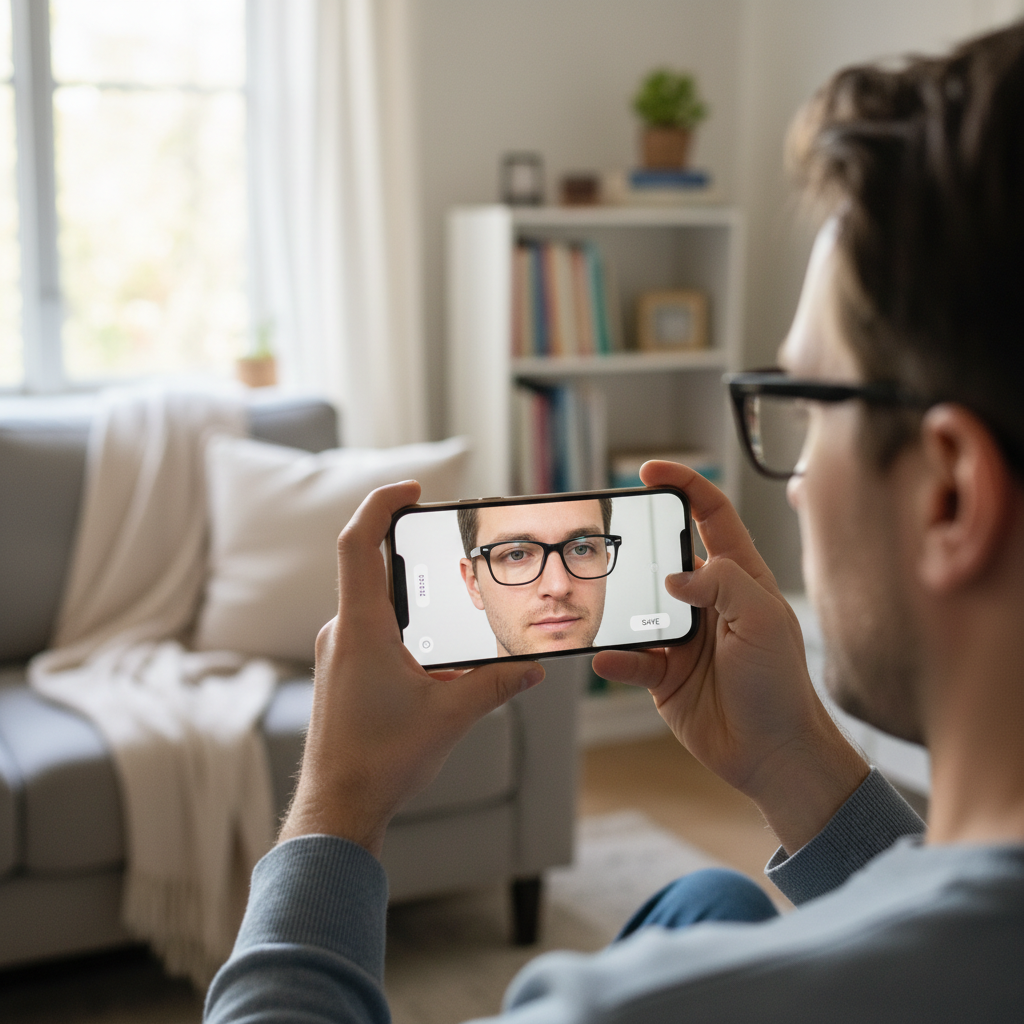
Virtual Try-On: When using virtual try-on tools, take the photo at eye level with your hair pulled back and a neutral expression. Avoid wide-angle selfie cameras, which can distort your features.
Frame Size: Pay attention to the frame measurements (lens width, bridge width, temple arm length) and compare them to a pair of glasses you already own that fits well.
Expert Warning: A Note for High Prescriptions
If your prescription has a sphere (SPH) value stronger than +4.00 or -4.00, you need to be more careful. With high prescriptions, factors like vertex distance (the distance from the back of the lens to your cornea) become much more critical. For these prescriptions, high-index lens materials are strongly recommended to reduce lens thickness and weight. A reputable retailer will often recommend the appropriate lens index based on your prescription power.
Step 4: Select Lenses and Coatings for Your LifestyleThink about how you use your glasses. Do you work on a computer all day? Consider blue light filtering. Are you in and out of the sun? Photochromic (transition) lenses might be a good fit. Anti-reflective coating is a valuable upgrade for nearly everyone, as it reduces glare and improves visual clarity, especially at night.
Step 5: Triple-Check Your Data EntryBefore you click "buy," review every number you've entered. Ensure the plus (+) and minus (-) signs are correct and that the SPH, CYL, and Axis values are assigned to the correct eye (OD and OS).
Step 6: Verify Your Glasses Upon ArrivalWhen your new glasses arrive, put them on and check your vision. Look around the room, read something up close and far away. Things should be clear and comfortable. If you feel dizzy, nauseous, or your vision seems distorted, there might be an issue with the prescription or the lens alignment. Contact customer service immediately.
Debunking a Common Myth: "Drugstore Readers Are Good Enough"
A common misconception is that over-the-counter (OTC) reading glasses are a fine substitute for a custom prescription pair. While they can be a handy backup, they are not the same.
According to the Cleveland Clinic, OTC readers have two major limitations. First, they offer the same power in both lenses, which doesn't work for the many people who have different prescriptions in each eye. Second, and most importantly, they cannot correct for astigmatism. Finally, their optical centers are fixed, which means they likely won't align perfectly with your pupillary distance, leading to the very eye strain you're trying to avoid.
Wrapping Up: Key Takeaways for Confident Online Shopping
Buying prescription glasses online can be a safe, affordable, and highly satisfactory experience. The power lies in your hands to control the outcome. By securing a current prescription, measuring your PD with care, meticulously vetting your chosen retailer, and following a structured ordering process, you can mitigate nearly all the potential risks.
The online marketplace has opened up a world of style and accessibility. By arming yourself with this knowledge, you can embrace it confidently, knowing you're making an informed decision for your eye health.
Frequently Asked Questions (FAQ)
Can I use my contact lens prescription to order glasses?No. A contact lens prescription is different from an eyeglass prescription. It includes different measurements, such as the base curve and diameter of the contact lens, and the power is often adjusted because the contact lens sits directly on your eye.
What if my new glasses feel "weird" at first?There is often a short adjustment period (from a few hours to a few days) as your brain gets used to a new prescription or frame shape. However, if you experience persistent headaches, dizziness, or distorted vision after a couple of days, contact the retailer.
How often should I get an eye exam?Most eye care professionals recommend a comprehensive eye exam every one to two years, depending on your age, risk factors, and whether you currently wear corrective lenses. Always follow the advice of your doctor.
Disclaimer: This article is for informational purposes only and does not constitute professional medical advice. Always consult with a qualified eye care professional for any issues concerning your eye health and before making any decisions about your vision care.
References
Cleveland Clinic. (n.d.). How to Read Your Eye Prescription. Retrieved from https://health.clevelandclinic.org/how-to-read-your-eye-prescription
Cleveland Clinic. (n.d.). Are Drugstore 'Cheaters' as Good as Prescription Reading Glasses?. Retrieved from https://health.clevelandclinic.org/are-drugstore-cheaters-as-good-as-prescription-reading-glasses
Code of Federal Regulations. (n.d.). 16 CFR Part 456 - Ophthalmic Practice Rules (Eyeglass Rule). Retrieved from https://www.ecfr.gov/current/title-21/chapter-I/subchapter-H/part-801/subpart-H/section-801.410
Choi, M., et al. (2011). The Accuracy of Online Spectacle Ordering. Optometry, published by PubMed. Retrieved from https://pubmed.ncbi.nlm.nih.gov/21871395/
The Vision Council. (n.d.). How Prescription Glasses and Contact Lenses are Made. Retrieved from https://thevisioncouncilfoundation.org/protect-your-eyes/how-prescription-glasses-and-contact-lenses-are-made-crafting-your-perfect-eyewear/
Walsh, J.E., et al. (1989). Ocular Ultraviolet Radiation Attenuation by Eyewear. Clinical and Experimental Optometry, published by PubMed. Retrieved from https://pubmed.ncbi.nlm.nih.gov/3752323/


