







Does Car Glass Block UV Rays? Why Drivers Still Need Shades
The Windshield Paradox: Why Your Car Isn't a Complete UV Shield
Many of us feel a sense of safety inside our cars, shielded from the elements. It's a common assumption that car glass provides total protection from the sun's harmful ultraviolet (UV) rays. However, this belief is only partially true and overlooks a significant risk to our long-term eye health. While your front windshield does a great job of blocking most UV radiation, your side and rear windows likely do not, creating a consistent source of exposure during every drive.
This article unpacks the science behind automotive glass, explains the specific dangers of in-car UV exposure, and provides a clear guide on why wearing the right sunglasses behind the wheel is a non-negotiable part of driver safety.

Not All Car Glass Is Created Equal: Laminated vs. Tempered
The key to understanding your in-car UV exposure lies in knowing that your vehicle uses two different types of glass. This distinction is the primary reason why the protection isn't uniform.
-
Front Windshield: Laminated Glass Your front windshield is constructed from laminated safety glass. This consists of two layers of glass bonded together with a transparent plastic interlayer, typically made of polyvinyl butyral (PVB). This PVB layer is a crucial safety feature that prevents the windshield from shattering into sharp pieces upon impact. Coincidentally, it is also an incredibly effective UV filter, blocking over 98% of both UVA and UVB rays.
-
Side and Rear Windows: Tempered Glass In contrast, most vehicles use tempered glass for the side and rear windows. This glass is treated with heat to make it much stronger than standard glass. When it breaks, it crumbles into small, granular chunks instead of sharp shards. While excellent for safety, standard tempered glass is not designed for UV protection. It effectively blocks most UVB rays (the kind that cause sunburn) but allows a significant portion—often over 60%—of UVA rays to pass right through.
Some manufacturers now offer optional laminated side windows or factory-applied UV-protective films, but this is far from standard. Unless you have specifically purchased a vehicle with this premium feature, it's safest to assume your side windows are a major entry point for UVA radiation.
The Hidden Danger: Cumulative UVA Exposure and Your Eyes
Ultraviolet radiation is divided into categories based on wavelength. While UVB rays are well-known for causing sunburn, UVA rays penetrate deeper into the skin and eyes, contributing to long-term, cumulative damage. This is the type of radiation that pours through your side windows, and its effects add up over a lifetime of driving.
The Driver's Side Effect: Opticians and ophthalmologists often observe a pattern in patients who drive frequently, such as truckers or sales representatives. These individuals can present with earlier or more advanced cataracts in their left eye (in left-hand-drive countries) due to the asymmetric, long-term UVA exposure received through the driver's side window. This clinical observation highlights the real-world consequences of unprotected driving.
Scientific research confirms the link between UV exposure and serious ocular diseases:
- Cataracts: The National Eye Institute (NEI) identifies UV light as a primary cause of cataracts, a clouding of the eye's natural lens. Research has shown how UV light can trigger a process called glycation within the lens, causing proteins to clump together and harden, leading to vision loss. A long-term study published in the Beaver Dam Eye Study found that consistent Vitamin C supplementation over 10 years was associated with a 60% lower risk of certain cataracts, highlighting the role of antioxidants in combating UV-induced oxidative stress.
- Eyelid Cancers: The delicate skin around your eyes is highly susceptible to sun damage. According to MD Anderson Cancer Center, 90% of eyelid cancers are basal cell carcinomas, directly linked to UV exposure.
- Pterygium: Often called "surfer's eye," this is a non-cancerous growth on the white of the eye that can grow over the cornea and affect vision. It is strongly associated with UV exposure, particularly from light entering from the side, a phenomenon known as the "Coroneo Effect" or peripheral light focusing.
Why You Need Sunglasses: Beyond the Glass
Even with the protection from a laminated windshield, sunglasses are a critical safety tool for several reasons:
-
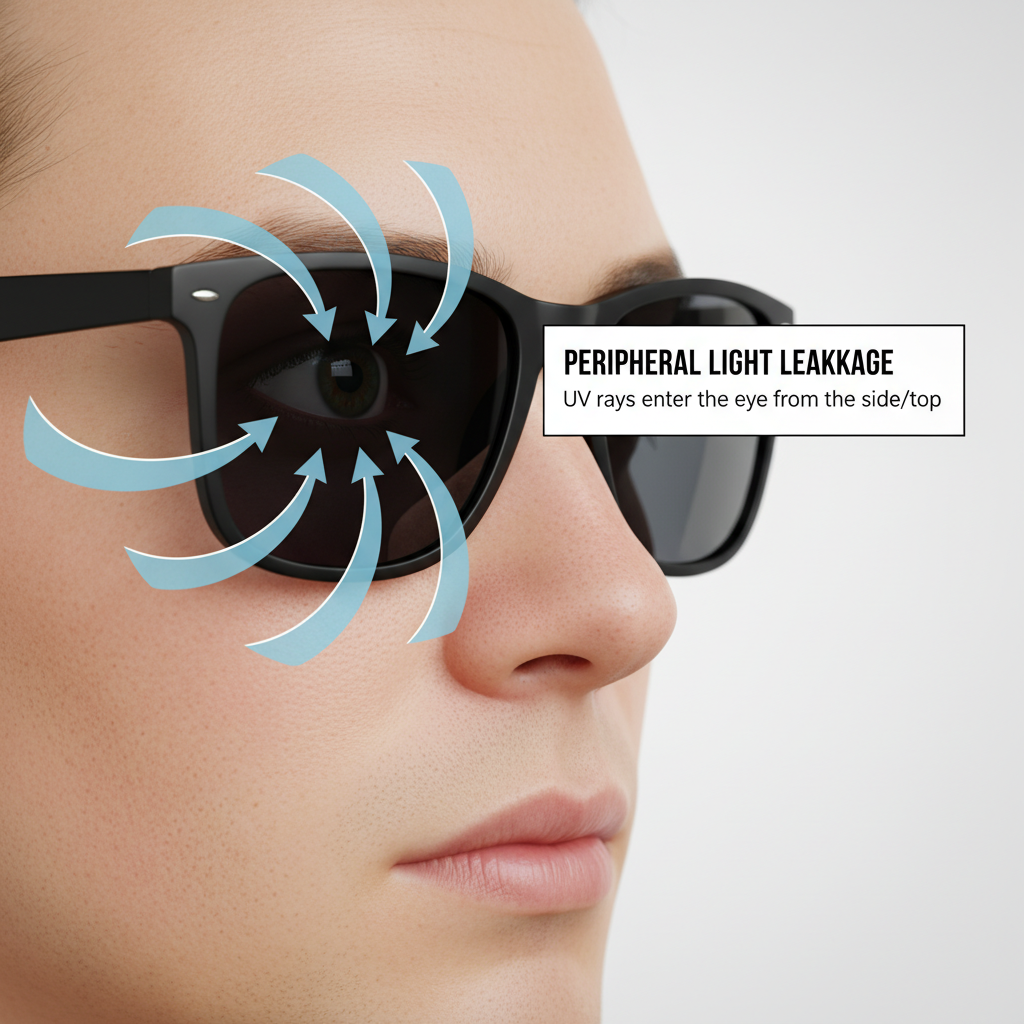
Peripheral Light Leakage: A significant amount of UV radiation doesn't hit your eyes directly but enters from the sides, top, and reflections from within the car. A 3D head-form study published in PMC found that middle-sized, flat-framed sunglasses offered the least protection precisely because of this peripheral light leakage. This underscores the need for well-fitting, larger, or wraparound frames.
-
Increased Risk for Light Eyes: If you have blue, green, or hazel eyes, you are inherently more sensitive to light and at higher risk for certain UV-related damage. According to Duke Health experts, this is because light-colored irises have less pigment to block harsh light. A study on Uveal Melanoma, a rare eye cancer, identified light eye color as a significant risk factor because the iris contains less protective melanin.
-
Glare Reduction: Glare from the road, other cars, or wet surfaces is a major cause of driver fatigue and can be dangerously blinding. Polarized lenses are specifically designed to filter this horizontal glare, dramatically increasing comfort and safety. However, it's crucial to remember that polarization is a feature for glare, not UV protection. You need both.
A Driver's Guide to Choosing Protective Sunglasses
Not all sunglasses are suitable for driving. Here’s what to look for to ensure you’re truly protected.
-
Look for the "UV400" Label: This is the most important feature. It signifies that the lenses block 99% to 100% of UV rays up to 400 nanometers, which covers the entire spectrum of UVA and UVB rays. A label that just says "UV-blocking" is not specific enough. As technical analysis has shown, standards that only protect up to 380 nm miss a significant amount of high-energy UVA light.
-
Choose the Right Lens Color: The American Optometric Association (AOA) recommends gray tints for driving as they maintain true color perception, which is vital for recognizing traffic signals and brake lights. Brown or amber tints also work well and can enhance contrast. Avoid lenses that significantly distort color.
-
Don't Be Fooled by Darkness: The darkness of the tint has nothing to do with its UV protection. In fact, wearing dark lenses without certified UV400 protection is more dangerous than wearing no sunglasses at all. The dark tint causes your pupils to dilate, allowing even more harmful UV radiation to enter your unprotected eyes.
-
Consider Polycarbonate Lenses: While CR-39 plastic lenses require a separate UV coating, polycarbonate lenses have inherent UV-blocking properties. They are also more impact-resistant, adding a layer of physical safety.
-
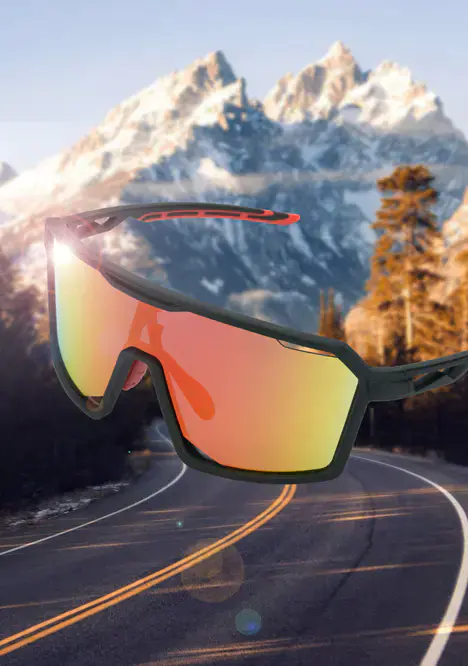
Prioritize a Good Fit: Choose frames that are large and sit close to your face. Wraparound styles are ideal for minimizing the peripheral light that can sneak in from the sides and top, a recommendation supported by the American Academy of Ophthalmology (AAO).
Make Eye Protection Your Co-Pilot
Your car is a bubble, but it’s not an impenetrable one. Relying on your car's glass alone for sun protection leaves your eyes exposed to the slow, cumulative damage of UVA radiation, drive after drive. The evidence is clear: the daily commute, errands, and road trips all contribute to your lifetime UV dose, increasing your risk for cataracts and other serious eye conditions.
Treating UV-protective sunglasses as essential driving equipment is a simple, effective step to safeguard your vision for the road ahead. By choosing a pair with certified UV400 protection and a frame that provides ample coverage, you take control of your eye health and ensure a safer, more comfortable experience behind the wheel.
Disclaimer: This article is for informational purposes only and does not constitute professional medical advice. Always consult with a qualified eye care professional for any health concerns or before making decisions about your eye health.
References
- American Academy of Ophthalmology (AAO). "Choosing the Best Sunglasses." https://www.aao.org/eye-health/glasses-contacts/sunglasses-3
- American Optometric Association (AOA). "UV Protection." https://www.aoa.org/healthy-eyes/caring-for-your-eyes/uv-protection
- Duke Health. "Myth or Fact: People with Light-Colored Eyes Are More Sensitive to Sunlight." https://www.dukehealth.org/blog/myth-or-fact-people-light-eyes-are-more-sensitive-sunlight
- MD Anderson Cancer Center. "9 things to know about sunglasses, eye protection and cancer." https://www.mdanderson.org/cancerwise/9-things-to-know-about-sunglasses--eye-protection-and-cancer.h00-159699123.html
- National Eye Institute (NEI). "New research sheds light on how UV rays may contribute to cataract." https://www.nei.nih.gov/about/news-and-events/news/new-research-sheds-light-how-uv-rays-may-contribute-cataract
- PMC (NCBI). "Ocular UV Dosimetry from Solar Radiation for Different Outdoor and Indoor Activities." https://pmc.ncbi.nlm.nih.gov/articles/PMC6803516/
- PMC (NCBI). "The Impact of Ultraviolet Radiation on the Aetiology and Development of Uveal Melanoma." https://pmc.ncbi.nlm.nih.gov/articles/PMC8038359/


