



Can Cheap Sunglasses Damage Your Eyes? Fact vs. Fiction
The Trust Gap: Why We Question Affordable Sunglasses
We’ve all been there: standing at a kiosk, looking at a stylish pair of sunglasses that costs less than lunch, and wondering, “Is this too good to be true? Can cheap sunglasses actually damage my eyes?” This question stems from a reasonable assumption that price correlates with quality, especially for a health-related product. When it comes to protecting our vision, the fear of getting it wrong can lead to confusion and mistrust.
The core of the issue isn't just the price tag; it's a lack of transparency. Consumers are rightfully concerned about whether low-cost sunglasses provide adequate protection against harmful ultraviolet (UV) radiation or if they might be a Trojan horse—a dark lens that dangerously widens the pupil without filtering the damaging rays. This guide is designed to close that knowledge gap. We will investigate the science behind UV protection, debunk dangerous myths, and provide a practical framework for identifying safe, effective, and affordable sunglasses. Our goal is to empower you to shop with confidence, knowing that protecting your eyes doesn’t have to break the bank.
The Darkness Myth: Why Tint is Not a Shield
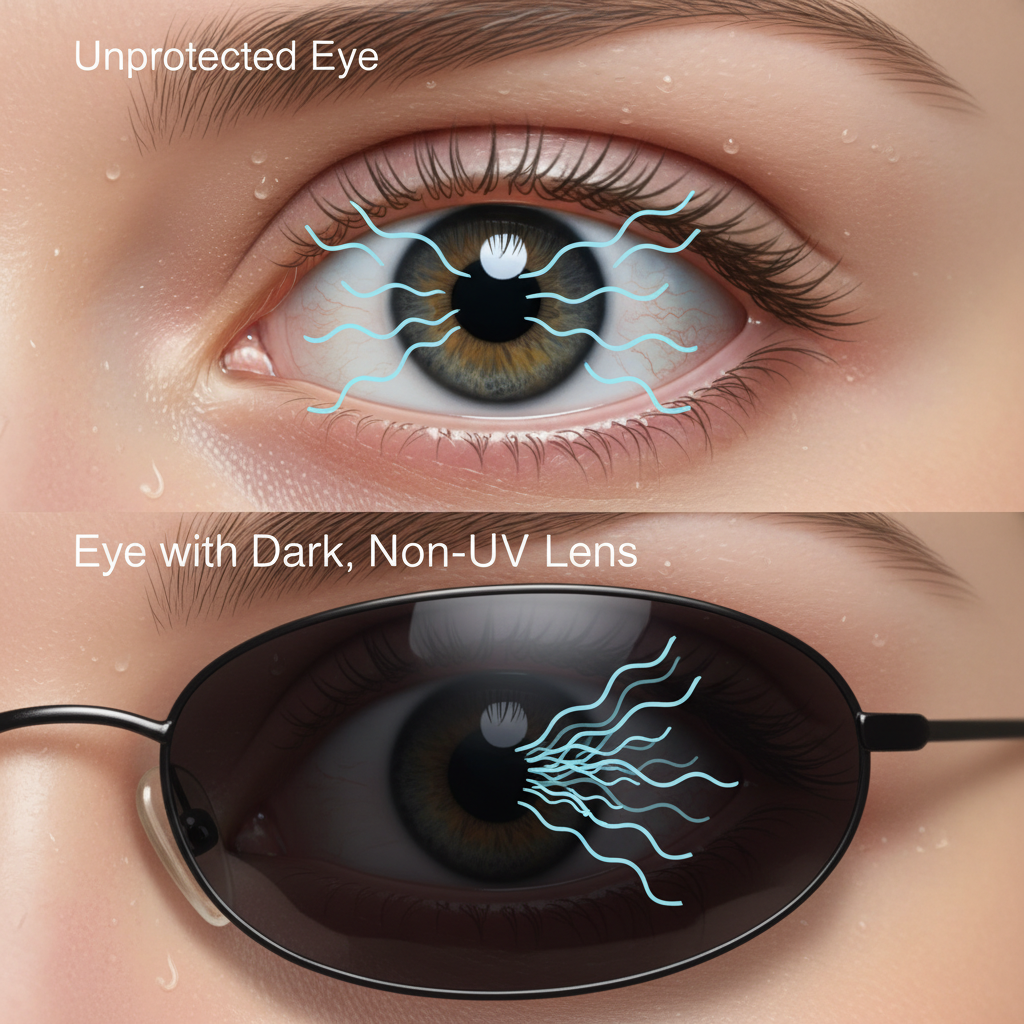
One of the most pervasive and dangerous myths in eyewear is that the darkness of a lens is a reliable indicator of its UV protection. This is fundamentally incorrect. The tint of a lens and its ability to block UV radiation are two separate properties.
The color or tint is designed to reduce the intensity of visible light, making your eyes more comfortable in bright conditions. UV protection, however, comes from a special coating applied to the lenses or from UV-absorbing properties inherent in the lens material itself.
Here’s the danger: wearing dark sunglasses without proper UV protection can be more harmful than wearing no sunglasses at all. As MD Anderson Cancer Center experts warn, dark lenses cause your pupils to dilate to let in more light. If those lenses aren't blocking UV rays, you are effectively opening a wider door for invisible, damaging radiation to enter and harm the sensitive structures inside your eye. This is known as the "Darkness Fallacy."
A study on sunglasses from various markets published in PubMed found that purchasing from unregulated sources significantly increases the risk of getting non-compliant UV filters. This reinforces the idea that verification is more important than appearance. The critical takeaway is to stop judging sunglasses by their color and start verifying their UV rating.
Decoding UV Protection: What "UV400" Really Means
To confidently choose safe sunglasses, it's essential to understand the language of UV protection. Ultraviolet radiation is divided into categories based on wavelength, with UVA and UVB rays posing the most significant threat to eye health.
- UVA (315-400 nm): These long-wavelength rays can penetrate deep into the eye, contributing to the development of cataracts and potentially macular degeneration.
- UVB (280-315 nm): Shorter wavelength rays that are primarily absorbed by the cornea and lens. They are the main cause of "snow blindness" (photokeratitis) and are strongly linked to pterygium (a growth on the eye) and certain eye cancers.
The American Optometric Association (AOA) recommends sunglasses that block 100% of both UVA and UVB rays. The gold standard label to look for is "UV400." This signifies that the lenses block all light rays with wavelengths up to 400 nanometers, which covers the entire spectrum of UVA and UVB rays.
Some older or less stringent standards may only certify protection up to 380 nm. However, as a technical report in PubMed highlights, the 380–400 nm band contains significant energy. A separate analysis by SPIE found that the 280–400 nm range contains 45% more UV energy than the 280–380 nm range. This 20 nm gap is not insignificant, making the UV400 standard a medically necessary benchmark, not just a marketing term.
A Practical Guide to Identifying Safe Sunglasses (Regardless of Price)
Price is not a reliable proxy for safety. A high-priced fashion brand can offer poor protection, while an affordable, purpose-built pair can be excellent. The key is to know what to look for.
1. The Label is Law: Look for UV400
First and foremost, check the label or sticker. According to FDA guidance, sunglasses sold in the U.S. must have accurate labeling. Look for explicit text stating "UV400," "100% UV Protection," or "Blocks 100% of UVA & UVB rays." If this information is missing, leave the sunglasses on the rack. A study on public awareness found that 47% of people who don't wear sunglasses cited "uncertainty in the efficiency of UV protection" as the reason. Verified labels are the first step in bridging this trust gap.
2. Lens Material as a Built-In Safeguard
The material of the lens itself plays a huge role in its inherent UV-blocking capability.
- Polycarbonate: This is a standout choice for affordable and safe eyewear. Polycarbonate material naturally blocks nearly 100% of UV radiation without any extra coatings. It is also lightweight and highly impact-resistant, making it the standard for sports and safety glasses.
- CR-39 Plastic: Standard plastic lenses require a UV-absorbing coating to achieve full protection. While effective, this coating can theoretically scratch or degrade over time. Research has shown that some lenses can lose UV-blocking efficacy after prolonged sun exposure (photobleaching), which is a good reason to consider replacing your sunglasses every few years, a topic we explore in our article on signs your sunglasses' UV defense is fading away.
3. Differentiating Polarization from UV Protection
Many people mistakenly believe that "polarized" is synonymous with "UV protected." As Harvard Health explains, these are two distinct features that solve different problems.
- UV Protection: Blocks invisible ultraviolet radiation to prevent eye disease.
- Polarization: Blocks horizontal light waves, which we perceive as glare from flat surfaces like roads, water, or snow.
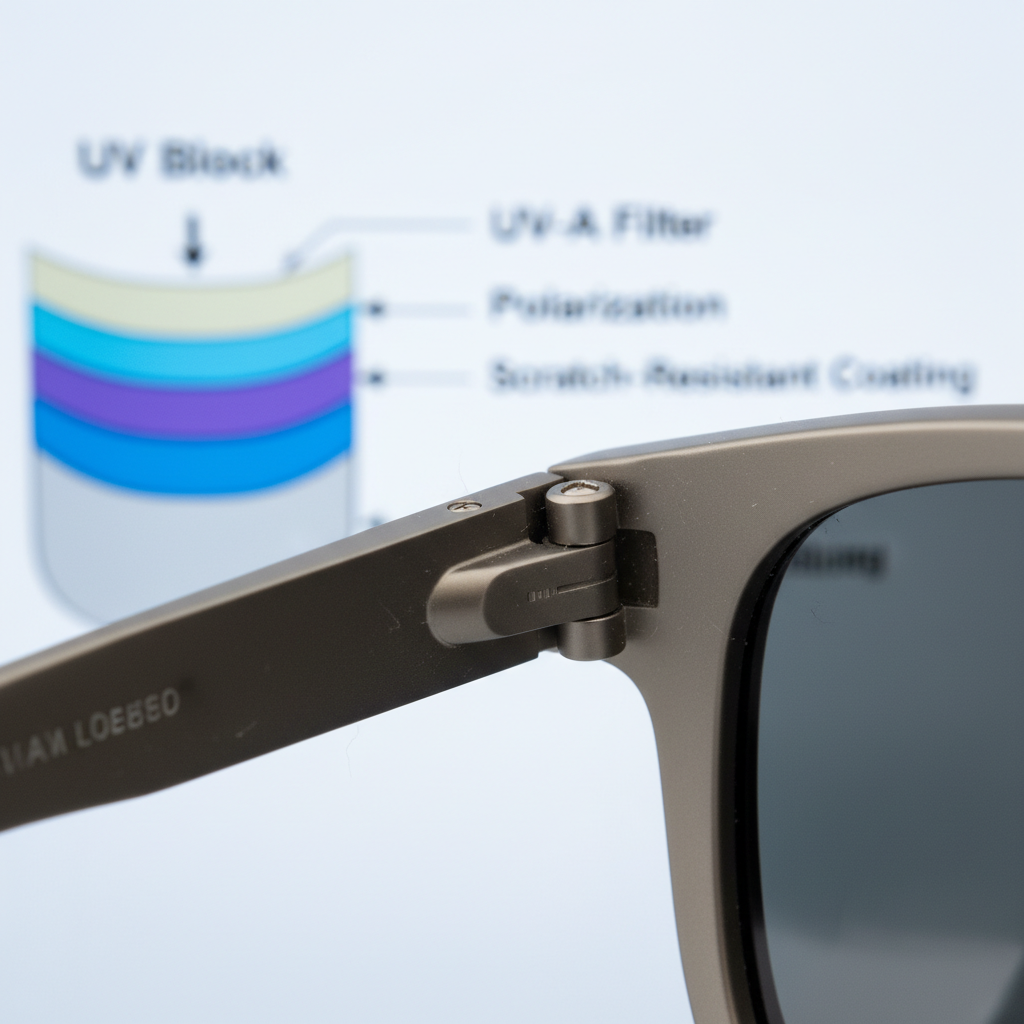
Polarization enhances visual comfort and clarity, but it does not inherently block UV rays. A polarized lens must also be rated for UV400. The "picket fence" analogy is helpful: imagine polarization as a vertical filter that blocks horizontal light waves (glare). UV protection is a separate, invisible chemical shield.
4. The Frame and Hinge Field Test
While the lenses protect you from radiation, the frame is what ensures the glasses are wearable and durable. Inexpensive glasses often fail at the hinges.
- The Hinge Test: A practical test I use is to gently open and close the temples about 50 times. On a poorly made pair, the hinges will quickly become loose, gritty, or wobbly. This signals the use of poor metal alloys or imprecise assembly that won't withstand daily use.
- Frame Geometry: Look for frames that provide ample coverage. The American Academy of Ophthalmology (AAO) recommends oversized or wraparound styles to prevent UV rays from leaking in from the sides, top, and bottom. A study using 3D models found that "middle-sized" sunglasses often offered the least protection due to this peripheral light leakage.
The Real Risks: Optical Clarity and Impact Resistance
Beyond UV protection, the quality of budget sunglasses can falter in two other critical safety areas: optical clarity and impact resistance.
Optical Distortions
Well-made lenses are "optically correct," meaning they don't distort the light passing through them. Poorly manufactured lenses can have waves, ripples, or inconsistencies that force your eyes to constantly refocus, leading to headaches, eye strain, and fatigue.
- The Tile Floor Test: The AAO suggests a simple DIY quality test. Hold the sunglasses at arm's length and look at a straight line, like the edge of a door or floor tiles. Move the glasses slowly from side to side. If the lines bend, wiggle, or distort, the lenses are optically poor and should be avoided.
Impact Resistance: The FDA Mandate
In the United States, all sunglass lenses must comply with the FDA's impact resistance regulations (21 CFR 801.410). This is verified using the "Drop Ball Test," where a 5/8-inch steel ball is dropped from a height of 50 inches onto the lens. The lens must not fracture.
- Why It Matters: This standard is crucial for preventing eye injuries from shattering lenses. A shocking 2011 study published in PubMed found that of online-ordered prescription glasses, 22.7% failed the FDA's impact resistance test. While this study focused on prescription eyewear, it highlights the safety failures that can occur when standards are not met. This is another reason polycarbonate is an excellent choice, as its inherent shatter resistance far exceeds that of standard plastic or glass. For a deeper look at this issue, see our guide on the hidden eye damage from uncertified sunglasses.
Your Eyesight Is Not a Bargain Bin Item
The evidence is clear: a cheap price tag does not automatically mean a pair of sunglasses is unsafe. The determining factor is not cost, but compliance with established safety standards. By focusing on a verified UV400 rating, choosing durable materials like polycarbonate, and checking for optical clarity, you can find affordable sunglasses that provide excellent protection.
Conversely, the greatest danger comes from ignorance—assuming a dark tint is a shield or buying from unverified sources where safety standards are an afterthought. The damage from UV radiation is cumulative and often irreversible, contributing to cataracts, macular degeneration, and cancers of the eye and eyelid. Protecting your vision is a non-negotiable aspect of your long-term health. Armed with the right knowledge, you can make intelligent, cost-effective choices that keep your eyes safe for years to come.
Disclaimer: This article is for informational purposes only and does not constitute professional medical advice. Always consult with a qualified eye care professional for any concerns about your eye health.
References
- MD Anderson Cancer Center. (n.d.). 9 things to know about sunglasses, eye protection and cancer.
- Cole BL. (2003). Solar UV protection by sunglasses. PubMed.
- U.S. Food & Drug Administration. (2023). Impact-Resistant Lenses: Questions and Answers.
- American Academy of Ophthalmology. (n.d.). How to Choose the Best Sunglasses.
- Harvard Health Publishing. (2021). Polarized sunglasses: Protecting your eyes from harmful glare.
- Bakkar, M. M., et al. (2022). Public Awareness of the Harmful Effects of Ultraviolet (UV) Radiation on the Eyes. PMC.
- Masili, M., & Schor, P. (2014). Ultraviolet protection of sunglasses: A review of the Brazilian standards. SPIE.
- Sliney, D. H. (2019). Ocular dosimetry and frame geometry. PMC.


