









How to Clean Sweat & Grime Off Your Lenses
TL;DR: The Quick-Clean Protocol
Don't have time for the details? Here’s the fast track to clean lenses:
Rinse Immediately: Use lukewarm tap water to wash off loose grit and sweat.
Lather Gently: A single drop of lotion-free dish soap between your fingertips is all you need. Gently rub the lenses and frame.
Rinse Again: Wash away all soap residue.
Pat, Don't Rub: Use a clean, folded microfiber cloth to pat the lenses dry. Finish with a single-direction wipe.
Air it Out: Store in a ventilated hard case to let any remaining moisture evaporate.
Following this simple routine after every workout will dramatically extend the life and clarity of your lens coatings.
Why Sweat and Grime Are Lens Killers
To understand the importance of proper cleaning, we first need to look at what you're fighting. Sweat isn't just water; it's a corrosive mix of salt, oils, and acids. When it dries on your lenses, the salt forms sharp, microscopic crystals. Wiping these dry crystals is like rubbing fine-grain sandpaper across your lens coatings, causing micro-abrasions that accumulate over time, creating a permanent haze.
Sunscreen is another major offender. Its oily base is designed to stick to skin, and it does the same to your lenses. The chemicals within some sunscreens can react with and degrade the anti-reflective (AR) and oleophobic (oil-repelling) coatings that are essential for clear vision. According to a study from the University of Utah, protective coatings can be scratched off, and aggressive cleaning or abrasive grime is a primary culprit. This damage is irreversible and compromises not just your view, but the protective qualities of the lens itself.
Maintaining the integrity of your lenses is a critical aspect of eye safety. A report on sports eyewear standards highlighted that a significant portion of serious ocular injuries from sports are preventable, much like occupational hazards. Clear, unobstructed vision is your first line of defense in avoiding impacts, and a lens that is hazed, scratched, or smeared cannot provide that.
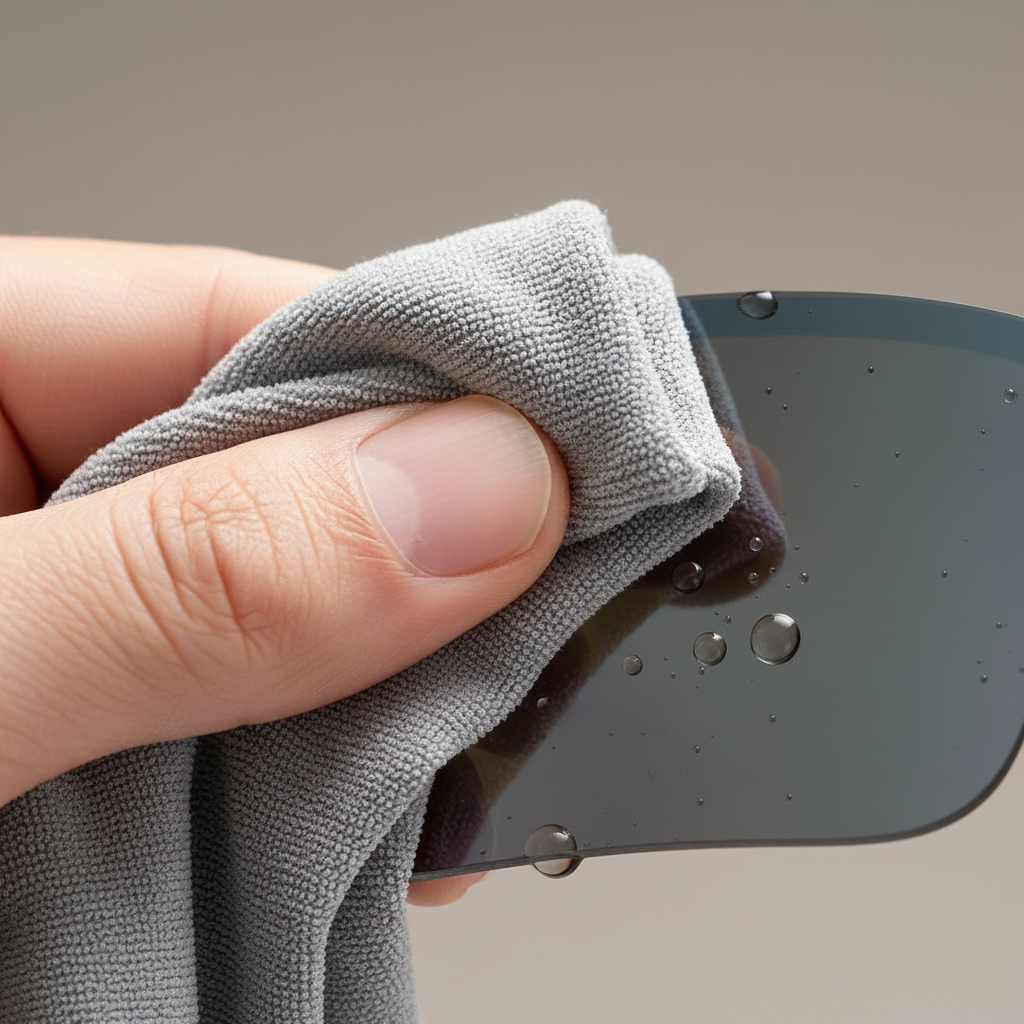
The Ultimate Step-by-Step Guide to Cleaning Your Sports Sunglasses
I’ve seen countless pairs of high-performance sunglasses ruined by well-intentioned but incorrect cleaning habits. The goal is to remove contaminants without harming the delicate coatings. This method is safe, effective, and uses items you already have.
What You'll Need:
Lukewarm Running Water: Hot water can damage some lens coatings over time. Cold water is less effective at breaking down oils.
Lotion-Free Liquid Dish Soap: Choose a simple, neutral soap. Soaps with lotions or moisturizers will leave behind a greasy film.
Clean, Lint-Free Microfiber Cloths: Have at least two on hand. One for drying, and one for a final polish if needed. Never use a cloth that has been washed with fabric softener, as it leaves a residue that causes smearing.
The Cleaning Protocol
Follow these steps immediately after a workout or any time your sunglasses are exposed to sweat, sunscreen, or dirt.
Initial Rinse (The Most Important Step): Hold the glasses under a gentle stream of lukewarm water. This crucial first pass removes salt crystals, dust, and other abrasive particles before you ever touch the lens surface. Don't skip this; it’s your best defense against scratches.
Gentle Lather and Wash: Place one small drop of lotion-free dish soap on your fingertip. Add a little water and lather it up. Gently apply the soapy water to the lenses, frame, nose pads, and temple arms. Use only your fingertips to rub the surfaces. The entire process of soap application and washing should be brief—no more than 30 seconds of soap contact.
Thorough Final Rinse: Rinse the sunglasses completely under lukewarm water. Ensure all traces of soap are gone, as leftover residue can cause streaks. Pay special attention to the areas where the lenses meet the frame and around the nose pads.
The Correct Drying Technique: Gently shake the glasses to remove excess water. Take a clean, completely dry microfiber cloth and fold it into a flat pad. Pat the lenses dry. Do not rub or use circular motions, as this can drag any remaining micro-particles across the lens. Once patted dry, you can perform a final, gentle wipe in a single direction (e.g., from the nose bridge outwards) to remove any last water spots.
Proper Storage: If possible, let the glasses air dry completely before storing. Place them in a hard-shell case with ventilation. Avoid soft pouches when the glasses are damp, as they can trap moisture against the lenses, which may encourage coating delamination over time.
Common Mistakes That Destroy Lenses: A Troubleshooting Guide
A common myth is that you need special, expensive cleaners. In reality, the simplest method is often the safest. The biggest threat to your lenses isn't the sweat; it's the mistakes made while trying to remove it. Avoiding these common pitfalls is just as important as the cleaning process itself.
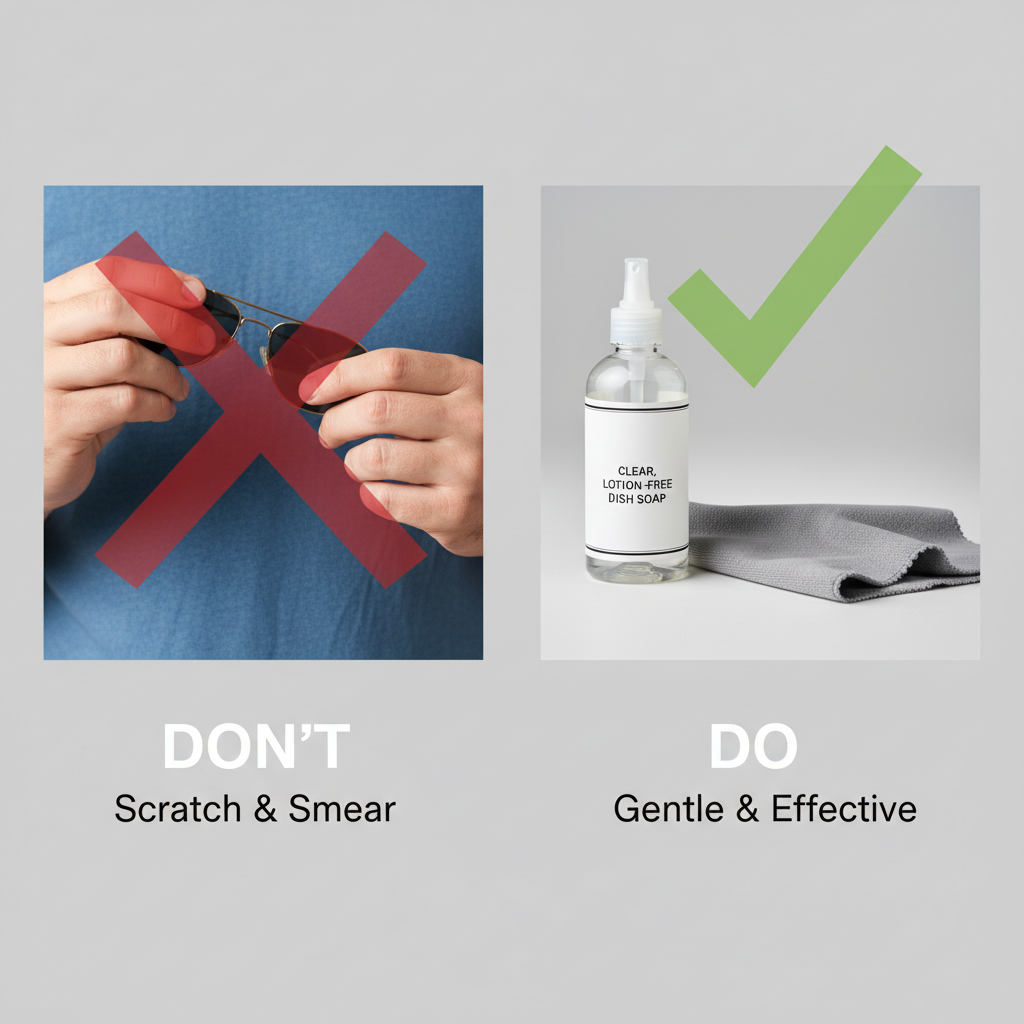
Here’s a breakdown of what not to do.
| Action to Avoid | Why It's Damaging |
|---|---|
| Wiping with Your T-Shirt or a Paper Towel | Clothing fabric, even soft cotton, has abrasive fibers that scratch lenses. Paper towels and tissues are made from wood pulp and are notorious for causing micro-abrasions. |
| Using Hot Water | Extreme heat can cause the various layers of a lens coating to expand and contract at different rates, potentially leading to cracking or peeling of the anti-reflective treatment. |
| Using Window Cleaner or Cleaners with Alcohol/Ammonia | These harsh chemicals are solvents designed to strip away grease and grime, and they will do the same to your lens coatings. This is one of the fastest ways to ruin a pair of glasses. |
| Dry Wiping When the Lens is Dirty | This is the cardinal sin of lens care. You are simply grinding the salt, dust, and dirt directly into the lens surface, guaranteeing scratches. Always rinse with water first. |
| Scrubbing in a Circular Motion | This technique doesn't "buff out" smudges. Instead, it just swirls any remaining particles around, maximizing the surface area for potential scratches. Single-direction wipes are safer. |
| Leaving Them on Your Car's Dashboard | The intense, focused heat inside a car can warp plastic frames and cause lens coatings to break down, a process known as crazing. |
Expert Warning: When Is the Damage Done?
Even with perfect care, high-performance eyewear has a finite lifespan, especially for athletes who use it daily. The coatings on your lenses are incredibly thin and are subject to degradation from environmental factors.
A technical analysis published by SPIE, the international society for optics and photonics, found that some lenses can experience a reduction in their UV-blocking efficacy after prolonged exposure to simulated solar radiation. This process, known as photobleaching, means that over time, your lenses may offer less protection than they did when new. This is why replacing heavily used sports sunglasses every couple of years is a prudent safety measure.
How can you tell if your lenses are permanently damaged? Look for these signs:
A Persistent Haze: If your lenses look foggy or hazy even after a thorough cleaning, the coating has likely been compromised by thousands of micro-scratches.
Rainbow Streaks or Oily Sheen: When you look at the lens from an angle, you might see a rainbow-colored or oily-looking pattern that won't wipe away. This is often a sign of coating delamination.
Constant Smearing: If fingerprints and smudges seem impossible to remove and just smear around, your oleophobic (oil-repelling) coating has likely worn off.
If you notice these issues, it's time to replace the lenses or the sunglasses. Attempting to "polish" or "buff" the damage away at home will only worsen the optical distortion. For maintaining optimal vision and safety, especially in high-speed sports, investing in a new pair with intact coatings is the correct choice. When considering a new pair, it's helpful to understand what goes into a quality lens, including the crucial differences between basic dark tints and advanced UV coatings.
Frequently Asked Questions (FAQ)
Q: How often should I clean my sports sunglasses?A: Ideally, you should perform a full rinse-and-wash cycle after every use where they are exposed to significant sweat or sunscreen. For casual wear, a daily or every-other-day cleaning is sufficient.
Q: Can I use pre-moistened lens wipes?A: Use them with caution. Some wipes contain high concentrations of alcohol that can damage coatings. If you use them, check the ingredients and opt for alcohol-free versions. More importantly, never use a wipe on a lens that has salt or grit on it. Always rinse the lens with water first, even if you plan to use a wipe.
Q: What about anti-fog sprays?A: Anti-fog sprays can be effective, but they work by applying a new, temporary hydrophilic coating on the lens. Some formulations may react poorly with the factory-applied anti-reflective or oleophobic coatings. If you need to use one, always do a small patch test on a corner of the lens first to ensure there is no adverse reaction.
Q: Does it matter what kind of microfiber cloth I use?A: Yes. Use a high-quality, dense-weave cloth specifically designed for optical surfaces. Keep it clean by hand-washing it with a drop of dish soap and letting it air dry. Never use fabric softener, as it will leave a chemical residue on the cloth that transfers to your lenses and causes smearing.
Disclaimer: This article is for informational purposes only and does not constitute professional medical advice. Consult with a qualified eye care professional for any concerns about your vision or eye health. Proper care of your eyewear is essential for safety, but it is not a substitute for regular eye examinations.
References
University of Utah Health. "How to Tell If Your Sunglasses Are Really Protecting Your Eyes." https://healthcare.utah.edu/healthfeed/2023/06/how-tell-if-your-sunglasses-are-really-protecting-your-eyes
Review of Sports Eyewear Protective Standards. PubMed, https://pubmed.ncbi.nlm.nih.gov/26875849/
SPIE. "UV protection provided by sunglasses: a review of the Brazilian standard, the ISO 8980-3 and the ANSI Z80.3 standards." https://ui.adsabs.harvard.edu/abs/2014SPIE.8930E..1EM/abstract


