









Do I Need a Different Reading Power for Each Eye?
TL;DR: When Your Eyes Don't Agree
- Yes, it is very common to need a different reading power for each eye. The official term for this is anisometropia.
- Over-the-counter (OTC) or "drugstore" readers have the same power in both lenses. If your eyes have different needs, these can cause eye strain, headaches, and persistent blurriness.
- This difference can be due to one eye being more nearsighted or farsighted than the other, or having a different level of astigmatism.
- The only way to know your exact needs for each eye is through a comprehensive eye exam.
- With a valid prescription, you can order custom-made reading glasses that provide clear, comfortable vision by correcting each eye individually.
It’s a familiar story: you notice that text messages are getting blurry and the words in your book seem to be shrinking. You pick up a pair of reading glasses from the local pharmacy, and while they help, something still feels off. One eye might see perfectly, while the other remains slightly out of focus. If this sounds like you, you’re not alone, and there’s a clear reason for it.
Many people discover that their eyes have different vision needs. This article explains why a one-size-fits-all approach to reading glasses might not be working for you and outlines the path to getting a perfectly tailored solution for comfortable, sharp near vision.
Why Your Eyes Can Have Different Needs
Just as you might have one foot that’s a slightly different size than the other, it’s extremely common for your eyes to have different refractive powers. This condition, known as anisometropia, is often the reason why generic reading glasses feel uncomfortable or ineffective.
According to medical experts at the Cleveland Clinic, a prescription shows these differences clearly. Your right eye (OD) and left eye (OS) can have distinct values for Sphere (SPH), Cylinder (CYL), and Axis, which correct for nearsightedness, farsightedness, and astigmatism, respectively.
When it comes to reading, another factor comes into play: presbyopia. As defined in the National Center for Biotechnology Information's medical library, presbyopia is the normal, age-related loss of the eye's ability to focus on nearby objects. This hardening of the lens inside your eye doesn't always progress at the exact same rate in both eyes, leading to a need for different levels of correction.
The Problem with One-Size-Fits-All Readers
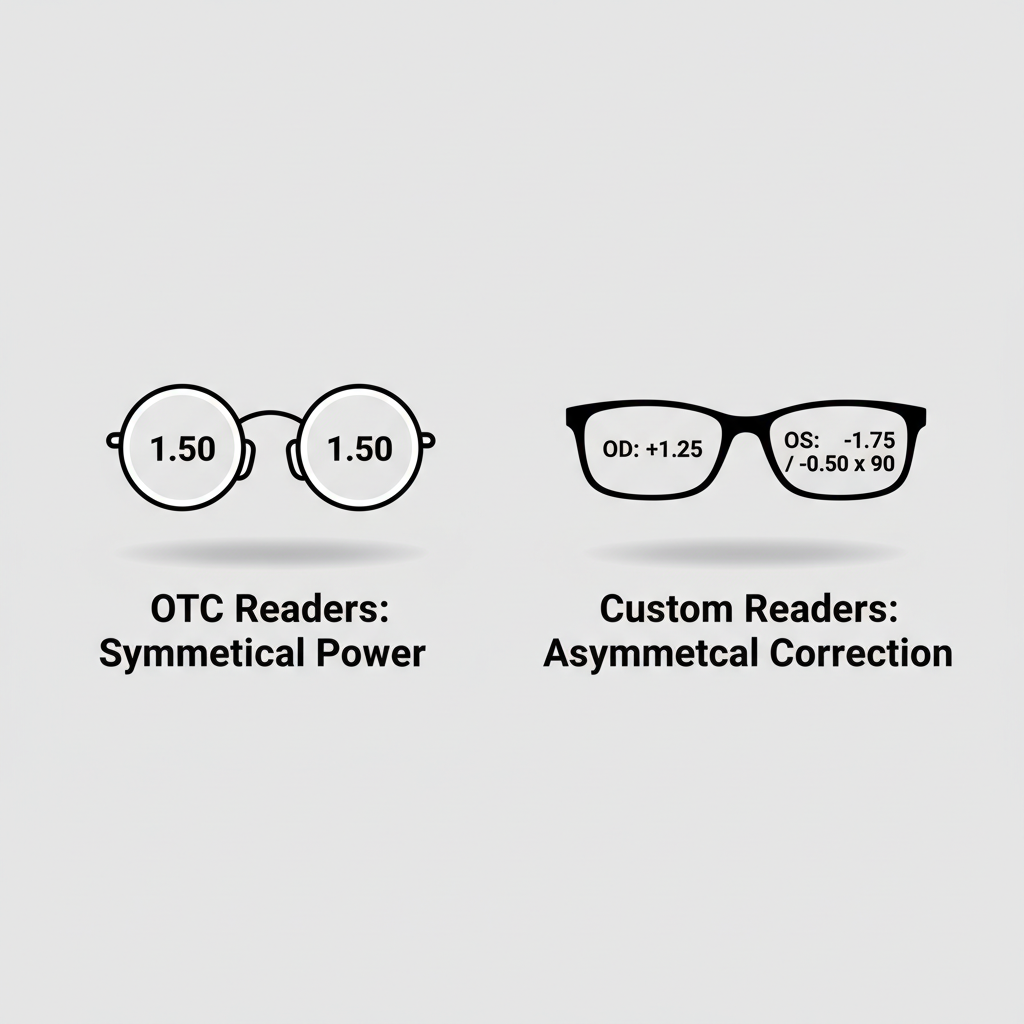
Over-the-counter (OTC) reading glasses are mass-produced with a simple assumption: that both of your eyes need the exact same level of magnification. They have identical spherical power in each lens (e.g., +1.50 in both the right and left) and offer no correction for astigmatism.
As the American Academy of Ophthalmology (AAO) points out, this is a significant limitation. If you have even a small amount of astigmatism or a difference in power between your eyes, OTC readers cannot provide optimal clarity. While a minor difference of less than 0.50 diopters might not be noticeable, practitioners find that a discrepancy of 0.75 diopters or more often leads to uncomfortable symptoms.
Debunking a Common Myth: "A Little Blurriness is Normal"
The Myth: Many people assume that experiencing some eye strain, mild headaches, or slight blurriness is just a normal part of wearing reading glasses.
The Reality: While any new pair of glasses can have a short adaptation period, persistent discomfort is not normal. It's a clear signal that the glasses are not a good match for your eyes. Forcing your brain to merge two different images—one clear and one blurry—is taxing. This can lead to significant visual fatigue, making reading and other near-tasks a chore instead of a pleasure. It's a problem that won't go away by "pushing through it."
OTC Readers vs. Custom Prescription Readers: A Comparison
To make an informed choice, it helps to see the differences laid out clearly. Here’s how generic and custom glasses stack up:
| Feature | Over-the-Counter (OTC) Readers | Custom Prescription Readers |
|---|---|---|
| Lens Power | Identical in both eyes (e.g., +2.00) | Specific to each eye's needs (e.g., OD +1.75, OS +2.25) |
| Astigmatism Correction | None | Precisely corrects for Cylinder (CYL) and Axis values. |
| Pupillary Distance (PD) | Based on a population average; not customizable. | Measured for your unique facial geometry for perfect alignment. |
| Optical Center | Fixed in the geometric center of the lens. | Aligned precisely with your pupils to prevent induced prism and strain. |
| Best For | Individuals with very similar vision in both eyes and no astigmatism. | Anyone with different powers (anisometropia), astigmatism, or a high prescription. |
| Common Issues | Can cause eye strain, headaches, and blurry vision if your eyes differ. | Requires a prescription and may have a higher initial cost. |
How to Get the Right Correction for Each Eye
If you suspect your eyes have different needs, the solution is straightforward and puts you in control of your visual health. It involves moving from guesswork to precision.
Step 1: Get a Professional Eye Exam
This is the single most important step. An optometrist or ophthalmologist will perform a comprehensive exam to determine the exact prescription for each of your eyes. This includes not only the power needed for distance but also the "ADD" power required for reading. It is crucial to distinguish a simple refractive error like presbyopia from more serious conditions. As experts at Johns Hopkins Medicine explain, vision loss that isn't correctable with standard glasses could be a sign of a more serious issue that requires medical attention.
Step 2: Know Your Rights and Get Your Prescription
After your exam, your eye doctor is required by law to provide you with a copy of your prescription. The FTC's Eyeglass Rule ensures you can take that prescription to buy glasses from any retailer you choose. This empowers you to find a solution that fits your budget and style without being tied to a single vendor. For more details, you can read our simple guide to understanding your eyeglass prescription.
Step 3: Measure Your Pupillary Distance (PD)
Your prescription is only half of the equation. For custom glasses to work perfectly, the optical center of each lens must align with the center of your pupil. This measurement is your Pupillary Distance (PD). For reading glasses, it's important to have an accurate near PD, which is typically 2-4 mm smaller than your distance PD. Using the wrong PD can cause eye strain, just like an incorrect power. You can learn how to measure your PD at home for a perfect fit.
Your Path to Clear, Comfortable Reading
Navigating the world of reading glasses can seem confusing, but it doesn't have to be. If you're struggling with uneven vision, follow this simple path to get the relief you need.
- Acknowledge Your Symptoms: Don't dismiss headaches, eye strain, or uneven blurriness as "normal."
- Skip the Guesswork: If OTC readers aren't providing crisp, comfortable vision, it's time for a better solution.
- Schedule an Eye Exam: This is the foundation for getting the right correction.
- Order Custom Glasses: Use your prescription and accurate PD to order a pair of reading glasses made just for you.
- Allow for Adaptation: Give your brain a few days to adjust to the new, clearer picture. If things still feel off, it's important to know what to do when your new prescription feels wrong.
By taking these steps, you can trade visual discomfort for effortless clarity, making reading a joy again.
Frequently Asked Questions (FAQ)
Is it normal to need different powers for reading? Yes, it is very common. Most people have some degree of difference between their two eyes, and this can become more noticeable when presbyopia develops.
How much of a difference between eyes is considered significant? While any difference can be corrected with a prescription, practitioners generally find that a power difference of 0.75 diopters or more is when people start to experience noticeable symptoms like eye strain, blur, or headaches with non-prescription glasses.
Can I just buy two pairs of drugstore readers and swap the lenses? This is not recommended. Besides being difficult, the optical centers of the lenses would not be aligned with your pupils, which can create its own set of problems and lead to more eye strain.
What if my distance vision is perfect but my reading vision feels uneven? This is a classic sign of presbyopia affecting your eyes slightly differently. Even if you don't need glasses for driving or watching TV, you may need custom reading glasses with a different power in each lens for close-up tasks.
Disclaimer: This article is for informational purposes only and does not constitute professional medical advice. The information provided is not a substitute for a comprehensive eye exam or a consultation with a qualified healthcare provider. Always seek the advice of your optometrist or ophthalmologist with any questions you may have regarding a medical condition or vision needs.


