



Does Everyone Eventually Need Reading Glasses?
TL;DR: Does Everyone Need Reading Glasses?
Yes, almost everyone will eventually need reading glasses. This is due to a natural, age-related eye condition called presbyopia, which typically begins in your early to mid-40s. It's not a disease, but a normal part of aging where the eye's natural lens becomes less flexible, making it hard to focus on close-up objects. This guide explains why it happens, how to find the right strength, and the difference between over-the-counter readers and custom prescription glasses.
It’s a moment many people experience. The font on a menu, phone screen, or book seems to have mysteriously shrunk. You find yourself holding things at arm's length to bring the words into focus, an action often called the "trombone effect." If this sounds familiar, you are likely encountering the first signs of presbyopia, a completely normal and near-universal change in vision.
The need for reading glasses is not a sign of poor eye health but rather a natural milestone. This article will demystify this process, explaining what happens to your eyes, how to determine if you need reading support, and how to select the right power for clear, comfortable vision.
What Is Presbyopia and Why Does It Happen?
Presbyopia is the gradual loss of your eyes' ability to focus on nearby objects. According to the National Eye Institute (NEI), this condition is a natural part of aging. Inside our eye, a clear lens works to change shape to focus light onto the retina, allowing us to see. When we are young, this lens is soft and flexible.
Starting around age 40, the lens begins to harden and lose its elasticity. As this happens, it can no longer change shape as easily to focus on close-up images. The result is blurry near vision. This process affects billions of people worldwide, with a study on the global prevalence of presbyopia highlighting it as the most common cause of vision impairment in middle-aged and older adults.
It’s important to distinguish presbyopia from farsightedness (hyperopia). While both can cause blurry near vision, farsightedness is a refractive error often present from a young age, caused by the shape of the eyeball. Presbyopia, on the other hand, is a functional issue caused by the aging of the lens.

The Telltale Signs You Might Need Reading Glasses
Symptoms of presbyopia develop gradually. According to the Mayo Clinic, you may be developing presbyopia if you notice:
- A tendency to hold reading material farther away to make the letters clearer.
- Blurred vision at a normal reading distance.
- Headaches or eye strain after reading or doing other close-up work.
- Needing brighter lighting when reading or doing close work.
- Squinting to see nearby objects.
If you find yourself nodding along to this list, it may be time to consider reading glasses.
A Practical Guide to Selecting Your First Pair
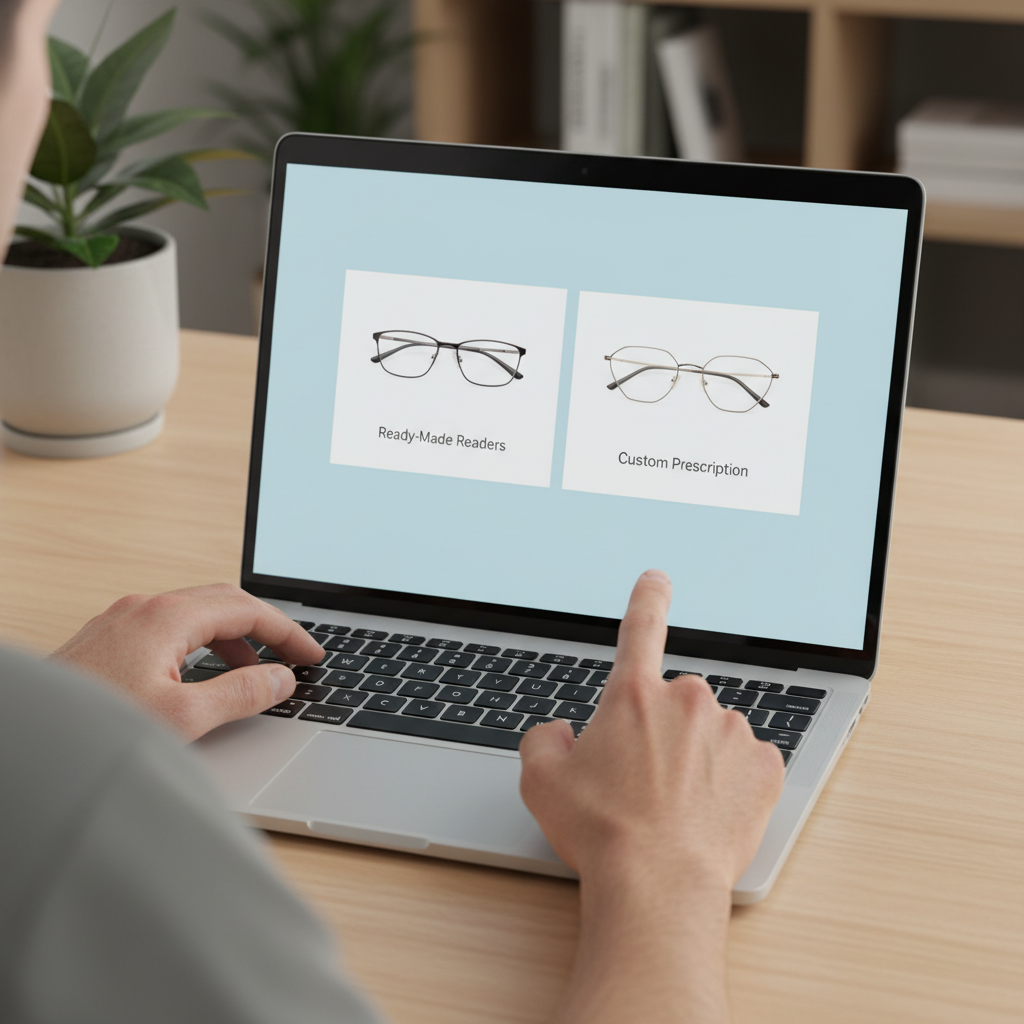
Choosing your first pair of reading glasses can feel daunting, but it doesn’t have to be. The first step is understanding the difference between the ready-made glasses at the drugstore and a custom pair ordered online or from an optician.
Debunking a Common Myth: Do Reading Glasses Weaken Your Eyes?
Let's clear this up immediately: wearing reading glasses will not make your vision worse or make your eyes "dependent" on them. Presbyopia is a progressive condition, meaning the lens will continue to lose flexibility over time regardless of whether you wear glasses. Reading glasses are simply a tool that compensates for this change, allowing you to see clearly and reduce eye strain. They help your eyes, they don't harm them.
Over-the-the-Counter (OTC) Readers vs. Custom Prescription Glasses
For many, ready-made "cheaters" from a drugstore are a convenient first step. However, they have significant limitations. As the American Academy of Ophthalmology (AAO) points out, OTC readers are essentially "one-size-fits-all." They have the same power in both lenses and do not correct for astigmatism, a common condition where the eye's cornea is irregularly shaped.
| Feature | Over-the-Counter (OTC) Readers | Custom Prescription Reading Glasses |
|---|---|---|
| Lens Power | Identical power in both lenses. | Specific power for each individual eye. |
| Astigmatism Correction | None. Can cause blurriness and headaches if you have astigmatism. | Precisely corrects for astigmatism (CYL and Axis values). |
| Pupillary Distance (PD) | Based on an average PD; can cause eye strain if your PD is different. | Made to your exact PD, ensuring the optical center is perfectly aligned. |
| Lens Quality & Coatings | Basic lenses; may lack anti-reflective or scratch-resistant coatings. | Can be customized with advanced coatings for reduced glare, and durability. |
| Use Case | Best for short-term use if you have no astigmatism and the same power in both eyes. | Ideal for all-day comfort, computer use, and anyone with astigmatism or different prescriptions in each eye. |
If you experience headaches with OTC readers, it may be due to uncorrected astigmatism or an incorrect pupillary distance. For a truly comfortable fit, especially if you spend hours reading, a custom pair is often the superior choice. If you're concerned about accuracy, understanding that even a small PD error can matter for online glasses is key.
Pro Tip: How to Choose the Right Power
Reading glass power is measured in units called diopters (D). The higher the number, the stronger the lens. While age can provide a starting point, a more accurate method involves your personal working distance.
-
Age-Based Estimate:
- Age 40-45: +0.75 to +1.25 D
- Age 45-50: +1.25 to +1.75 D
- Age 50-55: +1.75 to +2.25 D
- Age 55+: +2.25 to +3.00 D
-
Working Distance Method (More Accurate): As opticians often advise, your ideal power depends on how far you hold your reading material. Most people read a book or phone at about 14-16 inches (35-40 cm). When trying on glasses, pick a pair that brings text at your preferred distance into sharp, comfortable focus. It’s often best to start with a lower power (e.g., +1.00 or +1.25) and only increase if necessary. Using a lens that is too strong can cause as much discomfort as one that is too weak.
Many people also benefit from multiple pairs, such as a lower-power pair for computer work (at a farther distance) and a slightly stronger pair for reading books up close.
When to See a Doctor: Beyond Simple Reading Glasses
While presbyopia is a normal part of aging, a comprehensive eye exam is crucial. An optometrist or ophthalmologist can confirm you have presbyopia and rule out more serious eye conditions.
It's important to distinguish between the normal vision changes of aging and "low vision." According to Johns Hopkins Medicine, low vision is a significant visual impairment that isn't correctable with standard glasses, often caused by conditions like macular degeneration or glaucoma. If your vision changes are sudden, include dark spots, or are not helped by reading glasses, see an eye doctor immediately.
Your eye doctor will provide you with a full prescription. Thanks to the FTC's Eyeglass Rule, your eye care provider must give you a copy of your prescription at the end of your exam, whether you ask for it or not. This gives you the freedom to purchase your glasses from anywhere you choose, including online retailers where you can often find more affordable and stylish options.
For those with more complex needs, such as a strong prescription, modern lens technology can create thinner, more attractive lenses. You no longer have to worry about whether strong prescription lenses will distort your eyes.
Key Takeaways
- It's Normal: Needing reading glasses is a universal experience caused by presbyopia, a natural aging of the eye's lens.
- Start Simple: If you're in your early-to-mid 40s, a low-power (+0.75 to +1.25 D) pair of readers is a great starting point.
- Custom is Often Better: For astigmatism, different power needs in each eye, or significant screen time, a custom prescription pair offers superior comfort and clarity.
- Get Checked Out: Regular eye exams are essential to monitor your vision and rule out serious health issues.
Embracing reading glasses is about equipping yourself with the right tool to continue enjoying the activities you love, from reading a great book to scrolling through photos on your phone, with perfect clarity.
Frequently Asked Questions (FAQ)
1. Can I wear my reading glasses all day? Reading glasses are designed for near vision. If you only need them for reading, wearing them to look across the room will make distant objects appear blurry. If you need vision correction for both distance and near, you might consider progressive or bifocal lenses.
2. What's the difference between reading glasses and computer glasses? Computer glasses are optimized for an intermediate distance—the distance to your computer screen, which is typically 20-25 inches away. This distance requires a lower power than standard reading glasses, which are for closer distances (14-16 inches). Using the wrong power can lead to eye strain.
3. I bought drugstore readers but they give me a headache. Why? This is a common issue. It could be because the power is wrong for you, you have uncorrected astigmatism, or the pupillary distance (PD) of the glasses doesn't match your own. A custom pair made to your exact prescription and PD would likely solve this.
Disclaimer: This article is for informational purposes only and does not constitute professional medical advice. Please consult with a qualified optometrist or ophthalmologist for a comprehensive eye exam and to address your specific vision needs, especially if you have pre-existing conditions or experience sudden changes in vision.


