








Do Virtual Try-On Tools for Glasses Actually Work?
TL;DR: Do Virtual Try-On Tools Work?
Yes, Virtual Try-On (VTO) tools are incredibly effective for choosing a style, shape, and color that complements your face. However, they are not a substitute for a precise Pupillary Distance (PD) measurement, which is essential for visual clarity and comfort. For a successful online purchase, use VTO to find your look and a separate tool to measure your PD accurately.
Virtual Try-On (VTO) technology has changed how we shop for eyewear. The ability to see how hundreds of frames look on your face without leaving your home is a major advantage. But it also raises a critical question: Can a tool on your phone or computer really ensure your new glasses will fit and function correctly?
The answer is a nuanced one. While VTO is a fantastic tool for aesthetic choices, it’s only one part of a successful online eyewear purchase. Understanding what this technology does well—and what it can't do—is the key to getting a pair of glasses you'll love. This guide breaks down the science behind VTO, its limitations, and the steps you must take to guarantee a perfect fit.
How VTO Brings the Optical Store to Your Screen
At its core, VTO uses your device’s camera and sophisticated software to create a digital version of the in-store mirror. It maps your key facial features—like your eyes, nose, and the width of your face—to overlay a pair of frames onto your image in real-time.
The Technology Behind the Digital Mirror
Most modern VTO systems use augmented reality (AR) to create a realistic, 3D preview. This is far more advanced than older, 2D systems that simply placed a flat image of glasses over your picture. A 3D VTO tool allows you to turn your head from side to side, giving you a much better sense of the frame’s size, proportions, and how they sit on your face.
This technology excels at answering the big questions of style:
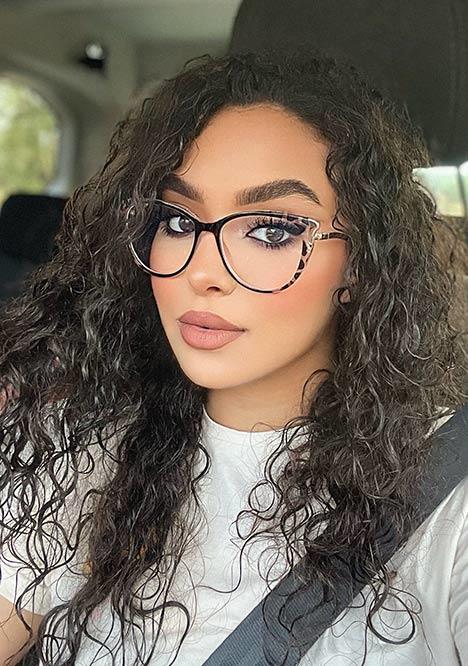
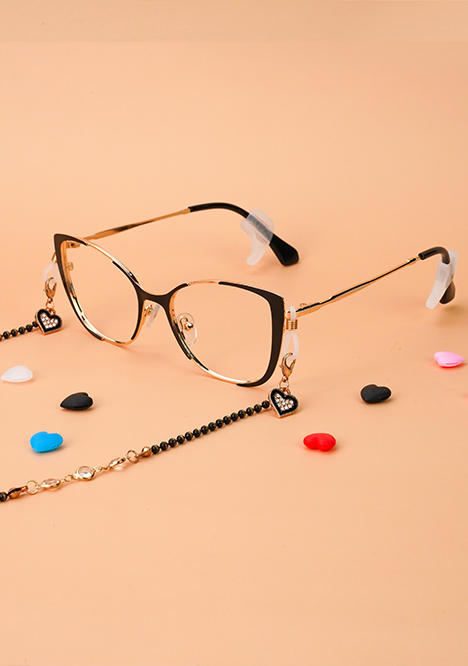
Frame Shape: Do these cat-eye frames complement my jawline? Are these round frames too wide?
Color and Material: Does this tortoiseshell pattern work with my skin tone? Is the metal finish too shiny?
Overall Proportions: Do the frames overwhelm my face or fit its scale?
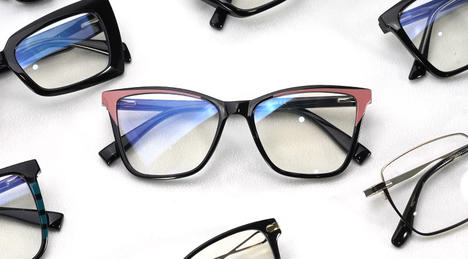
For narrowing down your choices from an aesthetic standpoint, VTO is an invaluable tool. It lets you experiment with bold styles you might otherwise be hesitant to try in a physical store.
The Measurement VTO Can't Guess: Your Pupillary Distance
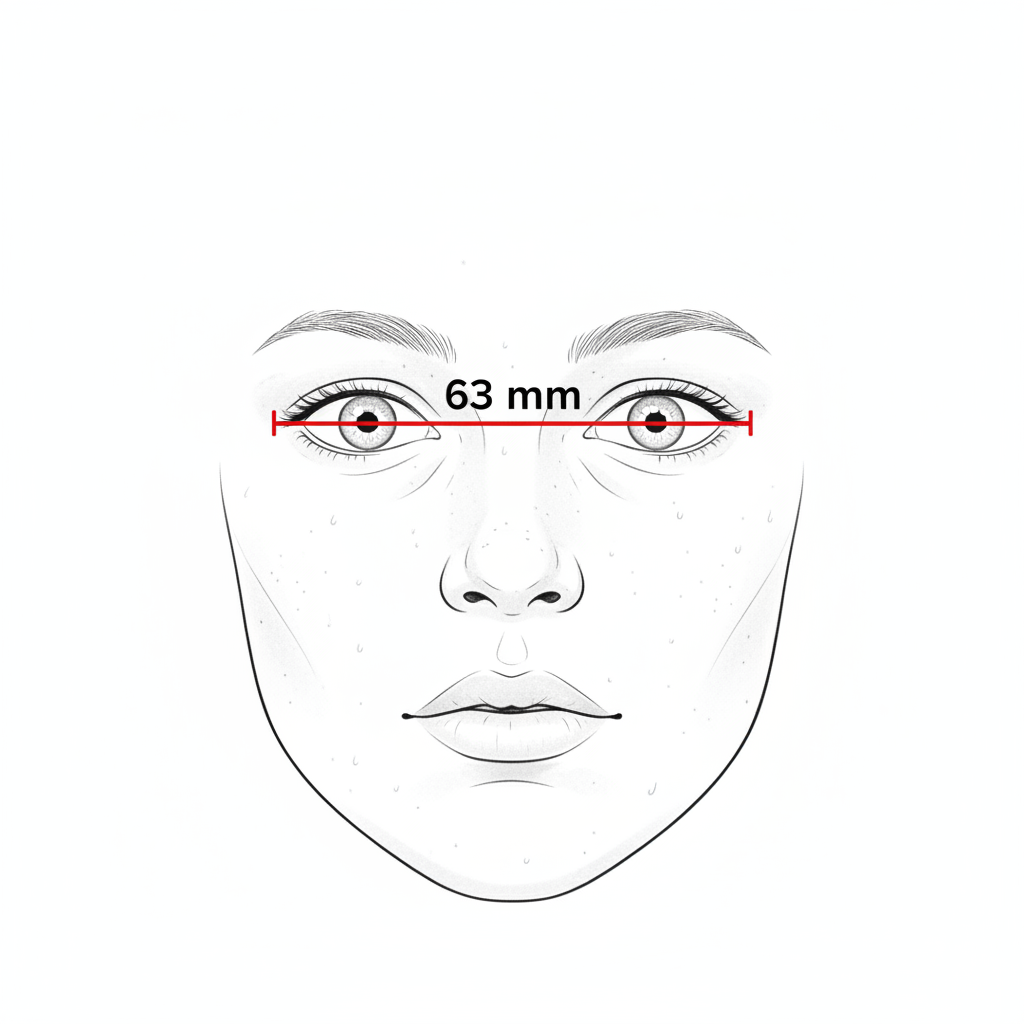
Here is where we move from style to science. The single most important measurement for your prescription glasses is your Pupillary Distance (PD). As the Cleveland Clinic explains, the PD is the distance in millimeters between the centers of your pupils. This measurement dictates where the optical center of your lenses should be placed. If the optical center is misaligned, you can experience eye strain, headaches, and distorted vision.
Why Your PD Might Be Missing From Your Prescription
Under the Federal Trade Commission's Eyeglass Rule, your eye doctor is legally required to provide you with a copy of your prescription immediately after your exam. However, the rules do not always compel them to include your PD measurement on that prescription. This can create a frustrating hurdle for consumers who want to take that prescription and shop online.
Fortunately, measuring your PD at home is straightforward and reliable if you follow the correct procedure.
How to Measure Your Pupillary Distance Accurately
Getting a precise PD measurement is critical. From my experience helping people order glasses online, the following steps are crucial for avoiding common errors. Aim for an accuracy of ±2 millimeters for single-vision lenses and an even tighter ±1 millimeter for multifocal lenses.
Checklist for an Accurate At-Home PD Measurement:
Find Good, Diffused Light: Stand in a room with plenty of natural, indirect daylight. Avoid harsh backlighting or shadows falling across your face.
Position Your Camera Correctly: Use your phone or a webcam. Hold it at eye level, approximately 1 to 1.2 meters (about 4 feet) away. Do not tilt the phone up or down.
Maintain a Neutral Expression: Look directly into the camera. Do not squint, smile widely, or raise your eyebrows, as this can shift your facial muscles and alter the measurement. Relax your face.
Use an Object for Scale: For tools that require a reference object, a standard magnetic-strip credit card is the ideal size. Hold it flat against your forehead or just below your nose.
Take Multiple Readings: Capture the measurement three times to ensure you get a consistent result. If the numbers vary widely, re-evaluate your setup and try again.

From Virtual to Reality: Ensuring a Perfect Fit
While VTO is excellent for checking the look of your frames, it can't tell you how they will feel. It cannot simulate the weight of the material, the pressure of the temple arms on the side of your head, or how the nose pads will rest.
Expert Warning: The Risk of Inaccurate Online Orders
It's important to approach online eyewear purchases with a critical eye. A study published in the journal Optometry and Vision Science found that a significant percentage of glasses ordered online did not meet required optical standards or impact resistance tests. This wasn't an issue with the prescription itself, but rather with the manufacturing and quality control process.
This finding underscores the importance of choosing a reputable online retailer that is transparent about its manufacturing process and has a clear, fair return policy. The risk is not in the online model itself, but in providers who prioritize low cost over quality standards.
Pro Tip: Special Considerations for Strong Prescriptions
If your prescription is stronger than ±4.00 diopters in either eye, another factor comes into play: vertex distance. This is the distance between the back of the eyeglass lens and the front of your cornea. A small change in this distance can affect how the prescription works.
While VTO can show you the frame shape, it won't accurately model the lens thickness or edge profile that comes with a strong prescription. When ordering, it is often a good idea to select a high-index lens material, which is thinner and lighter, to ensure a better cosmetic appearance and a more comfortable fit.
Wrapping Up: Making Virtual Try-On Work for You
Virtual Try-On tools are a reliable and highly useful part of the online glasses-buying journey. They empower you to explore styles and find the perfect frame to express your personality. However, they are a tool for aesthetics, not for clinical measurements.
To ensure your glasses are not just stylish but also optically correct and comfortable, you must pair the VTO experience with a precise, verified Pupillary Distance measurement. By understanding the roles of both, you can shop online with confidence and find the perfect pair of glasses delivered right to your door.
Frequently Asked Questions (FAQ)
Is VTO as good as trying on glasses in a store?For style, yes. VTO is excellent for seeing how frame shapes and colors look on your face. For fit, an in-person try-on is different, as you can feel the weight and pressure points of the frame. However, a combination of VTO for style and accurate measurements for fit can yield excellent results.
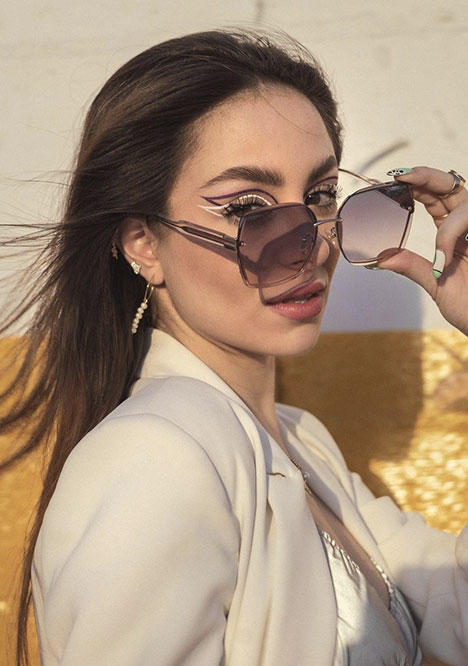
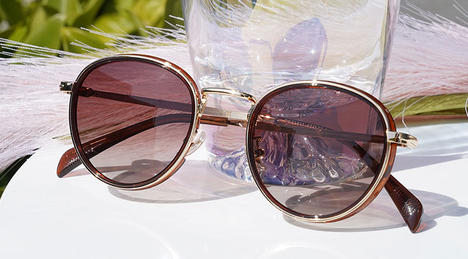
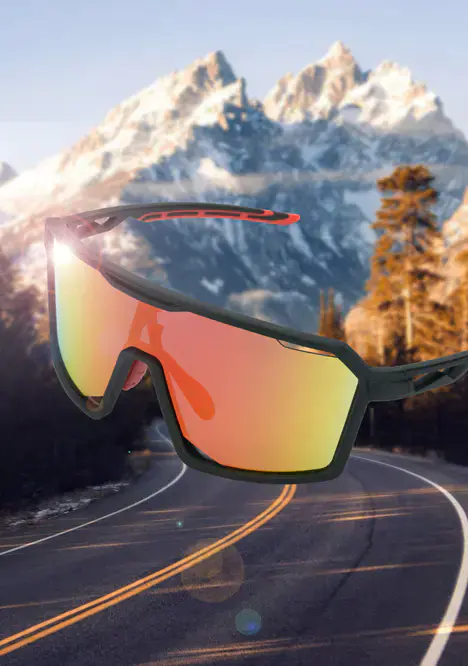
Can I use a VTO for sunglasses?Absolutely. VTO is perfect for trying on different sunglass styles, shapes, and sizes to see how they look before you buy.
What if my glasses don't fit right after using a VTO?This is typically due to an incorrect PD measurement or the frame dimensions not being right for your head size (e.g., temple arm length, bridge width). Reputable online retailers have adjustment tolerance policies and clear return instructions to resolve these issues. Always double-check your PD before ordering.
Why doesn't my eye doctor just give me my PD?While the FTC's Eyeglass Rule mandates the release of your prescription, it does not currently mandate the inclusion of your PD. Some optometrists provide it willingly, while others may not, as it is considered part of the dispensing service. However, you have the right to your prescription and can use it to purchase glasses anywhere you choose.
Disclaimer: This article is for informational purposes only and does not constitute professional medical advice. Always consult with a qualified eye care professional for any vision-related health concerns and before making a purchase based on a new prescription.


