










Should I drive with progressive lenses?
Should I Drive with Progressive Lenses? A Safety-First Guide
Getting a new pair of progressive lenses is a fantastic step toward seamless vision at all distances. However, it comes with a critical question that often causes anxiety: Is it safe to drive with them? The short answer is yes, absolutely—once you are fully adapted. But the key is in that last phrase: fully adapted.
Driving with new progressive lenses before your brain has adjusted to them can be disorienting and potentially unsafe. The unique design of these lenses, which blends distance, intermediate, and near vision into one, requires a short but essential period of neuroadaptation. This guide provides a definitive, safety-focused roadmap to help you navigate this adjustment period and become a confident driver with your new eyewear.
TL;DR: Your Driving Safety Checklist
- Indoors First (72 Hours): Wear your new glasses full-time at home for at least three days before you even consider driving. Practice walking, watching TV, and looking around the room.
- Point Your Nose: The golden rule of progressives. Turn your head to look at objects, don't just move your eyes. This ensures you are looking through the clearest part of the lens.
- Stationary Test: Before your first drive, sit in your parked car. Look at street signs and distant objects to confirm your distance vision is clear without needing to tilt your head.
- Start Slow: Your first drive should be short, during the day, on familiar roads with low traffic.
- Stop if Dizzy: If you feel any dizziness, nausea, or spatial distortion, stop driving. It's a sign your brain needs more time to adapt.
Understanding Your New View: Why Your Brain Needs to Adapt
Unlike single-vision lenses, which have one corrective power, progressive lenses are a marvel of optical engineering with multiple powers. This is what causes the initial unfamiliar sensations.
The Three Vision Zones
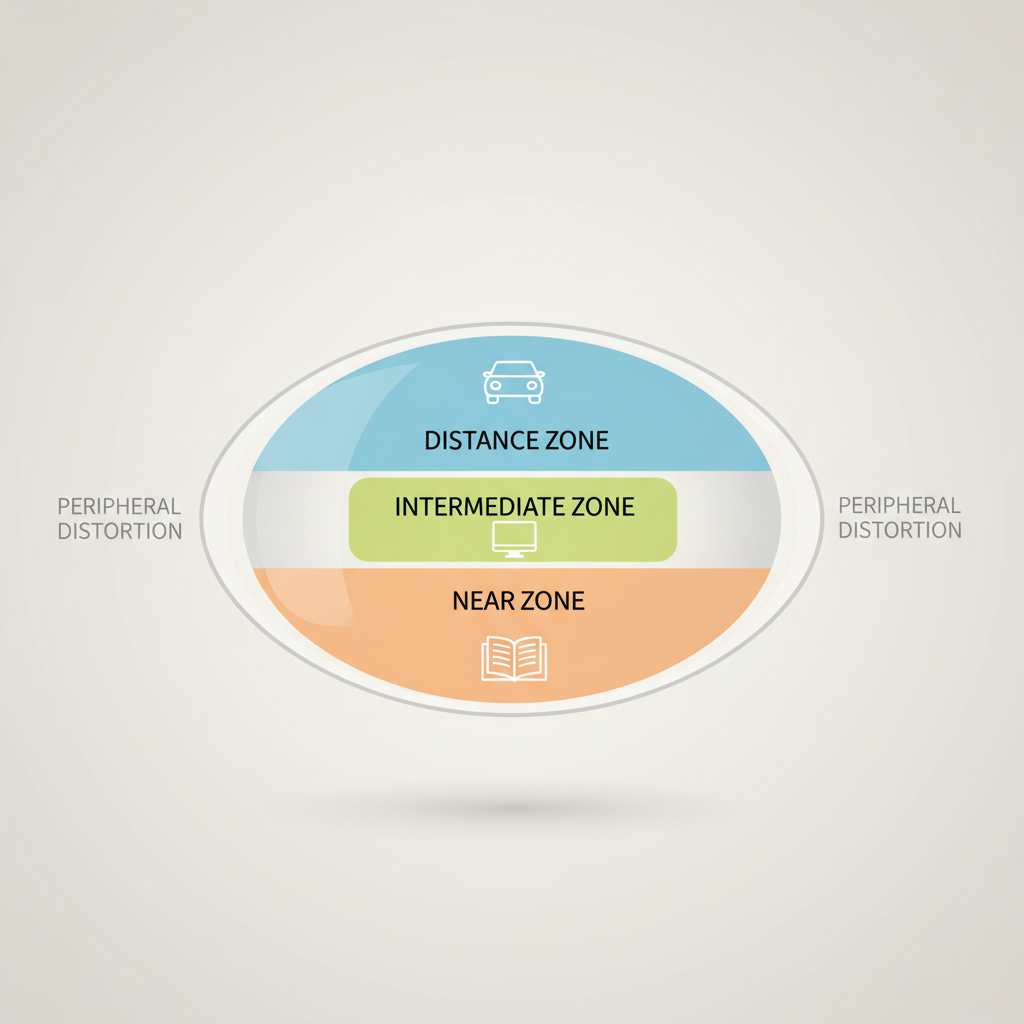
Every progressive lens is divided into three main, invisible zones that flow into one another:
- Distance Zone (Top): This is the largest part of the lens, located at the top. It’s designed for seeing things far away, making it your primary zone for driving. When you look straight ahead at the road, you are using this corridor.
- Intermediate Zone (Middle): This narrow middle channel is for viewing objects at arm's length. For driving, this is the part you’ll use to glance at your dashboard, GPS, or speedometer.
- Near Zone (Bottom): The bottom of the lens has the strongest power, optimized for close-up tasks like reading a book or using your phone. This zone is generally not used for driving.
The "Swim Effect": Decoding Peripheral Distortion
The smooth transition between these zones is a technological feat, but it comes with a trade-off. To blend the powers seamlessly, lens designers must place areas of soft, unavoidable distortion in the lower periphery of the lenses.
When you first wear progressives and move your head, these distorted areas can create a sensation that the world is moving or swaying. This is often called the "swim effect" or "rock and roll sensation" and is the number one reason new wearers feel disoriented. According to research on lens adaptation, this feeling is a normal part of the process as your brain learns to ignore these blurry peripheral areas.
Your brain is incredibly powerful. Over a few days, it will create a new "map" of your vision, learning to automatically find the clear zones and disregard the distorted ones. The key is to give it enough time and consistent input to build this map before taking on a complex task like driving.
The Pre-Driving Adaptation Plan: Your First 72 Hours
The most critical adaptation period occurs within the first 72 hours. During this time, you should focus on retraining your head-eye coordination in a safe, low-stakes environment. Do not drive during this initial phase.
Phase 1: Master Your Indoor Space
Your first goal is to make the glasses feel like a natural part of you. Wear them from the moment you wake up until you go to bed.
- Walk and Look: Walk around your house. As you do, consciously practice turning your head to look at objects in the room. Look out windows at distant trees or buildings.
- The "Point Your Nose" Technique: This is the most important habit to build. Instead of darting your eyes to the side, make a point of turning your head and pointing your nose directly at whatever you want to see clearly. Research on head-eye coordination shows that experienced progressive wearers naturally adopt this "Head Gain" strategy to keep their focus within the lens's clear central corridor.
- Practice with Stairs: Stairs can be tricky at first because you might naturally look down through the reading portion of your lenses, making the steps appear blurry or closer than they are. Hold the handrail and tuck your chin down, forcing your eyes to look through the upper distance portion of the lens. This is critical practice, as studies have shown that multifocal lens wearers can have up to 2.23 times the odds of falling, primarily due to this misperception of the lower visual field.
Phase 2: The Stationary Driving Test
After a few days of successful indoor wear, it's time to test your vision in the car—without leaving the driveway.
- Sit and Settle: Put on your seatbelt and adjust your mirrors as you normally would.
- Check the Dashboard: Look at your speedometer and GPS. You will need to slightly lower your head to view them through the intermediate zone. Practice finding this "sweet spot" without hunting for it.
- The Street Sign Test: This is a crucial safety check recommended by experienced opticians. Look straight ahead through the windshield at street signs or license plates 50-100 feet away. The text should be perfectly clear without you needing to tilt your head up or down. If you have to adjust your posture to see clearly at a distance, your glasses may be fitted incorrectly, and you should not drive.
On The Road: A Guide to Driving with Progressives
Once you've passed the stationary test and feel confident, you can begin low-risk driving.
- Start Small: Your first trip should be during the day, in good weather, and on familiar roads you know well. Avoid rush hour and highways.
- Checking Mirrors and Blind Spots: This requires the most significant behavioral change. You must turn your head fully to check your side mirrors, rearview mirror, and blind spots. A quick glance with just your eyes will land you in the peripheral distortion zone, giving you an unreliable view.
- Night Driving: Glare from headlights can be more pronounced with any new prescription. An anti-reflective (AR) coating is highly recommended for all drivers, as it allows up to 99.5% of light to pass through the lens, significantly improving reaction times and reducing distracting halos at night.
- Parking and Reversing: This can remain challenging for a while. The lower and peripheral parts of the lens, which you might use when looking over your shoulder or at a curb, are distorted. Use your mirrors actively, turn your head more than you normally would, and don't hesitate to use parking aids like cameras and sensors.

Fit & Function: Why Your Frame Choice is a Safety Issue
Not all frames are suitable for progressive lenses, and a poor fit can compromise your safety.
- Frame Height is Non-Negotiable: Progressive lenses require a certain amount of vertical space to accommodate all three vision zones. A frame that is too short will compress these zones, shrinking the clear field of view. As a rule of thumb, opticians recommend a minimum vertical frame height of 28mm.
- The Critical Role of a Professional Fitting: Even the most advanced lenses will fail if they aren't positioned correctly in front of your eyes. An optician takes precise measurements to ensure the optical center of the lens aligns with your pupil. If this measurement is off by even a few millimeters, it can drastically reduce the usable area of the lens, especially the narrow intermediate and distance corridors vital for driving.
- Lens Design Matters: "Soft" designs have wider intermediate zones and less aggressive peripheral distortion, making them easier to adapt to for driving. "Hard" designs prioritize a wide, clear distance zone but have more intense "swim effect." Discuss your lifestyle and priorities with your optician to select the best design for your needs.
Troubleshooting: When to Stop Driving and See Your Optician
Adaptation should be a process of steady improvement. If you experience persistent issues, don't try to "push through it" by driving.
Red Flags for Unsafe Driving
- Dizziness or Nausea: If you feel consistently dizzy, off-balance, or nauseous after 30 minutes of wear, your brain is struggling to process the new visual input. Do not drive.
- Headaches: Frequent headaches can signal that you are constantly fighting the lenses to find a clear spot.
- Inconsistent Clarity: If you have to constantly hunt for the "sweet spot" for distance vision, the fit or prescription may be incorrect.
As a practical heuristic, if you are still experiencing significant dizziness after a full week of consistent wear, delay driving and schedule a follow-up with your optician. It's important to differentiate between normal adaptation and a potential fitting error. Note that patients with higher astigmatism corrections (cylinder values above -1.50) may naturally require a 30-40% longer adaptation period.
Frequently Asked Questions
How long does it really take to get used to driving with progressives? Most users feel comfortable within a week, but it can take up to two weeks for complete, subconscious adaptation. The key is consistent daily wear.
Are progressive lenses dangerous for driving? They are not dangerous if you are fully adapted and follow the correct usage principles (e.g., pointing your nose). They are only a risk if you drive before your brain has adjusted to the new visual fields.
Can I switch back to my old single-vision glasses just for driving? While possible, it's not recommended. Constantly switching between different types of glasses can confuse your brain and prolong the adaptation process for your progressives. The goal is to make your new lenses your primary, all-day pair.
Why does it feel like the ground is curved or moving when I walk? This is the classic "swim effect" caused by the peripheral distortion in the lower part of the lenses. It is most noticeable when looking down and moving. This sensation should fade significantly within the first few days as your brain learns to ignore it.
Do more expensive progressive lenses make driving easier? Often, yes. Premium, free-form digital lenses are customized to your specific prescription, frame choice, and even how the frame sits on your face. This digital surfacing technology can significantly widen the clear visual corridors and reduce peripheral distortion, leading to a faster and more comfortable adaptation.
Disclaimer: This article is for informational purposes only and does not constitute professional medical advice. The information provided is not a substitute for a comprehensive eye exam or a consultation with a qualified optometrist or ophthalmologist. Always follow the specific guidance of your eye care professional regarding your prescription and adaptation to new eyewear, especially concerning activities like driving.
References
- Holden, B. A., Fricke, T. R., Ho, S. M., Wong, R., Schlenther, G., Cronjé, S., ... & Naidoo, K. (2008). Global vision impairment due to uncorrected presbyopia. Archives of ophthalmology, 126(12), 1731-1739.
- Johnson, J., & Doughty, M. J. (2009). A comparison of the effects of multifocal and unifocal spectacle lenses on the trailing-edge of the lower-limb during step-descent. Ophthalmic and Physiological Optics, 29(4), 423-432.
- Margarita, V., & Vayalamkuzhi, J. (2018). Head and eye movements with progressive addition lenses. Journal of Optometry, 11(3), 159-166.
- Gifford, P., & Gifford, K. L. (2016). The future of myopia control contact lenses. Contact Lens and Anterior Eye, 39(5), 312-323.


