










Eyelid Malignancies: Why Sunscreen Isn’t Enough for Eye Skin
The Vulnerable Zone: Why Eyelid Skin is Uniquely at Risk
The skin on our eyelids is the thinnest on the entire body, making it exceptionally susceptible to sun damage. While we diligently apply sunscreen to our faces, this delicate area is often neglected or inadequately covered. This oversight creates a dangerous gap in our sun protection strategy, leaving the door open for serious health consequences. According to oncology experts at the MD Anderson Cancer Center, a staggering 90% of skin cancers around the eye are Basal Cell Carcinomas, directly linked to UV exposure.
This risk is not uniform across the population. A significant 2021 study published in the International Journal of Molecular Sciences found that individuals with light-colored eyes (blue, green, or hazel) face a significantly higher risk for Uveal Melanoma, a rare but serious cancer of the eye itself. The reason lies in melanin, the pigment that gives our skin and eyes their color. Darker irises contain more protective eumelanin, which acts as a natural shield against UV radiation. In contrast, the cells in light-colored eyes have a fraction of this pigment, allowing more damaging UV light to penetrate. This biological reality means that for many, the risk is genetically higher, making robust protection even more critical.
The Sunscreen Gap: Why SPF Alone Is Not Enough
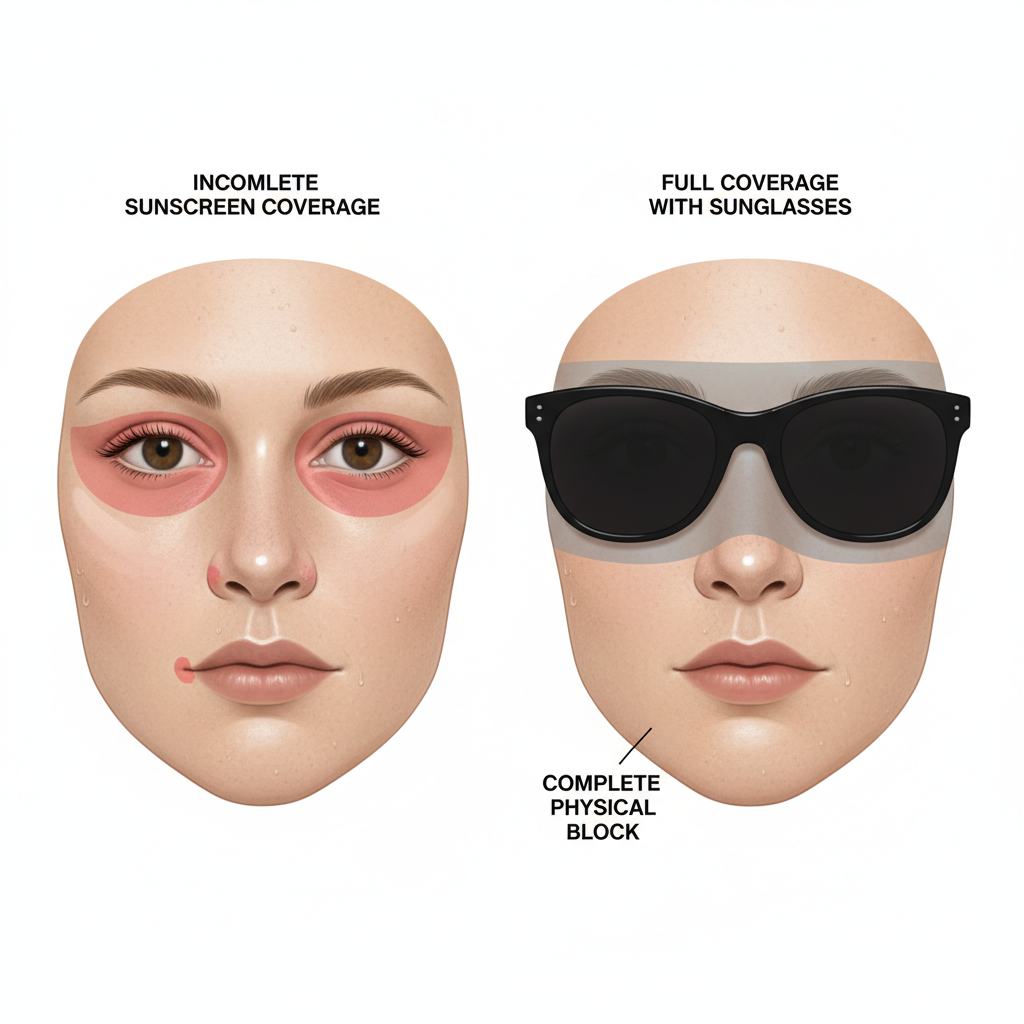
Even for the most conscientious sunscreen user, achieving adequate protection around the eyes is fraught with difficulty. The practical challenges and biological realities of the periorbital area create what dermatologists call the "sunscreen gap."
Expert Observation: In clinical practice, dermatologists and optometrists consistently observe that patients who rely solely on facial sunscreen have significantly higher rates of sun damage on the lateral canthus (the outer corner of the eye) and lower eyelids. These are areas frequently missed during application.
Here’s why sunscreen often fails in this critical zone:
-
Application Difficulty and Stinging: Applying sunscreen close to the lash line is challenging. There's a natural tendency to avoid the immediate eye area to prevent the product from migrating into the eye and causing painful stinging. This instinct leaves the most delicate skin unprotected.
-
The Displacement Factor: The eye area is not a static surface. Constant micro-movements from blinking, squinting, and smiling physically displace sunscreen. This means that even a perfect application loses its integrity within hours, creating a false sense of security.
-
Inadequate Coverage: Many people don't use enough product. Practitioners often recommend a "Rule of Nines for the Face," dedicating a blueberry-sized dollop of sunscreen for the periorbital area alone to achieve the stated SPF. While mineral sunscreens containing zinc oxide are less likely to sting, they are still subject to being rubbed or blinked away.
Ultimately, sunscreen serves as a secondary, imperfect defense for the eyelids, not a primary one.
The Physical Shield: Sunglasses as a Non-Negotiable Defense
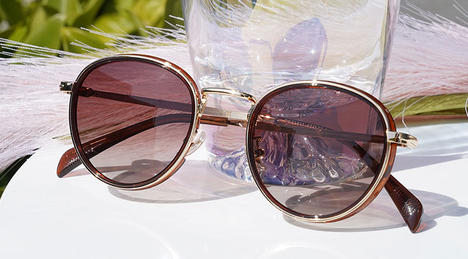
If sunscreen is an unreliable chemical barrier, high-quality sunglasses are an essential and effective physical one. They provide consistent, reliable protection from the moment they are put on, overcoming the inherent flaws of topical creams.
However, not all sunglasses are created equal. True protection hinges on two key factors: UV filtering and frame geometry.
UV400: The Gold Standard of Protection
The label "UV400" is the most important feature to look for. It signifies that the lenses block 100% of ultraviolet rays up to 400 nanometers, which includes all of the harmful UVA and UVB spectrum. Some older or lower-quality standards only protect up to 380 nm. A technical report from an expert researcher, published via PubMed, criticized these lesser standards as "not at all cautious," highlighting that the 380-400 nm band contains significant UV energy. This 20nm gap can be the difference between adequate and inadequate protection.
Crucially, lens darkness does not equal UV protection. As the American Academy of Ophthalmology (AAO) warns, wearing dark lenses without certified UV400 blocking is more dangerous than wearing no glasses at all. Dark tints cause the pupils to dilate, allowing more damaging UV radiation to enter an unprotected eye.
Frame Geometry: Blocking Light from All Angles
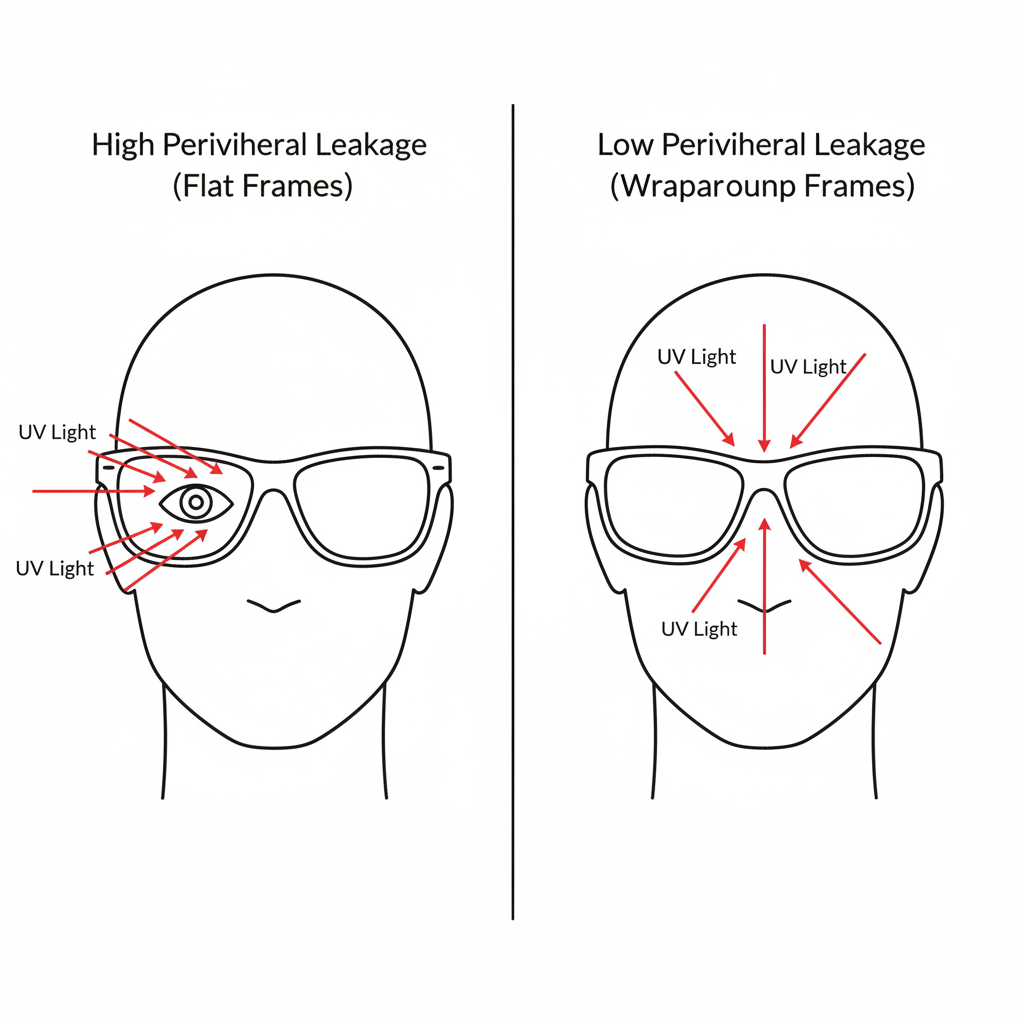
The sun’s rays don’t just come from straight ahead. A significant amount of UV radiation reaches the eyes from the sides, top, and by reflecting off surfaces. This is where frame design becomes a critical health feature.
- The Danger of Peripheral Leakage: A groundbreaking study using 3D head-forms equipped with UV sensors revealed that standard, medium-sized sunglasses could be the least protective style due to significant "peripheral light leakage."
- The Coroneo Effect: Researchers have identified a phenomenon called the "Peripheral Light Focusing" effect, where light entering from the side is focused onto the structures of the eye, increasing the risk for conditions like pterygium ("surfer's eye").
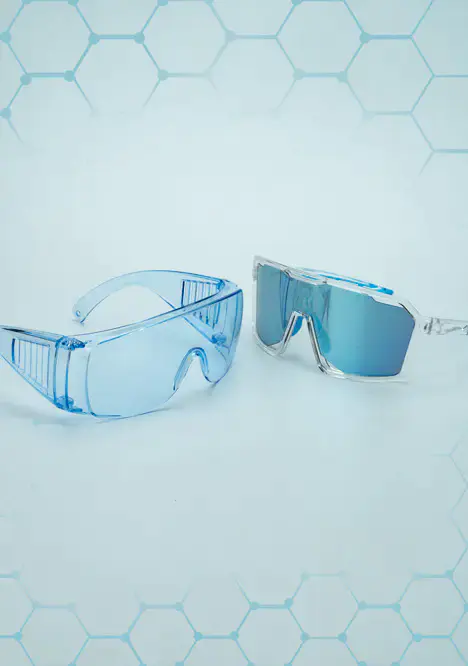
- Wraparound and Oversized for the Win: The most protective styles are oversized or wraparound designs that sit close to the face and have wide temples. According to the AAO, these shapes act as a physical barrier, effectively blocking the peripheral rays that flat-front frames let in.
An Actionable Guide to Complete Eye Sun Safety
Protecting the delicate skin around your eyes from cancer and premature aging doesn't require a complex regimen. It requires making the right choices and building consistent habits.
-
Mandate UV400 Protection: Never purchase a pair of sunglasses without a sticker or label explicitly stating "UV400" or "100% UV Protection." This is the single most important feature for your health. Wondering about your old favorite pair? Learn more about whether sunglasses can expire.
-
Prioritize Coverage and Fit: Choose frames that provide maximum coverage. Opt for oversized, wraparound, or other styles with wide temples that minimize gaps between the frame and your face. The closer the fit, the better the barrier.
-
Understand Lens Features: Polarization is fantastic for reducing glare, which is especially important for safe driving, but it is a comfort feature, not a UV-blocking one. Always confirm the UV400 rating independently of whether the lenses are polarized.
-
Protect the Next Generation: UV damage is cumulative over a lifetime. The Mayo Clinic advises that children can start wearing sunglasses as early as six months old. Yet, a German study found that while 50% of adults wear sunglasses, only 12.5% of children do. Instilling this habit early is a lifelong gift to their health.
-
Don't Be Fooled by Price: While it's crucial to avoid uncertified glasses from unreliable sources, high cost doesn't guarantee safety. An affordable pair of certified UV400 sunglasses is infinitely better than a designer pair with poor protection. The key is verified protection, not the price tag. For more on this, explore the truth about whether cheap sunglasses can damage your eyes.
Your eyes are one of your most precious assets, and the skin around them is their first line of defense. While sunscreen plays a role in overall facial care, it is an inadequate and unreliable shield for the periorbital area. A well-chosen pair of UV400 sunglasses, designed to provide full coverage, is the most effective and dependable tool you have to protect against long-term sun damage and reduce your risk of developing serious skin malignancies.
Disclaimer: This article is for informational purposes only and does not constitute professional medical advice. Always consult with a qualified healthcare provider or ophthalmologist for any health concerns or before making any decisions related to your eye health.
References
- MD Anderson Cancer Center. (n.d.). 9 things to know about sunglasses, eye protection and cancer. Retrieved from https://www.mdanderson.org/cancerwise/9-things-to-know-about-sunglasses--eye-protection-and-cancer.h00-159699123.html
- Pavlidou, V., et al. (2021). The Impact of Ultraviolet Radiation on the Aetiology and Development of Uveal Melanoma. International Journal of Molecular Sciences. Retrieved from https://pmc.ncbi.nlm.nih.gov/articles/PMC8038359/
- Cole, B. L. (2019). Solar UV protection by sunglasses and solar UV protection standards for sunglasses. PubMed. Retrieved from https://pubmed.ncbi.nlm.nih.gov/31274741/
- American Academy of Ophthalmology (AAO). (2022). How to Choose the Best Sunglasses. Retrieved from https://www.aao.org/eye-health/glasses-contacts/sunglasses-3
- Alfawaz, A., et al. (2019). Ocular UV Dosimetry from Different Sources of UV Radiation. Photochemistry and Photobiology. Retrieved from https://pmc.ncbi.nlm.nih.gov/articles/PMC6803516/
- Mayo Clinic. (2018). Mayo Clinic Minute: Why sunglasses are a must-wear. Retrieved from https://newsnetwork.mayoclinic.org/discussion/mayo-clinic-minute-why-sunglasses-are-a-must-wear/


