




The First Signs of Presbyopia to Watch For in Your 40s
TL;DR: The First Signs of Presbyopia
If you're in your 40s and find yourself holding your phone farther away to read texts, you're likely experiencing the first signs of presbyopia. This is a normal, age-related vision change where the eye's natural lens becomes less flexible, making it difficult to focus on close objects. Key signs include blurry vision up close, needing brighter light to read, and getting headaches after reading. While it can't be prevented, it's easily corrected with reading glasses. The best first step is a comprehensive eye exam to get an accurate diagnosis and the right prescription.
Finding yourself squinting at your phone? Do restaurant menus seem to be printed in a smaller font than they used to be? If you're over 40, you're not imagining it. You are likely encountering the first, subtle signs of presbyopia, a completely normal and universal change in vision that affects everyone.
This isn't a disease or a sign of poor eye health; it's a natural part of the aging process, much like getting gray hair. Understanding what's happening to your eyes is the first step toward managing it effectively and keeping your world in sharp focus. This guide will walk you through the science, the symptoms, and the simple solutions for presbyopia.
What is Presbyopia? The Science Behind the Blur
Before we dive into the symptoms, it helps to understand the mechanics of what’s happening inside your eye. According to a definitive overview from the National Center for Biotechnology Information (NCBI), presbyopia is a progressive loss of the eye's ability to focus on nearby objects.
Inside your eye, right behind the iris, sits the crystalline lens. When you're young, this lens is soft and flexible. Tiny muscles attached to it easily contract and relax, changing the lens's shape to focus light from both near and far objects directly onto your retina. This is called accommodation.
Starting around age 40, this lens naturally begins to harden and lose its elasticity. The muscles still work, but the lens can no longer change shape as easily to focus on that text message or the instructions on a medicine bottle. As a result, the light from near objects focuses behind the retina instead of on it, making close-up text look blurry.
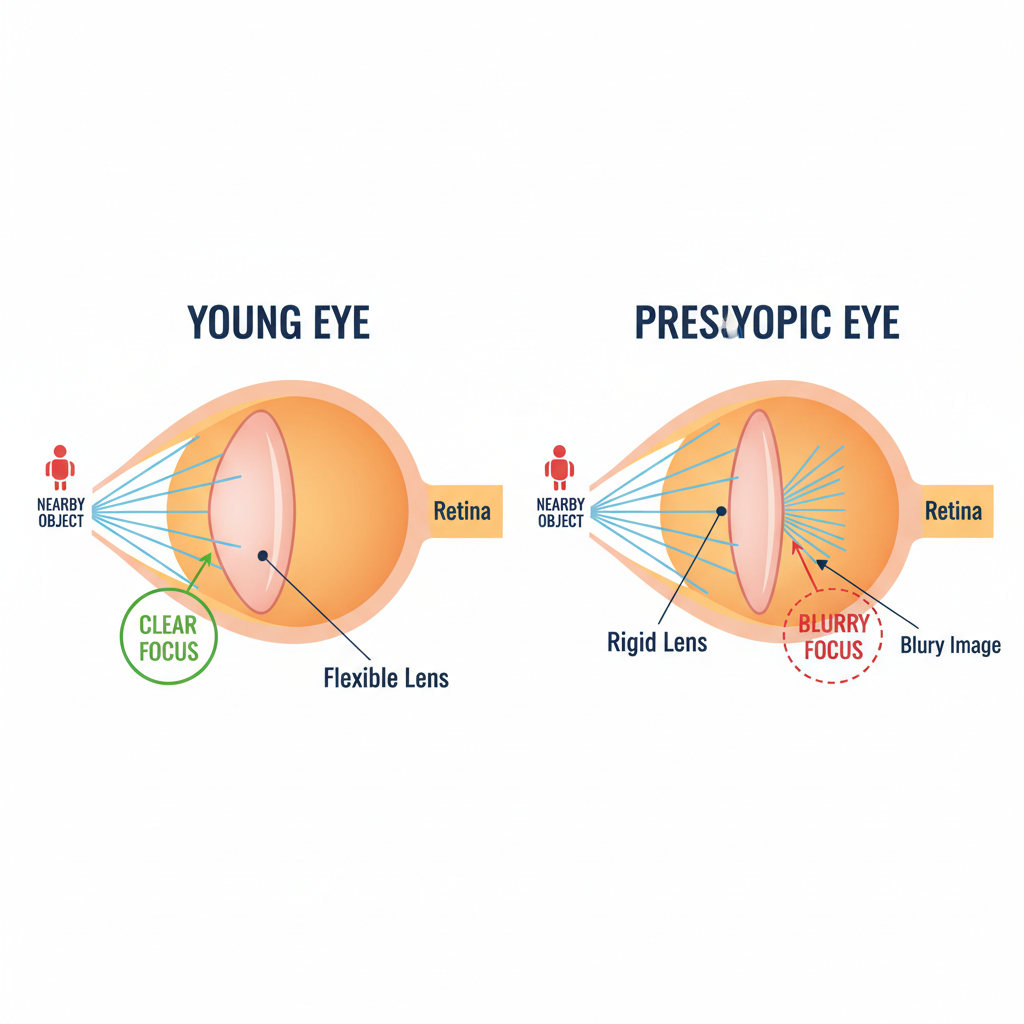
It’s important to distinguish presbyopia from farsightedness (hyperopia). While both can cause blurry near vision, hyperopia is a refractive error typically present from a younger age, caused by the shape of the eyeball. Presbyopia is a loss of focusing ability due to the aging of the lens.
The Telltale Signs: Are You Experiencing Early Presbyopia?
Presbyopia often creeps in so gradually that you might adapt without realizing it for months. However, there are several classic early warning signs. As noted by the Mayo Clinic, symptoms typically become noticeable in your early to mid-40s.
Here are the most common indicators:
- The "Trombone Effect": This is the most classic sign. You find yourself holding books, menus, or your smartphone farther and farther away to see the text clearly. You might joke that your arms are "too short."
- Needing Brighter Light to Read: You may find that you can read perfectly well in bright daylight but struggle in a dimly lit room. Increasing the contrast with direct task lighting becomes essential.
- Eye Strain or Headaches: After spending time on close-up tasks like sewing, reading, or working on a computer, you may experience a dull headache or a tired, aching sensation in your eyes. This is because your eye muscles are straining to force the rigid lens to focus.
- Intermittent Blurry Vision: Your vision may blur when you quickly switch your focus from a distant object to a near one. It takes your eyes a moment longer to adjust than it used to.
- Increased Squinting: You might reflexively squint to try and sharpen your focus on small print.

Myth vs. Reality: Debunking Common Presbyopia Misconceptions
There's a lot of misinformation surrounding reading glasses that can cause unnecessary concern. Let's clear up a common myth.
Myth: "If I start wearing reading glasses, my eyes will get lazy and become dependent on them, making my vision worse."
Reality: This is one of the most persistent myths in eye care. Reading glasses do not make your eyes weaker or accelerate the progression of presbyopia. The condition progresses naturally with age whether you wear glasses or not. The lens will continue to harden over time.
Think of it this way: if you have a sore knee, using a crutch doesn’t make your knee worse; it simply helps you walk without pain. Reading glasses are a tool that compensates for the lens's lost flexibility. They do the focusing work that your lens can no longer do on its own, which relieves eye strain and allows you to see clearly and comfortably. Avoiding glasses only leads to unnecessary headaches and frustration.
Your Next Steps: From Diagnosis to Clear Vision
If the symptoms above sound familiar, it’s time to take action. While presbyopia is normal, self-diagnosing isn’t the best route. A comprehensive eye exam is critical to confirm the diagnosis and, more importantly, to rule out other eye conditions that could be more serious.
As experts at Johns Hopkins Medicine point out, it's vital to distinguish normal age-related changes from "low vision," a more significant impairment that isn't correctable with standard glasses.
Once you have a diagnosis, you have two main choices for reading glasses.
Expert Warning: Over-the-Counter Readers vs. Custom Prescription
A common mistake is assuming all reading glasses are created equal. While inexpensive over-the-counter (OTC) "cheaters" are available at drugstores, they have significant limitations. A custom prescription provides a medically precise solution.
Here’s a breakdown to help you decide:
| Feature | Over-the-Counter (OTC) Readers | Custom Prescription Readers |
|---|---|---|
| Power | Same power in both lenses (e.g., +1.50) | Specific power for each eye, including "Add" power for reading. |
| Astigmatism Correction | None. | Precisely corrects for astigmatism (irregular cornea shape). |
| Optical Center | Generic, fixed center. | Pupillary Distance (PD) is measured for perfect optical alignment. |
| Best For | People with identical vision in both eyes and no astigmatism. | Anyone with astigmatism, different prescriptions in each eye, or who experiences headaches with OTC readers. |
| Potential Issues | Can cause headaches, eye strain, and dizziness if your eyes are different or have astigmatism. | None, as they are made specifically for your eyes. |
For many, especially in the very early stages, OTC readers can be a fine temporary solution. However, as presbyopia progresses or if you have any amount of astigmatism (which is very common), custom-made glasses are a superior choice. An inaccurate pupillary distance (PD) is a frequent cause of discomfort, an issue that custom glasses solve. If you're ordering online, using a precise measurement tool is crucial; for more information, see our guide on how to measure your PD at home.
Wrapping Up: Embrace the Change with Confidence
Experiencing the first signs of presbyopia is a milestone, not a malady. It is a normal, expected part of life that signals a change in your eye's focusing power. By recognizing the symptoms—the telltale "trombone effect," the need for more light, and post-reading headaches—you can take proactive steps.
The most important step is to schedule a comprehensive eye exam with an eye care professional. This ensures you get an accurate diagnosis, rule out any other health issues, and receive the correct prescription tailored to your unique eyes. Whether you opt for simple readers or custom progressive lenses, correcting presbyopia will eliminate eye strain and bring your near world back into sharp, comfortable focus.
Frequently Asked Questions (FAQ)
Can presbyopia be prevented or reversed? No. According to the American Academy of Ophthalmology (AAO), presbyopia is a natural part of the aging process and cannot be prevented or reversed. The changes to the eye's lens are inevitable.
Do eye exercises work for presbyopia? There is no scientific evidence to suggest that eye exercises can prevent, slow, or reverse presbyopia. The condition is caused by the physical hardening of the lens, which exercises cannot change.
Why do I get headaches when I try to read now? Headaches are a classic symptom of uncorrected presbyopia. Your ciliary muscles are working overtime, straining to make the stiff lens change shape. This constant strain leads to muscle fatigue and headaches. Reading glasses alleviate this strain.
What's the difference between computer glasses and reading glasses? It's all about focal distance. Reading glasses are typically designed for a focal distance of about 14-16 inches. A computer screen, however, is usually positioned farther away, in an "intermediate" zone (around 20-24 inches). Computer glasses have a weaker power than reading glasses to keep this intermediate distance clear.
Medical Disclaimer: This article is for informational purposes only and does not constitute professional medical advice. The information provided is not a substitute for a consultation with a qualified ophthalmologist or optometrist. Always seek the advice of your eye care professional with any questions you may have regarding a medical condition. Do not disregard professional medical advice or delay in seeking it because of something you have read here.


