













Free-form Digital Surfacing: Point-by-Point Lens Optimization
TL;DR: What is Free-Form Digital Surfacing?
Free-form digital surfacing is an advanced lens manufacturing process that uses computer-guided precision to create your prescription on a point-by-point basis. Unlike traditional lenses, which are often mass-produced from a limited set of molds, digital lenses are custom-carved for your specific prescription, frame choice, and how you wear your glasses.
Key benefits include:
- Edge-to-Edge Clarity: Significantly reduces the "fishbowl" effect and peripheral blur.
- Wider Field of View: Especially noticeable in progressive lenses, providing a larger, more natural-feeling reading area.
- Higher Definition Vision: Minimizes distortions and aberrations, which is critical for wearers with high astigmatism or strong prescriptions.
- Easier Adaptation: By creating a smoother, more customized visual experience, many users find the adjustment period for new glasses, particularly progressives, is much shorter.
The Limits of Conventional Lenses
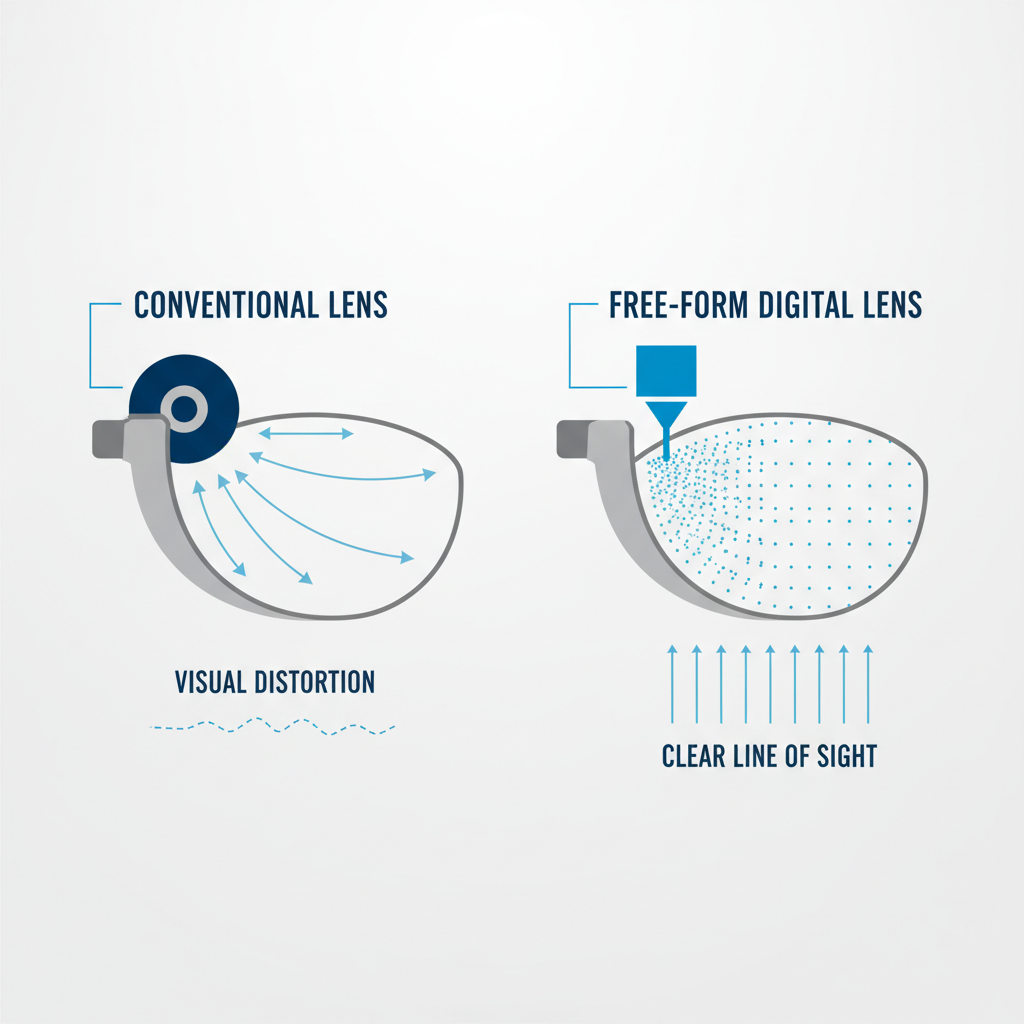
For decades, the vast majority of eyeglass lenses were made using a conventional, mold-based process. Think of it like buying a suit off the rack. A lens factory produces thousands of semi-finished "blanks," each with a pre-molded curve on the front surface. An optical lab then takes one of these blanks and simply grinds your prescription onto the back surface.
This method works reasonably well for simple, low-power prescriptions. However, its limitations become immediately apparent for anyone with more complex visual needs. Because the lens design is generic, it can’t account for the optical distortions that occur when you look away from the exact center of the lens. This results in common complaints:
- Peripheral Blur: The feeling that your vision is only clear in a small central "sweet spot." As you glance to the side, the world can seem to swim or distort. This is a well-known issue, especially for those switching from single vision to progressives.
- The "Fishbowl" Effect: A sensation that the world is bending or curving unnaturally at the edges of your vision.
- Narrow Corridors: For progressive lens wearers, the channel for intermediate and near vision can feel restrictive and difficult to find.
These issues are not defects; they are inherent limitations of a one-size-fits-all manufacturing process trying to correct a unique and complex visual system. The problem is particularly pronounced in lenses for high astigmatism, where the prescription itself has different powers at different angles.
The Digital Breakthrough: How Free-Form Surfacing Works
Free-form digital surfacing throws out the old playbook of molds and generic curves. Instead of treating a lens like a single object, it treats it as a collection of thousands of individual points. Using highly sophisticated software and hardware, it optimizes the prescription at every single one of those points.
The process is a marvel of optical engineering:
- Digital Mapping: Your prescription data, the precise shape and size of your chosen frame, and your personal fitting measurements (like pupillary distance) are loaded into a complex software program.
- Advanced Calculation: The software creates a three-dimensional model of your ideal lens. It runs complex calculations based on optical physics to determine the exact curvature needed at thousands of points across the lens surface. This process not only corrects your vision but also minimizes higher-order aberrations—the very distortions that cause blur and swim in conventional lenses. As the Minkwitz theorem in optics dictates, aberrations can be moved but not entirely eliminated; digital surfacing intelligently moves these distortions to the far periphery of the lens, outside your functional field of view.
- Precision CNC Surfacing: The digital design file is sent to a computer numerical control (CNC) generator. A diamond-tipped tool then carves your unique, complex surface onto the back of a lens blank. This process is incredibly precise, capable of creating surfaces accurate to within 0.01 diopters, a level of detail impossible with traditional methods.
- Finishing and Polishing: The lens is then polished to achieve perfect optical clarity, and any desired coatings (like anti-reflective or scratch-resistant layers) are applied.
This point-by-point optimization means your lenses are no longer just a generic approximation of your prescription; they are a high-definition solution built from the ground up for your eyes and your frame.
What Digital Optimization Means for Your Daily Vision
The difference between wearing conventional lenses and digitally surfaced ones can be dramatic, especially for those with complex needs. The theoretical benefits translate into tangible, real-world improvements.
Sharper Vision with Less Distortion
By managing the inherent aberrations, digital lenses provide a crisper, more comfortable visual experience. A randomized trial published in Optometry and Vision Science found that customized free-form progressive lenses provided significantly wider clear fields of view at near distances compared to standard lenses. This is especially critical for those with high astigmatism or strong prescriptions, where traditional lenses often cause noticeable visual distortions. For many, this can be the difference between seeing clearly and feeling like their strong prescription lenses distort their eyes.
Wider, More Usable Corridors in Progressives
For progressive wearers, the biggest advantage is a wider, more forgiving visual field. Research has shown that a majority of users prefer lens designs with lower peripheral astigmatism, even if central sharpness is identical. Digital surfacing achieves this by creating smoother transitions between distance, intermediate, and near zones, making it easier to find the right spot for every task without constant head movement. This also helps reduce the "swim" effect that can make some people feel they cannot wear progressive lenses.
Improved Night Driving and Low-Light Vision
Higher-order aberrations are a primary cause of glare, starbursts, and halos around lights at night. By minimizing these distortions, wavefront-guided digital lenses can lead to a significant improvement in visual quality after dark. Studies have demonstrated that these advanced lenses can reduce high-order aberrations by over 70% and improve contrast sensitivity by 43%, making night driving safer and more comfortable.
The Human Factor: Why Your Measurements Are Critical
Free-form technology is incredibly powerful, but it has an Achilles' heel: it is completely dependent on the quality of the data it receives. The most advanced lens in the world will perform poorly if it isn't perfectly aligned with your eyes.
This is where precise fitting measurements become non-negotiable. While conventional lenses are somewhat forgiving of small errors, the precision of digital lenses means that mistakes are magnified.
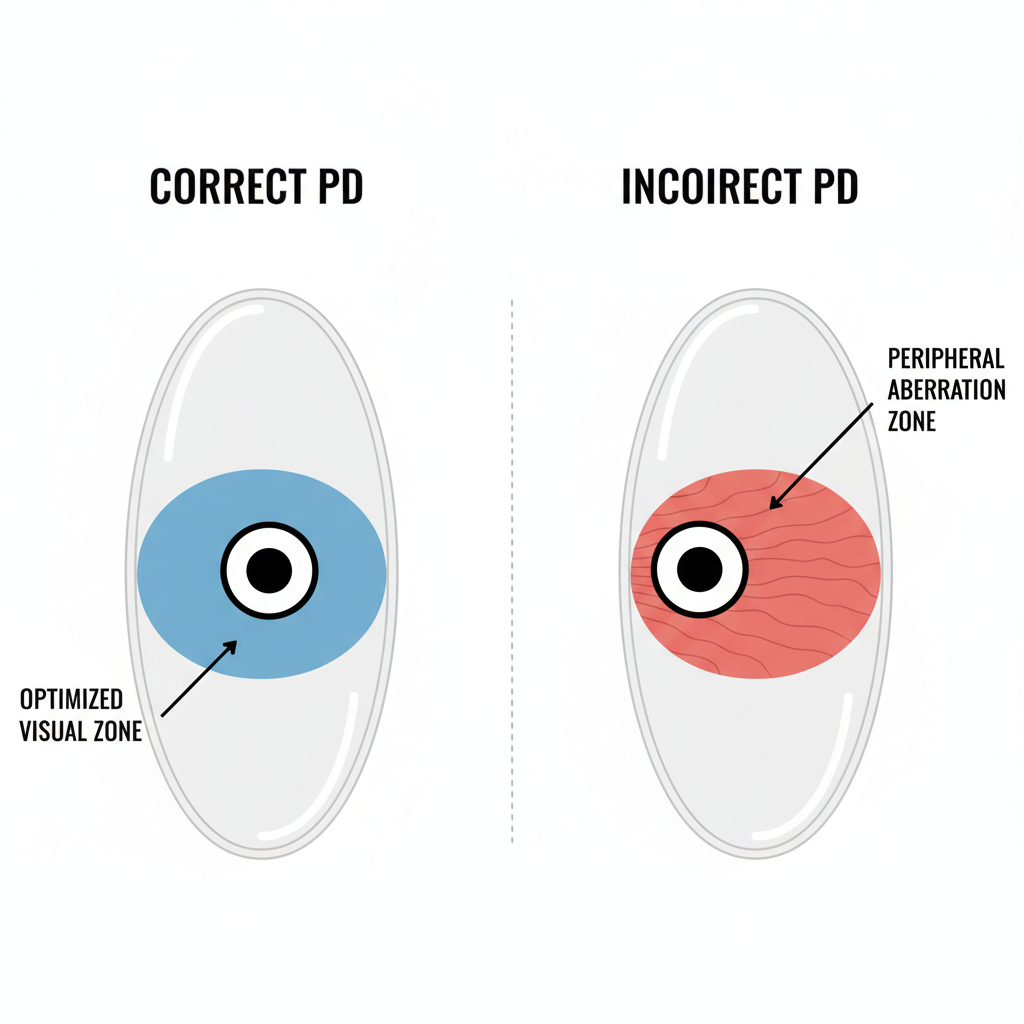
Practitioner Insight: Based on lab experience, the true value of digital surfacing is most apparent in prescriptions with a cylinder over -2.00 diopters or add powers above +2.00. However, these are also the prescriptions where small measurement errors have the biggest impact. An error in pupillary distance (PD) or segment height can completely negate the lens's benefits because it shifts the optimized visual zones away from where your pupil actually looks.
Key measurements include:
- Pupillary Distance (PD): The distance between the centers of your pupils. This ensures the optical center of the lens is directly in front of your pupil for the clearest distance vision.
- Segment Height (Seg Height): For progressives, this measures from the bottom of the lens to the center of your pupil. It determines the vertical placement of the reading corridor.
- Pantoscopic Tilt and Wrap Angle: These measure how the frame sits on your face—its vertical tilt and horizontal curve. Advanced free-form designs can use this data to further optimize the lens, ensuring the prescription is accurate for how you actually wear the glasses.
Because of this sensitivity, providing accurate measurements is more critical than ever for ordering glasses online. Using a reliable digital measurement tool or having the measurements taken by a professional ensures your investment in superior lens technology pays off.
Frequently Asked Questions (FAQ)
How can I tell if my lenses are digitally surfaced? Many manufacturers include a tiny, semi-visible laser engraving on the lens, often on the temporal side. Look for small initials (like 'DF' for digital free-form) or a series of dots arranged in a specific pattern. You may need to hold the lens up to a light and look at it from an angle to see it.
Why do free-form lenses cost more than basic lenses? The cost reflects the advanced technology, software, and machinery required. Unlike conventional lenses that can be mass-produced and stored, every digital free-form lens is custom-made to order, involving a more complex and time-intensive manufacturing process.
I have free-form lenses but still see some blur. Why? While digital lenses significantly reduce distortion, they can't eliminate it entirely. You may still notice some softness in your far periphery. Other causes can include:
- Adaptation Period: It can take a few days for your brain to get used to any new lenses, even high-tech ones.
- Fitting Errors: As noted, if the PD or Seg Height measurement is even slightly off, it can compromise performance. Studies on fitting errors show that inaccuracies can significantly compress the effective reading zone, negating the lens benefits.
- Manufacturing Tolerances: Even within acceptable industry standards, tiny "ring errors" from the surfacing process can sometimes be perceived by highly sensitive wearers.
Are digital lenses worth it for a simple, low-power prescription? The benefits of free-form technology are most dramatic for those with high prescriptions, high astigmatism, or progressive lenses. However, anyone can appreciate the enhanced clarity and wider field of view. If you are sensitive to visual imperfections or simply want the most advanced optical technology available, they can be a worthwhile upgrade.
Disclaimer: This article is for informational purposes only and does not constitute professional medical advice. Please consult with a qualified eye care professional for any vision-related concerns or before making any decisions about your eye health or treatment.


