










Why do I get a headache when I wear progressive glasses?
TL;DR: Your Quick Guide to Progressive Lens Headaches
- Headaches are common and usually fixable. They typically stem from incorrect measurements, the specific lens design, or your brain needing time to adjust.
- Frontal headaches (above the eyebrows) often point to an incorrect vertical fit. The lens's optical center isn't aligned with your pupil.
- Temple pain or side-pressure can be caused by the frame's fit, specifically the distance from the lens to your eye (vertex distance).
- Dizziness or a "swimmy" feeling is a normal part of the adaptation period. This effect, caused by peripheral distortion, should decrease significantly within two weeks.
- The Golden Rule for new wearers: Point your nose directly at what you want to see. Don't just move your eyes. This keeps your line of sight in the clearest part of the lens.
- If discomfort persists after two weeks, don't "tough it out." Return to your optician for a measurement and fit verification. It's a crucial step.
Getting a new pair of progressive lenses should be an exciting step toward seamless vision at all distances. So, when that excitement is replaced by a nagging headache, frustration is understandable. You've invested in advanced technology, but instead of clarity, you're experiencing pain, dizziness, or eye strain.
Rest assured, this is a common issue, and it is almost always solvable. A headache from new progressives isn't a sign that you can't wear them; it's a signal that something is "off." The cause could be the measurements, the specific type of lens you have, or the way your brain and eyes are learning to coordinate in a new way.
This troubleshooting guide will walk you through the most common causes of progressive lens headaches, helping you identify the likely culprit and providing a clear action plan to achieve the comfortable, clear vision you were promised.
Decoding Your Discomfort: A Symptom-to-Cause Guide
The first step in solving the problem is to play detective. The specific location and nature of your discomfort are powerful clues that can help you and your optician pinpoint the issue. In our experience, headaches from new progressives are rarely random; they are linked to specific aspects of the lens or its fit.

The Frontal Headache: A Telltale Sign of Incorrect Height
If you're experiencing a persistent, dull ache directly above your eyebrows, the most likely cause is an incorrect pupillary height (or fitting height) measurement. This is the vertical measurement from the bottom of the frame to the center of your pupil, and it dictates where the "power corridor" of the lens sits in front of your eye.
Expert Insight: In optical practice, a frontal headache localized just above the eyebrows is the most reliable indicator of an incorrect pupillary height. Even a discrepancy as small as 2mm can force you to constantly make micro-adjustments with your chin to find the "sweet spot" for clear vision, leading to significant muscle strain in your neck and forehead.
When this height is even slightly off, your eye isn't looking through the lens's intended optical center. To compensate, you subconsciously tilt your head up or down, creating tension that builds into a headache.
Temple Pain or Pressure: A Clue About Frame Fit
Is the pain concentrated at your temples or on the sides of your head? This often points to issues with the frame's fit relative to your face, specifically:
- Vertex Distance: This is the distance between the back surface of the lens and the front of your cornea. Progressive lens optics are precisely calculated for an average vertex distance. If your frames sit too far from your eyes, it can alter the effective power and distort the peripheral optics, causing your brain to work overtime.
- Frame Wrap: Highly curved or "wrapped" frames, while stylish, can be challenging for progressive lenses. The wrap angle can induce prism-like effects and aberrations in the periphery, leading to that feeling of pressure or strain on the sides of your head.
General Eye Strain, Fatigue, or a "Pulling" Sensation
If your discomfort is less of a headache and more of a generalized, weary feeling in your eyes, the issue could be an incorrect Pupillary Distance (PD). This is the horizontal distance between the centers of your pupils.
If the PD measurement on your lenses doesn't match your eyes, it forces your eyes to either converge (turn inward) or diverge (turn outward) slightly to fuse the two images into a single, clear picture. Maintaining this unnatural posture all day is a workout for your eye muscles, leading to fatigue and strain.
The "Swim Effect": When the World Feels Unstable
One of the most disorienting sensations for new progressive wearers is the "swim effect"—a feeling of dizziness or motion sickness, especially when turning your head. Straight lines may appear to curve, and the floor might seem to move. This is caused by the unavoidable peripheral distortion inherent in all progressive lenses.
According to the Minkwitz theorem, a fundamental principle of lens design, these aberrations can be moved around but never completely eliminated. It’s like pressing down on a waterbed; the water has to go somewhere. Lens designers can either create:
- "Hard" Designs: These lenses have a wide, clear central viewing area but concentrate the distortion into smaller, more intense peripheral zones. This can create a more pronounced "swim" effect.
- "Soft" Designs: These lenses spread the distortion over a larger area, making the "swim" less jarring but slightly narrowing the clear central corridor. For new wearers, soft designs are often more comfortable and easier to adapt to. In fact, one study found that 75% of subjects preferred lenses with lower peripheral astigmatism (soft design), even if it meant slightly less sharp central vision, because the overall comfort was higher.
This peripheral blur is a normal part of the lens architecture. For a deeper dive, read our guide on Switching from Single Vision to Progressives: Why the Peripheral Blur Is Normal.
Your Brain's Role: Neuroadaptation and Visual Habits
Getting used to progressive lenses is a skill. It's not just about your eyes; your brain needs to learn a whole new way of processing visual information. This process is called neuroadaptation, and it's why opticians recommend a consistent adaptation period of one to two weeks.
During this time, your brain learns to ignore the peripheral distortions and automatically find the right part of the lens for the task at hand. You can significantly speed up this process by adopting one crucial habit.
The Golden Rule: Point Your Nose at What You Want to See
Instead of moving your eyes side-to-side to look at something, physically turn your head to face it directly. This simple action keeps your line of sight squarely within the clear central corridor of the lens, bypassing the "swim" zones. Initially, this feels unnatural, but it quickly becomes second nature and is the single most effective technique for adapting to progressives.
It's also worth noting that certain personality traits can influence adaptation. Research suggests that individuals with anxious or perfectionist tendencies may report more difficulty, as they are often more sensitive to the minor imperfections in their visual field.
When It's the Wrong Tool for the Job
Sometimes, the headache isn't from a bad fit but from a mismatch between your lenses and your lifestyle. A general-purpose progressive is a jack-of-all-trades, but it may not be the master of the one task you do most: working at a computer.
The Computer Conundrum and Neck Pain
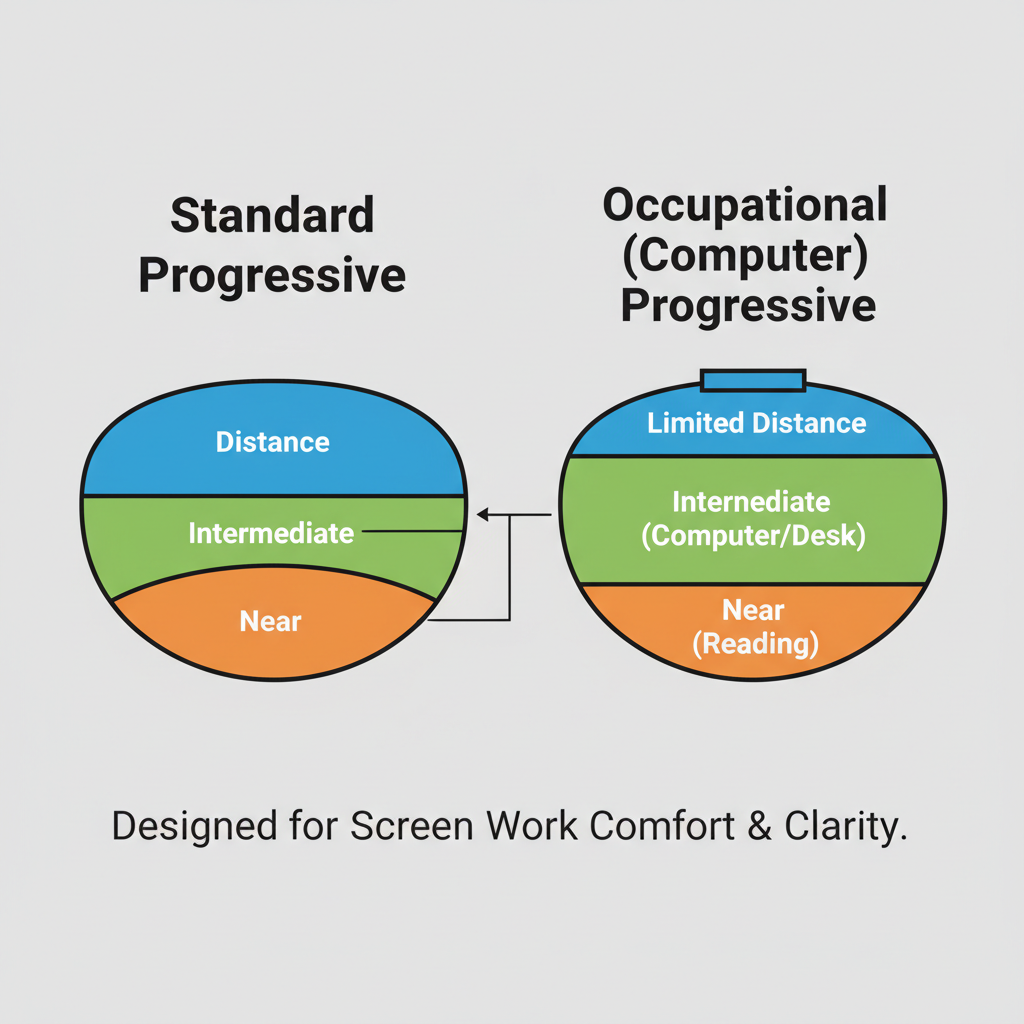
The intermediate zone of a standard progressive lens—the part used for computer distance—is notoriously narrow. To use it, you must adopt a "chin-up" posture, which can lead to significant neck and shoulder pain. Electromyography (EMG) studies confirm that this posture causes significantly higher muscle activity in the neck, leading to strain and headaches.
If you spend more than a couple of hours a day on a computer, a dedicated Occupational Progressive Lens (OPL), also known as a "computer progressive," is often the best solution. These lenses are designed with a much larger intermediate zone, providing a wide, comfortable field of view at screen distance without forcing you into an unnatural posture.
How Lens Technology Makes a Difference
Not all progressive lenses are created equal. Older, conventional lenses have the progressive design molded onto the front surface. Modern free-form digital lenses, however, are a game-changer.
Using highly precise computer-guided surfacing, the unique prescription is carved onto the back surface of the lens. This allows for point-by-point optimization, taking into account the frame fit and your specific prescription. Clinical trials show that these customized free-form lenses provide significantly wider clear fields of view at near distances compared to standard lenses, drastically reducing distortion and making adaptation easier.
Your Action Plan: A Step-by-Step Troubleshooting Checklist
If you're struggling with headaches, follow this structured plan. Don't give up on your new glasses without giving them a fair chance.
| Step | Action | Why It Helps |
|---|---|---|
| 1 | Commit to a 1-2 Week Adaptation Period | Your brain needs consistent input to learn the new visual system. Avoid switching back to your old glasses, as this resets the learning process. |
| 2 | Master the "Point Your Nose" Technique | Actively practice turning your head to look at objects. This is the fastest way to train your brain to stay in the clear vision corridor and avoid peripheral swim. |
| 3 | Check Your Frame's Position | Ensure your glasses are sitting correctly and not sliding down your nose. A small slip can completely misalign the fitting height, forcing you to hunt for the sweet spot. |
| 4 | Analyze Your Symptoms | Use the guide in Section 1. Go to your optician with specific feedback: "I have a frontal headache after an hour," is much more helpful than "These glasses feel weird." |
| 5 | Return for a Fit Verification | This is non-negotiable if problems persist. Ask your optician to re-verify the Pupillary Distance and, most importantly, the Fitting Height on the lenses themselves. Small errors here are the #1 cause of non-adaptation. |
| 6 | Discuss Lens Design & Lifestyle | If the fit is confirmed to be correct, discuss your daily activities. Ask if a "softer" lens design or a dedicated pair of computer progressives might be a better match for your needs. |
Headaches from new progressive lenses are a sign that an adjustment is needed—whether it's an adjustment in your habits, in the frame's fit, or in the lens itself. By systematically working through the potential causes, you can become an informed advocate for your own visual comfort. With the right measurements, lens technology, and a little patience, you can and will achieve the seamless, headache-free vision that progressives promise.
Frequently Asked Questions (FAQ)
Q1: Can everyone wear progressive lenses? While the vast majority of people can wear them successfully, some individuals with certain medical conditions or a high sensitivity to visual disturbances may struggle. Conditions like vertigo or specific inner-ear issues can sometimes make adaptation more difficult. For a detailed breakdown, you can explore our article on who cannot wear progressive lenses.
Q2: Will the headaches go away on their own? If the headache is due to neuroadaptation, it should significantly decrease within one to two weeks of consistent wear. If it's caused by a measurement error (like incorrect fitting height), it will not go away and will require a professional adjustment.
Q3: Is it safe to drive with new progressive lenses? Use caution initially. The peripheral distortion can affect your perception of space and speed. A study on older adults found that multifocal wearers had a higher risk of falling due to blurred lower peripheral vision. Give yourself a few days to adapt in safe environments before undertaking long drives, and be extra mindful when checking blind spots or parking.
Q4: Why do my new progressive lenses seem worse than my old pair? This is a common complaint and can be due to several factors: a change in lens design (from a "soft" to a "hard" design), a subtle error in the new fitting measurements, or a change in frame shape that alters the vertex distance and wrap angle. Don't assume your vision has worsened; it's more likely a technical issue with the new glasses.
This article is for informational purposes only and does not constitute professional medical advice. If you have persistent headaches, severe dizziness, or other concerning symptoms, consult with a qualified optometrist or ophthalmologist, especially if you have pre-existing medical conditions.
References
- Armstrong, R. A. (2018). Visual Acuity versus Subjective Preference for Progressive Addition Lens Designs. Optometry and Vision Science, 95(4), 346–353. Available at: https://pmc.ncbi.nlm.nih.gov/articles/PMC10104795/
- García-García, M., et al. (2020). Computer Vision Syndrome in Progressive Addition Lens Wearers. International Journal of Environmental Research and Public Health, 17(3), 1003. Available at: https://www.mdpi.com/1660-4601/17/3/1003
- Han, S. C., et al. (2014). The effect of the use of progressive addition lenses on neck and shoulder muscle activity while working at a video display terminal. Work, 47(4), 487-493. Available at: https://pmc.ncbi.nlm.nih.gov/articles/PMC3804966/
- Loch, J. A., et al. (2024). Falls Risk in Older Adults Wearing Multifocal Spectacles. Journal of the American Geriatrics Society. Available at: https://pubmed.ncbi.nlm.nih.gov/39882858/
- Ganesan, V., et al. (2011). Clinical assessment of customized free-form progressive addition lenses. Optometry and Vision Science, 88(2), E242-E249. Available at: https://pubmed.ncbi.nlm.nih.gov/21217408/


