










Do High-Index Lenses Have More Chromatic Aberration?
The Unseen Trade-Off: Understanding Color Fringing in Your Lenses
If you have a strong prescription, you likely appreciate the benefits of high-index lenses. They are remarkably thin and lightweight, preventing the thick, heavy "coke bottle" look of the past. Yet, you might have noticed a subtle, sometimes distracting, visual quirk: a faint rainbow or colored halo around objects, especially when you glance away from the center of your glasses. This phenomenon is known as chromatic aberration or "color fringing."
It's a common trade-off in optical physics. While high-index materials are excellent at bending light to correct your vision in a slimmer profile, this efficiency can cause white light to split into its component colors. This article will explain why this happens, who is most likely to notice it, and provide practical, expert-guided strategies for choosing lenses that minimize this effect, ensuring your world looks as sharp and clear as it should.
The Science Behind the Rainbows: Index vs. Abbe Value
To understand why your state-of-the-art lenses might show color fringes, we need to look at two key numbers that define any lens material: the Refractive Index and the Abbe Value.
- Refractive Index: This number (e.g., 1.50, 1.67, 1.74) indicates how effectively the material bends light. A higher index bends light more efficiently, allowing for a thinner and lighter lens for the same prescription power.
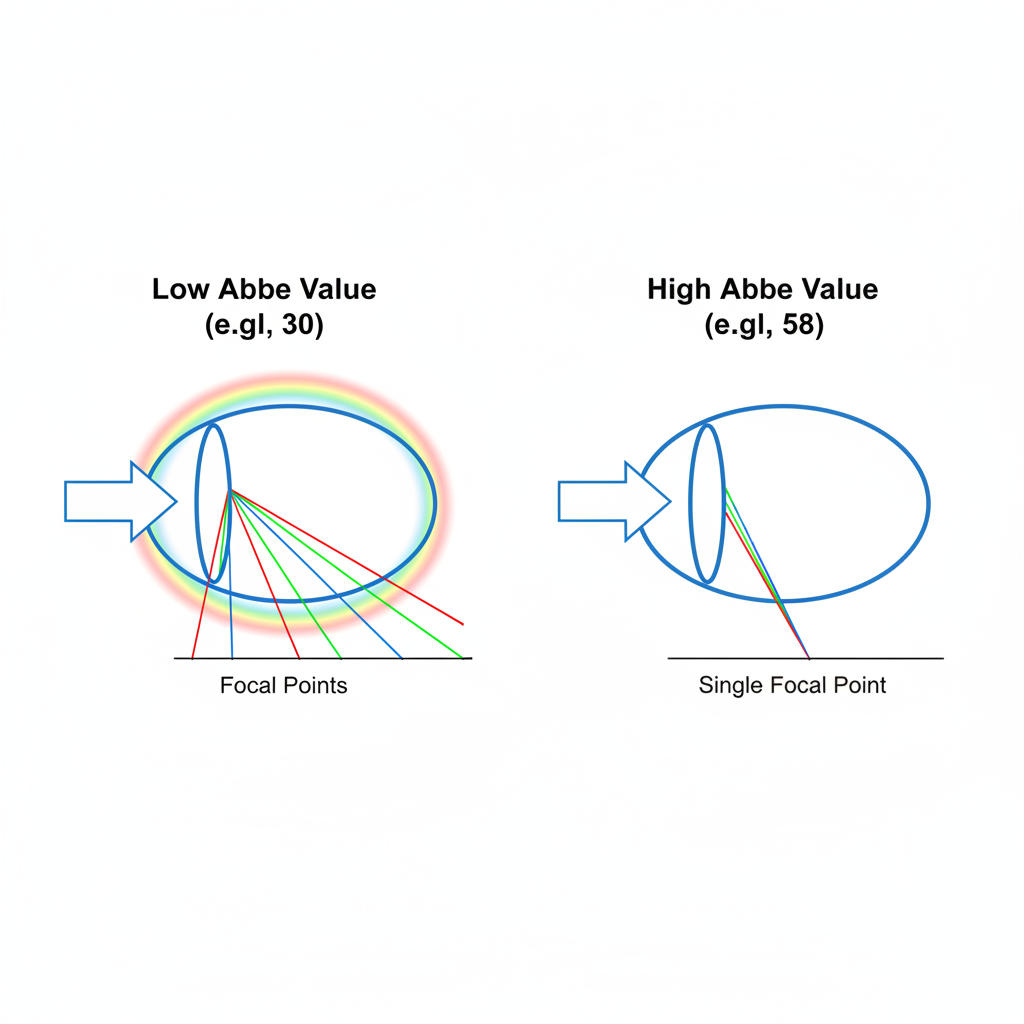
- Abbe Value: Named after physicist Ernst Abbe, this number measures how much the material disperses light into its constituent colors. Think of it as a measure of optical clarity. The relationship is inverse: the lower the Abbe value, the more chromatic aberration a lens will exhibit.
Essentially, as the refractive index goes up, the Abbe value often goes down. This creates a direct trade-off between lens thinness and optical purity. A material with a high Abbe value keeps the different wavelengths of light (red, green, blue) focused together at the same point, resulting in a crisp, color-true image. A material with a low Abbe value allows these wavelengths to separate, causing the colored halos you see in your peripheral vision.
Methodology Note: The Abbe Value (Vd) is calculated using a material's refractive indices at different standard wavelengths of light (nF for blue, nd for yellow, and nC for red). The formula, Vd = (nd - 1) / (nF - nC), quantifies this dispersion. For the wearer, a higher number simply means better color fidelity.
How Common Lens Materials Compare
Not all lenses are created equal. Understanding the properties of different materials is the first step to making an informed choice. Based on industry data and optical principles, here is how common materials stack up:
| Lens Material | Refractive Index | Abbe Value (Approx.) | Key Takeaway |
|---|---|---|---|
| Standard CR-39 Plastic | 1.50 | 58 | The old standard; optically very clear but can be thick for high prescriptions. |
| Trivex | 1.53 | 43-45 | Excellent optics with superior impact resistance. A great choice for many. |
| Polycarbonate | 1.59 | 30 | Extremely impact-resistant (used for safety glasses) but has the worst optical clarity. |
| High-Index 1.60 | 1.60 | 40-42 | Often the "sweet spot," providing a slim profile with good optical performance. |
| High-Index 1.67 | 1.67 | 32 | Significantly thinner and lighter, but color fringing becomes more noticeable. |
| High-Index 1.74 | 1.74 | 33 | The thinnest plastic lens available, for those with very high prescriptions where aesthetics are a top priority. |
As you can see from the table, polycarbonate has a very low Abbe value, which is why many people complain of poor peripheral vision with these lenses, even though they are incredibly safe. Conversely, standard CR-39 has superb optics but isn't a practical choice for higher powers.
Are You Prone to Noticing Chromatic Aberration?
While the physics are constant, not everyone perceives color fringing in the same way. You are more likely to be bothered by it if you fall into one of these categories:
- You Have a High Prescription: The effect is magnified as lens power increases. In practice, opticians observe that wearers with prescriptions stronger than -4.00 diopters of nearsightedness or +2.00 diopters of farsightedness are the most common group to report issues with color fringing.
- You Wear Large Frames: Chromatic aberration is most apparent when you look through the lens away from its optical center. Large, wide frames increase the amount of time you spend looking through the lens periphery, making the color separation much more obvious.
- You Are Visually Sensitive: Some individuals, particularly those in professions that require critical vision like graphic design, engineering, or piloting, are more attuned to optical imperfections and find them more distracting.
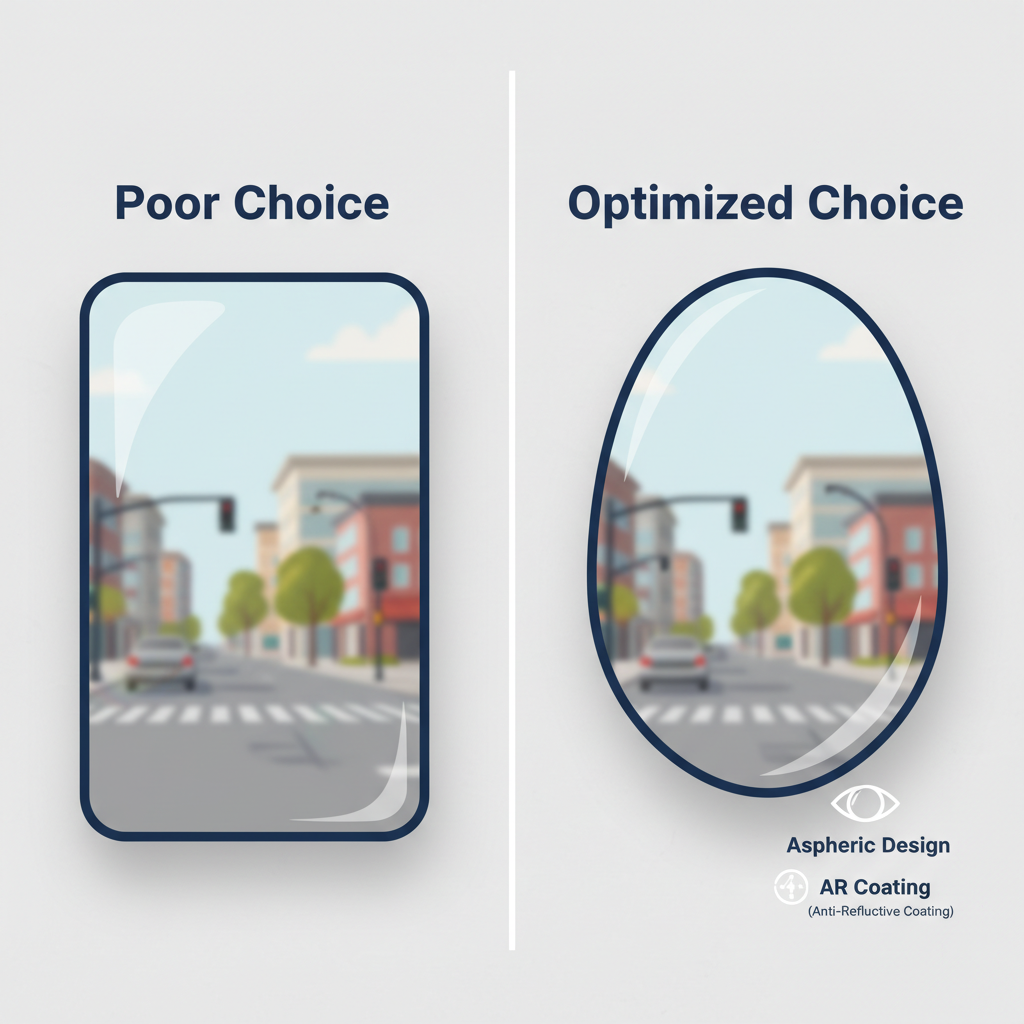
4 Expert Tips to Minimize Color Fringing and Maximize Clarity
If you're concerned about chromatic aberration, the solution isn't to give up on thin lenses. The key is to make intelligent choices about the entire eyewear package—material, design, frame, and coatings. Here’s how to get the best possible vision.
1. Select the "Sweet Spot" Material
Don't automatically request the highest index available. For many people, this is counterproductive. A common rule of thumb used by dispensing opticians is to match the material to the prescription:
- For prescriptions between -3.00 and -6.00 D: A 1.60 high-index lens is often the ideal choice. It offers a significant reduction in thickness compared to standard plastic but has a much higher Abbe value (around 40-42) than 1.67 or 1.74, providing a great balance of aesthetics and optical clarity.
- For prescriptions above -6.00 D: The benefits of a 1.74 high-index lens in reducing weight and thickness may outweigh the slight increase in color fringing. However, this is a conversation to have with your optician, and it should be paired with the right design choices below.
2. Insist on an Aspheric Lens Design
This is one of the most critical and overlooked factors. Traditional "spherical" lenses have a uniform curve like a slice of a ball. Aspheric lenses have a more complex, flatter curvature that changes from the center to the edge. This advanced design minimizes distortions across the entire lens surface, significantly reducing peripheral power errors and, you guessed it, chromatic aberration. A frequent fitting error is placing a high-power 1.67 or 1.74 lens in a large frame without an aspheric design, which is a recipe for maximizing peripheral blur and color fringing.
3. Choose Your Frame Wisely
Since aberration is worst at the edges, the frame itself is a tool to improve your vision. Opt for frames that are smaller and more rounded. This style helps keep your line of sight naturally positioned closer to the optical center of the lens, where vision is truest. A precise fitting is also crucial to ensure the optical center is perfectly aligned with your pupil.
4. Invest in a Premium Anti-Reflective (AR) Coating
While an AR coating cannot change the Abbe value of the lens material, it plays a vital role in reducing the perception of aberrations. High-quality AR coatings prevent light from reflecting off the back surface of the lens into your eye. According to Extra Information, these coatings are particularly effective at mitigating the visual impact of dispersion by cutting down on the internal reflections that make color fringing more pronounced and distracting.
Frequently Asked Questions
-
Is chromatic aberration in my glasses harmful? No, it is not physically harmful to your eyes. It is an optical flaw that can cause visual annoyance, distraction, and sometimes eyestrain or headaches for sensitive individuals.
-
Will I eventually get used to the color fringing? Many people do. Over a week or two, the brain can learn to "tune out" and ignore the peripheral color shifts. This process is called neural adaptation. However, if the effect is severe and impacts your daily activities, it is better to address the root cause with a better lens choice.
-
Why didn't my old glasses have this problem? This is a common question and usually comes down to a change in one of three things: material (e.g., you switched from standard plastic to polycarbonate), frame size (you chose a larger frame this time), or a significant change in your prescription.
-
What should I say to my optician to avoid this? Be proactive. Say, "I am sensitive to color fringing and peripheral blur. I would like to prioritize optical clarity. Can we choose a lens material with a higher Abbe value, like 1.60 or Trivex, and ensure it has an aspheric design?"
By understanding that lens selection is a balance of physics and personal perception, you can make an informed decision that goes beyond just "thinness." Choosing the right combination of material, design, and frame is the key to achieving the comfortable, crystal-clear vision you deserve.
This article is for informational purposes only and does not constitute professional medical advice. Consult with a qualified eyecare professional for any vision-related concerns or before making any decisions about your eyewear.
References
- Hoya Vision Care. "Polycarbonate vs. Trivex: A Technical Comparison." This document details the optical properties, including Abbe value, of different lens materials.
- IOT. "Understanding the Abbe Value in Lens Design." This article provides a technical explanation of the Abbe value and its importance in ophthalmic optics.


