












How to Measure Your Nose Bridge for Glasses
Unlock the secret to a perfect online glasses purchase by learning how to measure your nose bridge at home. This simple, step-by-step guide provides practical instructions to help you understand your dimensions and choose frames that won't slip.
TL;DR: Your Quick Guide to Measuring Your Nose Bridge
- The Goal: Measure the width of your nose where your glasses will sit, typically about 10-15mm below your pupils.
- Best Method (Ruler): Use a mirror and a millimeter ruler. Hold the ruler across your nose bridge and measure the distance between the points where the frame's nose pads should comfortably rest.
- The Expert Secret: Consistency is key. User error is more common than tool inaccuracy. To get the most reliable number, measure three times during different parts of the day (morning, afternoon, evening) and use the middle value.
- If You're Between Sizes: Always size up. It's easier to tighten a frame with adjustable nose pads than to endure the pinching of a frame that is too narrow.
Why Your Nose Bridge Measurement Is Crucial for a Perfect Fit
When you buy glasses, the frame rests on three key points: your left ear, your right ear, and the bridge of your nose. While the temple arms provide stability, the nose bridge bears the majority of the frame's weight. An incorrect bridge fit is the number one cause of common frustrations like glasses constantly slipping down your face or leaving painful red marks.
Think of it as the chassis of a car. If the support structure isn't aligned with the body, the entire vehicle becomes unstable. In the same way, a frame's bridge must match your unique anatomy. According to The Vision Council, eyeglass manufacturing is a process of precision, where millimeters dictate comfort and function. A frame with a bridge that is too wide for you will lack support and slide down, forcing you to constantly push it back up. Conversely, a bridge that is too narrow will pinch the nose, causing discomfort and potentially altering the optical alignment of your lenses.
This measurement ensures the lenses are positioned correctly in front of your eyes, a factor that is critical for clear vision, especially with progressive or high-power prescriptions. A poor fit can shift the optical center of the lens, leading to eye strain and headaches.
The Best At-Home Method for Measuring Your Bridge Width
While there are several ways to estimate your size, the most reliable at-home technique requires just a mirror and a simple tool. Here’s our recommended approach.
The Mirror and Ruler Method: A Step-by-Step Guide
This method provides a precise measurement in millimeters, which directly corresponds to the bridge size listed on eyeglass frames.
- Find a Well-Lit Space: Stand in front of a mirror with good, even lighting to see clearly.
- Position Your Tool: Take a flexible sewing ruler or a straight ruler with millimeter (mm) markings. If you don't have one, you can print a paper ruler online—just be sure to scale it correctly.
- Look Straight Ahead: Gaze directly into the mirror, keeping your head level.
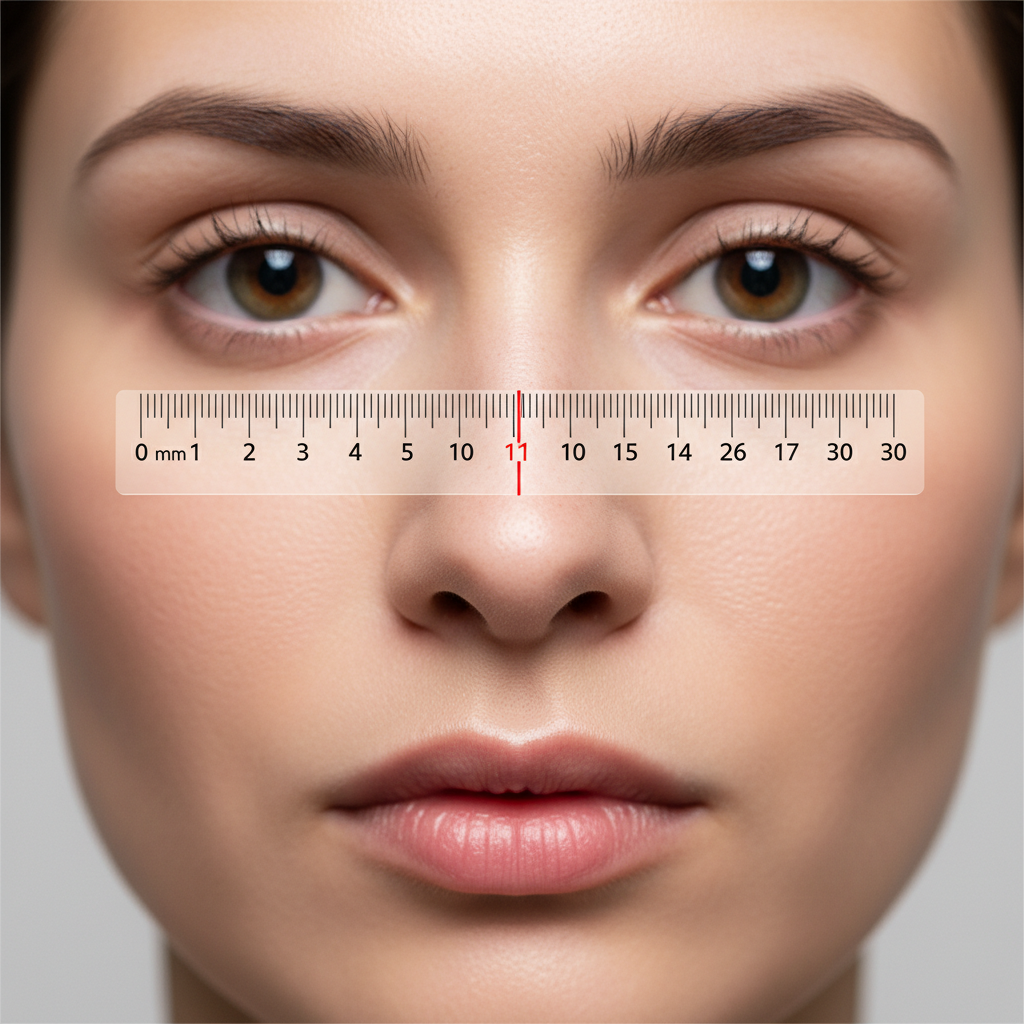
- Place the Ruler: Position the ruler across the bridge of your nose, approximately level with where your pupils are. The measuring edge should be where the glasses would naturally rest.
- Identify the Measurement Points: You are measuring the flattest, uppermost part of your nose on either side. This is the spot where the nose pads of a frame will sit. It is not the widest part of your nostrils.
- Read the Measurement: Record the distance in millimeters between these two points. This number is your bridge width.
The Expert's Secret to Accuracy: Overcoming Common Measurement Mistakes
In our experience as optical specialists, the most significant source of error in at-home measurements isn't the tool—it's inconsistency in how the measurement is taken. A slight angle or a bit of extra pressure can create a 2-3 mm variance, which is enough to compromise the fit.
Here are the professional "gotchas" to be aware of:
- The "Rule of Three" Heuristic: Nasal tissue can swell slightly throughout the day due to hydration and activity. To account for this, we advise taking three separate measurements: one in the morning, one in the afternoon, and one in the evening. Discard any outliers and use the median (middle) value as your most reliable measurement.
- When in Doubt, Size Up: If your measurement falls between two standard frame sizes (e.g., your bridge is 19 mm, and you're choosing between an 18 mm and 20 mm frame), it is almost always safer to choose the larger size (20 mm). This is especially true for metal frames with adjustable nose pads, as an optician can easily narrow the fit. It is impossible to widen a plastic frame that is pinching your nose.
- Beware of Parallax Error: When you look down at a ruler on your nose, the viewing angle can make the measurement appear different. Try to keep the ruler perfectly horizontal and read it while looking straight into the mirror. Taking a well-lit, high-resolution selfie with the ruler in place can help you read it more accurately.
Beyond Width: Understanding Low Bridge and "Asian Fit"
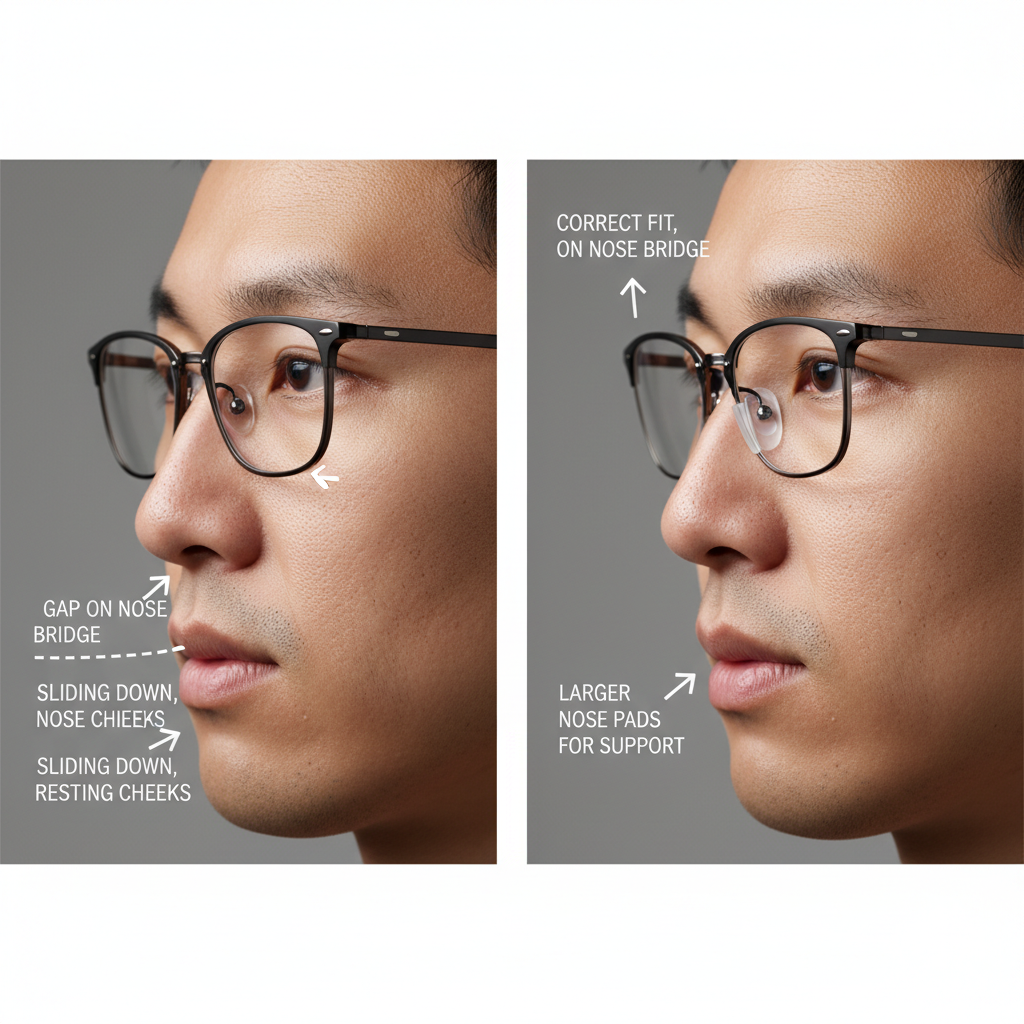
A standard bridge measurement only tells part of the story. For many individuals, especially those of East Asian descent or anyone with a less prominent nasal bridge, the height of the bridge is as important as its width. This is where "Low Bridge Fit" (also known as Asian Fit or Omni Fit) comes in.
You likely have a low nose bridge if:
- The bridge of your nose is level with or sits below your pupils.
- Standard frames tend to slide down your nose.
- The lenses of your glasses often rest on your cheeks.
- You find yourself tilting your head back to see through your lenses correctly.
Low bridge frames are engineered with specific modifications to solve these issues:
- Larger & Angled Nose Pads: They provide more surface area for support, preventing the frame from slipping.
- Reduced Pantoscopic Tilt: The frames have a flatter vertical angle, which keeps the bottom of the lenses from touching your cheeks.
- Wider Bridge with a Lower Set: The bridge itself is built to sit securely on a less prominent nasal slope.
For shoppers considering this fit, the critical measurement isn't just width but also the vertical distance from the pupil center to the point where the frame should comfortably sit. Many online shoppers overlook this depth, leading to frames that still rest on their cheeks. When in doubt, look for frames explicitly designed with these features.
How Your Bridge Measurement Translates to a Frame's Dimensions
When you browse for glasses online, you'll see a series of three numbers, such as 52-18-140. According to the Cleveland Clinic's guide on reading prescriptions, understanding these numbers is key to a good fit.
- 52 (Lens Width): The horizontal width of one lens in millimeters.
- 18 (Bridge Width): The distance between the lenses (DBL) in millimeters. This is the number that should correspond to your nose bridge measurement.
- 140 (Temple Length): The length of one of the arms of the frame.
Your personal bridge measurement should be within 1-2 mm of the frame's listed bridge width. Use this table as a general guideline:
| Your Personal Measurement | Recommended Frame Bridge Width | Fit Profile |
|---|---|---|
| 14 mm – 16 mm | 15 mm – 17 mm | Narrow Bridge |
| 17 mm – 19 mm | 18 mm – 20 mm | Average Bridge |
| 20 mm – 23 mm | 21 mm – 24 mm | Wide Bridge |
Remember the "size up" rule if you fall in between. A frame with an 18mm bridge will likely fit someone with a 17mm or 18mm measurement, but it might be too tight for a 19mm bridge.
Frequently Asked Questions (FAQ)
Q: Do metal frames or plastic frames fit differently? A: Absolutely. Most metal frames have adjustable nose pads, which offer a highly customizable fit. An optician can move them up, down, wider, or narrower. Most plastic (acetate) frames have a fixed, molded bridge, which makes getting the initial measurement correct far more critical.
Q: What if my nose is asymmetrical? A: This is very common. We recommend using a frame with adjustable nose pads, as they can be set to different heights and widths to accommodate asymmetry. If choosing a fixed bridge, you may need to try on different styles to see which one sits most evenly.
Q: Can I just use the bridge measurement from my old glasses? A: Yes, this is an excellent starting point. The bridge width is usually printed on the inside of the temple arm or on the bridge itself. However, keep in mind that different frame styles sit differently. For example, a heavy, oversized frame may feel less secure with the same bridge width as a lighter, smaller frame. If you're changing styles, re-measuring is always a good idea.
Q: My glasses keep slipping no matter what. What else can I check? A: If your bridge fit is correct, slipping is often caused by other fit issues. Ensure your frame width is appropriate for your face and that the temple arms are the correct length and properly adjusted.
Disclaimer: This article is for informational purposes only and does not constitute professional medical advice. For a complete assessment of your vision and fit needs, please consult a qualified optician or ophthalmologist, especially if you have complex prescription requirements or pre-existing conditions.
References
- The Vision Council: "How Prescription Glasses and Contact Lenses Are Made" - https://thevisioncouncilfoundation.org/protect-your-eyes/how-prescription-glasses-and-contact-lenses-are-made-crafting-your-perfect-eyewear/
- Cleveland Clinic: "How to Read Your Eye Prescription" - https://health.clevelandclinic.org/how-to-read-your-eye-prescription
- American Academy of Ophthalmology (AAO): "Tips for Choosing the Right Reading Glasses" - https://www.aao.org/eye-health/glasses-contacts/tips-choosing-right-reading-glasses


