











How to Measure Your PD at Home for a Perfect Fit
Getting Your Prescription Glasses Right: A Guide to Measuring Your Pupillary Distance
Ordering glasses online offers incredible convenience and value, but one crucial measurement stands between you and a perfect pair: your Pupillary Distance (PD). This number ensures the optical center of your lenses aligns perfectly with your pupils. An incorrect PD can lead to eye strain, headaches, and blurry vision.
I’ve seen many people feel anxious about taking this measurement themselves, worried they’ll get it wrong. The good news is that it’s a straightforward process you can do at home with a high degree of accuracy. This guide will walk you through two reliable methods, step-by-step, and provide expert tips to ensure you get it right the first time.
TL;DR: Your Quick Guide to Measuring PD
What it is: Pupillary Distance (PD) is the distance in millimeters between the centers of your pupils.
Why it matters: It centers your prescription lenses correctly in front of your eyes for clear, comfortable vision.
How to measure: You can use a mirror and a millimeter ruler or have a friend help you take a specific type of photo.
Key to accuracy: Always measure multiple times, keep the ruler or camera level with your eyes, and look straight ahead into the distance.
Understanding Pupillary Distance (PD) and Why It's Critical
Before we start measuring, let’s clarify what PD is and why it’s a non-negotiable part of your prescription details.
What Exactly is Pupillary Distance?
As defined by health resources like the Cleveland Clinic, Pupillary Distance is the measurement from the center of one pupil to the center of the other. You might see it written in two ways:
Single PD: A single number, like "63 mm," representing the total distance between your pupils. This is common for most single-vision prescriptions.
Dual PD (or Monocular PD): Two numbers, like "31.5/31.5," representing the distance from the bridge of your nose to the center of each pupil individually. This is essential for progressive lenses and high-power prescriptions where precision is paramount.
Your eye doctor measures your PD during an exam. However, they sometimes leave it off the prescription slip they hand you. It's important to know your rights. The Federal Trade Commission's Eyeglass Rule mandates that your eye doctor must provide you with your prescription, but the release of the PD measurement can be a gray area. Fortunately, you can measure it yourself.
Why Accuracy is Everything
Every prescription lens has an "optical center," the specific point that provides the truest vision. For your glasses to work correctly, this optical center must be aligned directly in front of your pupil. The entire process of crafting lenses, as detailed by organizations like The Vision Council, is a precision science. If the PD is off by even a few millimeters, you'll be looking through a less-optimal part of the lens.
This misalignment forces your eyes to work harder to focus, potentially causing:
Headaches
Eye strain and fatigue
Distorted or blurry vision
A "swim" or dizzy feeling
The stronger your prescription, the more sensitive your eyes will be to an incorrect PD.
Method 1: The Mirror and Ruler Method
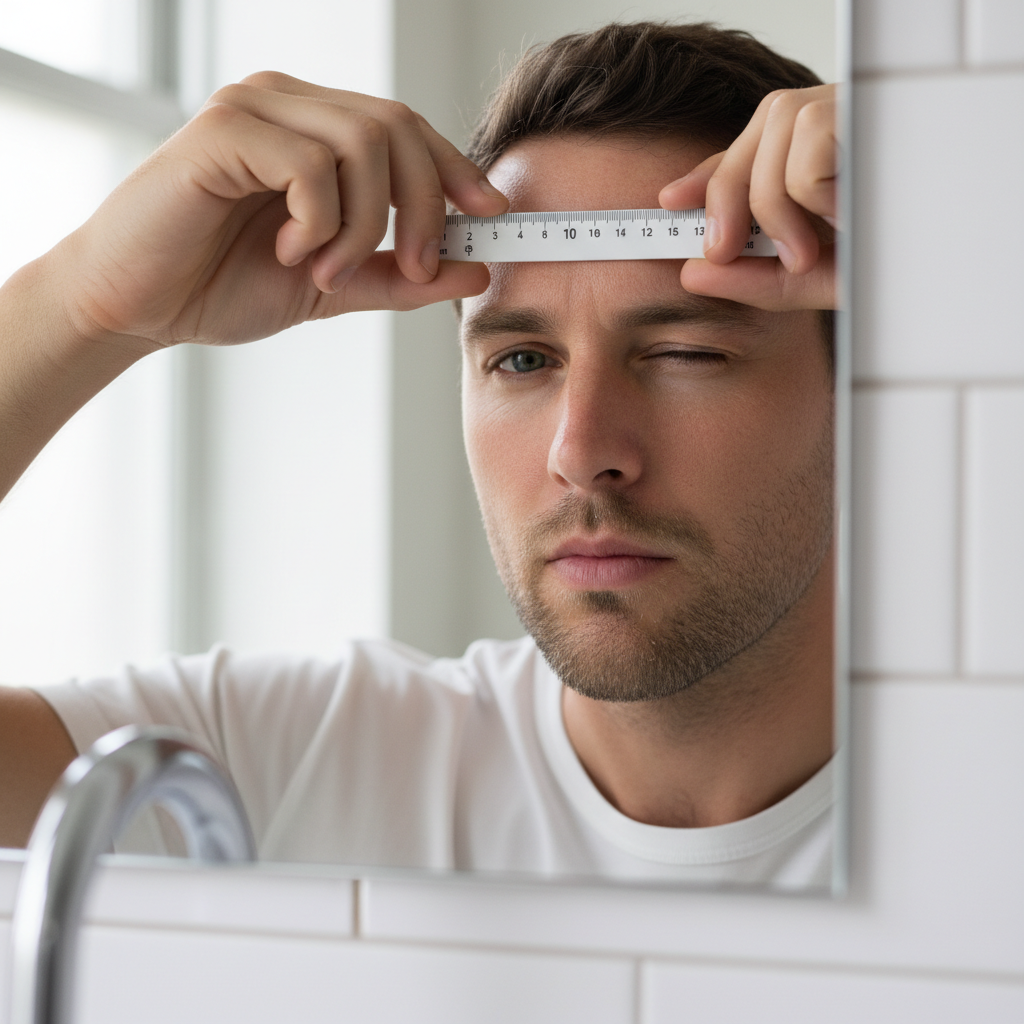
This is the most common and reliable way to measure your own PD. All you need is a mirror and a ruler with millimeter markings.
Step-by-Step Instructions:
Stand and Face a Mirror: Stand about 8 inches (20 cm) away from a mirror in a well-lit room.
Position the Ruler: Hold the ruler horizontally against your brow. Don't press it against your eyes.
Close Your Right Eye: Close your right eye and look directly into your left eye in the mirror. Align the "0 mm" mark of the ruler with the center of your left pupil. Keep the ruler steady.
Close Your Left Eye: Now, without moving the ruler, close your left eye and look directly into your right eye.
Read the Measurement: The millimeter mark that lines up with the center of your right pupil is your Single PD.
Repeat for Accuracy: A common mistake is measuring only once. I always recommend taking three separate measurements and using the average to ensure consistency. If you get 62 mm, 63 mm, and 62 mm, your most reliable PD is 62 mm.
Method 2: The Photo Method (With a Friend's Help)
This method is also very accurate if done correctly and is useful if you have trouble keeping the ruler steady in the mirror method.
Step-by-Step Instructions:
Find a Friend and a Reference Card: Ask a friend to take a photo of you. You will also need a standard-sized card with a magnetic strip (like a credit card or library card) to use for scale. The standard width of these cards is 85.6 mm.
Position Yourself: Sit or stand with your head straight. Look straight ahead at something approximately 10-20 feet away. Do not look at the person taking the photo. This relaxes your eyes and mimics a natural gaze.
Position the Card: Hold the card flat against your forehead. It's critical that the card is in the same plane as your eyes, not tilted.
Take the Photo: Have your friend stand about 5 feet away and take a photo of your face from the chest up. The most common error here is taking the photo from an angle. Ensure the camera is directly at your eye level—not from above or below. The photo should be in focus and well-lit.
Use an Online Tool or Measure Manually: You can now use this photo with an online PD measurement tool, which will use the card for scale to calculate your PD automatically. Alternatively, you can analyze the photo on a computer screen to measure the pixels and scale it yourself, though this is more advanced.
Pro Tips for a Perfect Measurement
Getting a precise PD is about controlling the variables. Here are the key details that professional opticians focus on, which you can apply at home.
| Best Practice | Why It Matters | Expert Tip |
|---|---|---|
| Measure 3 Times | Reduces random error and confirms a consistent reading. | Average your three measurements. If one is wildly different, discard it and measure again. |
| Maintain Eye Level | Prevents parallax error, where the camera or your viewing angle distorts the measurement. | Whether using a mirror or a camera, ensure your line of sight is perfectly level with your pupils. |
| Look Into the Distance | Your PD for distance vision is slightly wider than for near vision. Glasses are typically set for distance. | Focus on an object at least 10 feet away when your picture is being taken. |
| Use the Pupil Center | A common mistake is using the edge of the iris or an eyebrow as a landmark. | Always aim for the absolute center of your pupil, the black circle in the middle of your eye. |
Debunking a Common Myth: "A Millimeter or Two Doesn't Matter"
You might hear that being off by a millimeter is no big deal. For very mild prescriptions, you might not notice a small error. However, this is not true for everyone. For prescriptions stronger than ±4.0D or for any type of multifocal or progressive lens, precision is critical. Opticians work with a tight tolerance of ±1 mm for single-vision lenses and an even tighter ±0.5 mm for progressives. An error beyond this can compromise the effectiveness of your glasses.
Troubleshooting and When to See a Professional
Even with a perfect PD, your new glasses might feel strange at first. However, if you experience persistent issues, it could point to a measurement error.
Horizontal Blur or "Pulling": If vision feels blurry side-to-side or your eyes feel pulled outward or inward, the PD is the most likely culprit. Double-check your measurement.
Vertical Blur or "Swim": If the world feels like it's tilting or swimming, especially in progressive lenses, this often points to an incorrect fitting height, which is a vertical measurement that must be taken in person by an optician.
While at-home PD measurement is reliable for most single-vision glasses, you should always have your PD measured professionally if you:
Have a very high or complex prescription.
Are ordering progressive or bifocal lenses.
Have a known condition like strabismus (crossed eyes) that requires prism correction.
Wrapping Up: Key Takeaways
Measuring your PD at home is an empowering step toward buying glasses online confidently. By being meticulous and following the correct procedure, you can provide the accurate measurement needed to craft a pair of glasses that are comfortable and optically precise.
Remember these core principles:
Your PD is essential for aligning the optical center of your lenses.
Measure at least three times and average the results for consistency.
Keep your measuring tool (ruler or camera) perfectly level with your eyes.
For complex prescriptions or multifocal lenses, a professional measurement is the safest choice.
Frequently Asked Questions (FAQ)
What is a normal PD range?For adults, the average PD range is between 54 mm and 74 mm. For children, it's typically between 43 mm and 58 mm.
Can I use someone else's PD measurement?No. PD is unique to your facial structure, just like a fingerprint. Using someone else's PD will result in misaligned lenses and eye strain.
What is the difference between single PD and dual PD?Single PD is the total distance between your pupils. Dual PD measures from the center of your nose bridge to each pupil separately. Dual PD is more precise and necessary for progressive lenses.
Does my eye doctor have to give me my PD?According to the FTC's Eyeglass Rule, your doctor must give you your prescription after an exam. While the PD is technically part of your measurement data, its release is not always enforced in the same way. It is always best to ask for it specifically at the end of your exam.
Disclaimer: This article is for informational purposes only and does not constitute professional medical advice. The methods described are for measuring your own Pupillary Distance for the purpose of ordering eyeglasses. Consult a qualified optometrist or ophthalmologist for a comprehensive eye exam and for complex prescriptions, especially if you have pre-existing eye conditions.


