










Harsh Classroom Lighting: Choosing Lenses for Campus Life
TL;DR: Your Quick Guide to Beating Classroom Glare
- Problem: Harsh fluorescent lights in lecture halls cause eye strain, headaches, and fatigue by creating intense glare and visual "noise."
- Solution 1: Anti-Reflective (AR) Coating: This is your first and most crucial line of defense. A high-quality, multi-layer AR coating eliminates distracting reflections from both the front and back of your lenses.
- Solution 2: Specialized Tints: For persistent headaches or light sensitivity, an FL-41 tint is scientifically designed to filter the specific blue-green light waves emitted by fluorescent bulbs, providing significant relief.
- Solution 3: The Right Lens Material: If you have a strong prescription (above +/-4.00), choosing a high-index lens material (like 1.67 or 1.74) is essential. It makes lenses thinner, lighter, and drastically reduces internal reflections that cause glare.
Long nights in the library, early morning lectures, and hours spent staring at screens—campus life is a marathon for your eyes. But often, the most draining environment isn’t a textbook or a laptop; it’s the classroom itself. The constant buzz and harsh, unforgiving glare of overhead fluorescent lighting can turn a 90-minute lecture into a battle against eye strain, fatigue, and splitting headaches.
If you find yourself squinting, feeling drained, or leaving class with tired, sore eyes, you are not alone. This discomfort is a direct response to a challenging visual environment. The good news is that modern lens technology offers specific, powerful solutions designed to filter out the static and help you focus on what matters: your education.
This guide will walk you through the exact lens features that can transform your classroom experience, from advanced coatings that cut glare to specialized tints that calm your eyes.
Why Classroom Lighting Is a Unique Challenge
Unlike the warm, ambient light in a coffee shop or the natural light from a window, the fluorescent lighting common in universities and schools presents a unique set of problems for our eyes. According to the American Academy of Ophthalmology, prolonged focus in such conditions can lead to a cluster of symptoms often called Digital Eye Strain or Computer Vision Syndrome, even without a screen present.
Here’s what’s happening:
- Intense Glare: Fluorescent bulbs cast a broad, unfocused light that reflects off every surface—your desk, your notebook, and most importantly, your eyeglass lenses. This creates points of intense light that your eyes struggle to process.
- Invisible Flicker: Most fluorescent lights flicker at a rate that is too fast for you to consciously perceive, but your brain and eye muscles still try to keep up. This rapid, subconscious adjustment is a significant source of fatigue and can trigger headaches in sensitive individuals.
- Specific Wavelengths: These lights emit strong peaks in the blue and green portions of the light spectrum. For some people, particularly those prone to migraines, these specific wavelengths are known triggers for photophobia (light sensitivity) and headache.
Together, these factors create a form of visual "noise" that forces your visual system to work overtime, diverting cognitive resources away from learning and focus.
The First Line of Defense: Multi-Layer Anti-Reflective Coating
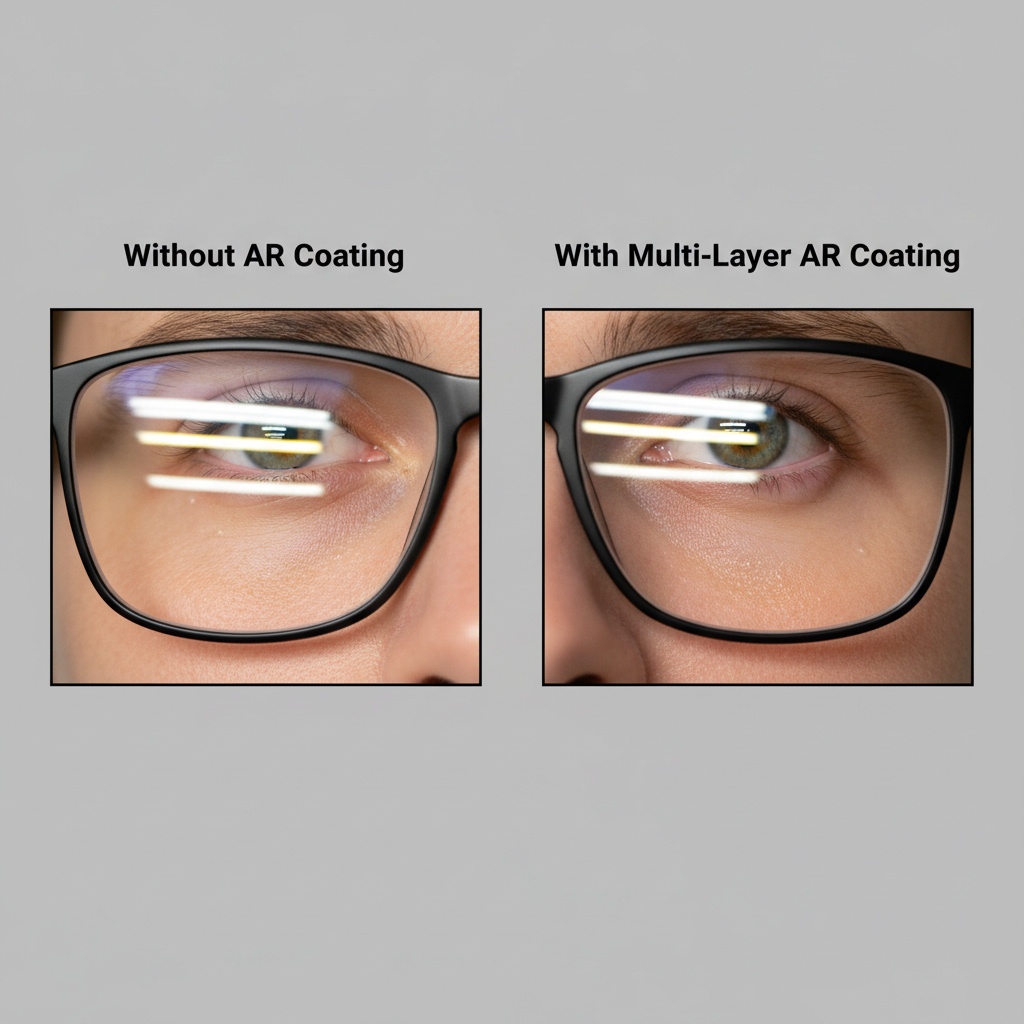
If you only choose one feature to combat classroom glare, make it a high-quality anti-reflective (AR) coating. Think of it as noise-cancellation for your eyes.
An AR coating is a microscopically thin series of layers applied to the lens surface that allows more light to pass through the lens directly to your eye. This serves two critical functions:
- It Eliminates Surface Glare: It cuts the reflections from overhead lights that bounce off the front of your lenses, making your vision clearer and more comfortable.
- It Prevents Back-Surface Reflections: This is a non-obvious but major source of eye strain. Light from behind you (like a window or another light fixture) can hit the back of your lenses and reflect directly into your eyes. A good AR coating neutralizes this, eliminating that distracting "ghost" image.
Expert Insight: Not All AR Coatings Are Created Equal A common issue with basic, single-layer AR coatings is that they often fail to eliminate a secondary, greenish reflection from intense overhead fluorescents. This can be just as distracting as the primary glare. A multi-layer AR coating is engineered to cancel out a much broader spectrum of light, ensuring a clearer, more comfortable visual experience without distracting color fringes. For a lecture hall environment, investing in a premium multi-layer coating is one of the most effective upgrades you can make.
Beyond Glare: Specialized Tints for Light Sensitivity
For some students, especially those who suffer from regular headaches or migraines, even a great AR coating isn't enough. If you are highly sensitive to fluorescent lights, the problem isn't just the glare—it's the light itself. This is where specialized tints come in.
Unlike sunglasses, which darken the entire world, therapeutic tints are designed to selectively filter out the most problematic wavelengths of light without compromising your overall vision. The most effective tint for this purpose is FL-41.
Developed specifically to help migraine sufferers manage photophobia, FL-41 has a distinct rosy hue. Its function is to absorb a significant portion of the blue-green light wavelengths that are prominent in fluorescent lighting and are known to trigger eye strain and headaches. For many users, the effect is a calming sensation, as if the visual "volume" in the room has been turned down.

A Note on Fit: Why Vertex Distance Matters The effectiveness of a therapeutic tint like FL-41 can be influenced by "vertex distance"—the space between the back of the lens and your eye. If glasses sit too far from your face, more unfiltered light can leak in from the sides and top. This is a frequent issue with one-size-fits-all frames purchased online. Ensuring your frames are properly adjusted to sit closer to your face will maximize the tint's protective benefits.
Lens Material and Thickness: The Unseen Factor in Glare
When dealing with glare, the material and thickness of your lenses play a surprisingly important role, especially for students with moderate to high prescriptions.
If your prescription is stronger than +/-4.00 diopters, your standard plastic (CR-39 or 1.50 index) lenses will be visibly thick. This thickness can create its own set of problems:
- Internal Reflections: Light can enter the edge of a thick lens and bounce around inside it before reaching your eye, creating distracting reflections that an AR coating can't fully eliminate.
- Distortion: Thick lenses can cause visual distortion, which you may have noticed if you’ve ever wondered, "Will strong prescription lenses distort my eyes?". This forces your brain to work harder to interpret images.
This is why high-index lens materials are so beneficial. Materials with a higher refractive index (like 1.67 or 1.74) bend light more efficiently. This means the same prescription can be achieved with a much thinner, flatter, and lighter lens. For wearers with strong prescriptions, prioritizing a high-index material can provide more comfort than any other single feature by fundamentally reducing the potential for internal reflections and distortion.
FAQ: Quick Answers for Campus Life
Q: Can I just use my blue light blocking glasses for classroom glare?
A: While they can help, glasses designed to filter blue light from screens are not optimized for the broad-spectrum glare of overhead lights. An anti-reflective coating is far more effective for glare, and an FL-41 tint is more targeted for fluorescent-induced headaches. For more on this, you can learn about how to add blue light filtering to prescription lenses and the general symptoms of digital eye strain.
Q: Are sunglasses a good option for indoor light sensitivity?
A: No. Wearing sunglasses indoors can actually make your eyes more light-sensitive over time (a process called dark adaptation). It also strains your eyes by making it harder to see and can be socially awkward. The goal is to filter specific, harsh light—not block all light.
Q: Is it worth paying more for these features?
A: Investing in the right lens technology is an investment in your academic performance and well-being. The cost of a multi-layer AR coating or a high-index material is minimal compared to the daily struggle with headaches and fatigue that can derail your studies.
Your Prescription for Academic Success
Navigating the demands of higher education is challenging enough without having to fight your environment. By making informed choices about your eyewear, you can eliminate a significant source of daily discomfort and cognitive drain.
Focus on a high-quality multi-layer AR coating as your foundation. If you have a strong prescription, make high-index lenses your priority. And if you struggle with headaches and light sensitivity, an FL-41 tint could be a life-changing addition. By tailoring your lenses to the unique challenges of the classroom, you free up your eyes—and your mind—to focus on what truly matters.
Disclaimer: This article is for informational purposes only and does not constitute professional medical advice. Please consult with a qualified eye care professional to determine the best lens solutions for your specific health needs and prescription.
References
- American Academy of Ophthalmology (AAO) on Digital Eye Strain. Sourced from general ophthalmology guidelines on eye health and computer use.
- Cleveland Clinic on Reading Prescriptions. Information on lens terminology and prescription strength. health.clevelandclinic.org/how-to-read-your-eye-prescription
- Ferris State University on High Index Lenses. Explanations of the physical properties and benefits of high-index materials. www.ferris.edu/optometry/patient-care/lensmaterial/high-Index-Lenses.htm


