




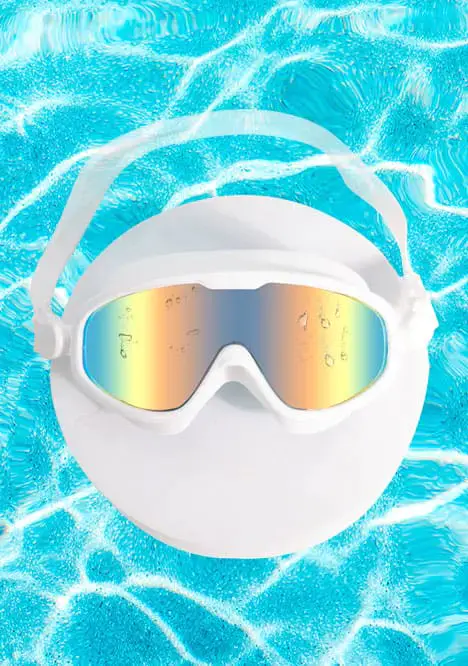
Light-Tint Lenses for Overcast Days & Evenings
Rethinking Eyewear: Beyond Bright Sunshine
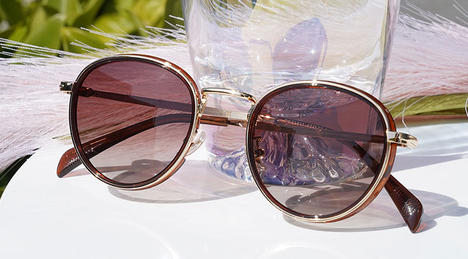
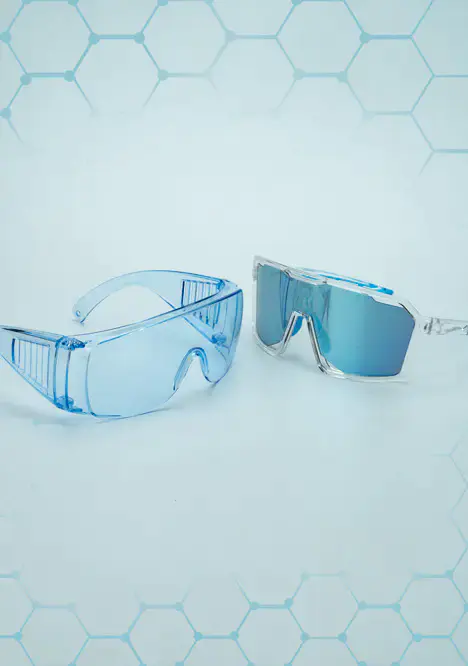
You don't need a blazing sun to benefit from a great pair of sunglasses. While dark lenses are essential for bright days, a different class of eyewear shines when the sky is gray: light-tint lenses. These versatile lenses, often in shades of yellow, rose, or even light blue, are engineered to enhance vision in low-light or challenging conditions. They work by filtering specific wavelengths of light to improve contrast and reduce glare, making them an indispensable tool for overcast days, driving at dusk, or navigating the city in the evening.
Think of them not as sunglasses, but as light-filtering glasses. They are designed to make your environment appear sharper and more defined when the light is flat and scattered, providing comfort and clarity when you need it most.
TL;DR: Your Guide to Light-Tint Lenses
- Purpose: Enhance contrast and reduce glare in low-light conditions, not just block sun.
- Key Metric: Look for Visible Light Transmission (VLT). For overcast days or evenings, a lens that transmits 75-90% of light (10-25% VLT filtering) is ideal. Anything that blocks more than 70% of light is often too dark for these conditions.
- Best Tints for Contrast: Yellow and rose tints are excellent for making details pop in flat or foggy light, which is particularly useful for driving.
- Night Driving Essential: An Anti-Reflective (AR) coating is non-negotiable for evening or night use to cut glare from headlights and streetlights.
The Science of Seeing Better in Low Light
The magic of a light-tint lens isn't about making the world darker; it's about making it clearer. This is achieved by manipulating contrast and managing the amount of light that reaches your eye.
It's All About Contrast, Not Just Darkness
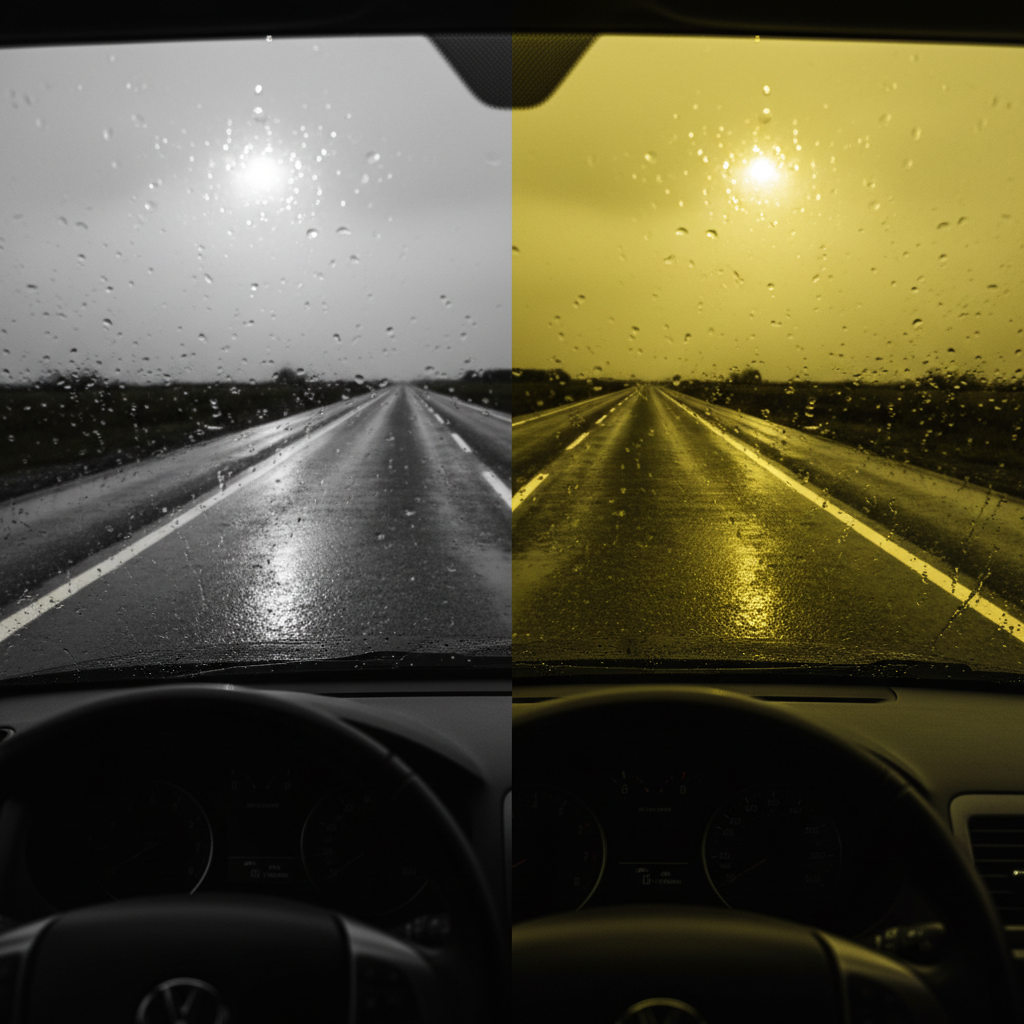
On a gray, overcast day, light is scattered and uniform, which can make it difficult to distinguish between shapes and objects. This is often referred to as "flat light." Light-tinted lenses, particularly in the yellow-to-rose spectrum, work by filtering out a portion of the blue light that is prevalent in these conditions. As the Cleveland Clinic notes, amber and brown lenses are known to enhance contrast. This selective filtering makes the remaining light spectrum appear sharper, causing details like road markings, potential hazards, and changes in terrain to stand out more vividly.
Understanding Visible Light Transmission (VLT)
Visible Light Transmission (VLT) is a crucial measurement that tells you what percentage of visible light a lens allows to pass through to your eye. A lower VLT number means a darker lens.
- Bright Sun (Standard Sunglasses): 10-20% VLT
- Low Light & Overcast (Light Tints): 25-80% VLT
- Clear Lenses: 90%+ VLT
A common mistake is choosing a lens that is too dark for the intended use. For driving on an overcast day or during twilight, a lens with a VLT above 30% (meaning it blocks less than 70% of light) is generally recommended. A lens darker than this can dangerously reduce visibility, a critical consideration for any activity that requires sharp vision.
Choosing Your Tint: A Practical Guide to Lens Colors
Different colors excel in different environments. This table breaks down the strengths and weaknesses of the most common light-tint options.
| Lens Color | Primary Benefit | Best For | Potential Drawbacks |
|---|---|---|---|
| Yellow / Amber | Maximum contrast enhancement | Driving in fog, haze, or overcast conditions; evening driving. | Can cause significant color distortion. |
| Rose / Copper | Good contrast, soothing to the eyes | Variable, partly cloudy days; everyday use in flat light. | Moderate color distortion. |
| Light Gray / Green | Neutral color perception | Driving and general use where color accuracy is important. | Less contrast enhancement than yellow or rose. |
| Light Blue | Reduces glare, high-fashion | Computer use, reducing glare from digital screens, stylish for city wear. | Can reduce contrast for some users. |
According to the American Optometric Association, gray lenses are a top choice for driving because they provide the most accurate color recognition. While yellow lenses boost contrast, they can make it harder to distinguish traffic light colors, a trade-off you must consider.
Real-World Scenarios: When to Wear Light-Tint Lenses
These lenses are specialized tools. Knowing when to use them unlocks their full potential.
Overcast and Foggy Day Driving
This is where yellow and rose lenses truly excel. By cutting through haze and sharpening the contrast between the road and the markings, they can reduce eye strain and improve reaction time. On a long drive under a monotonous gray sky, this added definition can make the experience significantly more comfortable and safer. For more on this topic, see our guide to UV Protection Sunglasses for Driving: A Safety Must.
Evening and Night Driving
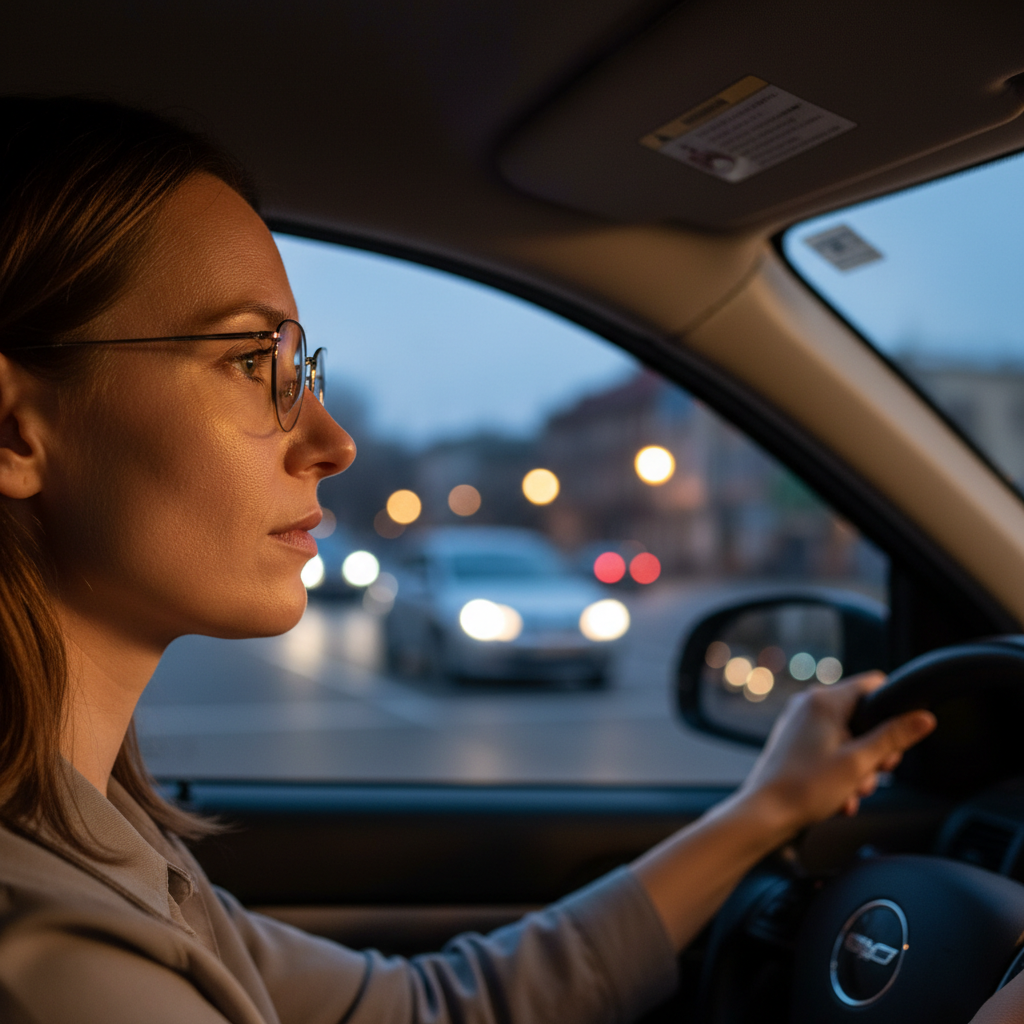
For driving after sunset, the primary challenge is glare from artificial sources like headlights and street lamps. Here, a very light-tint lens with a high-quality Anti-Reflective (AR) coating is essential. The tint helps with ambient light, but the AR coating is what does the heavy lifting, minimizing the distracting starbursts and reflections that can impair vision. A lens without an AR coating can actually make night driving worse by creating internal reflections off the back surface of the lens.
Indoor and Social Use
Lightly tinted lenses have also become a popular style accessory for indoor and evening social settings. A light blue or rose tint can soften harsh overhead lighting and reduce the perceived "visual noise" in a busy environment. They offer a subtle way to manage light sensitivity without resorting to dark sunglasses indoors.
Expert Advice & Common Pitfalls
Getting the most out of your eyewear means avoiding common mistakes and investing in the right features.
Myth Debunked: Darker Tints Are Not Better for Low Light
One of the most dangerous misconceptions is that a darker lens provides better protection or performance in all conditions. As detailed in our article, Are Darker Sunglass Lenses More UV Protective?, tint color has no bearing on UV protection. Furthermore, wearing lenses that are too dark in low-light situations severely restricts the amount of information reaching your eyes, compromising safety during activities like driving. Always choose a VLT appropriate for the ambient lighting conditions.
Pro Tip: Prioritize Anti-Reflective (AR) Coatings
I cannot overstate the importance of a good AR coating, especially for evening use. Much of the distracting glare at night comes from light sources behind you—like the headlights of a car in your rearview mirror—reflecting off the back surface of your lenses and into your eyes. An AR coating neutralizes these reflections, providing a clearer, less obstructed view. It's a feature that materially improves visual comfort and safety under artificial lighting.
Wrapping Up: Key Takeaways
Light-tint lenses are a sophisticated and practical addition to any eyewear collection. They prove that the right glasses are about more than just blocking the sun—they're about controlling light to create the best possible visual experience in any condition.
- Match the Lens to the Light: Use yellow or rose tints to boost contrast on overcast days.
- Check the VLT: For low-light use, ensure the lens isn't too dark to be safe. Aim for a VLT of 30% or higher.
- Insist on AR: For any evening or night driving, an Anti-Reflective coating is a critical safety feature.
By choosing the right combination of tint, VLT, and coatings, you can turn challenging lighting into a comfortable and clear visual experience.
Frequently Asked Questions (FAQ)
1. Can I wear light-tint lenses at night? Yes, but with caution. Only very light tints with a high VLT (e.g., 80-90%) are suitable for night driving, and they absolutely must have an Anti-Reflective (AR) coating to be effective against glare.
2. Are yellow "night driving glasses" a gimmick? They are not a gimmick, but their function is often misunderstood. They do not amplify light or give you night vision. They work by enhancing contrast, which can make objects appear sharper. However, their color-distorting properties mean they aren't the right choice for everyone.
3. Do light-tinted lenses offer UV protection? The tint color and darkness are separate from UV protection. A virtually clear lens can offer 100% UV protection, while a dark, cheap lens might offer none. Always ensure your glasses are labeled with "UV400" or "100% UV Protection," regardless of the lens color.
Disclaimer: This article is for informational purposes only and does not constitute medical or professional advice. The information provided is not a substitute for a consultation with a qualified eye care professional. Always consult with your optometrist or ophthalmologist for any eye health concerns, especially before using tinted lenses for driving if you have pre-existing conditions.
References
- Cleveland Clinic. (n.d.). Do Sunglasses Protect Your Eyes? Retrieved from https://health.clevelandclinic.org/do-sunglasses-protect-your-eyes
- American Optometric Association. (n.d.). UV Protection. Retrieved from https://www.aoa.org/healthy-eyes/caring-for-your-eyes/uv-protection
- Federal Aviation Administration. (n.d.). Sunglasses for Pilots. Retrieved from https://www.faa.gov/pilots/safety/pilotsafetybrochures/media/sunglasses.pdf


