










Managing the Weight of High Prescription Glasses
TL;DR: Your Guide to Lighter High-Prescription Glasses
Heavy glasses that slide down your nose, cause pressure headaches, or leave marks on your skin are a common frustration for those with strong prescriptions. But you are not stuck with uncomfortable eyewear. The solution lies in a combination of smart frame selection, advanced lens technology, and precise fitting.
Frame Choice is Crucial: Opt for smaller, rounder frames made from lightweight materials like titanium or TR-90.
Lens Index Matters: High-index lenses (1.67 or 1.74) are significantly thinner and lighter than standard plastic.
Aspheric Design is Key: Choose aspheric or atoric lenses to reduce thickness, weight, and visual distortion.
Fit Over Fashion: Tiny adjustments to nose pads and temple arms can dramatically improve comfort and weight distribution.
Measurements are Non-Negotiable: An accurate Pupillary Distance (PD) and Vertex Distance are critical for clarity and comfort with strong prescriptions.
The Foundation: Why Your Frame Choice is Everything
When managing eyeglass weight, we often focus solely on the lenses. However, the frame itself is responsible for a significant portion of the total weight and, more importantly, determines how thick your lenses will be. I have seen countless clients choose a large, fashionable frame only to be disappointed by the resulting thick, heavy lenses.
Pro Tip: Frame Size Matters More Than You Think
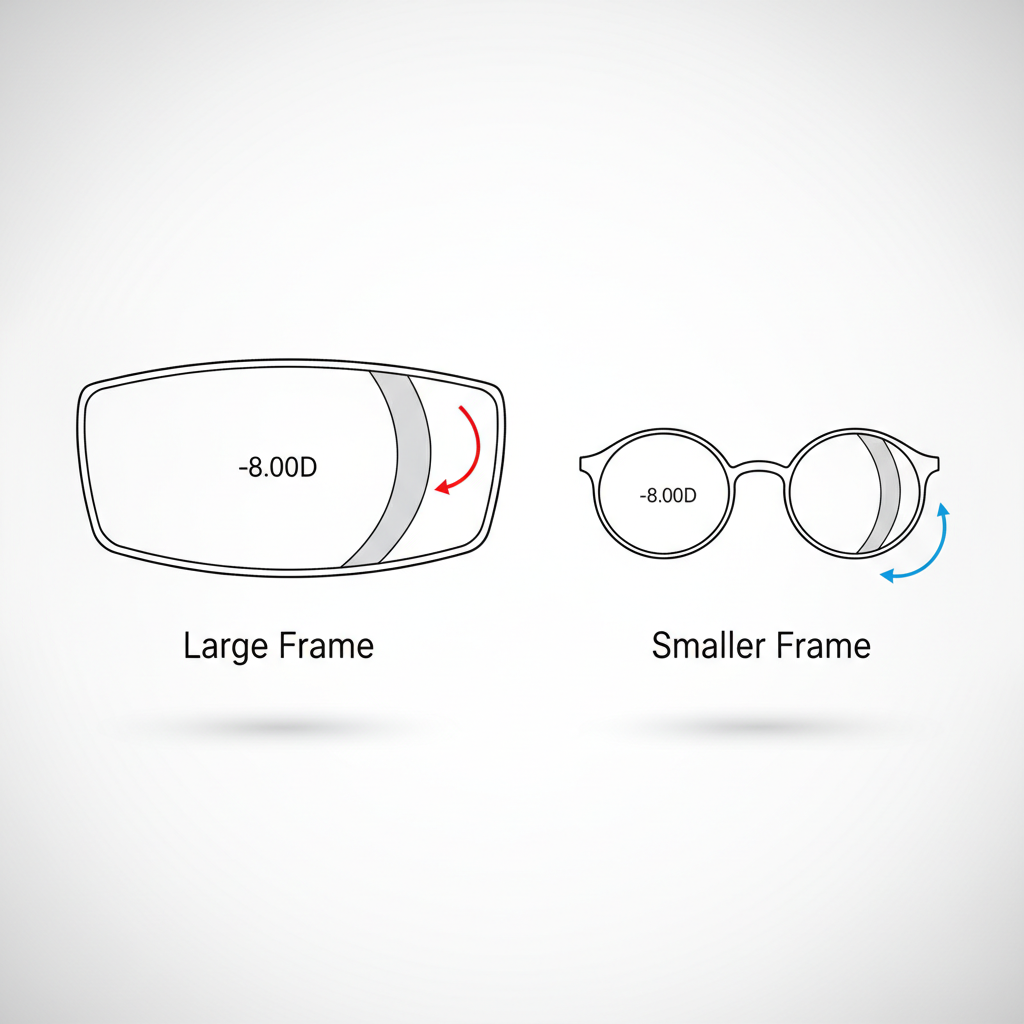
A common mistake is selecting a frame that is too wide. For a myopic (nearsighted) prescription, the lens is thinnest at the center and thickest at the edge. The larger the lens, the more of that thick edge you have to include.
Here’s a practical tip from my experience in the field: reducing the eye size of a frame by just 2–4 millimeters can decrease the edge thickness and overall mass of the finished lens by 20–40%. This is the single most effective change you can make. When you have a high prescription, think smaller. Look for frames with a lens width that keeps your pupils centered, minimizing the use of the thick, peripheral part of the lens.
Lightweight Materials: A Comparative Look
The material your frames are made from directly impacts their weight and durability. While classic acetate frames are popular, they can be heavy, especially in larger styles. For high-prescription wearers, exploring lighter alternatives is a game-changer.
| Material | Key Advantages | Best For | Considerations |
|---|---|---|---|
| Titanium | Extremely lightweight, strong, corrosion-resistant, hypoallergenic. | Everyday wear, users with metal sensitivities. | Higher initial cost, but excellent long-term value. |
| TR-90 | Highly flexible, durable, and very lightweight. | Active individuals, people prone to dropping their glasses. | Can feel less premium than metal frames. |
| Stainless Steel | Lightweight, strong, and more affordable than titanium. | A budget-friendly alternative to titanium. | May not be fully hypoallergenic for all users. |
For those who prefer the look of plastic, ask for modern acetate blends that are lighter than traditional versions. But for maximum weight reduction, titanium is often a superior choice.
The Heart of the Matter: Choosing the Right Lenses
After optimizing your frame choice, the next step is selecting the right lens material and design. This is where modern optical technology makes a world of difference. If you have a strong prescription, you should always be looking at high-index and aspheric options.
Understanding High-Index Lenses
Lens materials are categorized by their refractive index—a measure of how efficiently they bend light. As the experts at Ferris State University explain, a higher index means the material bends light more effectively, so less material is needed to achieve the same prescriptive power.
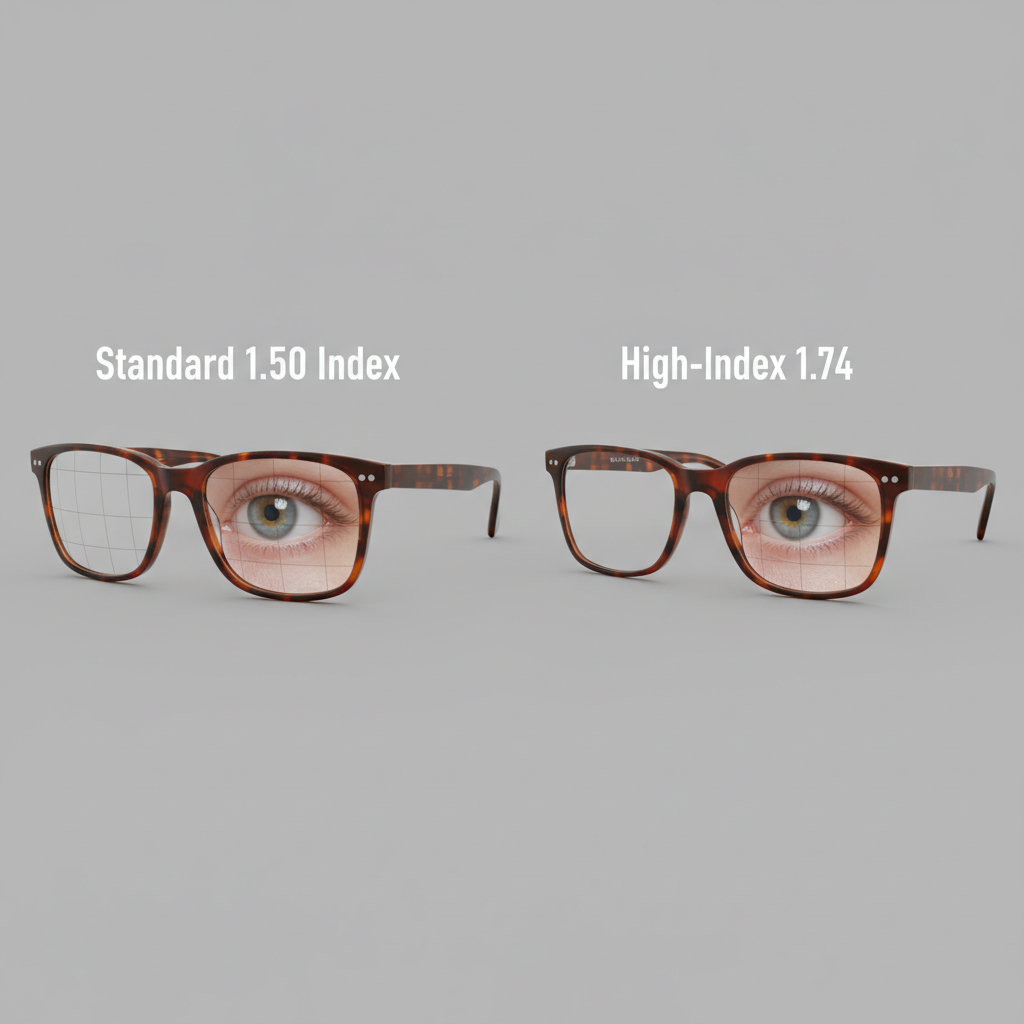
Standard Plastic (1.50 Index): This is the baseline, and it will be very thick and heavy for prescriptions above ±4.00 D.
High-Index (1.67 Index): A great option for prescriptions up to ±8.00 D. It provides a noticeable reduction in thickness and weight.
Ultra High-Index (1.74 Index): The thinnest and lightest plastic lens material available, recommended for the highest prescriptions.
From my experience, moving from a 1.50 to a 1.67 index lens is the sweet spot for many people, offering a great balance of improved aesthetics and manageable cost. For those with prescriptions stronger than -8.00 D, investing in 1.74 index lenses provides the maximum benefit.
Aspheric Design: The Secret to Flatter, Lighter Lenses
Beyond just the material, the lens design is critical. Traditional "spherical" lenses have a fully curved front surface, which can create a "bug-eye" or "coke-bottle" effect and distort your peripheral vision. Aspheric lenses have a more complex, flatter curvature. This design, as noted by the Optometrists Network, not only makes the lens itself thinner and lighter but also reduces the magnification of your eyes, leading to a much more natural appearance.
Essential Coatings for High-Index Lenses
High-index materials reflect more light than standard plastic, which can cause distracting glare. For this reason, an Anti-Reflective (AR) coating is not just an add-on; it is an essential component. It allows more light to pass through the lens for clearer vision and makes your lenses look nearly invisible. Furthermore, ensure your lenses include a scratch-resistant coating for durability and 100% UV protection. A study published in PubMed highlights that while many lens materials inherently block some UV, the combination of material and coatings provides the most reliable protection for your eye health.
The Perfect Fit: Why Micro-Adjustments Matter
A perfectly chosen frame and lens combination can still feel heavy if the fit isn't right. Weight distribution is key. A few millimeters of adjustment can be the difference between all-day comfort and constant annoyance.
The Critical Role of PD and Vertex Distance
Your Pupillary Distance (PD)—the distance between the centers of your pupils—is the single most important measurement for making glasses. An error in PD can lead to eye strain and headaches. This is especially true for high prescriptions, as even a small deviation can induce prismatic effects. For a deeper dive, you can check out this guide on whether a small PD error matters. If you need to measure it yourself, here are instructions on how to measure your PD at home.
Vertex Distance—the distance from the back of the lens to the front of your eye—also becomes critical for prescriptions stronger than ±4.00 D. A change of just 2-3 mm can alter the effective power of the lens. If your new glasses feel off, it might be that the vertex distance is different from the one used during your eye exam. This is a key reason why it's important to know what to do if your new online prescription feels wrong.
Expert Adjustments for Lasting Comfort
Don't underestimate the power of a good adjustment. Here are two high-leverage fixes I perform constantly:
Nose Pad Positioning: If your glasses are sliding down, the nose pads may be too wide. Moving the pads slightly closer together and a bit lower can relieve pressure on the bridge of your nose and secure the frames. Just a 2-3 mm adjustment can make a huge difference.
Temple Bend Tuning: Pressure behind your ears is another common complaint. A skilled optician can apply a micro-bend to the temple arms about 5-10mm from where they contact your ear. This shifts the pressure from resting entirely on the top of your ear to being more distributed along the mastoid bone behind it.
Debunking Myths and Understanding Your Rights
Navigating the world of online eyewear can be intimidating, especially with a high prescription. It's important to separate myth from fact and understand your rights as a consumer.
Myth: "Buying Glasses Online is Unsafe"
There is a perception that online glasses are of lower quality or less safe. A widely cited 2011 study in the journal Optometry found that a significant percentage of online-ordered glasses failed to meet optical or impact-resistance standards. However, the market has matured significantly since then. The key takeaway is not to avoid buying online, but to be a discerning customer.
Reputable online retailers work with the same professional labs as brick-and-mortar stores and must adhere to the same federal regulations. The FDA mandates that all prescription lenses sold in the U.S. be impact-resistant (21 CFR 801.410). A trustworthy vendor will be transparent about their manufacturing standards. For a full rundown, our checklist for buying glasses online safely can help you vet potential retailers.
Your Right to Your Prescription
Some eyecare providers may pressure you to buy glasses from them directly after an exam. It is crucial to know your rights. The FTC's Eyeglass Rule mandates that your eye doctor must give you a copy of your prescription at the conclusion of your exam, whether you ask for it or not. You are not required to purchase eyewear from them. This prescription portability is what allows you to shop around for the best value, including online. If you're ever unsure how to interpret the numbers and abbreviations, you can use a simple guide to reading your prescription.
Wrapping Up: Your Checklist for Lightweight Eyewear
Finding comfortable glasses with a high prescription is entirely possible. It requires being an informed and proactive consumer. By focusing on the interplay between frames, lenses, and fit, you can dramatically reduce the weight and improve your daily experience.
Key Takeaways Checklist:
[ ] Frame Size: Choose smaller, narrower frames to minimize lens edge thickness.
[ ] Frame Material: Prioritize lightweight materials like titanium or TR-90.
[ ] Lens Index: Select a high-index lens appropriate for your prescription (1.67 or 1.74).
[ ] Lens Design: Insist on an aspheric lens design to reduce weight and distortion.
[ ] Lens Coatings: Always include an Anti-Reflective (AR) coating.
[ ] Measurements: Ensure your Pupillary Distance (PD) is measured accurately.
[ ] Adjustments: Seek professional adjustments for nose pads and temple arms.
By following these steps, you can finally achieve what you've been looking for: glasses so light and comfortable, you'll forget you're even wearing them.
Frequently Asked Questions (FAQ)
How much thinner are high-index lenses really?
A 1.74 high-index lens can be up to 50% thinner than a standard 1.50 plastic lens for the same strong prescription. For a -6.00D prescription, this can mean a reduction in edge thickness of several millimeters, which also translates to a significant weight reduction.
Are titanium frames worth the extra cost?
For individuals with high prescriptions who wear their glasses all day, the answer is often yes. The superior comfort from the reduced weight, combined with their strength and longevity, makes titanium frames a worthwhile long-term investment in your daily comfort.
What if my new glasses still feel too heavy?
First, check the fit. Visit an optician to have the nose pads and temples adjusted, which can drastically change the weight distribution. If the issue persists, review your order. Was the frame size as small as possible? Was the highest practical lens index used? Sometimes, a remake with a smaller frame or higher index lens is the necessary solution.
Can I use my contact lens prescription to order glasses?
No. A contact lens prescription and an eyeglass prescription are not the same. Because glasses sit a certain distance from your eyes (the vertex distance) and contacts sit directly on them, the power required is different, especially for strong prescriptions. You must use a valid eyeglass prescription to order glasses.
Disclaimer: This article is for informational purposes only and does not constitute professional medical advice. Please consult a qualified optometrist or ophthalmologist for a comprehensive eye exam and to discuss your specific vision needs. Proper diagnosis and prescription can only be determined by a licensed eye care professional.


