









How to Measure Your Face for the Perfect Sunglass Fit
The Definitive Guide to Measuring Your Face for Sunglasses
Finding sunglasses that look great and feel comfortable is a common challenge when shopping online. A frame that’s too wide can overwhelm your face, while one that’s too narrow can pinch and cause discomfort. The secret to getting it right isn't about guesswork; it's about data. Knowing your own facial measurements is the single most effective way to ensure your new sunglasses fit perfectly.
This guide provides simple, step-by-step instructions for measuring your face at home. With just a ruler and a few minutes, you can gain the confidence to choose a frame that feels like it was made just for you, eliminating the frustration of returns and ensuring you get the ideal fit on the first try.
TL;DR: Your 60-Second Sunglass Fit Checklist
For those short on time, here are the essential steps to getting your core measurements.
| Measurement | What It Is | Why It Matters |
|---|---|---|
| Face Width | The total width of your face at the cheekbones. | This is the most crucial measurement for determining the overall frame size that will be proportional to your face. |
| Frame Dimensions | The numbers on the inside arm (e.g., 52-18-140). | These represent Lens Width, Bridge Width, and Temple Length, telling you the exact size of the frame. |
| Pupillary Distance (PD) | The distance between the centers of your pupils. | Critical for prescription lenses to ensure optical clarity and prevent eye strain. |
Section 1: Mastering the Core Measurements at Home
Before you can interpret the numbers on a sunglass frame, you need to know the numbers of your own face. These two measurements—Face Width and Pupillary Distance—are the foundation of a perfect fit.
How to Measure Your Face Width
Your face width is the primary indicator of the total frame width that will suit you best. Getting this right prevents frames from looking too small or too large.
Tools You'll Need:
- A straight ruler with millimeter (mm) markings.
- A mirror.
Step-by-Step Instructions:
- Position Yourself: Stand about 8-12 inches away from a mirror. Look straight ahead, keeping your facial expression neutral.
- Align the Ruler: Hold the ruler horizontally across your face. Align it so it runs just below your eyes, at the height of your cheekbones. This is the widest part of your face and the most relevant point for sunglass fit.
- Measure the Distance: Measure the distance from the outer edge of your left cheekbone to the outer edge of your right cheekbone. Ensure the ruler is straight and not angled.
- Record the Measurement: Note the measurement in millimeters. For most men, this will fall between 130mm and 150mm.
Common Mistake: Many people mistakenly measure across their eyebrows or temples. Measuring at the cheekbones provides a more accurate reference point for how a sunglass frame will actually sit and align with your facial features.
How to Measure Your Pupillary Distance (PD)
Pupillary Distance (PD) is the distance between the centers of your pupils. For prescription sunglasses, an accurate PD is non-negotiable. It ensures the optical center of the lens aligns perfectly with your eye, providing clear vision without strain. While not strictly necessary for non-prescription (plano) sunglasses, knowing your PD is valuable for any future eyewear purchases.
You can get a precise measurement from an optician, but an at-home measurement is a reliable starting point. For a more detailed walkthrough, you can review our complete guide on how to measure your PD at home for a perfect fit.
Tools You'll Need:
- A ruler with millimeter (mm) markings.
- A mirror.
Step-by-Step Instructions:
- Stand and Focus: Position yourself about 8 inches from a mirror.
- Close One Eye: Close your right eye and place the zero mark of the ruler directly over the center of your left pupil.
- Open and Align: Open your right eye and close your left. Look straight ahead.
- Read the Measurement: The millimeter line that aligns with the center of your right pupil is your PD.
- Repeat for Accuracy: Measure two or three times to ensure consistency. Most adult PDs are between 54mm and 74mm; for men, the typical range is 62-68mm.
Expert Warning: For non-prescription lenses or very weak prescriptions (under ±4.00D), a small variance of 2-3mm in your PD measurement is generally acceptable. However, for stronger prescriptions, even a small error can affect how the lenses work. This is because the distance between the lens and your eye (the vertex distance) becomes more critical. In such cases, we strongly recommend having your PD professionally measured by an optician.
Section 2: Decoding the Numbers on the Frame
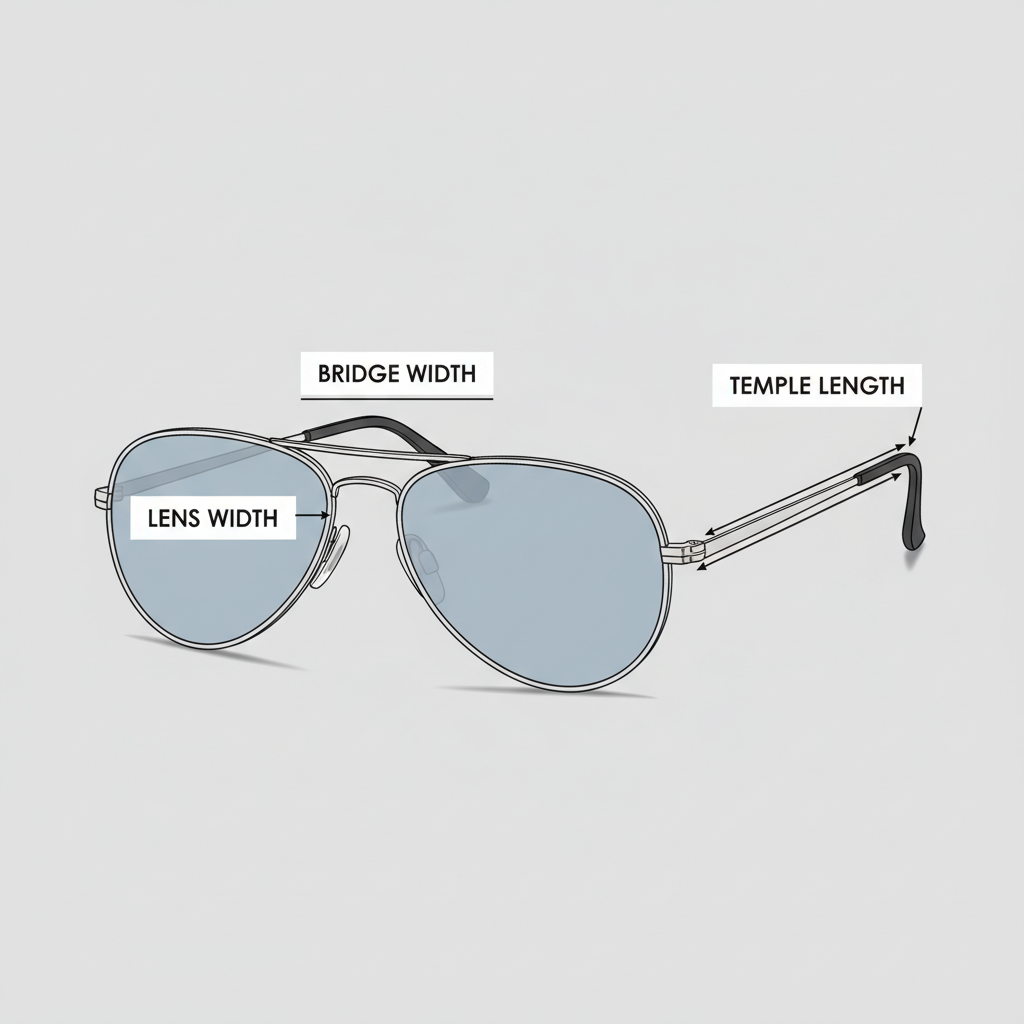
Every pair of quality sunglasses has a series of three numbers printed on the inside of the temple arm, such as 52-18-140. These are not random; they are the frame's precise dimensions in millimeters.
- Lens Width (e.g., 52): This is the horizontal width of one lens. For men's sunglasses, this typically ranges from 50mm to 60mm.
- Bridge Width (e.g., 18): This is the distance between the two lenses, which determines how the frame sits on your nose. The common range is 16mm to 20mm.
- Temple Length (e.g., 140): This is the length of the arm from the hinge to the tip. Standard lengths are 135mm, 140mm, 145mm, and 150mm.
The Simple Formula for a Great Fit
Here is how you connect your face width to the frame dimensions:
(2 x Lens Width) + Bridge Width ≈ Your Face Width
The result should be within a few millimeters of your measured face width. For example, using the numbers 52-18-140:
(2 * 52) + 18 = 104 + 18 = 122mm
This 122mm represents the width of the frame front. If your face width is 135mm, this frame would be too narrow. You'd want to look for a frame where the calculation results in a number closer to 135mm.
Section 3: Troubleshooting Common Sunglass Fit Issues
Even with measurements, you might encounter minor issues. Here’s how to diagnose and solve them.
| The Problem | The Likely Cause | The Solution |
|---|---|---|
| Slipping Down Your Nose | The Bridge Width is too wide, or the Temple Length is too short to curve properly behind your ear. | Look for a smaller bridge number (e.g., 16mm instead of 19mm) or a longer temple length. Frames with adjustable nose pads can also provide a more secure fit. |
| Pinching Your Temples | The Total Frame Width is too narrow for your face width. | Use the fit formula to find a frame with a larger combined lens and bridge width. Pay attention to frames labeled as "Wide" or "XL." |
| Leaving Marks on Your Nose | The Bridge Width is too narrow, causing the frame to rest heavily on the sides of your nose. | Select a frame with a wider bridge. This distributes the weight more evenly. |
| Sunlight Leaking in from the Sides | The frame style is too flat, or the Lens Width is too small for your face. | For maximum protection, choose larger lenses or a "wraparound" style. Research from PMC on Ocular UV Dosimetry shows that wraparound styles offer nearly 100% protection by blocking peripheral light. |
Pro Tip: When in Doubt, Go Larger for Sunglasses
If your measurements fall between two sizes, the safer choice for sunglasses is typically the larger one. Unlike regular eyeglasses, the primary function of sunglasses is coverage. Larger lenses offer more protection from harmful UV rays, a principle supported by the American Optometric Association (AOA), which recommends frames that cover the eye and surrounding areas. This enhanced coverage is crucial for protecting not just your eyes but also the delicate skin around them.

Wrapping Up: Your Path to the Perfect Fit
By investing a few minutes in measuring, you transform online sunglass shopping from a game of chance into a precise science. The key is to understand your own dimensions—face width and PD—and then use the numbers on the frame to find your match. This simple process empowers you to shop confidently, knowing that the style you choose will also provide the comfortable, secure fit you need.
Frequently Asked Questions (FAQ)
1. Can I just use the measurements from my current glasses? Yes, this is an excellent starting point. The three numbers on the temple arm of your existing, well-fitting glasses are a reliable guide for the size you should be looking for.
2. Does PD matter if I'm buying non-prescription sunglasses? For non-prescription (plano) lenses, an exact PD is not necessary for visual clarity. However, knowing your PD is useful for any future prescription eyewear you may purchase, and it helps you become more familiar with your personal sizing.
3. What if the sunglasses I like don't have the size listed? Reputable online retailers should always provide the frame dimensions. If they are missing, it's best to contact customer service to request them before purchasing. Avoid buying frames without this essential information.
4. How important is temple length? Temple length is crucial for ensuring the frame is secure. If the arms are too short, the sunglasses will perch on your ears and constantly slip forward. If they are too long, they won't provide a snug fit. Ensure the curve of the temple arm rests comfortably behind your ear.
Disclaimer: This article is for informational purposes only and does not constitute professional medical advice. If you have a strong or complex prescription, or if you experience headaches or eye strain with new glasses, consult a licensed optician or ophthalmologist.
References
- PMC: Ocular UV Dosimetry & Frame Geometry - https://pmc.ncbi.nlm.nih.gov/articles/PMC6803516
- American Optometric Association (AOA): UV Protection - https://www.aoa.org/healthy-eyes/caring-for-your-eyes/uv-protection
- U.S. Food and Drug Administration (FDA): Impact-Resistant Lenses Guidance - https://www.fda.gov/regulatory-information/search-fda-guidance-documents/impact-resistant-lenses-questions-and-answers


