








Minimizing Distortion in Prescription Sunglasses
Seeing Clearly: A Practical Guide to Minimizing Distortion in Prescription Sunglasses
Experiencing a dizzying 'fishbowl' effect or blurry edges with your new prescription sunglasses? You're not alone. For those of us with stronger prescriptions, the excitement of a new pair of shades can quickly turn into frustration when the world looks warped. This disorienting effect isn't a sign of a "bad" prescription, but rather a complex interplay between the power of your lenses, their shape, and the style of the frame.
The good news is that you don't have to choose between clear vision and stylish sun protection. Understanding the science behind the distortion is the first step toward eliminating it.
Here’s the short version: The pronounced curve of many sunglass styles clashes with the optics of a strong prescription, creating aberrations that your brain interprets as distortion. The solution lies in a strategic combination of modern aspheric lens designs, the right high-index materials, smarter frame choices, and critically precise measurements. This guide will walk you through each of these elements, empowering you to work with your optician to create a pair of sunglasses that offers a clear, comfortable, and expansive field of view.
The Root Causes: Why Your Vision Feels Warped
To fix the problem, we first need to understand the culprits. Distortion in high-prescription sunglasses typically stems from three key factors: lens curvature, prescription strength, and frame design.
The "Fishbowl" Effect and Base Curve
Every lens has a "base curve," which is the primary curvature on its front surface. Fashion sunglasses often have a very steep base curve (a high "wrap") to hug the contours of the face. While this looks great, it can be an optical disaster for a strong prescription. When your corrective power is ground into a steeply curved lens, it can induce unwanted aberrations, most notably oblique astigmatism. This causes the sensation that you're looking at the world through a fishbowl—straight lines may appear curved, and your peripheral vision can feel blurry and unstable. It's a common issue that can even lead to headaches and a feeling of imbalance.

How Strong Prescriptions Amplify the Problem
The stronger your prescription—whether it's for nearsightedness (a minus power) or farsightedness (a plus power)—the more sensitive your vision is to these optical imperfections.
- High-Minus Lenses: These lenses are thinnest in the center and thickest at the edges. In a large, curved sunglass frame, the edges can become extremely thick, and the dramatic change in curvature from the center to the periphery exaggerates distortion.
- High-Plus Lenses: These are thickest in the center and thin out toward the edge. They magnify what you see, and this magnification effect gets distorted in the periphery of a wrapped frame, causing objects to seem to swell or move unnaturally as you turn your head.
For a deeper dive into how lens shape impacts vision, our article on How Lens Curvature Affects High Prescription Vision provides more detail.
Common Misconception: "A Thinner Lens Is Always a Better Lens."
There's a prevailing myth that simply choosing the highest-index (thinnest) lens material will solve all distortion problems. This is only partially true. While high-index materials are essential for reducing the thickness and weight of strong prescriptions, they can also introduce another problem: chromatic aberration. According to optical experts at Ferris State University, materials with a higher index of refraction tend to have a lower Abbe value, which is a measure of how much they disperse light into its component colors. This can cause you to see distracting color fringes (like a faint rainbow) around high-contrast objects.
The real solution isn't just about choosing the thinnest material, but about balancing the index with an advanced lens design that corrects for aberrations.
The Solution: A Three-Part Strategy for Clarity
Achieving distortion-free vision requires a holistic approach that considers the lens design, material, and frame all at once. I've found the most success by focusing on these three areas.
Part 1: Insist on Aspheric Lens Designs
This is the single most important upgrade you can make. A standard spherical lens has a uniformly rounded curve across its entire surface, like a section of a baseball. An aspheric lens, by contrast, has a more complex, flatter curve that gradually changes from the center to the edge.
This sophisticated design is a game-changer for high prescriptions. It minimizes the unwanted magnification or minification effects at the lens periphery, dramatically reducing the 'fishbowl' sensation. It also provides a wider field of clear vision and has the cosmetic benefit of making your eyes look less magnified or minimized to others, a common concern we address in our article, "Will Strong Prescription Lenses Distort My Eyes?". For any prescription over ±3.00 diopters, I consider an aspheric design to be essential.
Part 2: Select the Right High-Performance Material
Once you've specified an aspheric design, the next step is choosing a material that makes your lenses thin, light, and clear.
| Lens Material | Refractive Index | Key Advantages | Potential Downsides | Best For |
|---|---|---|---|---|
| Polycarbonate | 1.59 | Highly impact-resistant, built-in UV blocking | Lower optical clarity (more chromatic aberration) | Active lifestyles, safety, and children's eyewear |
| Trivex | 1.53 | Excellent optical clarity, lightweight, very impact-resistant | Thicker than high-index options for the same power | Rimless frames and anyone prioritizing crisp optics with safety |
| High-Index 1.67 | 1.67 | Significantly thinner and lighter than standard plastic or polycarbonate | Higher cost, reflects more light (AR coating is a must) | Prescriptions from ±4.00D to ±8.00D |
| High-Index 1.74 | 1.74 | The thinnest and lightest plastic lens material available | Highest cost, most prone to chromatic aberration | Very strong prescriptions above ±8.00D |
A crucial add-on for high-index lenses is an Anti-Reflective (AR) coating. High-index materials naturally reflect more light than standard plastic. Without an AR coating, these reflections can create distracting glare, reducing visual clarity and comfort, especially when driving at night.
Part 3: Choose Your Frames Wisely
Even with the best lenses, the wrong frame can sabotage your vision.
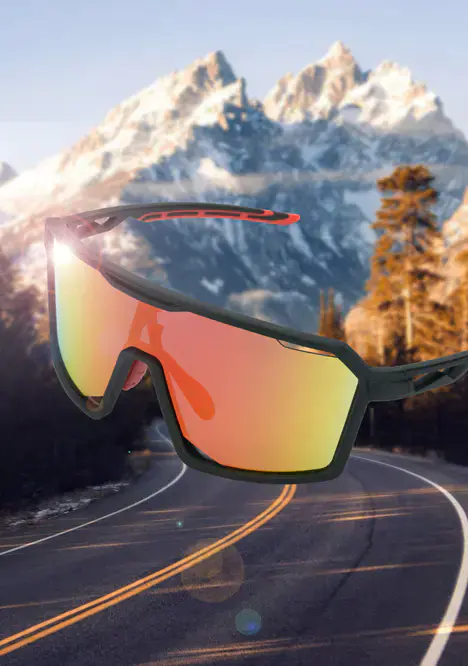
- Flatter is Better: As a rule of thumb, the flatter the frame front, the better. Avoid highly wrapped, "blade" style sunglasses that curve aggressively around your face. Look for frames with a base curve of 6 or less for the most predictable optical results.
- Size and Shape Matter: For strong plus (+) prescriptions, smaller, rounder frames help reduce the center thickness and overall weight. For strong minus (-) prescriptions, avoiding overly large or wide frames will minimize the visible edge thickness.
- Prioritize Adjustability: A frame with adjustable nose pads allows for fine-tuning of the vertex distance (how far the lenses sit from your eyes), which can have a meaningful impact on the effective power of your prescription.
According to the American Academy of Ophthalmology, oversized or wraparound styles are excellent for blocking UV light from the periphery. The key is to find a balance—a frame that offers good coverage without having an extreme wrap angle that induces distortion.
The Unseen Factor: Why Precision Measurements Are Non-Negotiable
A prescription from your doctor is just the starting point. To craft high-performance sunglasses, an optical lab needs several additional, highly precise measurements. A common mistake I see is people ordering glasses using only a binocular pupillary distance (PD), which can lead to errors.

Key Measurements for Success Checklist
Here are the measurements that are critical for minimizing distortion. Ensure these are accurately taken when you order.
- [ ] Monocular Pupillary Distance (PD): This is the distance from the center of your nose bridge to the center of each pupil individually (e.g., Right: 32mm, Left: 31.5mm). It ensures the optical center of each lens is perfectly aligned with your eye, which is crucial for clarity.
- [ ] Optical Center (OC) Height: This measures how high or low your pupils sit within the frame's lens opening. Incorrect OC height can induce prism and cause eye strain.
- [ ] Vertex Distance: The distance from the back surface of the lens to the front of your cornea. A change in this distance, especially with strong prescriptions, can alter how much correction you actually receive.
- [ ] Pantoscopic Tilt & Wrap Angle: These measure the vertical tilt and horizontal curve of the frame as it sits on your face. For any frame with even a modest wrap, compensating for these angles is key to preventing peripheral distortion.
Wrapping Up: Your Path to Distortion-Free Sunglasses
Living with a strong prescription doesn't mean you have to settle for distorted vision in your sunglasses. By taking a proactive and informed approach, you can achieve the clarity and comfort you deserve.
Remember the formula for success: start with an aspheric lens design to create a wider, clearer field of view. Pair it with the right high-index material and a mandatory AR coating to keep the lenses thin, light, and glare-free. Select a flatter, well-fitting frame that doesn't introduce optical errors. Finally, insist on precise, comprehensive measurements, especially a monocular PD.
Armed with this knowledge, you can confidently navigate the process of buying prescription sunglasses that not only protect your eyes and fit your style but also deliver a crystal-clear view of the world.
Frequently Asked Questions (FAQ)
1. Why do my new prescription sunglasses make me feel dizzy? Dizziness is often a symptom of the "fishbowl effect" caused by peripheral distortion. Your brain is trying to adapt to a visual field where straight lines appear curved. This is most common with strong prescriptions in highly wrapped frames. An aspheric lens design is the most effective solution.
2. Can I put my strong prescription in any sunglass frame? Technically, it's possible, but not advisable. Putting a high-power lens into an extremely large or highly curved frame is a recipe for thick, heavy lenses and significant peripheral distortion. It's best to choose frames that are optically suitable for your prescription.
3. Are polarized lenses a good idea for high prescriptions? Yes, polarization is an excellent feature that is independent of your prescription. It reduces glare from reflective surfaces like water and pavement. It can be combined with any lens design (including aspheric) and material (including high-index) to enhance visual comfort outdoors.
4. How long does it take to adapt to new prescription sunglasses? For a well-made pair with an aspheric design and correct measurements, the adaptation period should be minimal—from a few hours to a couple of days. If you still feel significant dizziness, distortion, or eye strain after several days, it's wise to have the measurements and lens alignment re-checked.
Disclaimer: This article is for informational purposes only and does not constitute professional medical advice. The information provided is not a substitute for a comprehensive eye exam or a consultation with a qualified optometrist or ophthalmologist. Always consult with your eye care professional for any health-related questions or before making any decisions about your vision care.
References
- American Academy of Ophthalmology (AAO). (n.d.). How to Choose the Best Sunglasses. Retrieved from https://www.aao.org/eye-health/glasses-contacts/sunglasses-3
- Ferris State University. (n.d.). High Index Lenses. Retrieved from https://www.ferris.edu/optometry/patient-care/lensmaterial/high-Index-Lenses.htm
- U.S. Food and Drug Administration (FDA). (2023). Impact-Resistant Lenses: Questions and Answers. Retrieved from https://www.fda.gov/regulatory-information/search-fda-guidance-documents/impact-resistant-lenses-questions-and-answers


