







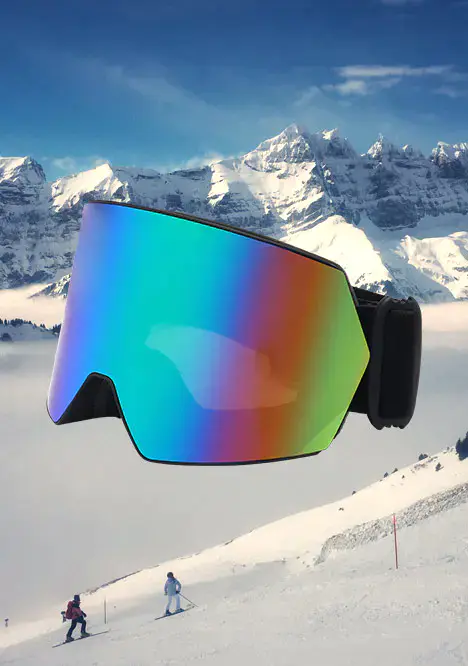
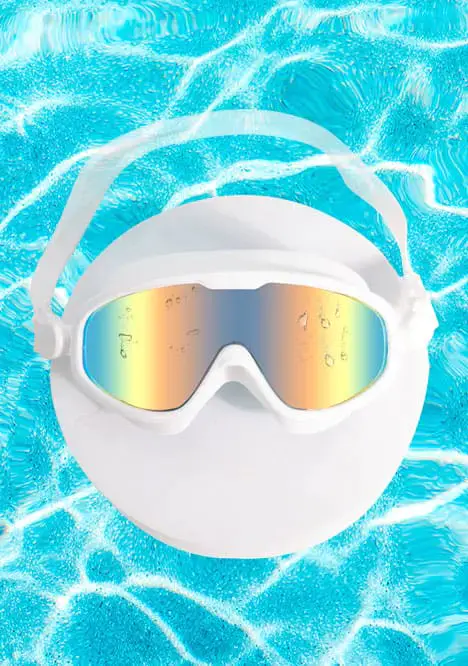
Choosing a Mirror Coating for Your Sunglasses
Beyond the Reflection: How to Choose the Perfect Mirror Coating
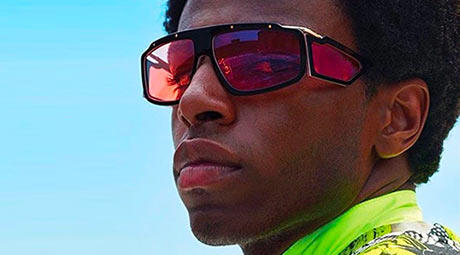
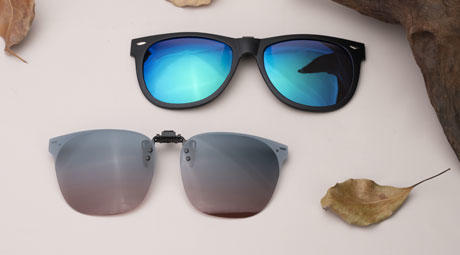
Mirrored sunglasses are more than just a style statement; they are a piece of high-performance optical technology. While the vibrant colors—from fiery reds to cool blues—are what first catch the eye, their primary purpose is to enhance your visual comfort and clarity in bright conditions. Choosing the right mirror is about understanding the science behind the shine.
This guide will walk you through everything you need to know, from how mirror coatings work to the critical partnership they have with the lens's base tint. We will explore how to match a mirror to your specific activities and what quality indicators to look for to ensure your sunglasses perform as well as they look.
TL;DR: Key Takeaways
- Function Over Fashion First: A mirror coating's main job is to reduce the amount of light entering your eyes, decreasing glare and improving comfort.
- Base Tint is Boss: The underlying color of the lens (gray, brown, or green) determines your color perception and contrast. The mirror coating is applied on top of this and adds to the effect.
- Match the Combo to the Activity: Different base tint and mirror combinations are optimized for specific environments, from driving to fishing on the open water.
- Quality is in the Details: Look for features like back-surface anti-reflective coatings and durable hard coats to maximize clarity and lifespan.
What is a Mirror Coating and How Does It Work?
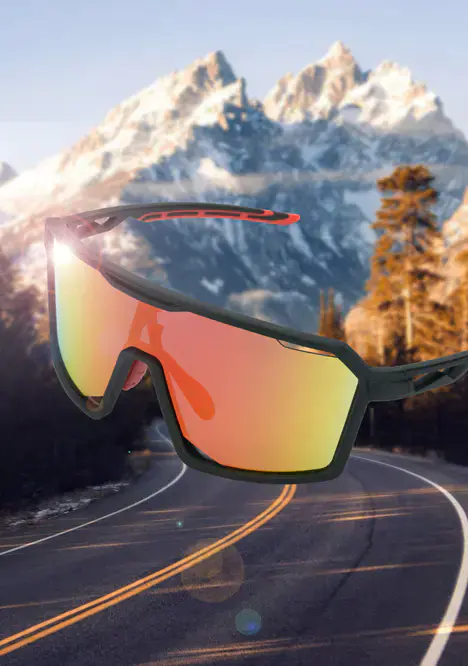
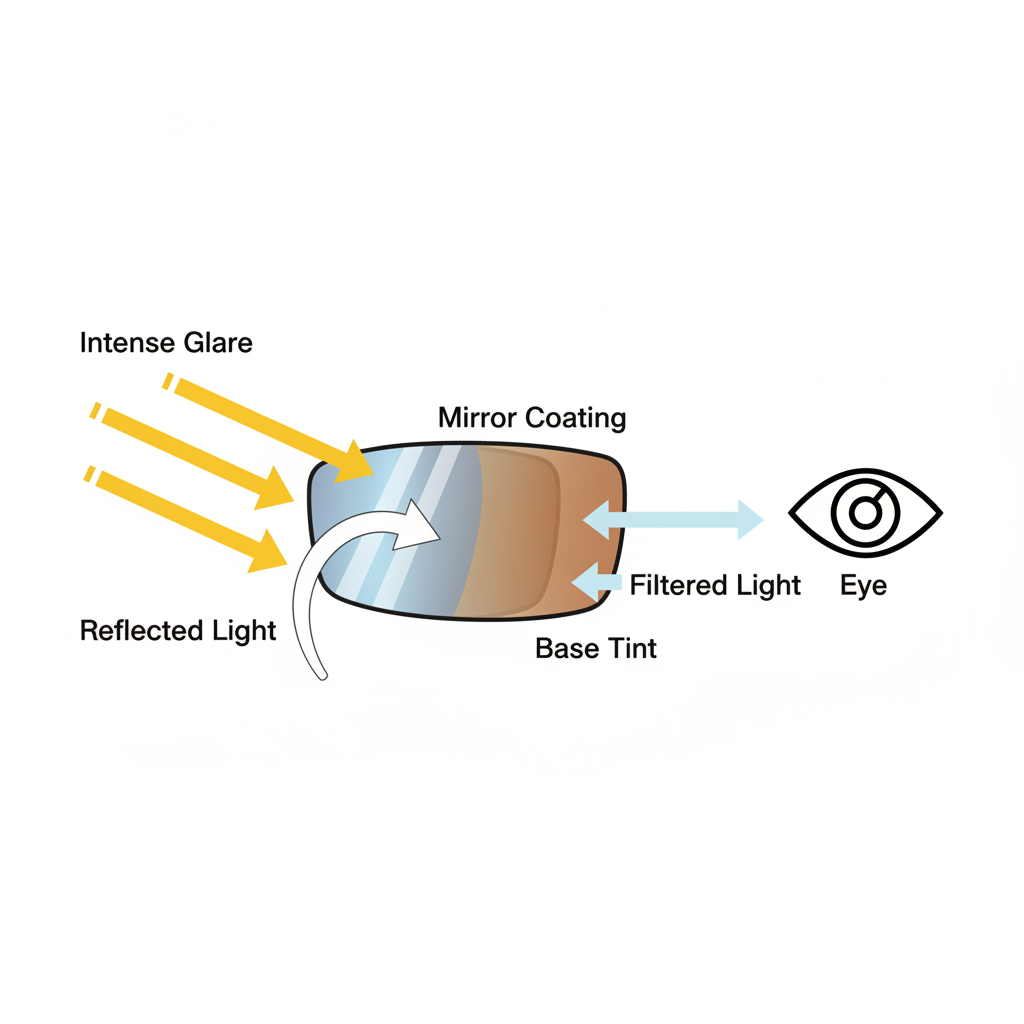
A mirror coating, also known as a flash coating, is an ultra-thin layer of metallic oxides applied to the front surface of a sunglass lens in a highly controlled vacuum chamber. This microscopic layer functions like a one-way mirror, reflecting a significant portion of bright, harsh light away from your eyes.
By bouncing excess light back, a mirror coating can reduce the amount of visible light passing through the lens by an additional 10% to 60% over the base tint alone. This is what makes them exceptionally effective for activities in intensely bright environments, such as on snow, water, or at high altitudes.
Common Misconception: Mirror Color Equals UV Protection
It's a frequent myth that the color or darkness of a mirror coating is responsible for blocking harmful ultraviolet (UV) rays. In reality, UV protection is a separate, invisible feature of the lens itself. Modern sunglass lenses, particularly those made from polycarbonate, have UV-blocking properties built directly into the material. As experts at the University of Utah Health explain, this embedded protection won't scratch off like a coating can. A quality pair of sunglasses should always offer 100% UV or UV400 protection, regardless of whether it has a mirror finish. The mirror's job is to manage visible light and glare, not UV radiation.
The Critical Partnership: Base Tint and Mirror Color
The single most important factor to understand when choosing a mirror is its relationship with the base tint of the lens. The base tint is the foundational color you see through, and it does the heavy lifting of managing contrast and color fidelity. The mirror coating is applied over this tint.
I’ve seen many people choose a mirror purely for its external look, only to be unhappy with the resulting vision. The key is to select the base tint for your primary activities first, then choose a mirror that complements it functionally and stylistically.
Here’s a breakdown of how common base tints perform and which mirrors pair well with them.
| Base Tint | Visual Effect | Best For | Recommended Mirror Pairing |
|---|---|---|---|
| Gray | Provides true-to-life color perception. Reduces overall brightness without distorting colors. | Everyday use, driving, general activities. | Silver, Graphite, or Blue: These maintain the color neutrality of the gray base. |
| Brown/Amber | Enhances contrast and depth perception, particularly in hazy or overcast conditions. | Fishing, hiking, and sports where spotting details is crucial. | Gold, Red, Bronze, or Blue: These can further boost contrast and work well aesthetically. |
| Green | Offers a good balance of contrast and color accuracy, brightening shadows and reducing glare. | General purpose, effective in both sunny and lower-light conditions. | Green, Silver, or Gold: These complement the versatile nature of the green base. |
A Practical Guide to Choosing Your Combination
Your lifestyle and hobbies are the best guide for selecting the right lens combination. Here are some real-world scenarios to help you decide.
For Driving and Aviation
For activities that require accurate color recognition, a neutral gray base tint is the top choice. It ensures that traffic lights and signals are seen correctly. A subtle silver or graphite mirror adds extra glare reduction without altering the color profile. It's worth noting that while great for drivers, polarized lenses are often discouraged for pilots, as the Federal Aviation Administration (FAA) warns they can interfere with reading digital cockpit displays.
For Water Sports (Fishing, Boating)
On the water, you’re battling intense, reflected glare. This is where a combination of polarization and a mirror coating shines. As Harvard Health Publishing explains, polarization filters out the horizontal light waves that create glare. Start with a brown or amber polarized base to dramatically increase contrast and help you spot fish or contours beneath the water's surface. Layering a vibrant blue or green mirror over this base provides maximum glare reflection and visual comfort.
For Snow Sports (Skiing, Snowboarding)
High-altitude snowfields produce some of the most intense glare on the planet. The American Academy of Ophthalmology (AAO) notes that snow can reflect up to 80% of UV rays, effectively doubling your exposure. A dark gray or brown base tint is essential, and a strong mirror in gold, red, or blue is highly recommended to reflect the maximum amount of light and protect your eyes from fatigue and conditions like snow blindness. Wraparound frames are also crucial to block light from the periphery.
Expert Considerations for Durability and Clarity
The quality of a mirrored lens goes beyond its color. A few technical details separate a high-performance lens from a purely cosmetic one.
The Hidden Glare: Back-Surface Reflections
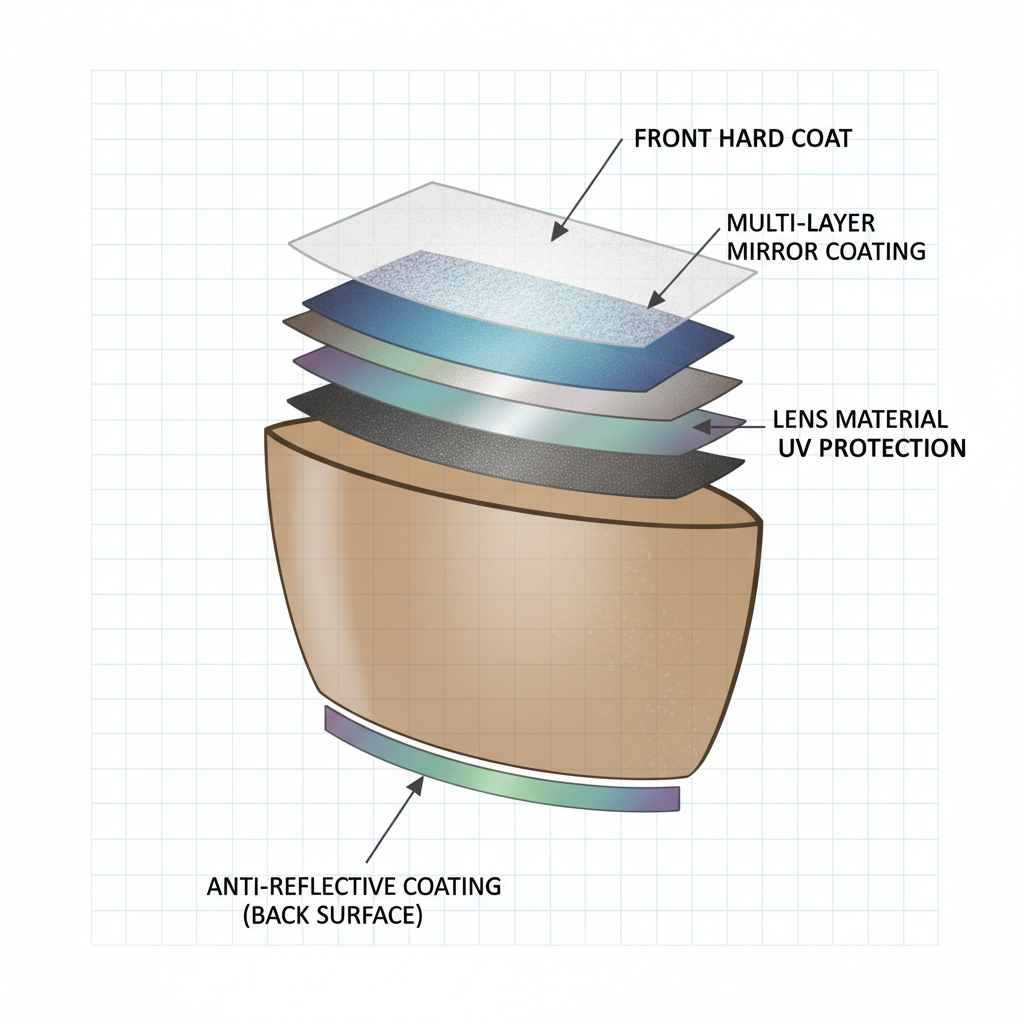
One of the most common complaints I hear is from people who can see the reflection of their own eye in their sunglasses. This distracting glare comes from light bouncing off the back surface of the lens into your eye. The solution is an Anti-Reflective (AR) coating applied to the backside of the lens. This specialized coating is a must-have for mirrored sunglasses, as it eliminates back-surface reflections and provides a much clearer, more comfortable visual experience.
Built to Last: Hard Coats and Edge Sealing
Mirror coatings are inherently more susceptible to scratches and damage than the base lens. A high-quality lens will always include a durable, scratch-resistant hard coat applied on top of the mirror to protect your investment. For prescription lenses, technicians should also seal the lens edge after cutting it to fit the frame. This prevents moisture from penetrating the layers, which can cause the mirror coating to delaminate or peel over time.
Caring for Your Mirrored Lenses
Proper care is essential to preserving the life of your mirror coating.
- Clean Gently: Use a microfiber cloth and a lens cleaner specifically formulated for coated lenses. If you don't have a cleaner, lukewarm water and a drop of mild dish soap will work.
- Avoid Harsh Chemicals: Never use ammonia-based cleaners (like window cleaner) or rough paper products, as they can strip the coating.
- Store Safely: When you’re not wearing them, keep your sunglasses in a rigid case to prevent scratches.
Wrapping Up: See and Be Seen
Choosing the right mirror coating is a balance of science and style. By starting with the right base tint for your needs and understanding how a mirror complements it, you can create a pair of sunglasses that offers superior performance and a personalized look. Remember to prioritize the technical features—100% UV protection, a back-surface AR coating, and a durable hard coat—to ensure your eyes are protected, comfortable, and seeing the world with maximum clarity.
Frequently Asked Questions (FAQ)
Does the color of the mirror coating affect UV protection? No. UV protection is an independent feature of the lens material itself. A quality lens provides 100% UV (UV400) protection regardless of its color, tint, or mirror. The mirror's function is to reduce visible light and glare.
Can mirrored lenses also be polarized? Yes, absolutely. Combining a mirror coating with a polarized filter creates a high-performance lens that is ideal for combating the extreme glare found on water and snow.
Do mirror coatings scratch easily? The mirror coating is a surface treatment, so it can be more prone to scratches than an uncoated lens. This is why it is critical to choose lenses that have a durable, scratch-resistant hard coat applied on top of the mirror for protection.
Why can I see my own eye reflected in my sunglasses? This phenomenon is caused by light reflecting off the back surface of the lens into your eye. It can be eliminated by adding an anti-reflective (AR) coating to the backside of the lenses, which is a highly recommended feature for all mirrored sunglasses.
Disclaimer: This article is for informational purposes only and does not constitute medical advice. Consult with a qualified eye care professional for any questions regarding your vision health and to determine the most appropriate eyewear for your specific needs.


