











Monocular PD: Why Nose Bridge Symmetry Affects Visual Clarity
TL;DR: The Two Numbers That Define Visual Comfort
Your pupillary distance (PD) is the measurement between the centers of your pupils. Most of the time, this is given as a single number, like 63mm. This is your binocular PD. However, for many people, a more precise measurement called monocular PD is essential for clear, comfortable vision. Monocular PD measures the distance from each pupil to the center of your nose bridge individually (e.g., Right: 31mm, Left: 32mm). If your facial features aren't perfectly symmetrical, using a single, averaged PD can lead to eye strain, headaches, and distorted vision. This article explains why.
Decoding Your Prescription: What is Pupillary Distance?
When you receive an eyeglass prescription, it's filled with abbreviations and numbers that map out the exact correction your eyes need. While terms like Sphere (SPH) and Cylinder (CYL) define the focusing power, the Pupillary Distance (PD) ensures that power is correctly placed in front of your eyes.
Think of your lenses as having a precise "sweet spot"—the optical center—where the prescription is perfectly true. The PD measurement tells the lab exactly where to align this sweet spot in your frames. If the alignment is off, you end up looking through a less-effective part of the lens, which can compromise visual quality.
Binocular vs. Monocular PD: The Difference Between Average and Exact
There are two ways to measure Pupillary Distance:
- Binocular PD: This is the total distance between the center of your left pupil and the center of your right pupil, expressed as a single number (e.g., 64mm). It's the most common measurement and is sufficient for many people with lower prescription powers and symmetrical faces.
- Monocular PD: This consists of two separate numbers, measuring the distance from the bridge of your nose to the center of each pupil individually (e.g., R: 31.5mm, L: 32.5mm). This method accounts for any facial asymmetry, ensuring the optical center of each lens is placed with precision.
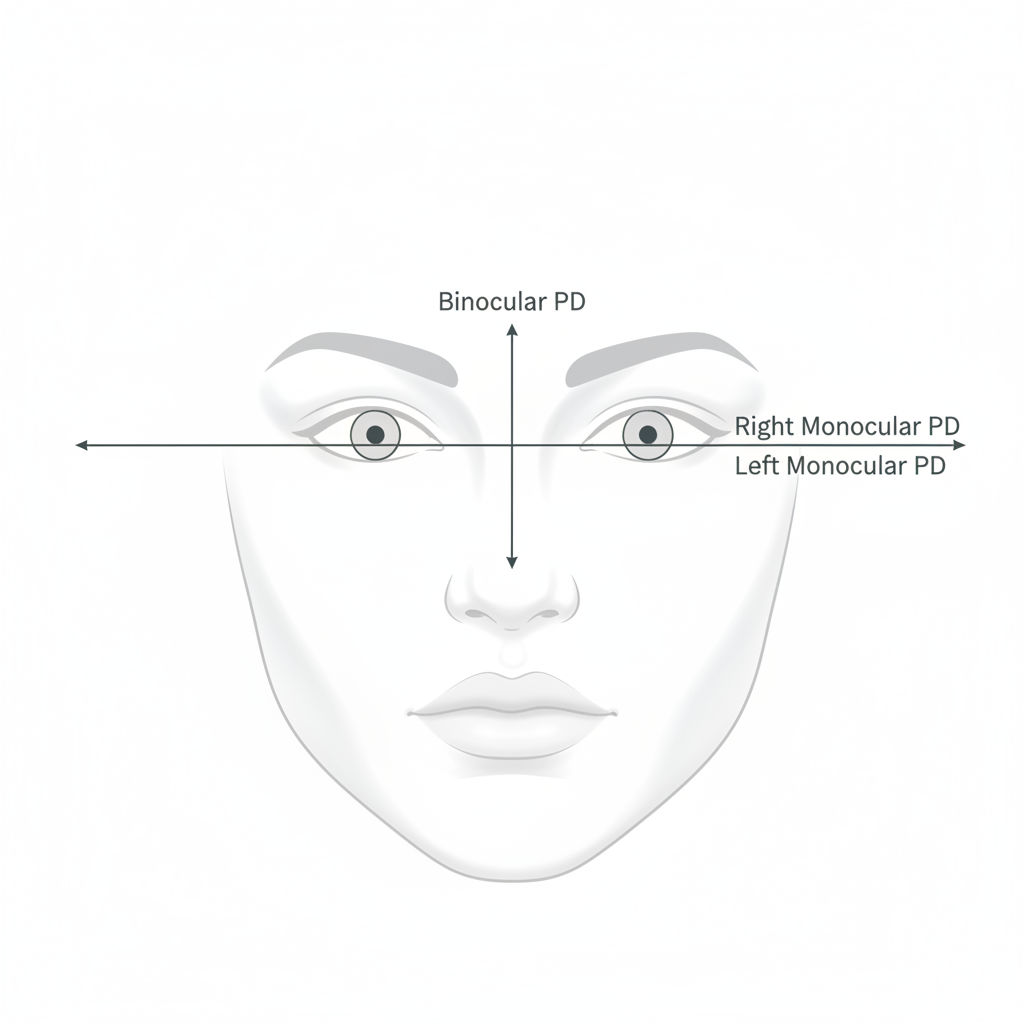
For many, the difference between their left and right monocular PDs is negligible. But for a significant portion of the population, facial features—like the position of your eyes relative to your nose—are not perfectly symmetrical. When this asymmetry exists, relying on an averaged binocular PD can cause problems.
The Hidden Problem: Facial Asymmetry and Induced Prism
Perfect facial symmetry is rare. It's common for one eye to be slightly further from the nose than the other. When you use a single binocular PD, the lab typically just divides that number by two to estimate the center for each eye. If your face is asymmetrical, this assumption is incorrect.
Let's say your true monocular PDs are Right 31mm and Left 33mm, but you use a binocular PD of 64mm. The lab will likely cut both lenses for a PD of 32mm. Your right lens will now be off by 1mm, and your left lens will be off by 1mm. This is called decentration.
This may not sound like much, but this small error forces your eyes to work harder to fuse two slightly misplaced images into one clear picture. This misalignment introduces an unwanted prismatic effect. In optics, a prism bends light. When the optical center of the lens isn't aligned with your pupil, it acts like a small, unintended prism.
Expert Insight: Based on optical principles, a lens decentration of just 2mm in a moderate prescription (around -4.00D) can induce a noticeable 0.5 prism diopter effect. This forces your eye muscles into a constant state of correction, leading to symptoms like eye strain, headaches, a "pulling" sensation, and even double vision.
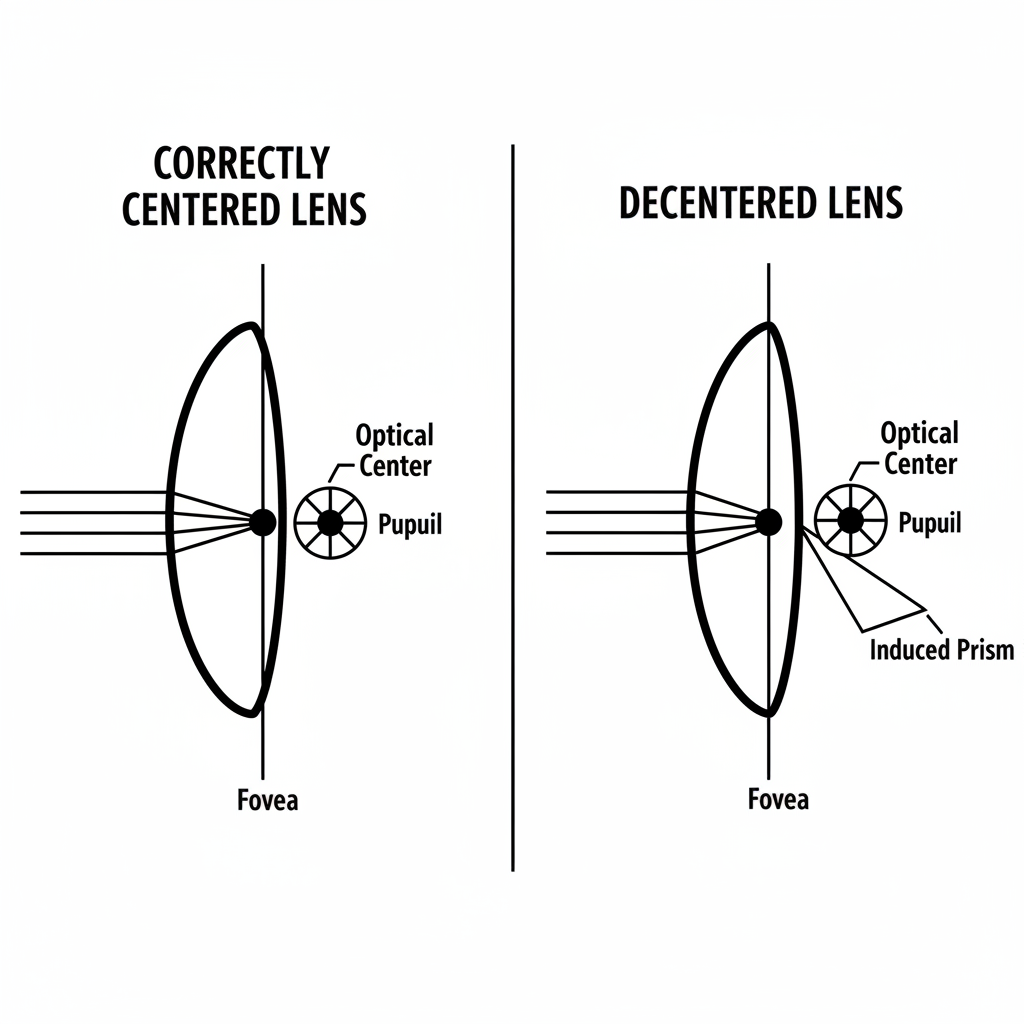
Your brain and eye muscles will struggle to overcome this induced prism, which is why a new pair of glasses can feel "off" or cause persistent discomfort that isn't just about "getting used to them."
Who Absolutely Needs a Monocular PD Measurement?
While a monocular PD provides a better fit for everyone, it is non-negotiable for certain individuals. You should insist on providing a monocular PD if you fall into any of these categories:
-
High Prescription Powers: The higher your prescription (generally over ±4.00 Sphere), the more pronounced the prismatic effect becomes with even tiny decentration errors. For those with strong prescriptions, precision is paramount. For more on this, see our guide on how lens curvature affects high prescription vision.
-
Progressive Lens Wearers: This is the most critical group. Progressive lenses have a very narrow vertical "corridor" that contains the power progression for near, intermediate, and distance vision. If the monocular PD is incorrect, you won't be looking through the correct part of the corridor, rendering the lens ineffective and causing significant distortion. Learn more about who cannot wear progressive lenses if fit is a concern.
-
Noticeable Facial Asymmetry: Look in the mirror. Does one eye appear slightly higher or farther from your nose? If you can see the asymmetry, however minor, a monocular PD is the only way to guarantee your lenses will be centered correctly.
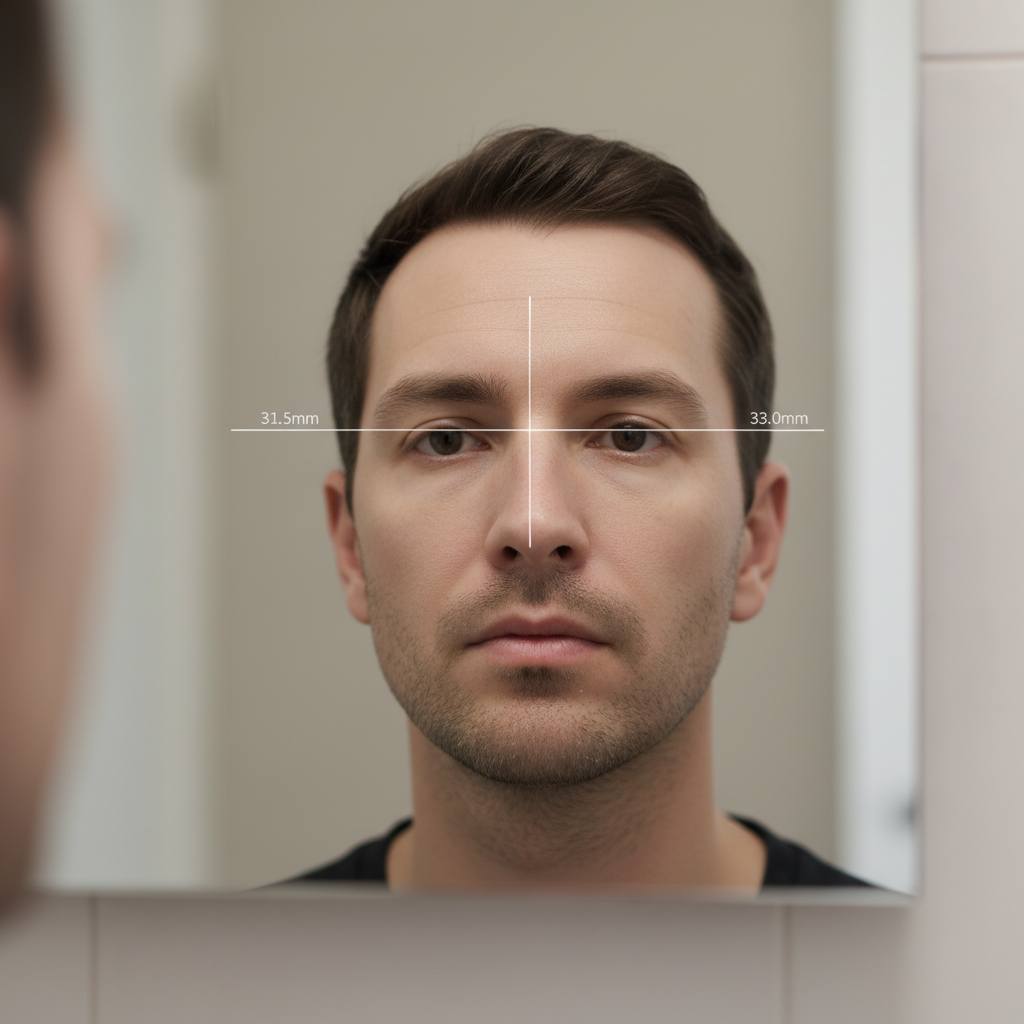
- History of Adaptation Issues: If you've previously struggled for weeks with new glasses, complaining of eye strain or headaches, an incorrect PD from a previous order is a likely culprit. Many people who believe they "can't wear" certain glasses are actually suffering from poorly centered lenses.
How to Get an Accurate Monocular PD
Given its importance, obtaining an accurate measurement is key. Here are the primary methods:
- Ask Your Optometrist: During your eye exam, you can request your monocular PD. According to the FTC's Eyeglass Rule, your eye doctor must provide you with your prescription after an exam, but the release of PD is not always mandated and can be a point of ambiguity. However, most will provide it if asked.
- Get Measured by an Optician: A trained optician can take your measurement with a pupilometer, a specialized tool for this purpose. This is the gold standard for accuracy.
- Use a Reputable Online Tool: Many online eyewear retailers offer digital tools that use your computer's camera or a smartphone app to measure your PD. When using these, it's crucial to follow the instructions precisely to ensure accuracy.
One common mistake is to try and measure the PD from an old pair of glasses. This is a risky approach because it assumes the old pair was made correctly. If the original PD was wrong, you are simply perpetuating the error.
FAQ: Monocular PD
Q: What happens if my monocular PD is wrong?
A: An incorrect PD can cause eye strain, headaches, fatigue, a pulling sensation, and even double vision. This is due to the unwanted prismatic effect created by looking through the wrong part of the lens.
Q: Is a 1mm difference really a big deal?
A: Yes, especially for those with high prescriptions or progressive lenses. The higher the power, the more a small error is magnified, leading to greater visual discomfort.
Q: Can I just add my two monocular PDs to get my binocular PD?
A: Yes. For example, if your monocular PD is R 32mm and L 33mm, your binocular PD is 65mm. However, you cannot accurately go the other way (dividing a binocular PD in half) if your face is asymmetrical.
Q: Why don't all stores require monocular PD?
A: While it is a best practice, it requires more careful measurement. Requiring a monocular PD is often a sign of a provider who prioritizes optical precision and a high-quality final product.
This article is for informational purposes only and does not constitute medical advice. Consult with a qualified eye care professional for any questions regarding your vision or prescription.


