


















Monofocal vs. Multifocal IOLs: Choosing the Right Lens.
Undergoing cataract surgery is a significant step toward reclaiming clear vision. Yet, the decision is no longer just about removing the cloudy lens; it’s about choosing its replacement. The intraocular lens (IOL) you and your surgeon select will define how you see the world for decades to come. The central choice often boils down to a fundamental trade-off: the crystal-clear, single-distance focus of a monofocal IOL versus the versatile, multi-distance range of a multifocal IOL.
This article provides a comprehensive, evidence-based comparison to help you navigate this critical decision. We will break down the technology, benefits, and inherent compromises of each lens type. By understanding how these IOLs align with different lifestyles, visual priorities, and even personality types, you can prepare for a more productive conversation with your surgeon and make a choice that truly fits your life.
Understanding Monofocal IOLs: The Gold Standard for Clarity
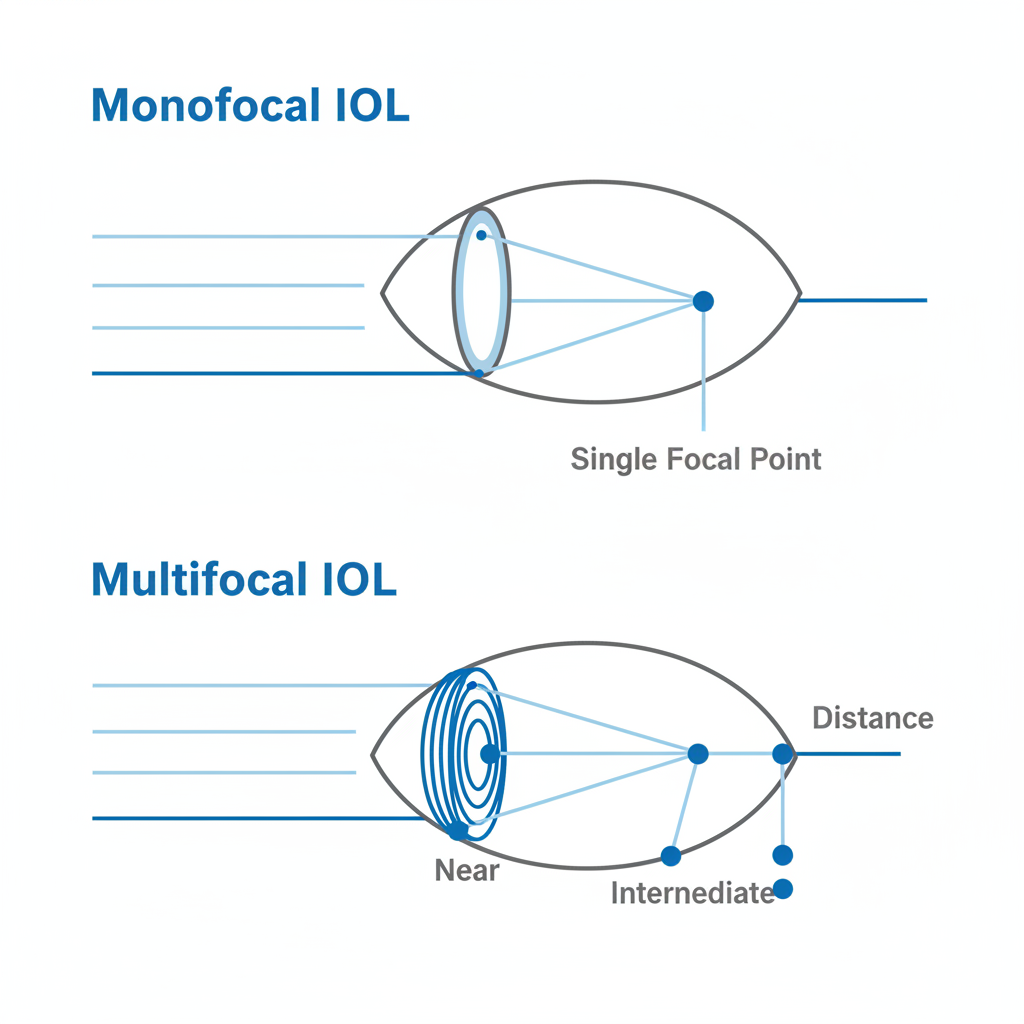
A monofocal IOL is an intraocular lens designed with a single, fixed focal point. For decades, it has been the standard and most commonly implanted lens in cataract surgery, renowned for its ability to deliver exceptionally sharp and high-quality vision at one specific distance.
Typically, patients opt to have their monofocal lenses set for distance vision. This allows for clear sight while driving, watching television, or enjoying landscapes. The trade-off is straightforward: vision at other distances will be blurry. If your IOL is set for distance, you will require reading glasses for near tasks like reading a book, using a smartphone, or seeing a menu. If set for near vision, you would need glasses to see clearly far away.
The Primary Advantages of Monofocal IOLs:
- Superior Image Quality: Because a monofocal lens dedicates 100% of available light to a single focal point, it produces the highest possible contrast sensitivity and image crispness. This is particularly beneficial in low-light conditions.
- Minimal Visual Disturbances: Monofocal lenses have the lowest incidence of dysphotopsias—unwanted visual phenomena like glare, halos, or starbursts around lights.
Who Is the Ideal Candidate for a Monofocal IOL?
A monofocal lens is often the best choice for individuals who prioritize the absolute quality of their vision at one distance above all else. This includes:
- Night Drivers: People who spend a lot of time driving at night benefit from the reduced glare and superior contrast.
- Detail-Oriented Professionals & Hobbyists: Pilots, graphic designers, or avid photographers who cannot compromise on visual clarity.
- Patients Who Don't Mind Glasses: Individuals who are accustomed to wearing reading glasses and are not bothered by the need to continue using them.
- The Visually Particular: As a clinical rule of thumb, patients who are highly sensitive to any visual imperfection are often more satisfied with the predictable, crisp optics of a monofocal IOL.
Multifocal IOLs: The Promise of Spectacle Independence
Multifocal IOLs are an advanced technology designed to provide a range of vision—near, intermediate, and far—reducing or eliminating the need for glasses after cataract surgery. They achieve this through a series of concentric rings of different powers etched onto the lens surface. This design allows the lens to split light and focus it on multiple points on the retina simultaneously.
The primary appeal is lifestyle convenience. Patients with multifocal IOLs can often read a text message, see their car's dashboard, and view a road sign without reaching for glasses. However, this versatility comes with inherent compromises rooted in the physics of the lens.
The Critical Trade-Offs of Multifocal IOLs:
- Light Splitting: Unlike a monofocal lens that directs all light to one point, a multifocal lens divides it. This means each focal point is inherently less bright. As a result, vision can seem less sharp, especially in dim environments.
- Reduced Contrast Sensitivity: The division of light directly impacts contrast sensitivity. This can make it more challenging to distinguish between subtle shades or to read fine print in low light.
- Dysphotopsias (Glare and Halos): The concentric rings that create multiple focal points are also the most common source of patient dissatisfaction. These rings can cause noticeable halos, glare, or starbursts around light sources, which are most prominent at night. While many patients adapt to these phenomena, they can be persistent for some.
Who Is the Ideal Candidate for a Multifocal IOL?
A multifocal IOL is best suited for individuals whose primary goal is to minimize their reliance on glasses for most daily activities. The ideal candidate is typically someone who:
- Is highly motivated to achieve spectacle independence.
- Understands and accepts the potential for visual side effects like halos and reduced contrast.
- Has a laid-back, adaptable personality and is less likely to be bothered by minor visual imperfections.
- Does not have other underlying eye diseases, like macular degeneration or glaucoma, that already compromise contrast sensitivity.
In clinical practice, the best candidates often express their goal as, "I'm tired of needing glasses for everything," rather than, "I want to see perfectly clearly for driving."
Key Factors in Your Decision: A Clinical Perspective
Choosing between these two excellent technologies is a deeply personal decision. Beyond the technical specifications, a surgeon considers several factors to recommend the right lens for you.
Your Lifestyle and Visual Priorities
This is the most important part of the evaluation. Be prepared to discuss the following with your surgeon:
- What are your most common daily activities (e.g., computer work, reading, driving, sports)?
- How much night driving do you do?
- What are your most important hobbies? Do they require critical, sharp vision (e.g., sewing, woodworking, art)?
- How do you feel about wearing glasses? Is it a minor inconvenience or a major frustration?
Your Ocular Health and Anatomy
Not everyone is a good candidate for multifocal IOLs from a clinical standpoint. Your surgeon will perform a thorough examination, paying close attention to:
- Ocular Surface Disease: Conditions like significant dry eye can be exacerbated by multifocal IOLs and can worsen visual quality.
- Pupil Size: According to clinical experience, individuals with very large pupils, especially in low light, may experience more significant issues with glare and halos from multifocal lenses.
- Coexisting Eye Conditions: Patients with glaucoma, diabetic retinopathy, or macular degeneration are generally advised to choose monofocal IOLs to maximize contrast sensitivity, which may already be compromised by their condition.

Neuroadaptation: Giving Your Brain Time to Adjust
With multifocal IOLs, the brain is presented with multiple images at once and must learn to select the clearest one for the task at hand while ignoring the others. This process is called neuroadaptation and it takes time.
Practitioners advise patients to be patient for at least 2-4 weeks, and sometimes a few months. During this period, it's crucial to avoid constantly comparing the vision between your two eyes and to use good, direct lighting for reading and other near tasks. Over time, most people's brains successfully adapt, and the halos and other visual disturbances become much less noticeable.
Beyond the Binary: Exploring Other IOL Technologies
The choice is not strictly limited to monofocal and multifocal lenses. Other technologies offer a middle ground or address specific needs:
- Extended Depth of Focus (EDOF) IOLs: These lenses work by elongating a single focal point rather than splitting light into multiple distinct points. The result is a more continuous range of high-quality vision, typically from distance to intermediate (computer distance). They offer better spectacle independence than a monofocal lens with a much lower risk of glare and halos compared to a multifocal lens.
- Toric IOLs for Astigmatism: Astigmatism is a common condition where the cornea is shaped more like a football than a basketball, causing blurred vision at all distances. A Toric IOL is a special lens with built-in astigmatism correction. This is a feature that can be combined with monofocal, multifocal, or EDOF IOLs to provide the best possible vision.
Making the Final Choice: Partnering with Your Surgeon
There is no universally "best" IOL. The optimal choice is the one that best aligns with your eyes, your lifestyle, and your visual goals. The crisp, predictable clarity of a monofocal lens is an excellent choice for those who prioritize image quality and don't mind readers. The versatile range of a multifocal lens is a life-changing option for those who value spectacle independence and can adapt to the visual trade-offs.
The most critical step in this journey is a thorough and honest conversation with your cataract surgeon. Use the information in this guide to think deeply about your personal needs. By entering that discussion prepared, you empower yourself and your surgeon to make a collaborative decision that will bring you visual satisfaction for years to come.
***
This article is for informational purposes only and does not constitute professional medical advice. The choice of an intraocular lens is a significant medical decision that must be made in consultation with a qualified ophthalmologist after a comprehensive eye examination. Your surgeon will discuss the risks, benefits, and alternatives for your specific situation.


