












Myopia vs. Astigmatism: Decoding Different Types of Blurry Vision
Myopia vs. Astigmatism: A Quick Comparison
| Feature | Myopia (Nearsightedness) | Astigmatism |
|---|---|---|
| Core Problem | The eyeball is too long, or the cornea is too curved. | The cornea or lens is irregularly shaped, like a football. |
| How Light Focuses | Light focuses in front of the retina. | Light focuses on multiple points, none of which may be on the retina. |
| Primary Symptom | Distant objects are blurry; near objects are clear. | Vision is blurry or distorted at all distances. |
| Prescription Term | Sphere (SPH), a minus number (e.g., -2.50). | Cylinder (CYL) and Axis (e.g., -1.00 x 180). |
| Common Complaint | "I can't read road signs." | "Headlights have starbursts or halos at night." |
What is Myopia? The Science of Nearsightedness
Myopia, commonly known as nearsightedness, is a refractive error that affects your ability to see distant objects clearly. According to the American Academy of Ophthalmology (AAO), this occurs when the physical length of the eye is too long from front to back, or when the cornea (the eye's clear front surface) has too much curvature.
Think of your eye like a movie projector and your retina as the screen. In a perfectly focused eye, the lens projects the image precisely onto the screen. In a myopic eye, the screen is positioned too far back. This causes the light rays to converge and form a clear focal point in front of the retina, not on it. By the time the light reaches the retina, the rays have started to spread out again, creating a blurred image of anything far away.

How Myopia Affects Your Vision
The defining symptom of myopia is the ability to see things up close with perfect clarity while struggling with objects in the distance. This can manifest as:
- Difficulty reading signs while driving.
- Trouble seeing the board in a classroom or a presentation at work.
- Needing to sit closer to the television.
- Frequent squinting to try and sharpen distant images.
- Headaches and eye strain from the effort of trying to focus.
Understanding Myopia on Your Prescription
When you look at your prescription, the correction for myopia is indicated under the Sphere (SPH) column. As explained by the Cleveland Clinic, this value measures the lens power required to move the light's focal point backward onto the retina.
- The Sign: For myopia, the SPH number is always negative (–).
- The Number: The value, measured in units called diopters (D), indicates the severity. A prescription of -1.00 D is considered mild myopia, while -6.00 D or more is classified as high myopia.
What is Astigmatism? When Vision is Distorted
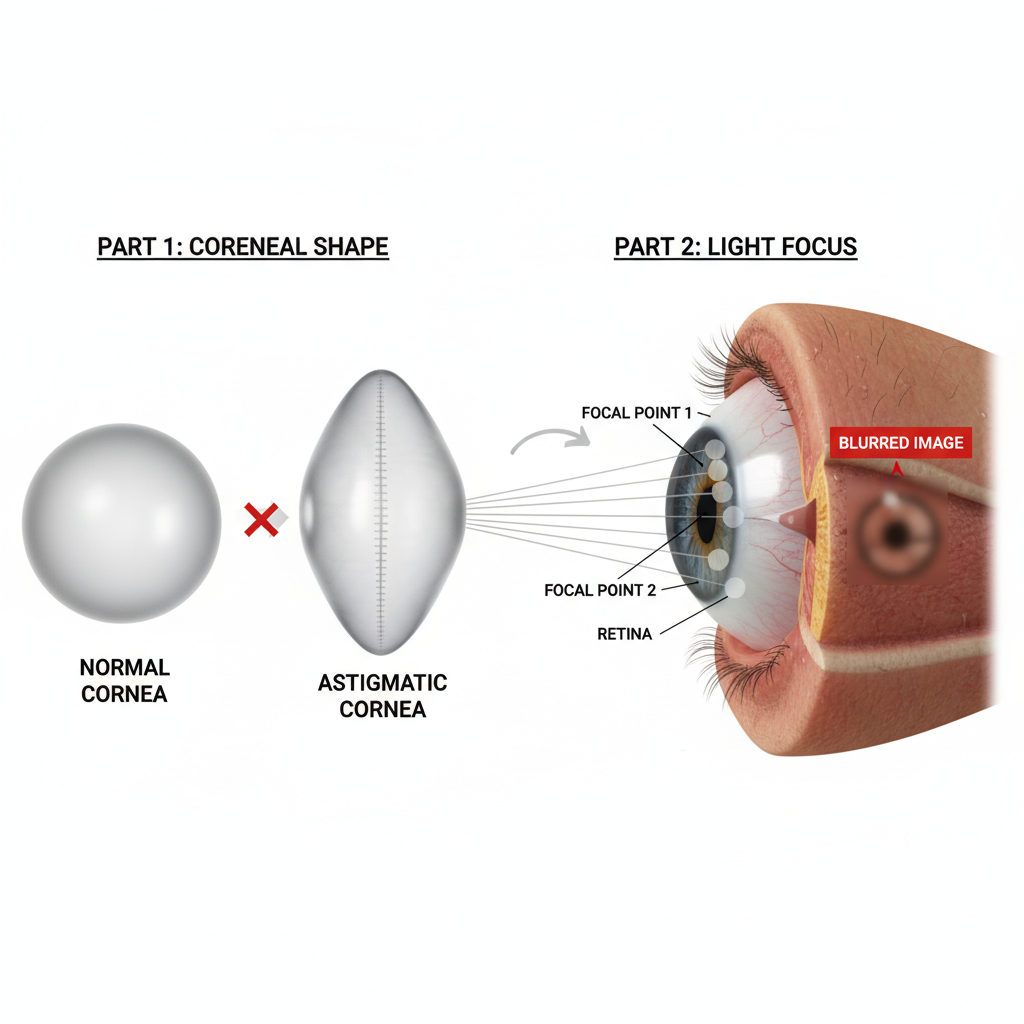
Astigmatism is another extremely common refractive error, but it works differently than myopia. While myopia is a problem of focus distance (front-to-back), astigmatism is a problem of focus consistency. It occurs when the cornea, or sometimes the lens inside the eye, has an irregular, non-spherical shape.
Instead of being shaped like a perfectly round basketball, an astigmatic cornea is shaped more like an American football or the back of a spoon. This toric shape has two different curves—one steeper and one flatter. Because of this, the eye has two separate focal points from a single object, causing light to focus unevenly on the retina. A large-scale study on pediatric vision found astigmatism to be the most prevalent type of refractive error, highlighting its commonality.
How Astigmatism Affects Your Vision
Because astigmatism creates multiple, competing focal points, it causes blur and distortion at all distances, both near and far. The brain struggles to merge the two indistinct images, leading to a unique set of symptoms:
- A general lack of sharpness or detail in your vision.
- "Ghosting" or double images, especially with high-contrast text.
- Halos, starbursts, or streaks around lights, particularly noticeable at night.
- Significant eye strain and headaches, as your eye muscles constantly try to accommodate for the blur.
- Squinting is also common, as it can temporarily change the shape of the eyelid opening to help focus light more clearly.
Understanding Astigmatism on Your Prescription
Correcting astigmatism requires more information than just a sphere value. On your prescription, it is defined by two numbers: Cylinder (CYL) and Axis.
- Cylinder (CYL): This measures the power needed to correct the difference between the cornea's two curves. Like SPH for myopia, it's typically a negative number and is measured in diopters. A higher CYL number (e.g., -2.00) means more significant astigmatism.
- Axis: This is a number between 1 and 180, representing an angle in degrees. It tells the lab the exact orientation of the astigmatism—in other words, where to place the cylindrical correction on the lens to counteract your cornea's unique shape.
The Common Reality: Myopia with Astigmatism
For many people, these two conditions occur together. It is very common to have an eye that is both slightly elongated (myopic) and irregularly shaped (astigmatic). This results in what is called a compound prescription, which will have values for SPH, CYL, and Axis. An example might look like this: -2.50 -1.25 x 175.
This means the person needs -2.50 D of spherical power to correct their nearsightedness, plus an additional -1.25 D of cylindrical power oriented at the 175-degree axis to correct their astigmatism.
The "Sharp but Weird" Adaptation Period
When patients with a significant astigmatism correction receive new glasses, a common piece of feedback is that their vision is "sharp but weird." The floor might seem to tilt, straight lines may appear curved, and there can be a mild "fishbowl" sensation.
This is a completely normal part of the neuroadaptation process. For years, your brain has been working overtime to fuse two blurry, distorted images into one. Your new lenses are now delivering a single, perfectly focused image to your retina for the first time. It typically takes 48 to 72 hours for your brain to recalibrate and accept this new, correct visual input. Communicating this expectation is key to preventing unnecessary returns or feelings of frustration.
Why This Distinction Is Critical for Your Eyewear
Understanding whether you have myopia, astigmatism, or both is crucial because it dictates the type of lens technology you need for clear and comfortable vision.
Lens Design and Technology
- Simple Myopia: Can be corrected effectively with standard spherical lenses.
- Astigmatism: Requires toric lenses, which have the cylinder and axis correction built in.
- High Myopia with Astigmatism: This combination benefits most from aspheric toric lenses. Aspheric designs create a flatter, thinner, and lighter lens profile that significantly reduces the peripheral distortion and eye magnification that can occur with strong prescriptions. For more on this, see our guide on how lens curvature affects high prescription vision.
A key heuristic for opticians is that when the CYL power is half or more of the SPH power (e.g., -2.00 SPH and -1.00 CYL), the astigmatism becomes the dominant visual factor. In these cases, precise fitting and advanced aspheric lens designs are paramount for patient satisfaction.
The Importance of a Precise Fit
While a simple myopic lens is forgiving, a lens correcting for astigmatism is not. The axis must be perfectly aligned with your eye. An error of just 5 to 10 degrees in a moderate-to-high prescription can induce noticeable blur and headaches, often requiring a remake of the lenses. This is why accurate pupillary distance (PD) and fitting height measurements are non-negotiable for anyone with astigmatism.
Why Over-the-Counter Glasses Fall Short
Off-the-shelf reading glasses found in drugstores only contain a simple spherical correction (for farsightedness, or presbyopia). They contain no astigmatism correction. According to the Cleveland Clinic, this is why they are unsuitable for many people, as uncorrected astigmatism can lead directly to the eye strain and headaches these glasses are meant to prevent.
Your Right to Clear Vision
Understanding your vision is the first step toward advocating for your health. Thanks to the FTC's Eyeglass Rule, your eye doctor is required to provide you with a copy of your prescription immediately following an exam. This empowers you to take that prescription and purchase eyewear from any provider you choose, ensuring you get the right technology for your specific needs at a competitive price.
Frequently Asked Questions
Can you have astigmatism without being nearsighted or farsighted? Yes. It's possible to have a prescription with a "Plano" or "PL" sphere value, which means you have zero spherical error, but still have a cylinder and axis value to correct for astigmatism.
Does astigmatism get worse over time? Like myopia, astigmatism can change throughout your life. It's common for the axis or power to shift slightly, which is why regular eye exams are essential to ensure your correction is up to date.
Why do my new glasses for astigmatism make me feel dizzy? This is part of the adaptation period. Your brain and inner ear (which controls balance) are adjusting to the new, clearer visual information that is free from the distortion you were used to. The sensation typically fades within a few days of consistent wear.
Is it possible to have astigmatism in only one eye? Absolutely. It's very common for the prescription to be different between the two eyes (a condition called anisometropia). One eye could have compound myopia with astigmatism, while the other has only simple myopia or no correction at all.
Disclaimer: This article is for informational purposes only and does not constitute professional medical advice. Always consult with a qualified optometrist or ophthalmologist for any concerns about your eye health and to receive a comprehensive eye exam and prescription.


