












Why New Glasses Make the Floor Look Slanted: The Distortion Effect
The World at a Slant: Why Your New Glasses Make Everything Look Tilted
You just picked up your new glasses, excited for crisp, clear vision. You put them on, take a look around, and suddenly the floor looks like it’s sloping away from you. Straight lines appear to curve, and you feel a dizzying sense of walking on uneven ground. This disorienting experience is surprisingly common, especially with new or significantly changed prescriptions. It’s not a sign that your eyes are "bad" or that you’ll never adjust; it’s the result of your brain working hard to process a brand-new visual world.
This article explains the science behind why your new glasses can cause spatial distortion. We will break down the optical reasons for the "slanted floor" effect, provide a step-by-step guide to help your brain adapt, and outline the red flags that indicate you should see your optician for a re-check.
TL;DR: Why Your New Glasses Cause Distortion
- Brain Adaptation: Vision happens in your brain, not just your eyes. A new prescription forces your brain to relearn how to interpret visual signals, causing temporary distortion.
- Astigmatism Correction: This is the most common cause. Changes to the cylinder (CYL) and axis in your prescription alter how light focuses on your retina, which can make straight lines appear curved or tilted.
- Pupillary Distance (PD) Errors: Even a tiny inaccuracy in the measurement of the distance between your pupils, especially the individual distance for each eye (monocular PD), can create an unwanted prismatic effect that warps your vision.
- Lens Power and Design: High-powered lenses and new lens types like progressives naturally have more peripheral distortion that your brain needs to learn to ignore.
The Science of Sight: Why Your Brain is Temporarily Confused
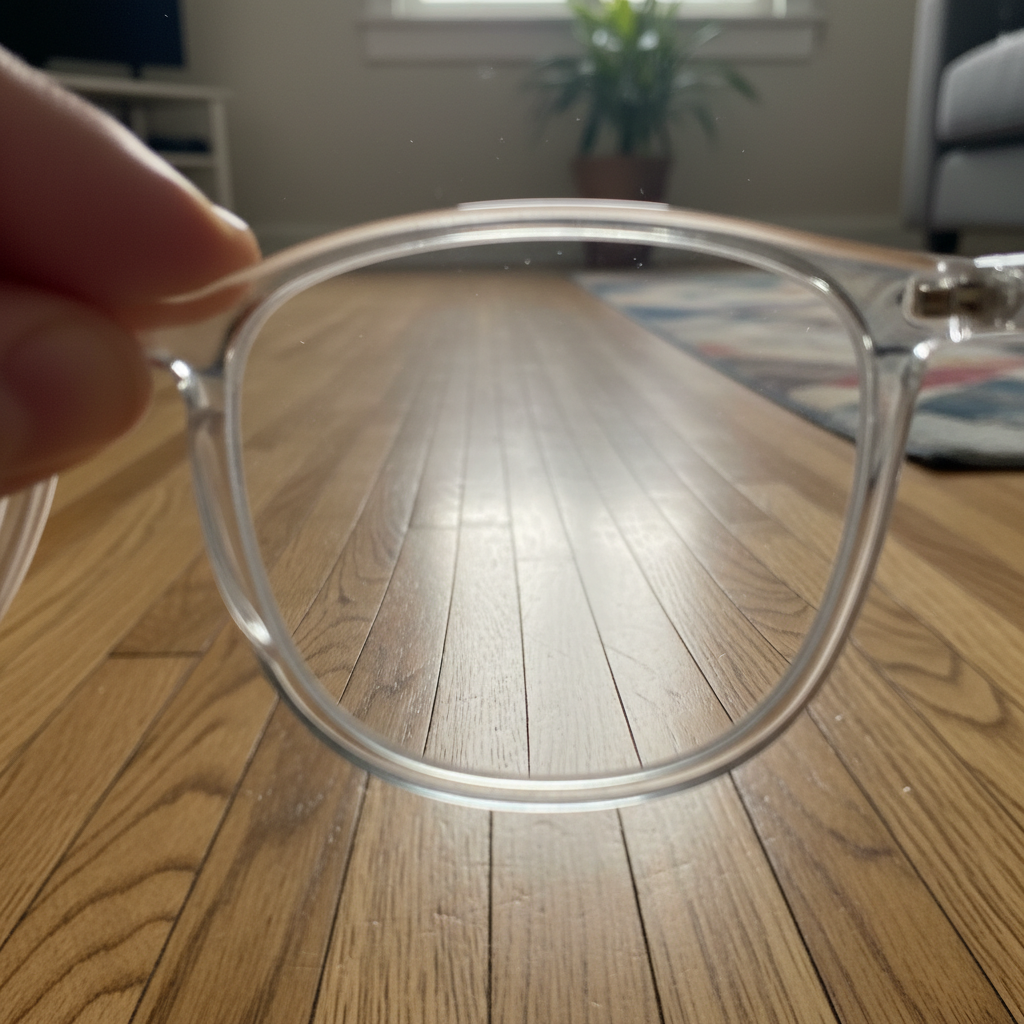
Before we dive into the solutions, it’s crucial to understand that seeing is an active process managed by your brain. Your eyes are the cameras, but your brain is the powerful processor that interprets the incoming light, corrects for errors, and creates the stable, three-dimensional world you perceive.
When you wear new glasses, you’re essentially upgrading your camera’s hardware. Your brain, which was perfectly calibrated to the old, familiar signals (even if they were blurry), now receives a flood of new, sharper, and slightly different information. This mismatch between the old "visual map" and the new data is what causes the strange sensations of slanting floors and curved walls. This process is called neuro-adaptation.
Several key optical factors contribute to this initial confusion:
- Astigmatism and the Axis: Astigmatism occurs when the cornea or lens is shaped more like a football than a sphere. To correct this, your prescription includes a cylinder (CYL) power and an axis, which is a specific angle (from 1 to 180 degrees) at which that power is applied. According to the Cleveland Clinic, this correction ensures light focuses on a single point. When your axis changes, even slightly, the orientation of the world your brain perceives is rotated, causing the tilting effect.
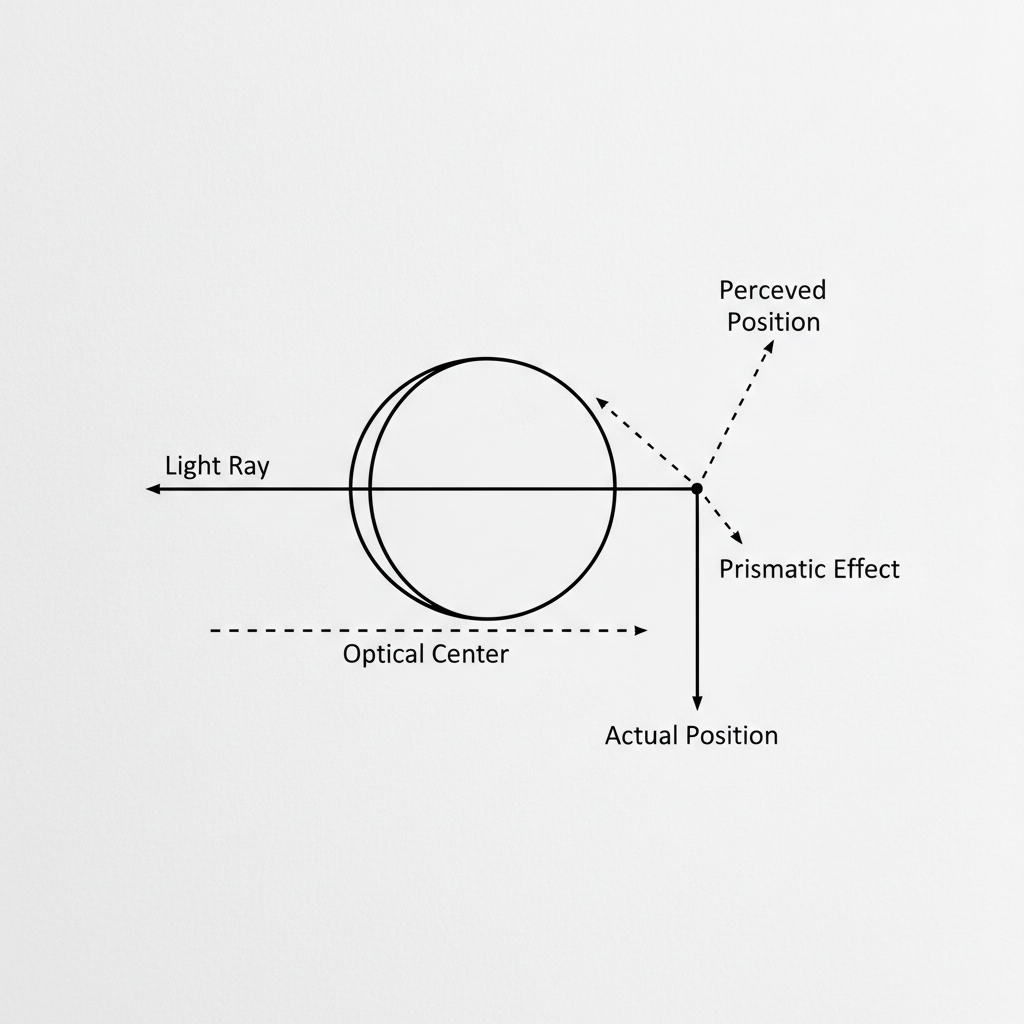
- The Unwanted Prism Effect: Lenses are thickest at their optical center, the one point where light passes straight through without bending. If you look through any other part of thelens, light is bent, creating a prismatic effect. As explained in clinical resources like StatPearls, this can make objects appear shifted. A small error in your Pupillary Distance (PD) measurement means the optical centers of the lenses won't be aligned with your pupils, forcing you to look through a part of the lens that induces this prismatic shift, leading to distortion.
- Aniseikonia (Image Size Difference): If you have a different prescription in each eye, the lenses may magnify or minify images at slightly different rates. This difference, known as aniseikonia, can cause significant issues with depth perception and spatial awareness. Research published in the Official Journal of the College of Optometrists notes that even a 2-4% difference in image size can trigger dizziness and visual motion distortions.
Your Adaptation Playbook: A 5-Step Guide to Seeing Straight
While unsettling, this distortion is usually temporary. Your brain is incredibly plastic and will build a new, accurate visual map. Here is a practical, step-by-step process to make the adaptation period smoother and safer.
Methodology Note: The following steps are based on common clinical heuristics provided by experienced opticians. The "one-week rule of thirds" is a practical guideline, not a formal medical standard, used to gauge adaptation progress.
- Commit to Full-Time Wear: The most important step is to wear your new glasses consistently. Taking them off and switching back to your old pair is like resetting the adaptation process. Your brain needs consistent input to learn the new rules. Put them on when you wake up and wear them until you go to bed.
- Start in a Safe, Familiar Space: Do not put on a powerful new prescription for the first time and immediately go for a drive or walk down a flight of stairs. Spend the first few hours in a controlled environment like your home. This allows your brain to adjust without the added pressure of complex navigation.
- Retrain Your Head-Eye Coordination: With new glasses, especially those with astigmatism correction or progressive lenses, you need to learn to "point your nose, not just your eyes." Instead of shifting your eyes to look at something peripherally, turn your head to face it directly. This keeps your gaze passing through the clearest, most accurate part of the lens—the optical center.
- Practice Simple Visual Exercises: Spend a few minutes periodically focusing on different objects. Look at a distant object for 20 seconds, then a near object for 20 seconds. Trace straight lines with your eyes, like the edge of a doorframe or window, to help your brain re-calibrate what "straight" looks like.
-
Be Patient, But Use a Timetable: Adaptation doesn't happen in an instant. Use this practical rule of thumb to track your progress:
- After 3-4 Days: You should notice roughly a 30% improvement. The distortion should be less intense and feel more manageable.
- After One Week: You should be feeling about 60-70% better. The world should look mostly normal, with only occasional moments of oddness.
- After Two Weeks: For most people, the adaptation is complete.
If your progress stalls or you don't meet these general milestones, it may be time to consult your optician.

Red Flags: When Distortion Isn't Just Adaptation
While a period of adjustment is normal, some symptoms are not. Contact your eye care professional if you experience any of the following, as it may indicate an error in the prescription or the lens manufacturing:
- Persistent Headaches or Severe Eye Strain: Mild strain is expected, but debilitating headaches that don't ease up are a warning sign.
- Nausea or Dizziness That Doesn't Subside: Feeling slightly off-balance initially is common, but ongoing vertigo or nausea could point to a significant issue.
- No Improvement After One Week: If you have worn your glasses consistently for a full week and the distortion is just as bad as it was on day one, the chances of it resolving on its own are low.
- Clear Vision in One Eye, Blurry in the Other: While prescriptions often differ between eyes, the perceived clarity should feel balanced. A significant difference could indicate an error.
- You Have to Tilt Your Head to See Clearly: If you find yourself adopting an unusual head posture to get clear vision, it often means the optical center or the progressive corridor is misplaced.
Remember, an optician's measurements are critical. As noted from clinical experience, an error of just 2mm in a monocular PD measurement can induce enough prismatic effect to make adaptation nearly impossible for some wearers. Don't hesitate to ask for a re-check.
Frequently Asked Questions (FAQ)
Q: How long does it really take to get used to new glasses? A: The typical adaptation period is a few days to two weeks. Using the "one-week rule of thirds" can help you gauge your progress. If you're not at least 60-70% adapted after one week of full-time wear, a professional re-evaluation is recommended.
Q: Why do my old glasses feel more comfortable? A: Your brain has spent years perfecting its interpretation of the signals from your old glasses. It created a stable and reliable "map." Even though your new glasses provide clearer information, your brain initially prefers the familiar, comfortable map it already knows.
Q: Will this distortion damage my eyes? A: No. The distortion and disorientation are part of a neurological process and will not cause any physical harm to your eyes. It is a temporary sensory mismatch while your brain adapts.
Q: Is it normal to feel dizzy with new glasses? A: Yes, mild dizziness or a feeling of being off-balance is a common symptom of neuro-adaptation, particularly with high prescriptions, astigmatism changes, or a switch to progressive lenses. However, if the dizziness is severe or doesn't improve, consult your optician.
Q: I have a strong prescription. Will my lenses always distort my eyes' appearance? A: High-power lenses can cause some magnification ("bug-eye") or minification ("tiny-eye") effect. However, modern solutions can help. You can learn more about how to manage this in our article on strong prescription lenses and eye distortion.
Disclaimer: This article is for informational purposes only and does not constitute professional medical advice. If you are experiencing persistent vision problems, headaches, or dizziness, consult with a qualified optometrist or ophthalmologist for a comprehensive eye exam and personalized guidance.
References
- Cleveland Clinic. (n.d.). How to Read Your Eye Prescription. Retrieved from https://health.clevelandclinic.org/how-to-read-your-eye-prescription
- Patel, D. S., & Sharts, M. (2023). Prisms in Ophthalmology. In StatPearls. StatPearls Publishing. Retrieved from https://www.ncbi.nlm.nih.gov/books/NBK580488/
- Kaye, S. B., et al. (2024). Aniseikonia, spatial perception and binocular vision. Official Journal of the College of Optometrists. Retrieved from https://pmc.ncbi.nlm.nih.gov/articles/PMC11603396/
- American Academy of Ophthalmology (AAO). (n.d.). Tips for getting used to new glasses. Retrieved from https://www.aao.org/eye-health/glasses-contacts/new-glasses-tips


