









The Optical Center (OC) Height: The Most Overlooked Metric in Online Ordering
The Unseen Metric: Why Optical Center Height is Crucial for Clear Vision
You found the perfect frames online, meticulously entered your prescription, and waited for their arrival. But when you put them on, something feels off. The vision isn't perfectly crisp, you feel a slight "pulling" sensation, and by the end of the day, a headache is blooming. The culprit might not be your prescription, but a tiny, overlooked measurement: the Optical Center (OC) Height.
This article addresses a critical detail in online eyewear ordering: the assumption that your pupils sit at the geometric center of the frame. We will explain what Optical Center (OC) Height is and why it must align perfectly with your pupils. A mismatch induces unwanted prism, causing the exact eye strain, headaches, and visual distortion that can make a new pair of glasses feel wrong.
TL;DR: Why Your OC Height Matters
- What it is: OC Height is the vertical measurement in millimeters from the bottom of the lens to the center of your pupil.
- The Default Problem: Most online orders default this to the frame's geometric center, which doesn't account for how frames actually sit on your unique facial structure.
- The Consequence: A mismatch between your pupil and the OC forces your eyes to work harder, causing headaches, eye strain, and distorted vision. This effect is magnified in higher prescriptions.
- The Solution: Measuring your OC Height ensures the lenses are custom-made to your eyes and face, providing optimal clarity and comfort.
The Physics of Sight: Why OC Alignment is Non-Negotiable
To understand why OC height is so important, we first need to understand how a prescription lens works. Think of your lens not as a simple piece of curved plastic, but as a complex series of prisms. There is only one point on that lens that has zero prismatic power: the optical center.
When you look straight through the optical center, light passes directly to your retina without being bent, providing the clearest vision. However, if your pupil is not aligned with this center, you are essentially looking through a different part of the lens—a part that acts like a prism.
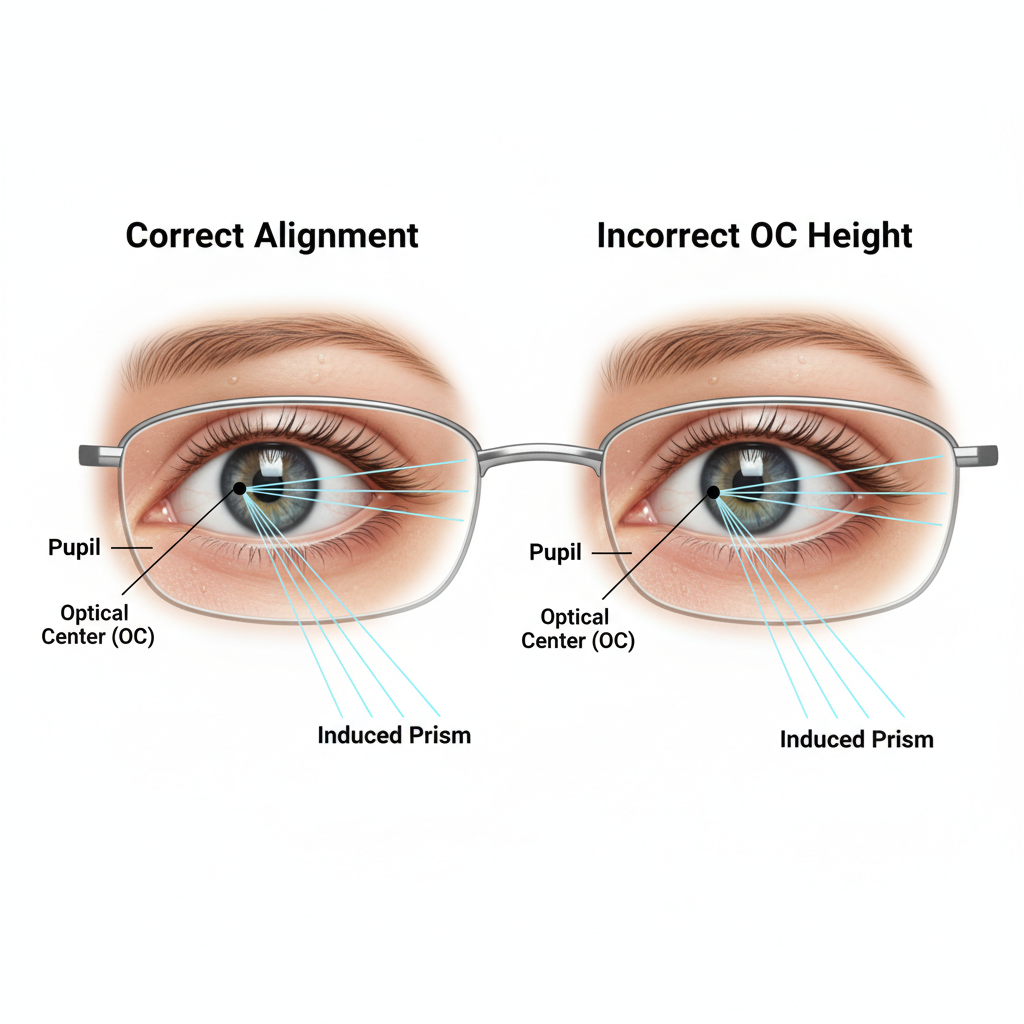
Induced Prism: The Hidden Source of Your Discomfort
This misalignment creates what is known as "induced prism." Your eye muscles must then work to correct for the light being bent incorrectly. This constant, subconscious effort is what leads to a cascade of symptoms:
- Headaches: Especially around the temples and forehead.
- Eye Strain: A feeling of fatigue or soreness in the eyes.
- Distorted Vision: The world might feel like it's tilting, or you may experience a "pulling" sensation.
- Dizziness or Nausea: In more severe cases, the brain's struggle to merge two misaligned images can lead to motion-sickness-like symptoms.
This isn't just a feeling; it's physics. The effect is quantified by a principle known as Prentice's Rule. While the formula is technical (Prism = Power x Decentration / 10), the takeaway is simple: the stronger your prescription and the further the OC is from your pupil, the more prism is induced.
Methodology Note: In optical practice, a mismatch of just 2-3 millimeters in OC height can induce approximately 0.5 prism diopters for every diopter of prescription power. For a common -4.00 prescription, that's 2 prism diopters of unintentional vertical prism—a primary trigger for headaches and visual discomfort, as noted by experienced opticians.
Who Is Most at Risk for OC Mismatch?
While a correct OC height benefits everyone, the negative effects of a mismatch are more pronounced for certain individuals and eyewear choices.
- People with High Prescriptions: As explained by Prentice's Rule, the higher your sphere or cylinder power, the more dramatic the prismatic effect from even a small OC error. If you have a strong prescription, you are much more likely to feel the uncomfortable effects of a default OC placement. This is also why strong prescriptions can sometimes distort the appearance of your eyes.
- Individuals with Unique Facial Features: Not everyone's pupils align with the geometric center of a frame. If you have a low brow, high cheekbones, a low nose bridge, or if your eyes are set closer together or farther apart than average, your glasses will sit in a position where a centered OC is incorrect.
- Wearers of Large or Deep Frames: The trend of oversized frames makes the geometric center assumption even more likely to be wrong. On a tall frame (one with a deep "B" measurement), your pupil is almost always located in the top half of theframe, not the dead center.
- Progressive Lens Wearers: For multifocal lenses like progressives, the vertical alignment is absolutely critical. The equivalent measurement, "Segment Height," determines where the reading portion of the lens begins. An error here of more than 1-2 millimeters can render the lenses unusable. For more detail, you can read about who cannot wear progressive lenses.
A Practical Guide to Measuring Your OC Height
Measuring your OC Height at home is straightforward, but it requires precision. An accurate measurement is far better than relying on a default that doesn't fit you.
Disclaimer: This guide is for informational purposes. For complex prescriptions or if you are unsure, a measurement by a qualified optician is the most reliable method. This information does not constitute professional medical advice.

Step-by-Step Instructions
- Wear the Frames Correctly: Put on the frames you plan to order. Adjust them so they sit comfortably and naturally on your face. This is the single most important step.
- Stand Before a Mirror: Stand about 8-12 inches away from a mirror in a well-lit room. Your posture should be relaxed and natural.
- Close Your Right Eye: Look straight ahead at your open left eye in the mirror.
- Mark the Pupil: Using a non-permanent marker, place a small dot on the left lens directly over the reflection of your pupil.
- Repeat for the Other Eye: Now, close your left eye and look straight ahead at your open right eye. Mark the dot for your right pupil.
- Measure the Distance: Take the glasses off. Using a ruler that measures in millimeters, measure the vertical distance from the very bottom of the lens (the inside edge of the frame) up to the center of the dot you marked. Do this for each lens.
- Record Your Measurement: This number, in millimeters, is your OC Height for each eye. It is normal to have slightly different measurements for your left and right eye.
Common Mistakes to Avoid
A precise measurement requires avoiding a few common errors.
- Incorrect Posture: Do not tilt your head up or down. A common mistake is tilting the head back, which will result in a measurement that is too high.
- Unnatural Frame Position: Do not push the glasses up the bridge of your nose or let them slide down. The measurement must be taken with the frame in its natural, everyday wearing position.
- Measuring from the Wrong Point: Always measure from the bottom-most edge of the lens visible within the frame, not from the bottom of the frame itself.
The Manufacturing Difference: From Default to Custom-Made
When you order glasses online without providing an OC height, the lab defaults to cutting the lenses based on the frame's geometric center. It’s a one-size-fits-all approach.
However, when you provide a specific OC height, you upgrade your order from a generic product to a custom-made medical device. The lab uses your measurement to decenter the lens during the surfacing process. This means they grind the lens so that the true optical center is placed exactly where your pupil will be, regardless of where that is within the frame.
This precision ensures you get the clearest and most comfortable vision possible, fully leveraging the power of your prescription and the quality of your lenses, which are manufactured to meet stringent safety standards, such as the FDA's requirement for impact resistance.
Frequently Asked Questions (FAQ)
Q: Is it normal for my left and right OC heights to be different? A: Yes, completely normal. Facial asymmetry is common, and it’s very typical for one eye to be slightly higher than the other. This is precisely why a separate measurement for each eye is beneficial.
Q: My old glasses didn't have an OC height. Why do I need one now? A: You may have gotten lucky with your previous pair if the frame happened to align well with your pupils, or if your prescription was low enough that the induced prism was not noticeable. As prescriptions change or you choose different frame styles (especially larger ones), the need for an accurate OC height becomes much more critical.
Q: What are the main symptoms of an incorrect OC height? A: The most common symptoms are persistent headaches, a feeling of eye strain or fatigue, a "pulling" sensation, and vision that doesn't feel perfectly sharp or stable. It can feel like you're constantly trying to "find" the clear spot in your lenses.
Q: Can a bad OC height cause lasting damage? A: While extremely uncomfortable, an incorrect OC height in adults will not cause permanent damage to your eyes. However, the persistent strain and headaches can significantly impact your quality of life. For children, proper lens alignment is more critical for healthy visual development.
Q: What should I do if I think my OC height is wrong on my new glasses? A: If you are experiencing symptoms of visual discomfort, the first step is to have the OC placement checked. An optician can verify the measurement on your lenses. If it's incorrect, the lenses will likely need to be remade.
YMYL Disclaimer
This article is for informational purposes only and does not constitute professional medical advice, diagnosis, or treatment. Always seek the advice of your physician or other qualified health provider with any questions you may have regarding a medical condition. Never disregard professional medical advice or delay in seeking it because of something you have read here.
References
- Cleveland Clinic. (n.d.). How to Read Your Eye Prescription. Retrieved from https://health.clevelandclinic.org/how-to-read-your-eye-prescription
- The Vision Council. (n.d.). How Prescription Glasses and Contact Lenses Are Made. Retrieved from https://thevisioncouncilfoundation.org/protect-your-eyes/how-prescription-glasses-and-contact-lenses-are-made-crafting-your-perfect-eyewear/
- U.S. Food & Drug Administration (FDA). (n.d.). Impact-Resistant Lenses: Questions and Answers. Retrieved from https://www.fda.gov/regulatory-information/search-fda-guidance-documents/impact-resistant-lenses-questions-and-answers


