



A Parent's Checklist for Buying Kids' Eyewear Online
A Parent's Checklist for Buying Kids' Eyewear Online
Feeling unsure about buying your child's glasses online? It’s a common concern. You want the convenience and selection of online shopping, but you also need to ensure the health and safety of your child's vision. Our essential checklist walks you through every step, from understanding the prescription to ensuring a perfect fit, empowering you to make a confident and successful purchase.
TL;DR: Your Quick Checklist for Success
- Get a Current Prescription: Always start with a comprehensive eye exam. Your eye doctor is required by law to give you a copy.
- Measure PD Accurately: Pupillary Distance is critical. Use a two-person method for the best results.
- Choose Kid-Tough Materials: Select polycarbonate or Trivex lenses for their superior impact resistance and built-in UV protection.
- Nail the Frame Fit: The frame width should match your child's face width. Pay close attention to the bridge fit, especially for little noses.
- Check the Return Policy: Only buy from retailers with a clear and easy domestic return policy.
Step 1: Secure a Complete and Current Prescription
Before you even start browsing, the foundation of a successful purchase is a valid prescription from a qualified eye care professional.
Your Right to a Prescription
Some parents feel pressured to buy glasses from the same place their child had an eye exam. However, it's important to know your rights. The Federal Trade Commission's Eyeglass Rule mandates that your eye doctor must give you a copy of the prescription immediately after the exam, whether you ask for it or not. This prescription portability is what allows you to shop around for the best value and style for your child.
Decoding the Numbers and Terms
An eyeglass prescription can look like a secret code. Understanding it is the first step to ensuring you order the correct lenses. While our Simple Guide to Reading Your Eyeglass Prescription goes into more detail, here are the basics:
- OD (Oculus Dexter): This refers to the right eye.
- OS (Oculus Sinister): This refers to the left eye.
- SPH (Sphere): This indicates the main lens power, measured in diopters, to correct for nearsightedness (a minus sign, -) or farsightedness (a plus sign, +).
- CYL (Cylinder) & Axis: These values correct for astigmatism, a common condition where the eye is shaped more like a football than a sphere. A recent study on refractive errors in children found that astigmatism is a primary concern, making accurate correction crucial.
- PD (Pupillary Distance): This is the distance in millimeters between the centers of your pupils. It's essential for aligning the optical center of the lenses with your child's eyes.
Step 2: Measure Pupillary Distance (PD) with Precision
This is arguably the most critical measurement you'll take at home. An incorrect PD can lead to eye strain, headaches, and blurry vision because the lenses won't be properly centered. While some online tools exist, a manual measurement can be highly accurate if done carefully.
The Two-Person Method for Best Accuracy
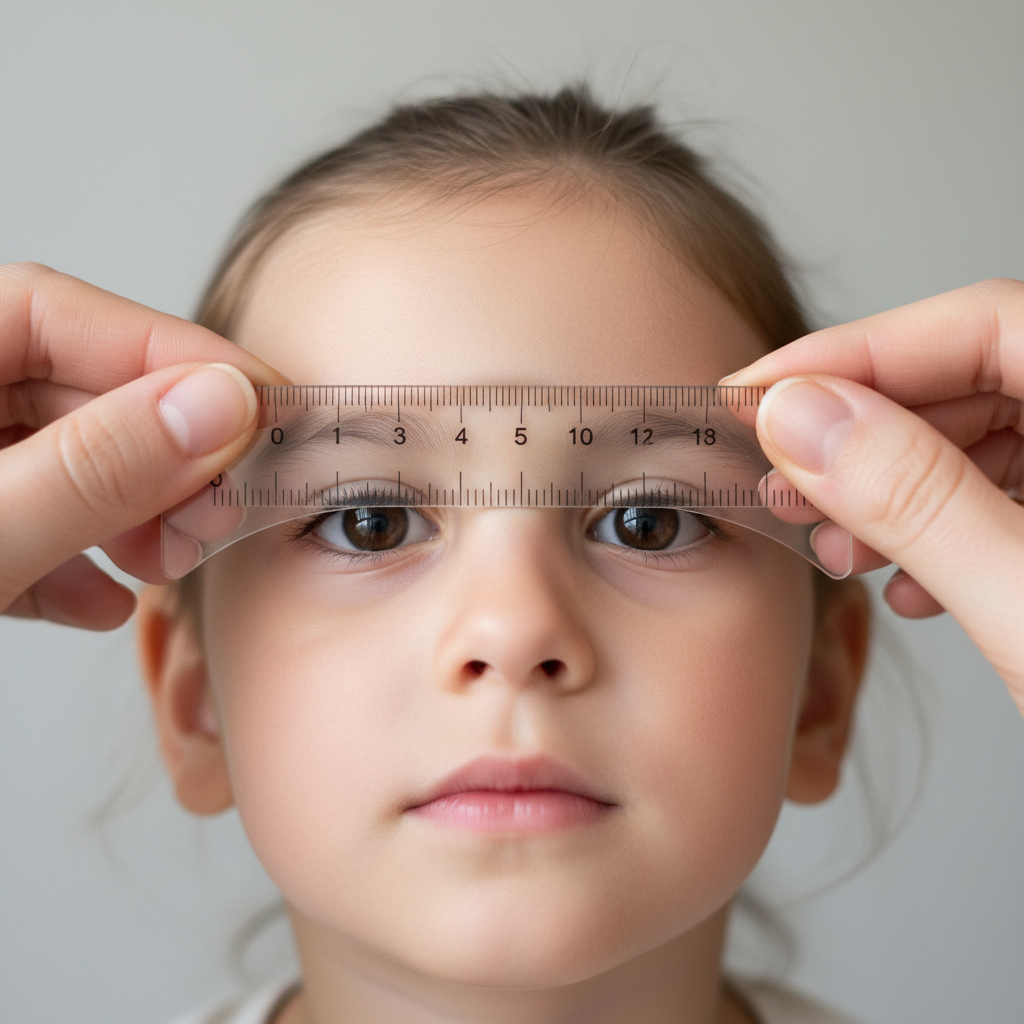
For children, we recommend a two-person approach to get a measurement within the desired ±1–2 mm tolerance. Selfies or single-person methods can have errors of 3–7 mm, which is too high for a child's developing vision.
- Person 1 (The Child): Have your child sit down and look straight ahead at a distant object (at least 20 feet away). Keeping their eyes fixed is key.
- Person 2 (The Measurer): Sit directly in front of the child at their eye level.
- Measure: Place a millimeter ruler across the bridge of the child's nose. Close your right eye and align the ruler's '0' mark with the center of their left pupil.
- Record: Now, close your left eye and open your right. Read the measurement at the center of their right pupil. This number is the PD.
- Repeat: Take the measurement two or three times to ensure consistency.
For a more detailed walkthrough, you can follow our guide on How to Measure Your PD at Home. An error in PD is one reason a new online prescription can feel wrong, so taking your time here pays off.
Step 3: Choose Frames That Fit and Last
For kids, frame selection is about more than just style; it's about safety, comfort, and durability.
Material Matters: Safety First
Always choose frames made from flexible, durable materials. More importantly, the lenses must be impact-resistant. We strongly recommend polycarbonate or Trivex lenses for all children's eyewear. These materials are significantly more impact-resistant than standard plastic. The U.S. Food and Drug Administration (FDA) mandates that all prescription lenses sold in the US pass a drop-ball test to verify their strength, and these materials provide the highest level of protection for active kids.
They also naturally block harmful UV rays, a benefit confirmed by research showing that plastic lenses offer superior UV attenuation compared to other materials.
Getting the Right Fit: A Practical Guide
A common mistake is buying frames that are too large, assuming the child will "grow into them." Ill-fitting glasses will constantly slip down, defeating their purpose.
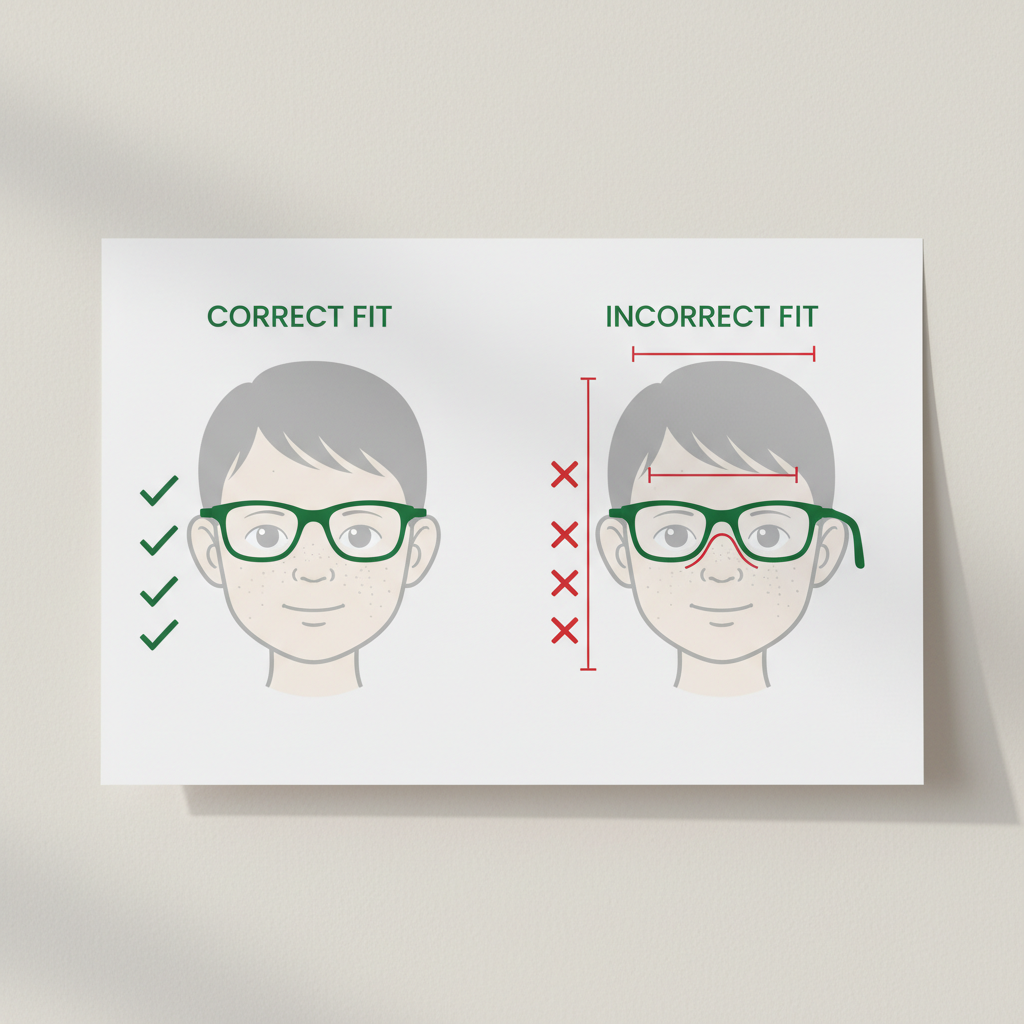
Use this table as your guide:
| Fit Check | What to Look For | Pro Tip |
|---|---|---|
| Frame Width | The total width of the frames should be slightly wider than your child's face, with minimal space at the temples. | A good estimate is to match the frame width to the temple-to-temple measurement of your child's head. |
| Eye Position | Your child's eyes should be centered horizontally and vertically within the lens opening. | This ensures the optical center of the lens aligns perfectly with their pupils for the clearest vision. |
| Bridge Fit | The bridge of the glasses should sit securely on their nose without pinching or leaving red marks. | For children with low or wide nasal bridges, look for frames with adjustable or silicone nose pads. |
| Temple Length | The arms (temples) should extend straight back to their ears and only curve down at the very end. | Kids' temple lengths typically range from 115–130 mm. Spring hinges add durability and a more forgiving fit. |
| No Slipping! | Have your child look down and shake their head. The glasses should stay put. | If they slip, the bridge is likely too wide or the temples are too long. |
Step 4: A Note on Blue Light Lenses for Kids
With the rise of screen time, many parents ask about blue light blocking glasses. It's a topic filled with misinformation.
Expert Warning: Debunking the Eye Strain Myth
A common myth is that blue light from screens causes digital eye strain. However, the clinical consensus is that eye strain is primarily caused by reduced blink rates and focusing fatigue, not by the blue light itself. As one ophthalmologist from the Cleveland Clinic explains, the best remedy for eye strain is the "20-20-20 rule" (every 20 minutes, look at something 20 feet away for 20 seconds). A rigorous double-blind study found no significant difference in eye strain symptoms between participants wearing blue-blocking lenses and those wearing placebos.
More importantly, some research suggests that indiscriminately blocking blue light during the day could be problematic for a child's development. A model proposed in a Mayo Clinic proceeding theorizes that spectral deprivation during childhood might interfere with the eye's natural development, potentially accelerating nearsightedness.
The takeaway? For preventing eye strain, blue light glasses are not the answer. For managing a child's sleep cycle, however, they can be a useful tool when used correctly—in the evening, not during the day.
Wrapping Up: Your Path to a Perfect Pair
Buying your child's glasses online can be a simple and rewarding process when you follow a structured approach. By starting with an accurate prescription, taking a careful PD measurement, and prioritizing fit and material over fleeting trends, you can ensure your child gets a pair of glasses that are safe, comfortable, and effective. Always confirm the retailer offers domestic returns and has a responsive customer service team to help you with any final adjustments.
Frequently Asked Questions (FAQ)
Q: What if the glasses arrive and they don't seem right? A: First, double-check the prescription details you entered against the doctor's script. Then, check the fit using our guide. If the vision still feels off, contact the seller immediately. Reputable sellers have clear policies for remakes or returns.
Q: How often does my child need an eye exam? A: The American Optometric Association recommends annual eye exams for children wearing prescription glasses, or as recommended by their eye doctor.
Q: Are more expensive kids' glasses better? A: Not necessarily. The most important factors are the impact resistance of the lenses (polycarbonate is a must), a proper fit, and an accurate prescription. A well-fitting, affordable pair is far better than an expensive, ill-fitting one.
Q: Can I use my child's old frames for a new prescription? A: Sometimes, but it's often better to get a new, properly fitting frame, especially since children grow quickly. An optician can tell you if the old frames are still suitable and in good condition for a lens replacement.
Disclaimer: This article is for informational purposes only and does not constitute professional medical advice. Always consult a qualified healthcare professional for any health concerns or before making any decisions related to your child's vision.
References
- Federal Trade Commission. (n.d.). Buying Prescription Glasses or Contact Lenses: Your Rights. FTC Consumer Advice. Retrieved from https://consumer.ftc.gov/buying-prescription-glasses-or-contact-lenses-your-rights
- U.S. Food and Drug Administration. (2020). Impact-Resistant Lenses: Questions and Answers. FDA.gov. Retrieved from https://www.fda.gov/regulatory-information/search-fda-guidance-documents/impact-resistant-lenses-questions-and-answers
- Rosenfield, M., et al. (2020). Do Blue-Blocking Lenses Reduce Symptoms of Digital Eye Strain? PubMed. Retrieved from https://pubmed.ncbi.nlm.nih.gov/32007978/
- Bajic, N. (2022). Do Blue Light Blocking Glasses Actually Work? Cleveland Clinic Health Essentials. Retrieved from https://health.clevelandclinic.org/do-blue-light-blocking-glasses-actually-work
- Ostovari, J., et al. (2024). The Unintended Consequences of Blue Light Filtering Spectacles in Children. Mayo Clinic Proceedings: Digital Health. Retrieved from https://pmc.ncbi.nlm.nih.gov/articles/PMC12009466/


