





Getting the Best Fit with Virtual Try-On Tools
Getting the Best Fit with Virtual Try-On Tools
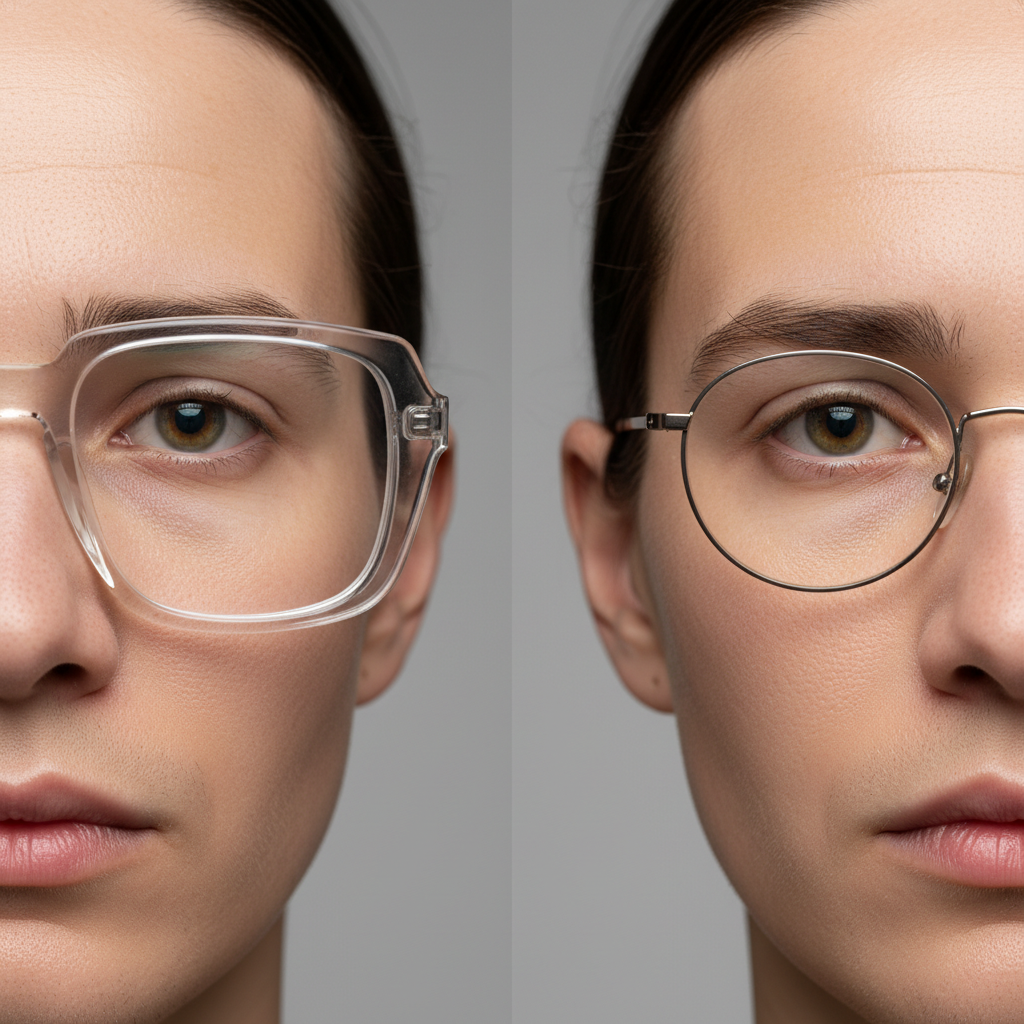
Virtual Try-On (VTO) is a fantastic starting point for shopping for glasses online, but it's only half the battle. Seeing how a frame looks on your face is one thing; ensuring it fits perfectly for clear, comfortable vision is another. A poor fit can lead to headaches, eye strain, and distorted vision—turning your stylish new accessory into a daily frustration.
This guide provides the professional techniques you need to go beyond the VTO preview. We'll show you how to combine precise measurements with your VTO experience to confidently predict how your new glasses will feel and function in the real world.
TL;DR: Key Steps for a Perfect Fit
Measure Your Monocular PD: Get the pupillary distance for each eye individually, not as a combined number.
Calibrate Your VTO: Use a credit card against your forehead to give the software an accurate real-world scale.
Measure Your Old Frames: Use a well-fitting pair of your current glasses as a blueprint, matching the lens width, bridge width, and temple length.
Consider Your Prescription: High-power or progressive lenses have specific frame requirements for optimal performance.
Why a Perfect Fit Is About More Than Just Style
The precise placement of your lenses in front of your eyes is critical for clear vision. Every prescription has an "optical center," the specific point in the lens that provides the truest correction. If your frames are too wide, too narrow, or sit incorrectly on your nose, the optical center will be misaligned with your pupils.
This misalignment forces your eyes to work harder, which can cause a range of issues, including:
Visual Distortion: The edges of your vision may appear blurry or warped.
Eye Strain: Your eye muscles are constantly working to compensate for the incorrect lens position.
Headaches: Persistent eye strain is a common trigger for tension headaches.
A study published in PubMed Central found that a significant percentage of glasses ordered online failed to meet optical tolerance standards, often due to improper lens placement. This highlights why taking control of your measurements is a crucial step in ensuring both the safety and efficacy of your eyewear.
The Foundation: Your Prescription and Pupillary Distance (PD)
Before you even open a VTO tool, you need two key pieces of information: your full prescription and your Pupillary Distance (PD).
According to the Federal Trade Commission's Eyeglass Rule, your eye care provider must give you a copy of your prescription automatically after an exam. However, this rule doesn't always extend to your PD measurement. While your prescription details the corrective power your lenses need, your PD tells the lab exactly where to center those lenses.
What is Pupillary Distance (PD)?PD is the distance in millimeters between the centers of your pupils. For the most accurate fit, especially for stronger prescriptions or progressive lenses, you need a monocular PD—the measurement from the center of your nose bridge to the center of each pupil individually. A combined, or binocular, PD can sometimes mask slight asymmetries in your face, leading to a less precise fit. The acceptable tolerance is tight: typically within ±1mm for single-vision lenses.

Mastering the Virtual Try-On: Pro Tips for Accuracy
A VTO tool is only as good as the information it's given. An arm's-length selfie taken at an angle will create parallax distortion, making frames appear smaller or larger than they are. To get a reliable preview, you must calibrate the tool properly.
Here’s a step-by-step checklist for an accurate VTO session:
Find Good Lighting: Position yourself in a well-lit room with soft, even light. Avoid strong backlighting or shadows that can obscure your facial features.
Calibrate the Scale: This is the most important step. Hold a standard-sized card with a magnetic strip (like a credit card or driver's license) flat against your forehead or just below your nose. This gives the software a real-world object to scale everything against.
Position Your Phone Correctly: Place your phone at eye level, approximately 40–50cm (16–20 inches) away from your face. Do not hold it at arm's length or at an angle. Use a tripod or prop it up for stability.
Maintain a Neutral Head Position: Look directly into the camera. Keep your head level and avoid tilting it up, down, or to the side.
Remove Obstructions: Push back any hair that might cover your eyes or the sides of your face. Heavy makeup can sometimes interfere with the software's ability to detect facial contours, so a clean face is best.
Common Misconception Debunked: Many believe any selfie will work for VTO. In reality, the angle and distance of a typical selfie create significant distortion, leading to an inaccurate representation of frame size and an incorrect PD measurement. Taking the time to calibrate with a card and proper camera positioning is the single best thing you can do to ensure the frames you see on screen are true to size.
Beyond VTO: Using Your Current Frames as a Blueprint
The most reliable way to predict how new glasses will fit is to use a pair you already own and love. On the inside of the temple arm of your current frames, you will likely find a series of three numbers. These are the frame's core dimensions.
| Measurement | What It Is | Why It Matters |
|---|---|---|
| Lens Width (A-Width) | The horizontal width of one lens in millimeters. | This determines the overall scale of the frame front. A good starting point is to find new frames with a lens width within ±2mm of your current pair. |
| Bridge Width | The distance between the two lenses, where the frame sits on your nose. | This is critical for comfort. A bridge that is too tight will pinch, while one that is too wide will cause the glasses to slide down. |
| Temple Length | The length of the arm from the hinge to the tip that rests behind your ear. | This ensures the glasses are secure. Too short, and they'll slip forward; too long, and they won't sit properly. |
When browsing online, compare the dimensions of the new frames to your existing pair. Be wary of sites that only list an overall "frame width," as this single number doesn't tell you how the glasses will sit on your nose or how the lenses will be positioned relative to your eyes.
Special Considerations for a Flawless Fit
Not all prescriptions are created equal. If you have a strong prescription or wear multifocal lenses, certain frame styles will work much better than others.
For High Prescriptions (≥ ±4.00D):With a strong prescription, the edges of your lenses will be thicker. To minimize this effect and reduce weight, consider the following:
Choose Higher-Index Lenses: These materials are denser and can achieve the same corrective power in a thinner, lighter lens.
Select Smaller, Rounder Frames: Avoid very large or angular frames. The larger the lens, the more pronounced the edge thickness will be. A smaller, rounder shape allows the thickest part of the lens to be trimmed away during the cutting process.
For Progressive Lenses:Progressive lenses contain multiple viewing zones (distance, intermediate, and near) in one lens. For these zones to be functional, the frame must have enough vertical height. Look for frames with a lens height (sometimes called B-width) of at least 30mm. A shorter frame may not have enough room to accommodate the full reading corridor, forcing you to tilt your head uncomfortably. As explained by Western Michigan University's Unified Clinics, the design of these lenses requires careful fitting.
Wrapping Up: Your Checklist for Online Eyewear Success
Buying glasses online offers incredible choice and value, but it requires a bit of homework. By moving beyond a simple VTO preview and becoming an active participant in the measurement process, you can ensure your new eyewear is comfortable, effective, and stylish.
Start with Your Prescription: Get a current, complete copy from your eye care provider.
Prioritize a Monocular PD: Measure it yourself carefully or have a professional do it.
Use VTO as a Calibrated Tool: Use a reference card and proper camera positioning for an accurate size preview.
Leverage Your Current Frames: Match the lens width, bridge width, and temple length for a predictable fit.
Choose Frames Suited to Your Lens Type: Don't put high-power or progressive lenses in a frame that won't support them properly.
Frequently Asked Questions (FAQ)
What if my pupillary distance (PD) isn't on my prescription?Your eye care provider is not legally required to include your PD on the prescription. You can ask for it, but if they decline, you can accurately measure it at home using a ruler and a mirror or with the help of a friend. Many online tools can also guide you through this process.
Can I use my contact lens prescription to order glasses?No. A contact lens sits directly on your eye, while glasses sit a short distance away (this is called the vertex distance). Because of this distance, the power values required for your prescription are different. Using a contact lens prescription for glasses will result in incorrect vision.
How much variance in frame measurements is acceptable?For a comfortable fit, try to stay within ±2mm for lens width and bridge width, and ±5mm for temple length compared to a pair of glasses that you know fits well.
Disclaimer: This article is for informational purposes only and does not constitute medical advice. The information contained herein is not a substitute for and should never be relied upon for professional medical advice. Always seek the advice of your physician or other qualified health provider with any questions you may have regarding a medical condition.


