

















Phoria vs. Strabismus: Understanding Eye Misalignment
Do Your Eyes Work Against Each Other? Understanding Phoria and Strabismus
You’ve had your vision checked, and your prescription is up to date. Yet, you still struggle with persistent eye strain, headaches, or even occasional double vision, especially after long hours of reading or screen time. If this sounds familiar, the issue might not be how clearly you see, but how well your eyes work together.
The root of the problem often lies in a category of conditions known as binocular vision dysfunction (BVD), where the eyes are misaligned. This article will clarify the two primary types of eye misalignment: phoria, a hidden tendency for the eyes to drift, and strabismus, a visible and constant eye turn. Understanding the difference is the first step toward finding the right solution and finally achieving comfortable, single vision.
TL;DR: Phoria vs. Strabismus
- Phoria: A latent or hidden misalignment. Your brain works overtime to force your eyes to stay aligned, causing symptoms like eye strain, headaches, and fatigue. The eye turn is not visible to others.
- Strabismus: A manifest or visible misalignment. One eye is constantly turned in, out, up, or down. To avoid double vision, the brain often ignores the image from the turned eye.
- Correction: Phorias are often managed with specialized lenses containing prism, which helps relax the eyes. Strabismus may require a combination of prism, vision therapy, or surgery.
What is Phoria? The Hidden Misalignment
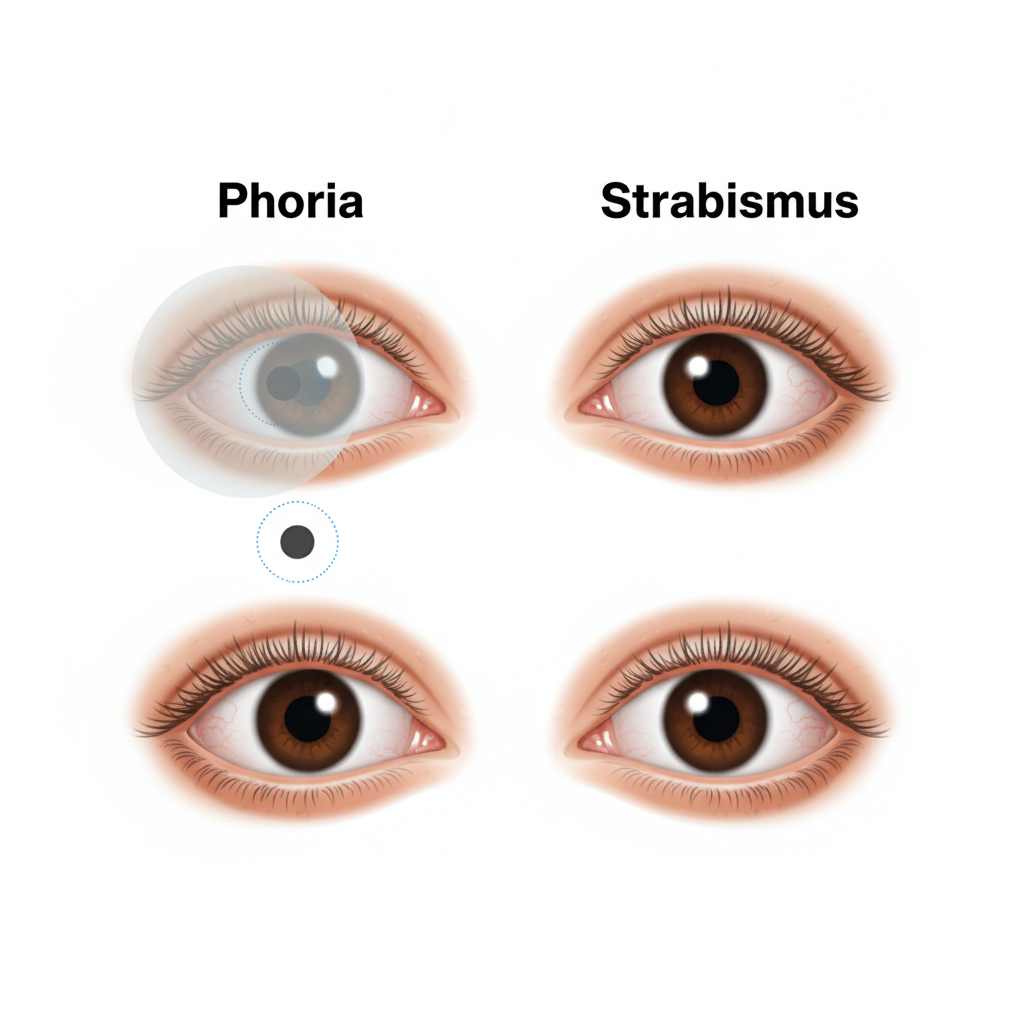
Phoria is a condition where your eyes have a natural tendency to drift out of alignment when you are not actively focusing on an object. Think of it as your eyes’ “resting position” being slightly misaligned.
Your brain, through a powerful mechanism called fusional vergence, constantly works to counteract this drift and keep the eyes pointed in the same direction. This continuous effort is what leads to a host of uncomfortable symptoms, even though your eyes appear straight to an observer. According to a study on Binocular Vision Dysfunction (BVD), these symptoms can even be linked to anxiety and dizziness, affecting daily life for years before a proper diagnosis is made.
Common Symptoms of Phoria:
- Asthenopia: A clinical term for eye strain, often felt as a dull ache in or around the eyes.
- Headaches: Typically located in the temples or forehead, worsening with visual tasks.
- Reading Difficulties: Losing your place on the page, rereading lines, or feeling sleepy after a short time.
- Intermittent Blurry Vision: Vision that fluctuates or becomes blurry, especially when you're tired.
- Light Sensitivity (Photophobia): Feeling uncomfortable in bright lighting conditions.
Types of Phoria:
Phorias are classified by the direction of the drift:
- Esophoria: The eyes tend to drift inward, toward the nose.
- Exophoria: The eyes tend to drift outward, toward the ears.
- Hyperphoria / Hypophoria: One eye tends to drift upward (hyper) or downward (hypo) relative to the other.
What is Strabismus? The Visible Eye Turn
Strabismus is a constant, observable misalignment of the eyes. Unlike phoria, the brain cannot overcome the eye turn with fusional vergence, so one eye is visibly pointing in a different direction. This is what most people refer to as being "cross-eyed" or having a "lazy eye."
To prevent constant double vision (diplopia), the brain often employs a suppression mechanism, effectively ignoring the visual input from the misaligned eye. While this resolves the double vision, it can lead to a serious secondary condition called amblyopia (lazy eye), where the vision in the turned eye fails to develop properly, resulting in reduced visual acuity that cannot be corrected with glasses alone.
Common Signs of Strabismus:
- A visibly turned eye (in, out, up, or down).
- Poor depth perception or clumsiness.
- Tilting the head to see an object clearly.
- Squinting or closing one eye, especially in bright sunlight.
Research into the origins of these conditions shows a strong genetic link for strabismus, with heritability estimated as high as 92%. Phoria, on the other hand, is more influenced by environmental factors.
At a Glance: Key Differences Between Phoria and Strabismus
| Feature | Phoria (Latent Misalignment) | Strabismus (Manifest Misalignment) |
|---|---|---|
| Visibility | Eye turn is not visible to others. Eyes appear straight. | Eye turn is clearly visible to others. |
| Brain's Response | Brain actively fights the misalignment, causing strain. | Brain ignores (suppresses) the image from the turned eye. |
| Primary Symptoms | Eye strain, headaches, fatigue, reading trouble. | Double vision (if not suppressed), poor depth perception. |
| Risk of Amblyopia | Low risk. | High risk, especially in children. |
| Treatment Goal | Relieve the strain on the visual system. | Realign the eyes and/or restore binocular vision. |
How Are Eye Misalignments Diagnosed?
Diagnosing phoria or strabismus requires a comprehensive eye examination that goes beyond a standard vision test. An optometrist or ophthalmologist will perform specific tests to assess your binocular vision.
The most common diagnostic tool is the Cover Test. By covering one eye, the doctor breaks the brain's fusional lock.
- If you have a phoria, the covered eye will drift to its resting position. When the cover is removed, the doctor will observe the eye quickly moving back into alignment.
- If you have strabismus, the misaligned eye will remain turned even when both eyes are open, and the straight eye will move to pick up fixation when the other is covered.
As noted in clinical resources like StatPearls, doctors use tools like a Prism and Alternate Cover Test (PACT) to precisely measure the angle of the deviation in units called "prism diopters."
Expert Insight: A crucial part of diagnosis is measuring the misalignment at different distances. The deviation at 6 meters (for driving) can be very different from the deviation at 40 cm (for reading). A thorough exam assesses both to determine the right corrective approach, as the fusional system behaves differently for near and far tasks.
Corrective Solutions: Prism Lenses, Vision Therapy, and More
Treatment for eye misalignment is tailored to the type and severity of the condition. The goal is always to achieve comfortable, single, and functional binocular vision.
1. Prism Lenses
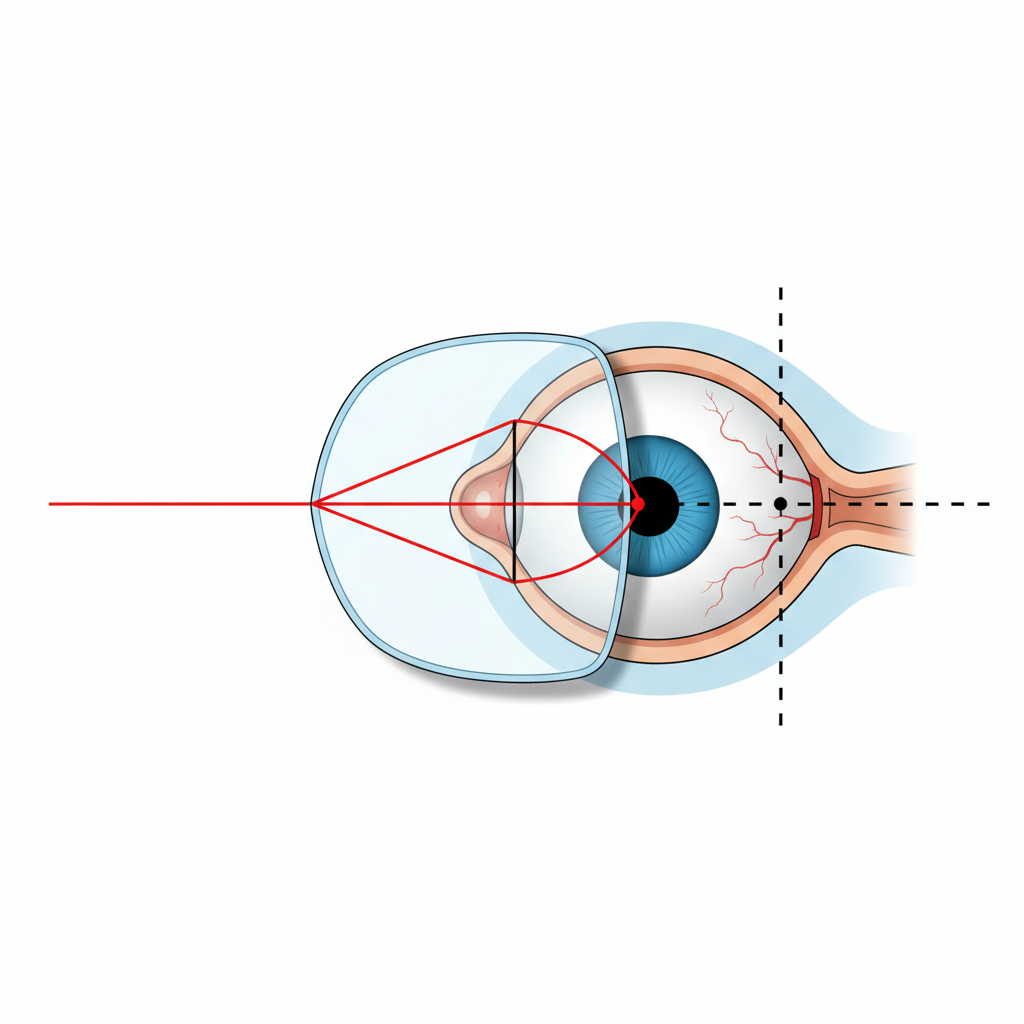
For symptomatic phorias, the most common solution is incorporating prism into your eyeglass lenses. A prism is a wedge-shaped piece of glass or plastic that bends light.
Instead of forcing your eye muscles to strain, a prism lens redirects the image to where the eye is naturally pointing. This allows the brain to fuse the two images into a single picture without the exhausting effort. It doesn't "cure" the phoria, but it effectively neutralizes the strain.
Expert Insight: Prescribing prism is both a science and an art. It's often considered only when a patient's reported symptoms align with the measured deviation. A trial frame with the proposed prism is used in-office to confirm that it subjectively relieves the symptoms. Lenses with higher amounts of prism (over 4-5 diopters) can be thicker and may cause noticeable color fringing (chromatic aberration), so careful lens material and frame selection are essential.
2. Vision Therapy
Vision therapy is like physical therapy for the eyes and brain. It involves a series of prescribed exercises and activities designed to strengthen eye muscle coordination, improve focusing ability, and retrain the brain's visual pathways.
For conditions like Convergence Insufficiency (a type of exophoria where the eyes struggle to turn inward for near tasks), office-based vision therapy has been shown to be highly effective. Unlike prism lenses that compensate for the problem, vision therapy aims to functionally improve the visual system itself.
3. Surgery
For large-angle, constant strabismus, surgery on the extraocular muscles may be recommended. The procedure adjusts the tension of the eye muscles to physically realign the eye. Surgery is often followed by vision therapy to teach the brain how to use the newly aligned eyes together.
Frequently Asked Questions (FAQ)
1. Can eye misalignment develop in adults? Yes. While many cases are congenital, phorias can become symptomatic later in life due to increased visual demands (like heavy computer use) or as the visual system ages. Strabismus can also appear in adults due to medical conditions like diabetes, thyroid disease, or head trauma.
2. Can adults be treated for amblyopia (lazy eye)? For decades, it was believed that amblyopia could only be treated in young children during a "critical period." However, recent research, such as the ATS 20 study on adult amblyopia therapy, shows that a significant number of adolescents and even adults can achieve vision improvement through methods like patching or vision therapy.
3. Why do my new prism glasses make the floor look slanted? This is a common adaptation symptom. Prism lenses can cause spatial distortion, making flat surfaces appear tilted or curved. As discussed in studies on spectacle adaptation, this sensation is caused by the brain adjusting to the new visual input. For most people, this feeling subsides within a few days to two weeks of consistent wear. If it persists, consult your eye care provider.
4. Will over-the-counter reading glasses help my eye strain? No. Over-the-counter readers are simple magnifiers and contain the same power in both lenses. They cannot correct for astigmatism or any form of eye misalignment (phoria or strabismus). If your eye strain is caused by a phoria, OTC glasses will not alleviate the underlying problem.
Disclaimer: This article is for informational purposes only and does not constitute professional medical advice. If you are experiencing symptoms of eye misalignment, consult a qualified optometrist or ophthalmologist for a comprehensive eye examination and personalized treatment plan.
References
- StatPearls [Internet]. (2023). Prisms in Ophthalmology. Treasure Island, FL: StatPearls Publishing. Available from: https://www.ncbi.nlm.nih.gov/books/NBK580488/
- Debbink, A. H., et al. (2023). Psychiatric Comorbidity in Patients with Binocular Visual Dysfunction. Poster presented at Psych Congress. Available from: https://nvminstitute.org/wp-content/uploads/2023/08/Psych-Congress-BVD-Poster.pdf
- Sanfilippo, P. G., et al. (2009). The Heritability of Strabismus and Phoria. Ophthalmology. Available from: https://pmc.ncbi.nlm.nih.gov/articles/PMC2757458/
- Pediatric Eye Disease Investigator Group. (2017). A Randomized Trial of Levodopa as Treatment for Residual Amblyopia in Older Children. Ophthalmology. Available from: https://pmc.ncbi.nlm.nih.gov/articles/PMC5396957/
- Scheiman, M., et al. (2008). Convergence Insufficiency Treatment Trial Study Group. A randomized clinical trial of treatments for convergence insufficiency in children. Archives of Ophthalmology. Available from: https://pubmed.ncbi.nlm.nih.gov/19001211/


