


Pickleball Safety Glasses: High-Impact Protection on the Court
TL;DR: Your Quick Guide to Pickleball Eye Safety
For those short on time, here are the non-negotiable rules for protecting your eyes on the court:
- Certification is Key: Only wear eyewear that is explicitly rated ASTM F803. This is the safety standard for high-impact racquet sports. Standard sunglasses or prescription glasses are not safe substitutes.
- Material Matters: Lenses must be made from polycarbonate or Trivex. These materials are shatter-resistant and can withstand a high-speed impact, unlike regular plastic or glass.
- Fit is Everything: Your frames must be snug and stable. A great test is to look down and shake your head vigorously; if they slide or lift, the fit is inadequate for impact protection.
- Coverage Counts: Choose a wrap-around style frame. This design protects your eyes from off-center shots and reduces peripheral light leakage, which can be a source of glare and UV exposure.
- Choose Tints for Performance: Avoid overly dark lenses, especially for mixed-light conditions. Amber, rose, or brown tints enhance contrast, making it easier to track the ball against the court and sky.
The Unseen Risk: Why Your Everyday Glasses Are a Liability
Pickleball is fast, social, and fun. But the reality is that a hard-plastic ball traveling at high speed is a significant threat to your eyes. The most common myth I encounter when fitting players is the belief that their regular prescription glasses or sunglasses offer adequate protection. They do not.
Standard eyewear is designed to hold lenses for vision correction, not to stop a projectile. In fact, it can create a greater hazard. According to the U.S. Food and Drug Administration (FDA), all eyewear sold in the country must meet a minimum level of impact resistance (under regulation 21 CFR 801.410). However, this "drop ball test" is designed to prevent lenses from shattering during normal use, not to withstand the force of a pickleball smash.
When struck, non-protective eyewear can fail in two dangerous ways:
- The Lenses Shatter: Regular plastic or glass lenses can break into sharp fragments that can be driven into the eye.
- The Frame Breaks: A standard frame can snap, dislodging the lens towards your eye or creating sharp edges that can cause lacerations.
A study published in PubMed analyzing online-ordered eyewear found that a significant percentage failed to meet even basic impact-resistance standards, highlighting the danger of using uncertified glasses for sports. The only way to ensure your eyes are safe is to use eyewear specifically designed and tested for the task.

Decoding the Gold Standard: What ASTM F803 Certification Means
When you see "ASTM F803" printed on a pair of sports glasses, it’s not just marketing jargon. It is a guarantee of a specific level of protection, certified by ASTM International, an organization that develops and publishes technical standards for a wide range of materials and products.
The ASTM F803 standard is specifically for sports eyewear and is the benchmark for high-impact activities like pickleball, squash, and lacrosse. To earn this certification, eyewear must survive rigorous testing that simulates real-world impacts. This includes being struck by projectiles of various sizes fired at speeds up to 90 mph.
Key components of the ASTM F803 standard include:
- Superior Lens Retention: The frame must be designed to hold the lens securely, preventing it from being knocked out of the frame and into the eye upon impact. A study on safety eyewear impact performance found that the frame's groove design is just as critical as the lens material itself for safety.
- Impact-Resistant Materials: Both the lenses and frame must be made from high-impact materials, like polycarbonate, that can absorb and distribute force without shattering.
- Full Coverage: The design must offer sufficient coverage to protect the entire eye socket.
Safety Callout: Always look for the "ASTM F803" marking directly on the frame or lens. Do not mistake it for ANSI Z87.1, which is a standard for occupational safety glasses and is not rated for the same level of high-velocity impact found in sports.
Anatomy of a Perfect Pair of Pickleball Glasses
Beyond certification, the best pickleball glasses combine protection with performance-enhancing features. Understanding these components will help you choose a pair that not only keeps you safe but can also elevate your game.
Lenses: The Heart of Protection and Performance
The lenses are your first and most important line of defense.
- Material Science: Your only choices should be Polycarbonate or Trivex. Both are incredibly impact-resistant and lightweight, and they naturally block 100% of harmful UV rays. While polycarbonate is the industry workhorse, Trivex offers slightly better optical clarity with a higher Abbe value, meaning less chromatic aberration (color fringing), which can be beneficial for players highly sensitive to visual distortions.
-
Tints for a Competitive Edge: Lens color is about more than style. The right tint can improve your ability to see the ball.
- Amber, Rose, or Brown: These tints are excellent for enhancing contrast. They filter out blue light, making the yellow pickleball "pop" against the green or blue court and the sky. This is the tint I most frequently recommend for all-around performance.
- Gray: A neutral gray tint reduces overall brightness without distorting color, making it a good choice for players who play in consistently bright sunlight and prefer true-to-life color perception.
- Clear: For indoor or night play, a clear lens provides the necessary impact protection without dimming your vision.
-
Essential Coatings:
- Anti-Fog: Intense play generates heat and sweat, a perfect recipe for fogging. An anti-fog coating is crucial for maintaining clear vision during a heated match.
- Anti-Reflective (AR): An AR coating on the backside of the lens prevents light from bouncing off the surface and into your eye, reducing distracting glare.
Frames: The Unsung Hero of Stability and Comfort
A high-performance lens is useless if the frame doesn't keep it in the right place.
- Wrap-Around Design: A frame that curves to follow the contour of your face offers two key benefits. First, it provides critical protection from peripheral impacts. Second, as shown in studies on UV dosimetry, it drastically reduces the amount of UV radiation that can leak in from the sides and top.
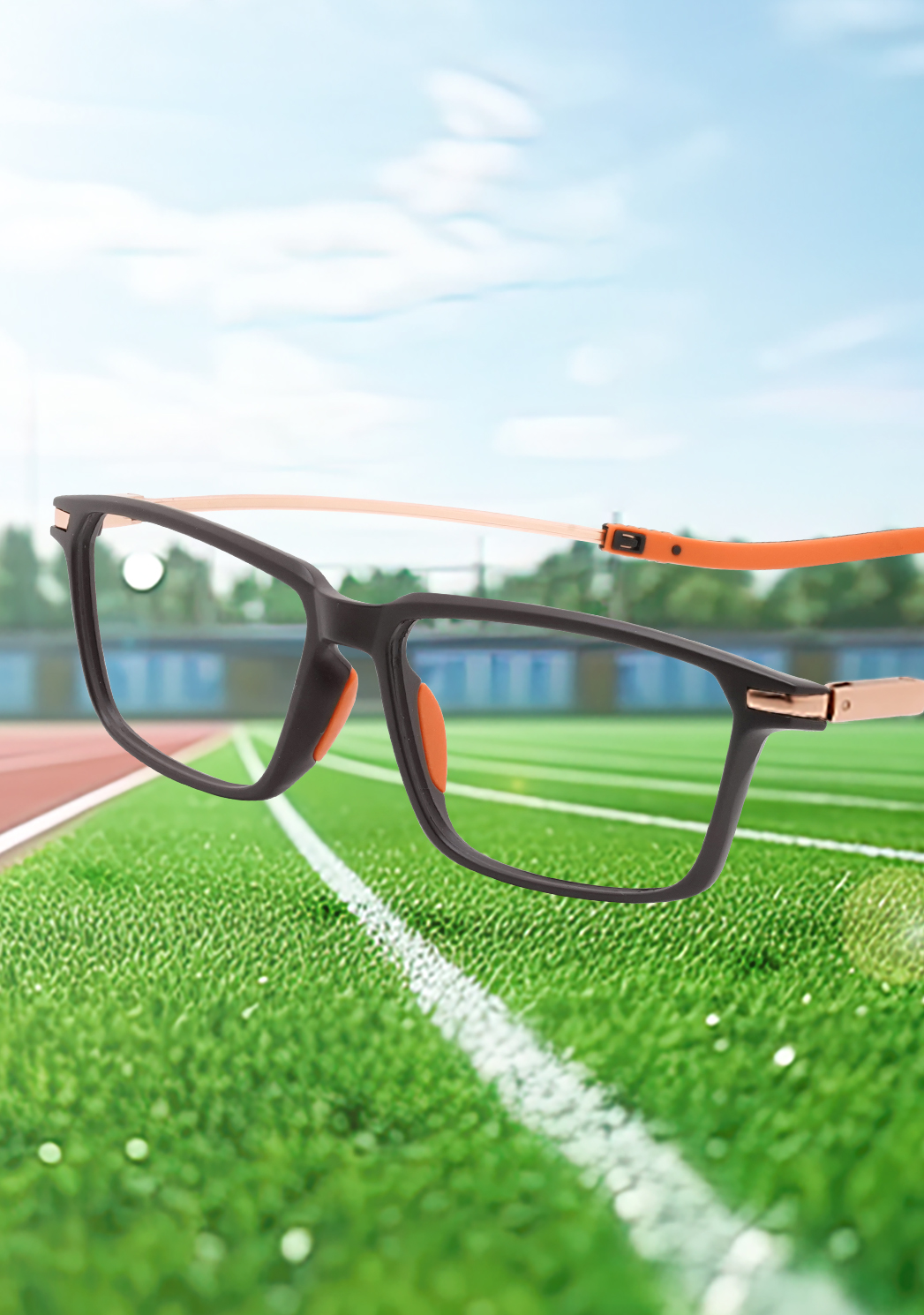
- Secure Fit: Look for frames with rubberized temple tips and nose pads. These elements grip your skin, even when you’re sweating, to keep the glasses from sliding down your nose.
- Ventilation: Small vents built into the frame or lens help circulate air, which is another key strategy in the battle against fogging.

A Fitter’s Guide: My 4-Step Test for a Secure, Performance-Ready Fit
From my experience fitting hundreds of athletes, I’ve learned that the most common mistake is confusing a "snug" fit with a "secure" one. A secure fit means the glasses become a stable part of your face, moving with you, not on you. Before you buy any pair, run through this simple four-step process.
1. Check the Gaps: Put the glasses on and look in a mirror. The frame should sit comfortably on your brow and cheeks without significant gaps where a ball could enter.
2. Perform the "Head-Shake Test": This is my go-to heuristic. Look straight down at your feet and shake your head side-to-side with a vigorous "no" motion. If the frames slide down your nose or the temples lift from behind your ears, the fit is too loose for on-court action.
3. Verify the Vertex Distance: For prescription wearers, this is critical. The "vertex distance" is the space between the back of the lens and the front of your eye. For optimal vision and safety, this distance should ideally be between 12-14 millimeters. If it's too far, your effective prescription strength can change, and it increases the chance of the lens making contact with your eye during an impact.
4. Scan Your Field of View: Turn your head and move your eyes. The frame should not create any major blind spots that could cause you to miss seeing the ball or another player on the court.
Frequently Asked Questions
Can I wear my regular prescription glasses under a protective goggle? While this is technically safer than wearing them alone, it’s not ideal. The fit can be uncomfortable, and the glasses underneath can still break. A better solution is to get prescription sports glasses made with polycarbonate or Trivex lenses.
Are expensive pickleball glasses really worth it? Price doesn't always equal safety. The most important factor is the ASTM F803 certification, not the brand name. That said, premium frames may offer better fit, comfort, and more advanced lens coatings. A study on sunglasses from formal versus informal markets showed that unregulated sources carry a higher risk of non-compliance with safety standards, a lesson that applies here.
How do I stop my glasses from fogging up? First, choose a frame with good ventilation. Second, add an anti-fog coating to your lenses. Third, ensure a proper fit; if the glasses are too close to your face, they can trap moisture. You can also use anti-fog sprays or wipes as a temporary solution.
What's the best way to clean my sports glasses? Polycarbonate lenses are softer than glass and can scratch easily. Never wipe them with your shirt. Rinse them with lukewarm water to remove debris, then gently clean them with a microfiber cloth and a lens cleaner specifically formulated for coated lenses.
Disclaimer: This article is for informational purposes only and does not constitute medical advice. Always consult with a qualified eye care professional to determine the best eye protection for your specific needs, especially if you have pre-existing eye conditions or require a prescription.
References
- U.S. Food and Drug Administration (FDA). (n.d.). Impact-Resistant Lenses: Questions and Answers. Retrieved from https://www.fda.gov/regulatory-information/search-fda-guidance-documents/impact-resistant-lenses-questions-and-answers
- Dunaief, D. (2011). Accuracy of prescription eyeglasses ordered online. PubMed. Retrieved from https://pubmed.ncbi.nlm.nih.gov/21871395/
- Vinger, P. F. (2007). Lens and frame factors in the efficacy of spectacle lens impact resistance. PubMed. Retrieved from https://pubmed.ncbi.nlm.nih.gov/17258162/
- Ferris State University. (n.d.). High Index Lenses. Retrieved from https://www.ferris.edu/optometry/patient-care/lensmaterial/high-Index-Lenses.htm
- Sliney, D. H. (2019). Ocular UV dosimetry: the role of glasses and contact lenses in protecting the eye from UV radiation. PMC. Retrieved from https://pmc.ncbi.nlm.nih.gov/articles/PMC6803516/
- Cole, B. L. (2003). Are sunglasses being sold in the formal market more likely to meet the requirements of the Australian sunglasses standard than those sold in informal markets? PubMed. Retrieved from https://pubmed.ncbi.nlm.nih.gov/12643804/


