








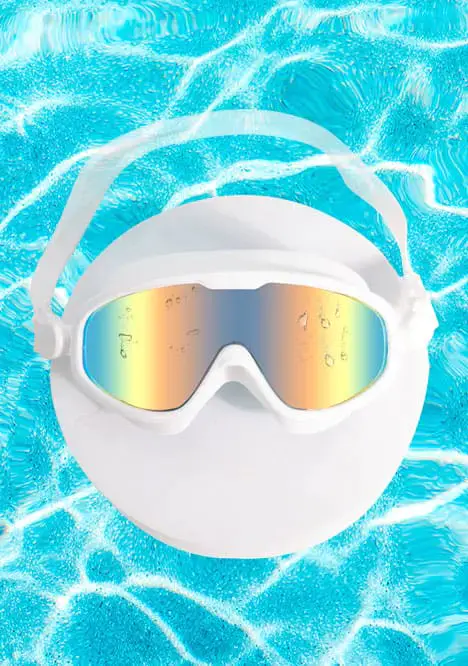
Polycarbonate Lenses: Do They Have Built-In UV Safety?
TL;DR: Your Quick Guide to Polycarbonate UV Safety
Yes, polycarbonate lenses have inherent, built-in UV protection. The material itself blocks over 99% of harmful UV rays without needing special coatings. This is a fundamental property of the polymer. However, always look for a "UV400" or "100% UV Protection" label to guarantee full safety, as this certification is the gold standard. Remember, the darkness of a lens has no bearing on its UV-blocking capability.
Have you ever picked up a pair of sunglasses and assumed the dark tint was what protected your eyes from the sun? It’s one of the most common—and dangerous—myths in eyewear. True protection isn't about color; it’s about material science. Some advanced materials, like polycarbonate, have UV safety built right into their molecular structure.
This article demystifies the science behind polycarbonate lenses. We'll explore their natural UV-blocking properties, debunk the myth that darker lenses are better, and explain why a "UV400" certification is the only label you should trust. Understanding this will change how you shop for glasses, ensuring you get protection that is scientifically verified, not just cosmetic.
The Great Sunglass Myth: Why Darkness Is Deceptive
Many people believe that the darker a sunglass lens, the more protection it offers. This assumption feels intuitive, but it is incorrect and can be harmful. The darkness of a lens is simply a tint designed to reduce visible light, making your eyes more comfortable in bright conditions. It has no inherent relationship to UV protection.
In fact, wearing dark lenses that lack certified UV protection can be more dangerous than wearing no sunglasses at all. As experts at MD Anderson Cancer Center warn, a dark tint causes your pupils to dilate, or open wider, to let in more light. If the lens isn't blocking UV rays, this dilation creates a larger pathway for harmful radiation to enter your eye and cause damage to the retina and lens.
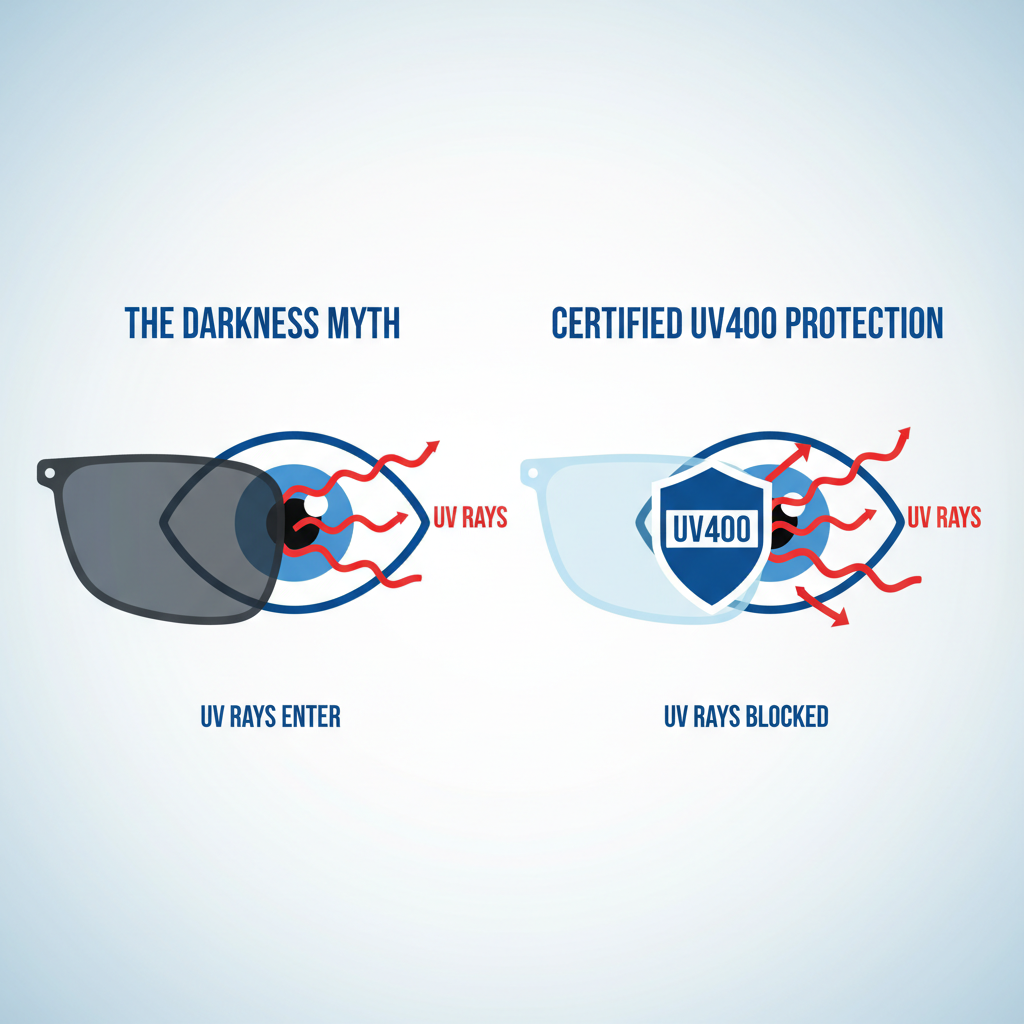
True safety comes from invisible protection. Lenses must be treated with UV-absorbing chemicals or, even better, be made from a material that inherently blocks UV radiation. This is why you should always ignore the color and darkness of a lens and instead look for the one specification that matters: a UV400 rating.
What Does UV400 Mean?
A UV400 rating signifies that the lens blocks 100% of UV light up to 400 nanometers, which covers all harmful UVA and UVB rays. As a technical report on solar UV protection pointed out, the international standards that cap protection at 380 nm are "not at all cautious," as the 380-400 nm band contains significant solar energy. This makes the UV400 standard the most comprehensive and safest choice for your eyes.
The Power of Polycarbonate: Built-In Protection
This brings us to lens materials, and specifically, to polycarbonate. Polycarbonate is a high-tech thermoplastic polymer that was originally developed for aerospace applications. Its unique combination of properties makes it an exceptional material for eyewear.
One of its most significant advantages is its inherent ability to block ultraviolet radiation. The polymer chains that make up polycarbonate are natural absorbers of UV light. This means that a clear, uncoated polycarbonate lens already blocks over 99% of the sun's damaging UV rays. The protection is not a film or coating that can scratch off or wear away; it is an intrinsic property of the material itself.
This is a crucial distinction. While other materials like standard plastic (CR-39) require a separate UV-blocking coating to be applied, polycarbonate provides this safety from the start. As research into clear lens UV protection confirms, even non-tinted lenses made from the right material can offer significant UV defense.
Beyond its UV-blocking capabilities, polycarbonate is also prized for its incredible impact resistance. According to FDA regulations (21 CFR 801.410), all prescription lenses sold in the U.S. must pass an impact test, commonly known as the "drop ball test." Polycarbonate exceeds this standard by a wide margin, making it up to 10 times more impact-resistant than regular plastic or glass lenses. This makes it the standard material for safety glasses, sports goggles, and children's eyewear.
Polycarbonate vs. Other Materials: A Performance Breakdown
Choosing the right lens material involves balancing several factors: safety, optical clarity, weight, and thickness. While polycarbonate is a top performer in safety, it's helpful to see how it stacks up against other common materials.
Here’s a comparison table to help you understand the trade-offs:
| Feature | Polycarbonate | CR-39 (Standard Plastic) | High-Index Plastics (1.67+) | Glass |
|---|---|---|---|---|
| Inherent UV Protection | Excellent (blocks >99% UVA/UVB) | Poor (Requires a coating) | Varies (Often requires a coating) | Poor (Requires a coating) |
| Impact Resistance | Excellent (Highest) | Good | Poor to Fair | Very Poor (Shatters) |
| Optical Clarity (Abbe Value) | Good (Lower value, ~30) | Very Good (Higher value, ~58) | Good to Very Good (Varies) | Excellent (Highest value) |
| Weight | Very Light | Light | Very Light | Heavy |
| Best For | Safety, kids, sports, everyday wear | General use, low prescriptions | Strong prescriptions (thinner profile) | Scratch resistance (at risk of shatter) |
As the table shows, polycarbonate provides an unmatched combination of built-in UV protection and impact resistance, making it an ideal choice for the vast majority of wearers, especially those with active lifestyles.
Verifying Your Protection: From Labels to Frame Fit
While polycarbonate’s inherent properties are a huge advantage, you shouldn’t take safety for granted. A staggering 47% of people who don't wear sunglasses cite "uncertainty in the efficiency of UV protection" as the main reason. This highlights a major trust gap that can only be bridged by clear, verifiable standards.
Look for the UV400 Label
No matter the material, always look for a label or marking that explicitly states "UV400" or "100% UVA/UVB Protection." This certification is your guarantee that the lenses meet the highest safety standards. The American Optometric Association recommends sunglasses that block 100% of UV-A and UV-B rays, and the UV400 label is the clearest indicator of this.
The Importance of Frame Geometry
Even with the best lenses, your protection isn't complete if UV rays can leak in from the sides. A 3D study using sensor-equipped mannequins revealed that the frame's shape is critical. It found that "middle-sized" sunglasses often provided the least protection due to peripheral light leakage. For maximum defense, especially during high-exposure activities like skiing or being on the water, consider oversized or wraparound frames that sit close to the face and block light from all angles.
Key Takeaways
Building true confidence in your eyewear comes from understanding the science behind it. When it comes to UV safety, relying on assumptions about lens color is a mistake. The key is to prioritize material and certification.
Here are the essential points to remember:
- Polycarbonate Has Built-In Safety: Polycarbonate lenses inherently block over 99% of harmful UV radiation due to the material's molecular structure.
- Darkness is Not Protection: The tint of a lens only reduces visible light; it does not block UV rays. Dark, non-UV-protective lenses are more dangerous than wearing no glasses at all.
- Trust the UV400 Standard: The "UV400" label is your only guarantee of complete protection against all UVA and UVB rays.
- Material and Fit Matter: Polycarbonate offers superior impact resistance, and a well-fitting wraparound frame prevents dangerous peripheral UV leakage.
By choosing lenses based on these principles, you ensure your eyes get the reliable, science-backed protection they deserve.
Frequently Asked Questions (FAQ)
Do all polycarbonate lenses block 100% of UV light?
Most high-quality polycarbonate material blocks over 99% of UV radiation. However, to be absolutely certain, you should only purchase glasses that are explicitly labeled as "UV400" or offering "100% UVA/UVB protection." This certification verifies that the final product meets the highest safety standards.
If polycarbonate is so great, why are other materials used?
Other materials offer different trade-offs. For instance, CR-39 plastic has better optical clarity (a higher Abbe value), which some people with mild prescriptions might prefer. High-index plastics are used to make lenses for strong prescriptions thinner and lighter. Glass offers the best optical clarity and scratch resistance but is heavy and shatters easily. Polycarbonate remains the top choice for safety and all-around performance.
Can a UV coating scratch off?
On cheaply made lenses where UV protection is just a thin coating, it can potentially scratch or degrade over time. This is a key advantage of polycarbonate, where the UV protection is integrated into the material itself and cannot be scratched off.
Are clear polycarbonate prescription glasses also UV-protective?
Yes. This is one of the greatest benefits of the material. Because the UV protection is inherent, even completely clear polycarbonate lenses used for regular prescription glasses offer full UV protection. This provides a constant shield for your eyes, whether you are indoors near a window or step outside for a moment.
Disclaimer: This article is for informational purposes only and does not constitute medical advice. Please consult with a qualified eye care professional for any concerns about your vision or eye health. They can provide personalized recommendations based on your specific needs.
References
- MD Anderson Cancer Center: 9 Things to Know About Sunglasses
- PubMed: Solar UV Protection Technical Report
- PMC: UV Protection by Clear Lenses
- FDA: Impact-Resistant Lenses Regulations
- PMC: Public Awareness of UV Harm
- PMC: Ocular UV Dosimetry & Frame Geometry
- American Optometric Association: UV Protection


