







Post-Concussion Vision Syndrome: How Prism Lenses Help Recovery
The Unseen Injury: How Brain Trauma Disrupts Your Visual World
A concussion or Traumatic Brain Injury (TBI) is often seen as an injury to the brain, but its effects ripple outward, profoundly impacting the one sense we rely on most: our vision. More than just "seeing stars," a concussion can fundamentally disrupt the intricate communication network between your eyes and your brain. According to data from the U.S. Department of Veterans Affairs, a significant portion of veterans with a history of head injuries—up to 45%—experience chronic, long-term vision problems like light sensitivity and persistent blur.
This collection of symptoms is known as Post-Concussion Vision Syndrome (PCVS). It’s not a problem with the eyes themselves, but with the brain's ability to process the information the eyes are sending. The result is a debilitating condition where the visual world feels unstable, overwhelming, and exhausting to navigate. One of the most common underlying issues in PCVS is a condition called Binocular Vision Dysfunction (BVD), where the eyes are subtly misaligned, forcing the brain to work overtime to fuse two separate images into a single, clear picture.
This constant strain can trigger a cascade of symptoms that go far beyond blurry vision. Research has shown a staggering link between BVD and mental health, with one study finding that over 57% of patients being treated for anxiety and depression screened positive for BVD. For these individuals, the world can feel disorienting and physically uncomfortable, leading to symptoms like:
- Chronic headaches and migraines
- Dizziness, vertigo, and poor balance
- Overwhelming eye strain, especially with screens
- Anxiety in large, open spaces or crowded stores
- Difficulty reading and concentrating
- Extreme sensitivity to light (photophobia)
Fortunately, a powerful, non-invasive tool can help manage these symptoms and support neurological recovery: prism lenses.
What Are Prism Lenses and How Do They Realign Vision?
To understand how prism lenses work, we first need to understand the problem they solve. In a healthy visual system, both eyes point at the exact same spot, sending two nearly identical images to the brain. The brain then effortlessly merges them into a single 3D image. In Binocular Vision Dysfunction, this alignment is broken. The eyes are no longer a perfect team, and the brain receives two mismatched images.
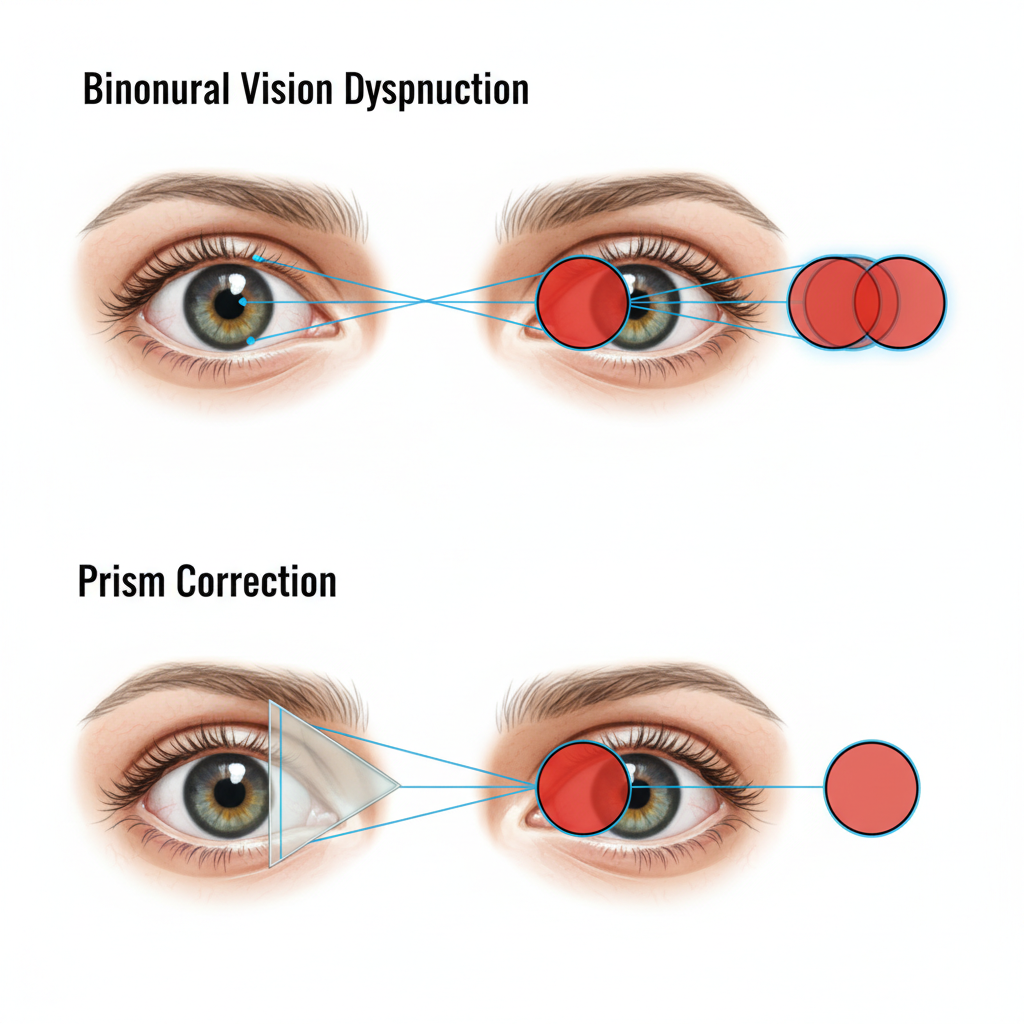
This is where prisms come in. A prism is a specialized lens that bends light. Unlike a standard prescription lens that corrects focus (for nearsightedness or farsightedness), a prism redirects the path of light before it enters the eye. As explained in clinical resources on the physics of prisms, this deviation shifts the perceived location of an image without changing its clarity.
By precisely angling the prism, an optometrist can redirect the image from the misaligned eye to land on the correct spot on the retina (the fovea). This "tricks" the brain into thinking the eyes are perfectly aligned. The brain no longer has to strain to fuse the two images, which can dramatically reduce the neurological overload that causes the symptoms of PCVS.
Think of it like this: if two projectors are aimed at a screen but are slightly misaligned, you see a blurry, doubled image. Instead of physically forcing the projectors back into alignment (which the eye muscles are struggling to do), a prism acts like a mirror that redirects the beam from one projector so it lands perfectly on top of the other. The result is a single, clear picture with minimal effort.
The Clinical Role of Prisms in Concussion Recovery
For someone recovering from a concussion, prism lenses are not just about seeing more clearly; they are a neuro-rehabilitative tool designed to reduce brain strain and restore a sense of stability.
1. Alleviating Dizziness and Imbalance One of the most disruptive symptoms of PCVS is a feeling of constant unsteadiness, often diagnosed as Vertical Heterophoria (a vertical misalignment of the eyes). Research into balance disorders has found that patients with these conditions have significantly higher rates of BVD. By using microprisms to correct the misalignment, a remarkable 82% of patients reported a significant reduction in their sense of unsteadiness. The prisms provide a stable visual foundation, allowing the brain's vestibular (balance) system to recalibrate.
2. Reducing Headaches and Eye Strain Constant muscle strain and sensory conflict are major triggers for post-concussion headaches. By resolving the underlying visual misalignment, prism lenses can significantly reduce the frequency and intensity of these headaches. Studies on specialized prismatic lenses, such as Neurolenses, have demonstrated a statistically significant reduction in headache impact scores for patients with BVD. This relief is crucial for allowing a concussed individual to re-engage with daily activities like reading and screen use.
3. Supporting Broader Vision Therapy Prisms are often a foundational component of a comprehensive vision therapy program. They provide immediate symptom relief, which creates a stable baseline for other therapeutic activities. Once the brain is no longer exhausted from the simple act of seeing, a patient can more effectively engage in exercises designed to rebuild accommodative (focusing) skills, improve eye tracking, and expand their peripheral awareness.
The Fitting Process: More Than a Standard Eye Exam
Prescribing prism is both an art and a science that goes far beyond a typical eye exam. While a standard exam checks for acuity (how clearly you see the chart), a neuro-optometric assessment evaluates how your eyes and brain work together as a team.
In clinical practice, a common mistake is to prescribe a prism based solely on a static cover test performed in the exam room. The true test of a patient's needs is revealed during dynamic tasks. Your doctor may assess you while you walk down a hallway, track moving objects, or scan a complex environment. This is because the brain’s visual demands change dramatically when the body and head are in motion.
Based on this comprehensive evaluation, the optometrist will determine the precise amount and direction of prism needed. There are two primary types:
- Fresnel Prisms: These are thin, flexible vinyl sheets that can be pressed onto the inside of any pair of glasses. They are excellent for trial periods, for patients whose prescription may change during recovery, or for lower prism amounts (typically under 6 prism diopters). They are easily adjustable but can slightly reduce visual clarity due to the visible ridges in the material.
- Ground-In Prisms: For permanent or high-power prescriptions, the prism is ground directly into the lens itself. This offers superior optical clarity and durability. However, it requires careful frame selection. Because a prism works by creating a thick edge and a thin edge, a larger and more robust frame is often necessary to accommodate the lens, a factor that is frequently underestimated.

What to Expect: Adapting to a New Visual Reality
Adapting to prism lenses is a unique experience because you are retraining your brain. It's common for patients to go through an adjustment period of 24 to 72 hours. During this time, you might feel that floors look tilted, walls seem curved, or your spatial awareness feels slightly "off." This is a normal part of the neuro-adaptation process, as your brain learns to trust the new, corrected visual input.
Here are a few tips to ease the transition:
- Start Slow: Wear your new glasses for short periods at home before venturing into more complex environments.
- "Point Your Nose": A common piece of advice for adapting to new lenses is to turn your head to look at objects rather than just your eyes. This helps keep your vision centered in the clearest part of the lens.
- Avoid Driving Initially: Wait until the feeling of spatial distortion subsides before you get behind the wheel.
This initial disorientation is temporary. It is a sign that the lenses are working to change the signals between your eyes and brain. Communicating with your optometrist during this period is key to a successful outcome.
Ultimately, prism lenses serve as a critical intervention in the multidisciplinary approach to concussion recovery. By stabilizing a person's visual world, they reduce debilitating symptoms, alleviate neurological strain, and open the door for more effective rehabilitation, paving the way for a return to normal life.
Frequently Asked Questions (FAQ)
Q: Are prism lenses the same as reading glasses or bifocals? A: No. Reading glasses and bifocals add magnifying power to help with focusing on near objects, a condition known as presbyopia. Prism lenses do not change the focusing power; they change the direction of light to compensate for eye misalignment. Some lenses can, however, incorporate both prism and a reading power if needed.
Q: Will I have to wear prism glasses forever? A: It depends on the individual and the nature of the injury. For some, prisms are a temporary tool used during the recovery phase to help the brain heal. As vision therapy progresses, the prism amount may be reduced or eliminated. For others with more significant or permanent misalignment, prism lenses may be a long-term solution for managing symptoms.
Q: Can I drive with prism glasses? A: Yes, once you have fully adapted to them. It is crucial to wait until any initial feelings of spatial distortion or dizziness have completely disappeared before driving. Your optometrist will provide specific guidance on when it is safe for you to do so.
Q: Why do my new prism glasses make me feel dizzy or nauseous at first? A: This feeling is a normal part of the brain's adaptation process. Your brain has been working hard to compensate for a visual misalignment, and the prism lenses suddenly remove that strain. This change can cause a temporary sensory conflict, leading to dizziness or a feeling of motion. This sensation typically resolves within a few days as your brain adjusts to the new, more efficient way of seeing.
Disclaimer: This article is for informational purposes only and does not constitute professional medical advice. If you have sustained a head injury or are experiencing vision problems, consult with a qualified neuro-optometrist or medical professional for a comprehensive evaluation and personalized treatment plan.
References
- U.S. Department of Veterans Affairs, Health Services Research & Development. "Traumatic Brain Injury (TBI): Visual Impairment." Accessed via
https://www.hsrd.research.va.gov/for_researchers/cyber_seminars/catalog/transcripts/7568.doc - Neuro-Optometric Rehabilitation Association & NVM Institute. "BVD & Psychiatric Comorbidity Poster." Accessed via
https://nvminstitute.org/wp-content/uploads/2023/08/Psych-Congress-BVD-Poster.pdf - StatPearls (NCBI). "Prisms in Ophthalmology." Accessed via
https://www.ncbi.nlm.nih.gov/books/NBK580488/ - Feinberg, M., et al. (2022). "Vertical Heterophoria in Patients with Dizziness and/or Imbalance." Frontiers in Neurology. Accessed via
https://pmc.ncbi.nlm.nih.gov/articles/PMC9540399/ - Neurolens. "The Impact of Contoured Prism on the Health-Related Quality of Life of Patients with Headaches, Neck, and Shoulder Pain." Translational Vision Science & Technology. Accessed via
https://tvst.arvojournals.org/article.aspx?articleid=2793325


