









Preventing Spiderweb Cracks Around Rimless Frame Drill Points
The Invisible Force Cracking Your Lenses
That frustrating spiderweb of tiny cracks spreading from the screws of your rimless glasses isn't random bad luck. More often than not, it isn't caused by a direct frontal impact, like dropping your glasses. The real culprit is usually an invisible force: torsional stress.
Every time you take your glasses off with one hand, slide them on top of your head, or even just through the minor flexing of daily wear, you apply a slight twisting force to the frame. This creates shear stress that concentrates directly on the most vulnerable points of a rimless design: the drill-mount holes.
Think of it like trying to bend a twig. A fresh, green twig (a ductile material) will flex and bend under pressure. A dry, brittle twig, however, will snap at the slightest bend. Standard high-index lens materials behave like that dry twig. They are incredibly hard and offer fantastic optical clarity, but they are also brittle and "notch sensitive." The drill hole acts as a pre-made weak spot, or notch, where all that twisting stress gathers until the material fails.
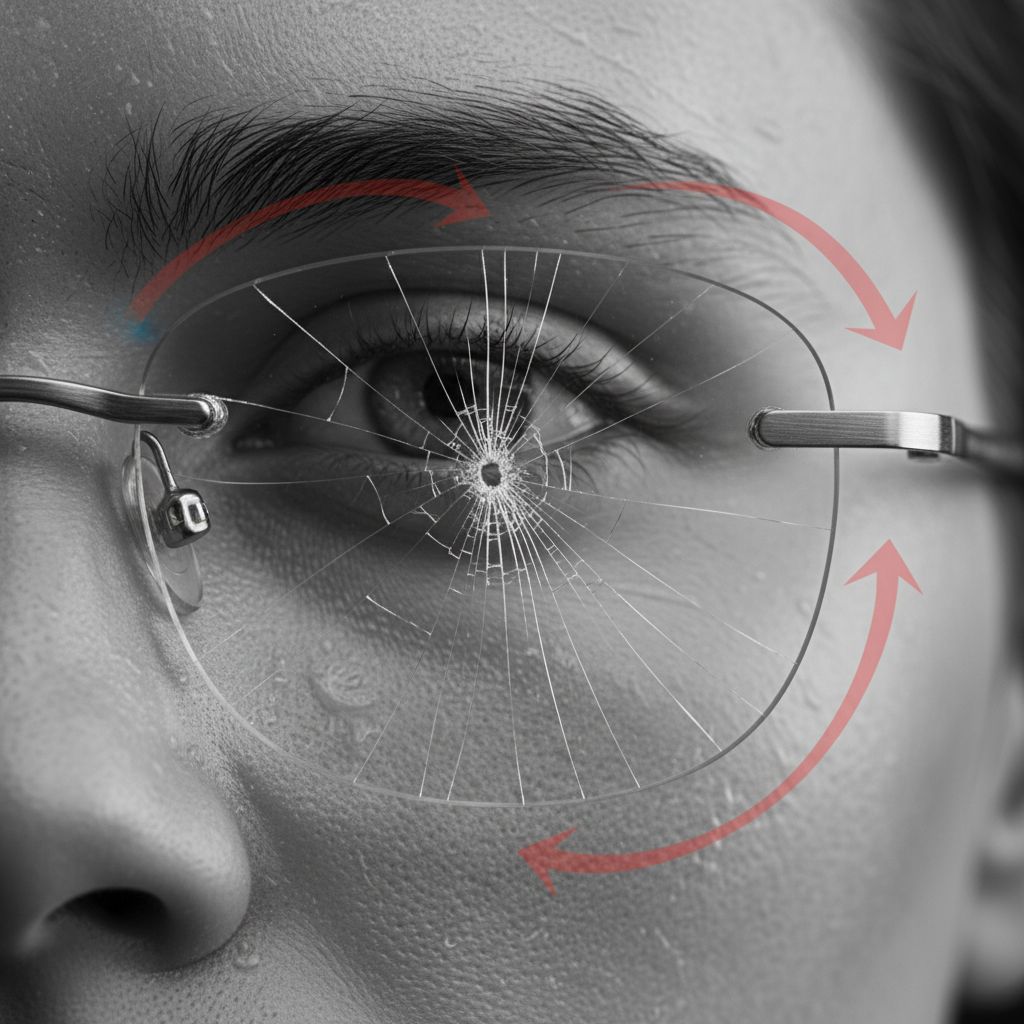
Shop Floor Insight: In our experience handling repairs, the single most common cause of spiderweb cracks is not impact from the front, but lateral twisting force applied to the temple arms. This creates a shear stress at the drill point that brittle materials simply cannot withstand.
Material Science is the Solution: Polycarbonate & Trivex
Since the design of rimless glasses inherently creates stress points, the only reliable way to prevent cracking is to choose a lens material that is flexible and strong enough to absorb that stress. This is where standard plastics fall short and advanced polymers excel.
Why Standard High-Index Plastics Fail
Materials like CR-39, or high-index plastics (e.g., 1.67, 1.74), are chosen for their ability to be ground into very thin, lightweight lenses, which is especially important for stronger prescriptions. However, this thinness comes at the cost of durability. Their rigid, brittle nature makes them highly susceptible to stress fractures, particularly in a drill-mount frame that offers no protective rim.
The Unbeatable Durability of Polycarbonate
Polycarbonate is a high-tech polymer with exceptional impact resistance. It’s the same material used for bullet-resistant glass, safety goggles, and astronaut helmet visors. Its key property is ductility—the ability to flex under stress and return to its original shape without breaking.
This flexibility makes it the ideal material for rimless frames. It easily absorbs the daily torsional forces that would cause a high-index lens to crack. In fact, all eyewear sold in the United States must meet a standard for impact resistance set by the FDA, and polycarbonate lenses inherently exceed this standard by a wide margin.
A Critical Rule of Thumb: Based on our repair and assembly data, for any rimless design where the lens is under 2mm thick at the drill point, Polycarbonate is non-negotiable. The risk of cracking with any other material is simply too high.
Trivex: The Best of Both Worlds
For those seeking a premium option, Trivex offers a compelling alternative. It is another highly impact-resistant material, nearly as durable as polycarbonate, but with superior optical clarity (a higher Abbe value, meaning less chromatic aberration or "color fringing"). It is also one of the lightest materials available. While Trivex is an excellent choice, it works best on designs where the lens is slightly thicker and requires meticulous finishing of the drill holes to ensure a smooth, stress-free surface.
The Art of Assembly: How Professionals Prevent Cracks
Choosing the right material is half the battle. The other half lies in proper assembly, a step that requires precision and specialized components. Understanding this process reveals why a professionally assembled pair of rimless glasses is far more durable.
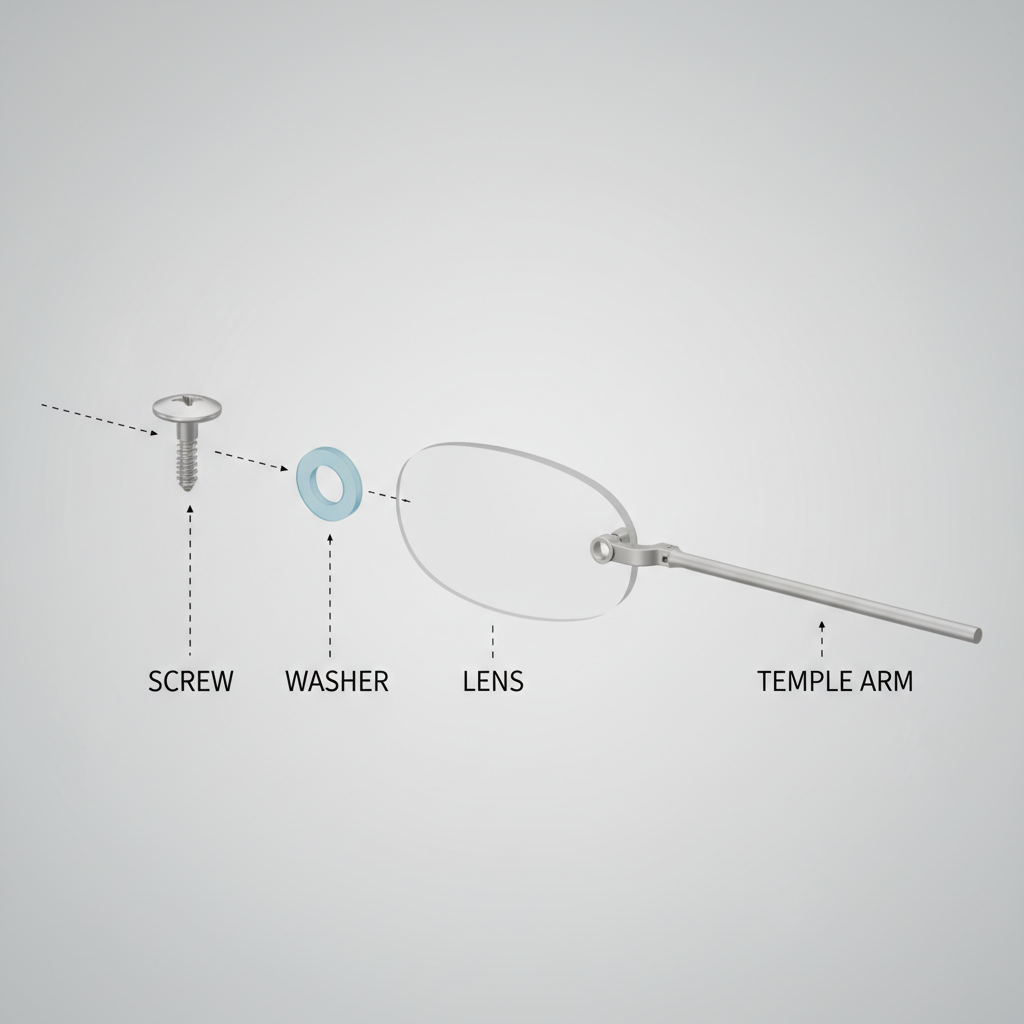
- Protective Washers: A metal screw tightened directly against a plastic lens is a recipe for disaster. Professionals use tiny nylon or polyurethane washers on both sides of the lens. These soft washers act as cushions, distributing the clamping force evenly and preventing the hard metal screw from creating a pressure point.
- Preventative Thread Locker: Over-tightening the screw is a primary cause of lens cracking. To avoid this, a drop of low-strength thread locker (like Loctite 222) is applied to the screw threads during assembly. This prevents the screw from loosening due to daily flexing and temperature changes, eliminating the need for excessive, damaging torque.
- Correct Torque: Without the need to over-tighten, the screw can be set with just enough force to be secure, respecting the integrity of the lens material.
Your Role in Rimless Longevity
Even with the best materials and assembly, how you handle your glasses makes a difference. Adopting a few simple habits can dramatically extend the life of your rimless eyewear.
- Use Two Hands: Always use both hands to put on and take off your glasses. This ensures even pressure and eliminates the twisting force that comes from a one-handed motion.
- Avoid the Perch: Never wear your glasses on top of your head. This stretches the frame arms, applying constant outward pressure on the drill mounts.
- Seek Professional Help: If a screw feels loose, resist the urge to tighten it yourself with a household screwdriver. You will almost certainly over-tighten it and crack the lens. An optician has the right tools and feel to adjust it safely.
By understanding the interplay between design, materials, and handling, you can ensure your minimalist eyewear provides not just style, but lasting durability.
Frequently Asked Questions (FAQ)
Q: Can I use a strong prescription with rimless frames?
A: Absolutely. The key is to pair your strong prescription with a durable lens material like Polycarbonate or Trivex, not a standard high-index plastic. These materials can be made thin and light while providing the necessary structural integrity. For more details, see our guide on using strong prescriptions with rimless frames.
Q: Are Polycarbonate lenses lower quality than high-index lenses?
A: They are not lower quality, but they are optimized for different properties. High-index lenses prioritize optical thinness above all else. Polycarbonate prioritizes impact resistance and durability. For a frame style with inherent stress points like a rimless design, durability is the more critical property for longevity.
Q: Why did my new rimless glasses crack when my old ones lasted for years?
A: The most likely reason is a difference in lens material. Your older pair may have been fitted with polycarbonate lenses, which are highly resistant to cracking. Your new pair might have been made with a more brittle high-index plastic that couldn't withstand the daily stresses of a drill-mount frame.
Disclaimer: This article is for informational purposes only and does not constitute professional medical or optical advice. Consult with a qualified optician or eyecare professional to determine the best lens and frame combination for your specific needs.
References
- Food and Drug Administration (FDA). "Guidance for Industry: Impact-Resistant Lenses." This guidance outlines the federal requirement (21 CFR 801.410) that all spectacle lenses sold in the U.S. must pass a drop ball test for impact resistance. Link to FDA Guidance


