















Decoding Prism Base Directions: Mapping Lenses to Alignment
TL;DR: Your Guide to Prism Correction
If your prescription has "Prism" and "Base" values, your lenses contain a special correction to align your two eyes, preventing double vision and reducing eye strain. The Base Direction—Up, Down, In, or Out—tells the lab where to place the thickest edge of the prism. This guide breaks down what each direction means, how it corrects your specific eye alignment, and how to verify your lenses are made correctly.
What Is Prism and Why Is It on My Prescription?
If you've ever felt like your eyes are fighting each other, you understand the discomfort of binocular vision dysfunction (BVD). This condition occurs when your eyes are slightly misaligned, forcing your brain to work overtime to merge two separate images into a single, clear picture. According to research, this struggle is not just tiring; it can be linked to anxiety, dizziness, and persistent headaches.
This is where prism correction comes in. It’s a component added to your lenses designed to resolve symptoms caused by conditions like:
- Phorias (Latent Misalignment): A tendency for an eye to drift when it's covered or tired.
- Tropias (Manifest Misalignment): A constant, noticeable turn of an eye (a form of strabismus).
- Convergence Insufficiency: Difficulty turning the eyes inward to focus on near objects, leading to strain while reading.
The Physics of Prism: Bending Light to Align Your Vision
A prism lens is, at its core, a tool that bends light. It redirects the image you are looking at to land on the correct spot on your retina, without forcing your eye muscles to strain. Think of it as a visual "trick": the prism moves the image to where your eye is naturally pointing, so your brain perceives the world as single and clear.
As defined by clinical optics resources like StatPearls, a prism deviates light toward its thickest part, known as the base. The image, in turn, is shifted toward the thinnest part, the apex. This intentional shift is what alleviates the double vision or eye strain caused by the misalignment.

On your prescription, you'll see this noted in two columns:
- Prism: A number measured in prism diopters (e.g., "2.0") that indicates the strength of the correction.
- Base: A direction—Up, Down, In, or Out—that tells the optician how to orient the prism in your lens.
Decoding the Four Base Directions: Up, Down, In, and Out
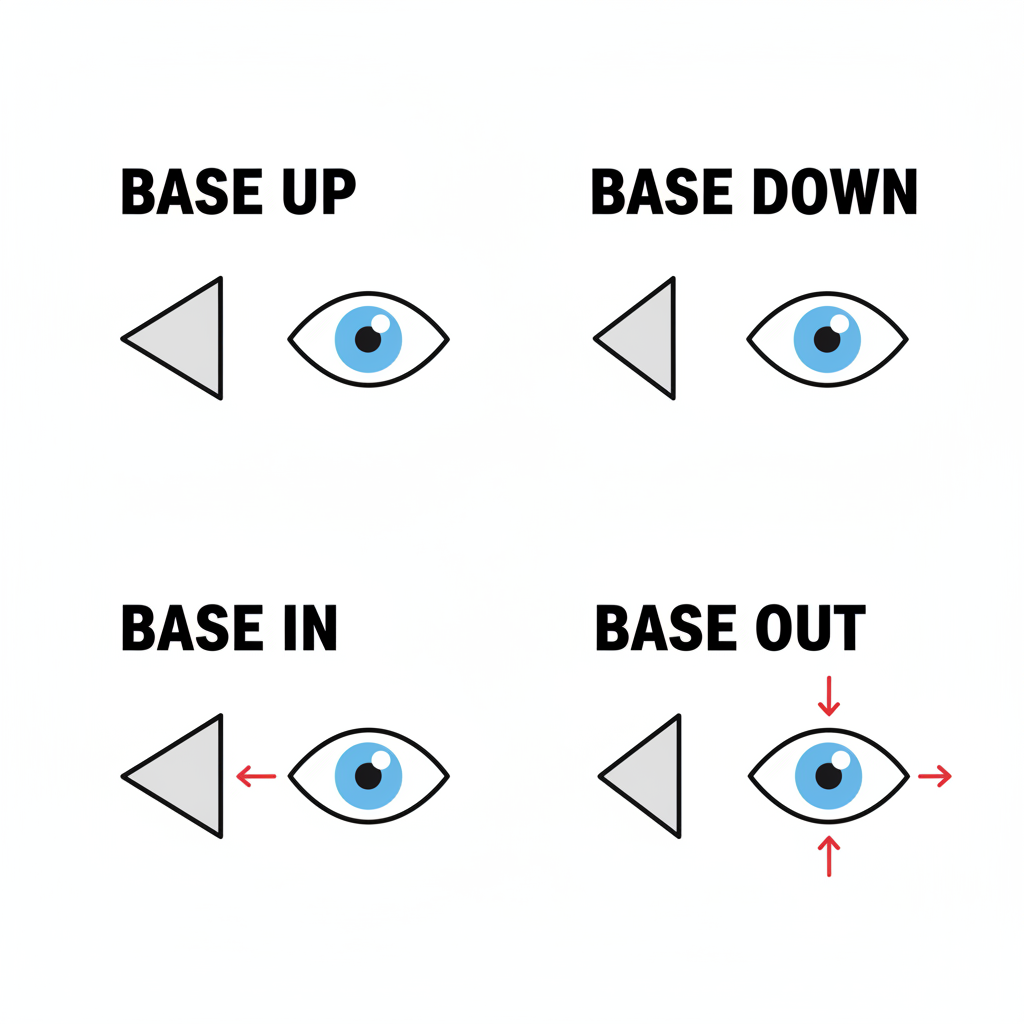
The base direction is the map that guides how your lenses are made. It corresponds to the thickest edge of the prism and is determined by the specific direction your eye deviates.
Horizontal Prism: Managing Inward and Outward Misalignment
Horizontal prism corrects eye alignments on the horizontal plane—either turning inward toward the nose or outward toward the temples.
-
Base Out (BO): This is used to correct esophoria or esotropia, where one or both eyes have a tendency to turn inward. The prism is ground with the base (thickest edge) facing the outer edge of your glasses (your temple). This shifts the perceived image outward, allowing your inwardly turned eye to see it without straining to straighten out.
-
Base In (BI): This is the solution for exophoria or exotropia, where one or both eyes tend to drift outward. The prism base is positioned facing the inner edge of your glasses (your nose). This moves the image inward, meeting the natural, deviated position of your eye.
Vertical Prism: Correcting Upward and Downward Misalignment
Vertical prism addresses misalignments where one eye is aimed higher or lower than the other.
-
Base Up (BU): This corrects for hypotropia or hypophoria, a condition where one eye points downward relative to the other. The prism is made with its base at the top of the lens. This orientation bends light downward, moving the image down to meet the eye’s resting position.
-
Base Down (BD): This is prescribed for hypertropia or hyperphoria, where one eye aims upward. The prism base is located at the bottom of the lens, which effectively moves the image up for the misaligned eye to see clearly.
From Lab to Your Face: How Prism Lenses Are Made and Verified
Understanding the theory is one thing, but ensuring your glasses are made correctly is what truly matters. The effectiveness of prism correction is highly sensitive to how the lenses are manufactured and fitted.
Manufacturing Precision: Splitting and Placement
When you have a horizontal prism prescription, opticians often use a technique called prism splitting. For instance, if your prescription calls for 4.0 diopters of Base Out (BO) prism, the lab may grind 2.0 diopters of BO into the right lens and 2.0 diopters into the left lens. This is a standard practice for powers above 3.0 diopters because it helps to:
- Balance the weight and thickness of the lenses.
- Reduce cosmetic distortions and visual discomfort known as aniseikonia (a difference in image size between the two eyes).
However, this rule does not apply to vertical prism. As clinical fitting experience shows, a prescription for Base Up (BU) prism for the right eye must be ground on the right lens. It cannot be placed as Base Down on the left lens to achieve the same effect, as this can interfere with the brain's vertical adaptation and cause further discomfort.
A Quick Check You Can Do at Home
While you need an optician to measure the exact power, you can often do a simple, non-destructive check to see if prism is present in your lenses. If you have high-index lenses, hold your glasses up to a light source and look for a chromatic fringe or a "rainbow" effect, particularly around the edges. This color separation is a natural side effect of light passing through a high-index material with prism and is typically more pronounced than in standard CR-39 lenses. Its presence can be a quick confirmation that a prism has been ground into the lens.
Frequently Asked Questions About Prism Lenses
-
Why do my new prism glasses feel strange? Like with switching to progressive lenses, there is an adaptation period. Your brain has been working hard to compensate for misalignment, and it needs time to learn to relax and let the prisms do the work. This can initially cause a "pulling" sensation or mild disorientation.
-
Can the need for prism correction change over time? Yes. Binocular vision can change due to age, injury, or progression of an underlying condition. It's also possible for vision therapy to improve muscle control, potentially reducing the amount of prism needed. Regular eye exams are crucial.
-
What if I still have double vision or headaches with my new glasses? If symptoms persist after a week of full-time wear, contact your eye doctor. This could indicate a need for a prescription adjustment, a fitting error (like an incorrect pupillary distance), or a more complex underlying issue.
-
Can I get prism correction in any type of lens or frame? Yes, prism can be ground into most lens types, including single vision, bifocal, progressive, and sunglasses. However, higher prism powers can increase lens thickness and weight, which may limit your frame choices. Your optician can help you select a frame that works well with your prescription.
Beyond the Jargon: Trusting Your Correction
Understanding your prism prescription is the first step toward visual comfort and confidence. The base direction is not just technical jargon; it is a precise map that translates your unique visual needs into a physical tool for alignment. By knowing whether you need Base In, Out, Up, or Down, you can have more effective conversations with your optician and better understand the technology working to bring your world into a single, clear focus.
However, this knowledge should complement, not replace, professional expertise. The precise fitting of prism lenses is critical to their function. Always rely on a qualified optician to take accurate measurements and ensure your glasses are made to specification.
Medical Disclaimer: This article is for informational purposes only and does not constitute medical advice. The information contained herein is not intended to be a substitute for professional medical advice, diagnosis, or treatment. Always seek the advice of your physician or other qualified health provider with any questions you may have regarding a medical condition. Never disregard professional medical advice or delay in seeking it because of something you have read in this article.
References
- Jauregui, R., & T_soro, M. D. (2024). Prisms In Ophthalmology. StatPearls Publishing. Available at: https://www.ncbi.nlm.nih.gov/books/NBK580488/
- Borsting, E., & CITT-ART Investigator Group. (2020). Vision Therapy for Convergence Insufficiency. Available at: https://pmc.ncbi.nlm.nih.gov/articles/PMC8092638/
- Debinski, W., et al. (2023). BVD and Psychiatric Comorbidity Poster. NVM Institute. Available at: https://nvminstitute.org/wp-content/uploads/2023/08/Psych-Congress-BVD-Poster.pdf
- Al-Haddad, C., et al. (2023). Spectacle Adaptation and Aniseikonia. Available at: https://pmc.ncbi.nlm.nih.gov/articles/PMC11603396/


