












How Incorrect Segment Height Causes Progressive Lens Blurriness
Why a Few Millimeters Can Make or Break Your Vision
Progressive lenses are a marvel of optical engineering, blending multiple prescriptions into a single, seamless lens. They offer clear vision at a distance, up close for reading, and everything in between. But for this complex system to work, it must be perfectly aligned with your eyes. The single most critical measurement for this alignment is the segment height, or "seg height."
If you've recently gotten new progressive glasses and find yourself constantly tilting your head up or down to see clearly, there's a high probability your segment height is incorrect. This measurement determines where the invisible "corridor" of power sits in front of your pupil. A minor error of just 2mm can render an expensive, high-tech lens virtually unusable, forcing you into unnatural postures that cause neck strain and visual frustration. According to one study, such fitting errors can significantly compress the effective reading zone, negating the benefits of even the most advanced lenses.
This guide will help you troubleshoot whether your glasses are sitting too high or too low, understand the common causes of these errors, and perform a quick self-check to diagnose the problem.

Is Your Segment Height Too High?
A segment height that is measured too high is one of the most common and disorienting progressive lens errors. It effectively pushes the entire lens design upward, forcing you to look through the wrong portion of the lens for everyday tasks.
Key Symptoms
-
Blurry Distance Vision: When looking straight ahead at a distant object, the image is not sharp. You instinctively tilt your head down or lower your chin to find the "sweet spot."
- The Mechanism: Your pupil is aligned with the intermediate or even the near-vision portion of the lens corridor. These zones are too powerful for distance viewing, causing immediate blur.
-
Difficulty with Stairs and Curbs: Looking down at your feet or descending stairs feels unstable and blurry. This is a significant safety concern.
- The Mechanism: Your natural downward glance places your eyes deep into the near-vision zone, which is calibrated for reading a book at 16 inches, not navigating terrain 6 feet away. This magnification mismatch can distort depth perception. Research highlights this danger, showing that multifocal lens wearers have 2.23 times the odds of falling compared to those wearing bifocals, primarily due to this lower-field blur.
-
Chronic Neck Strain: You may develop a persistent "chin-down" posture to compensate for the high segment. This unnatural position can lead to significant neck and shoulder pain. Studies using electromyography (EMG) have shown that an inappropriate lens section forces wearers into postures that cause significantly higher muscle activity and strain.

Is Your Segment Height Too Low?
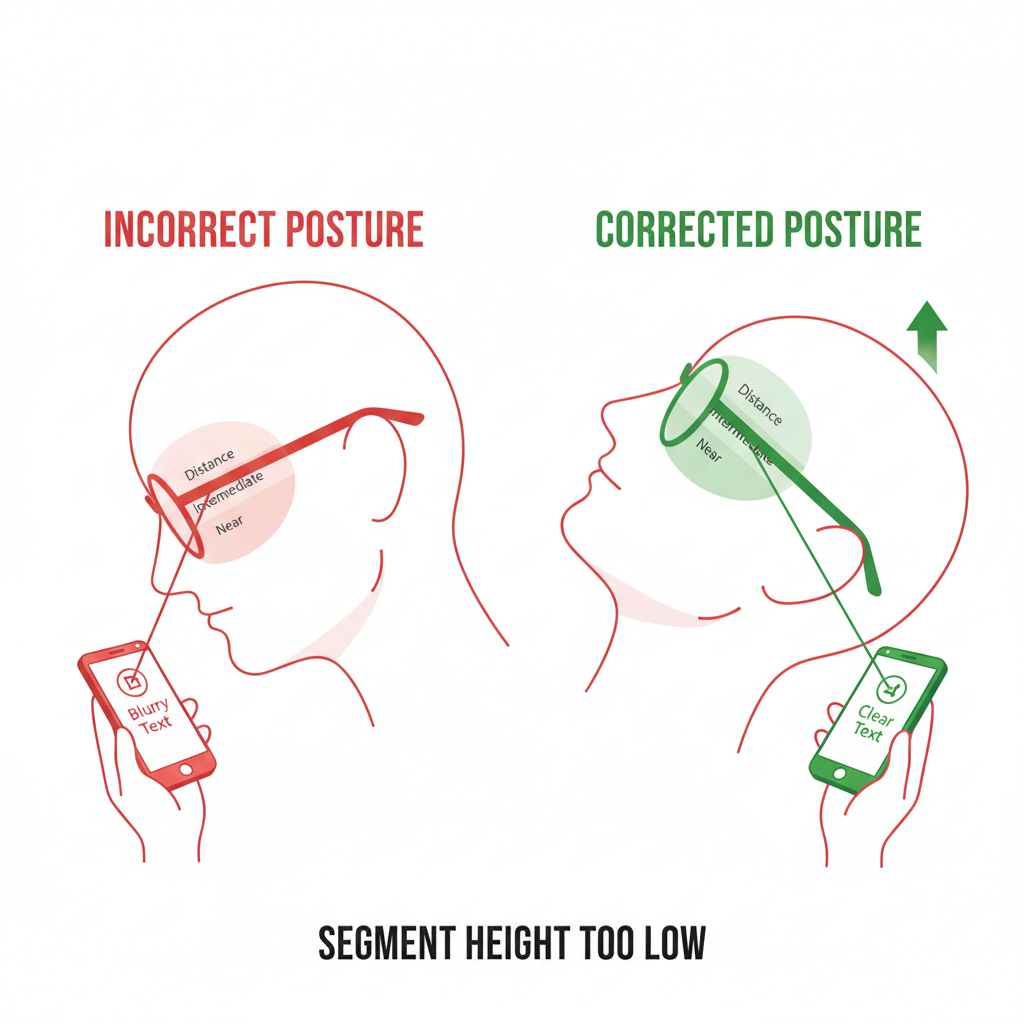
When the segment height is too low, you lose access to the near and intermediate portions of the lens without making exaggerated and uncomfortable movements. The functional part of the lens is effectively out of reach.
Key Symptoms
-
Struggling to Read: You cannot read a book or see your smartphone clearly. To find focus, you have to lift your head, adopt a "chin-up" posture, or physically slide your glasses down your nose.
- The Mechanism: When you look down to read, your pupil only reaches the top of the intermediate corridor. This zone lacks the necessary magnification for comfortable near vision, making text appear blurry and small.
-
Computer Vision Syndrome: You experience significant eye strain, neck pain, and headaches when working on a desktop computer. You find yourself craning your neck to see the screen.
- The Mechanism: The intermediate zone—which should align perfectly with your computer screen—is positioned too low. To use it, you're forced to tilt your head back, a posture that is a major risk factor for Computer Vision Syndrome (CVS). One study found that a non-neutral neck posture increases the odds of CVS in progressive wearers by 3.27 times.
-
The "Missing" Reading Zone: You feel like you have to hunt for the reading power, and even when you find it, the clear area seems incredibly small.
- The Mechanism: A low segment height forces you to look through the very bottom of the lens to read, where optical distortions are naturally higher. You never get to experience the full, wide reading area you paid for.
Common Causes of Segment Height Errors
While errors can happen anywhere, they are particularly common with online orders where precise, in-person measurements are not possible. Understanding these pitfalls is key to getting a perfect fit.
A Note from Experience: Based on patterns from customer returns and troubleshooting, the most frequent source of error in online orders is customers measuring the segment height from the bottom of the frame's rim instead of from the deepest point of the frame's inner eye wire. This is especially problematic in angled or stylized frames like cat-eye or wayfarer shapes, where the difference can be several millimeters.
-
Shallow Frame Selection: Frames with a short vertical B-measurement (less than 30mm) are poor candidates for progressive lenses. They physically compress the progressive corridor, leaving almost no room for the intermediate zone and a tiny reading area. This drastically increases the likelihood of non-adaptation.
-
Ignoring Pantoscopic Tilt: Most frames have a slight "pantoscopic tilt," meaning the bottom of the lens is angled closer to your cheeks. Experienced opticians often add 1mm to the measured segment height for every 10 degrees of tilt to compensate. This crucial adjustment is nearly impossible to account for in a simple DIY measurement.
-
Parallax Error in Self-Measurement: When you try to dot your own pupil in a mirror using a ruler, you are viewing it from an angle. This "parallax error" can easily lead to a measurement that is off by several millimeters.
The Dry-Erase Marker Self-Check
If you suspect an error, you can perform a quick check at home. This test can help you confirm your suspicions before contacting your optical provider.
What You'll Need:
- Your progressive glasses
- A mirror
- A non-permanent, fine-tip marker (like a dry-erase marker)
The Steps:
- Put on your glasses and sit or stand comfortably about 1-2 feet from a mirror.
- Close one eye. With the other eye, look straight ahead at your pupil in the mirror.
- Place a dot on the lens with the marker, directly over the reflection of your pupil. Try to keep your head perfectly still.
- Repeat for the other eye.
- Take off the glasses. The dots on your lenses represent your pupils' position. You can now measure the vertical distance from the very bottom of the lens cutout (not the frame rim) to the center of the dot. This is your approximate segment height.
How to Interpret the Results:
- If you have blurry distance vision and the dot is located high up in the lens, your segment height is almost certainly too high.
- If you struggle to read and the dot is located very low in the lens, leaving little room below it, your segment height is likely too low.
Disclaimer: This article is for informational purposes only and does not constitute professional medical advice. The self-check is an estimation tool to help diagnose a potential problem. If you experience persistent issues, consult a qualified optician or optometrist for a comprehensive evaluation of your eyewear and prescription.
Getting the Perfect Fit is Not a Luxury
Adapting to progressive lenses always involves a short period of neuro-adaptation as your brain learns to use the new visual fields. However, the symptoms of an incorrect segment height are different—they are persistent, uncomfortable, and often lead to physical strain.
If your symptoms match the descriptions of a seg height that is too high or too low, the issue is not with your ability to adapt; it's with the measurement of the lens. Use the self-check to gather evidence, and then confidently contact your eyewear provider for a re-check. A proper fit is the most important factor in progressive lens satisfaction, ensuring you get the clear, comfortable vision you paid for.
References
- Gifford, P., & Gifford, K. L. (2018). The impact of fitting errors on the visual fields of progressive addition lenses. Investigative Ophthalmology & Visual Science, 59(9), 4893-4893.
- Johnson, L., & Buckley, J. G. (2025). Falls Risk in Older Adults Wearing Multifocals. Journal of Vision, 25(2), 112.
- Ganesan, S., & I. (2014). Neck muscle activity and head posture during computer work among presbyopic adults: A comparison of single vision and progressive lenses. Work, 49(1), 101-9.
- Chu, B. S., & Rosenfield, M. (2019). Computer vision syndrome in visual display terminal workers wearing progressive addition lenses. International Journal of Environmental Research and Public Health, 17(3), 1003.


