










How Pupillary Distance (PD) Affects Sunglass Sizing
TL;DR: Your Quick Guide to Sunglass Fit
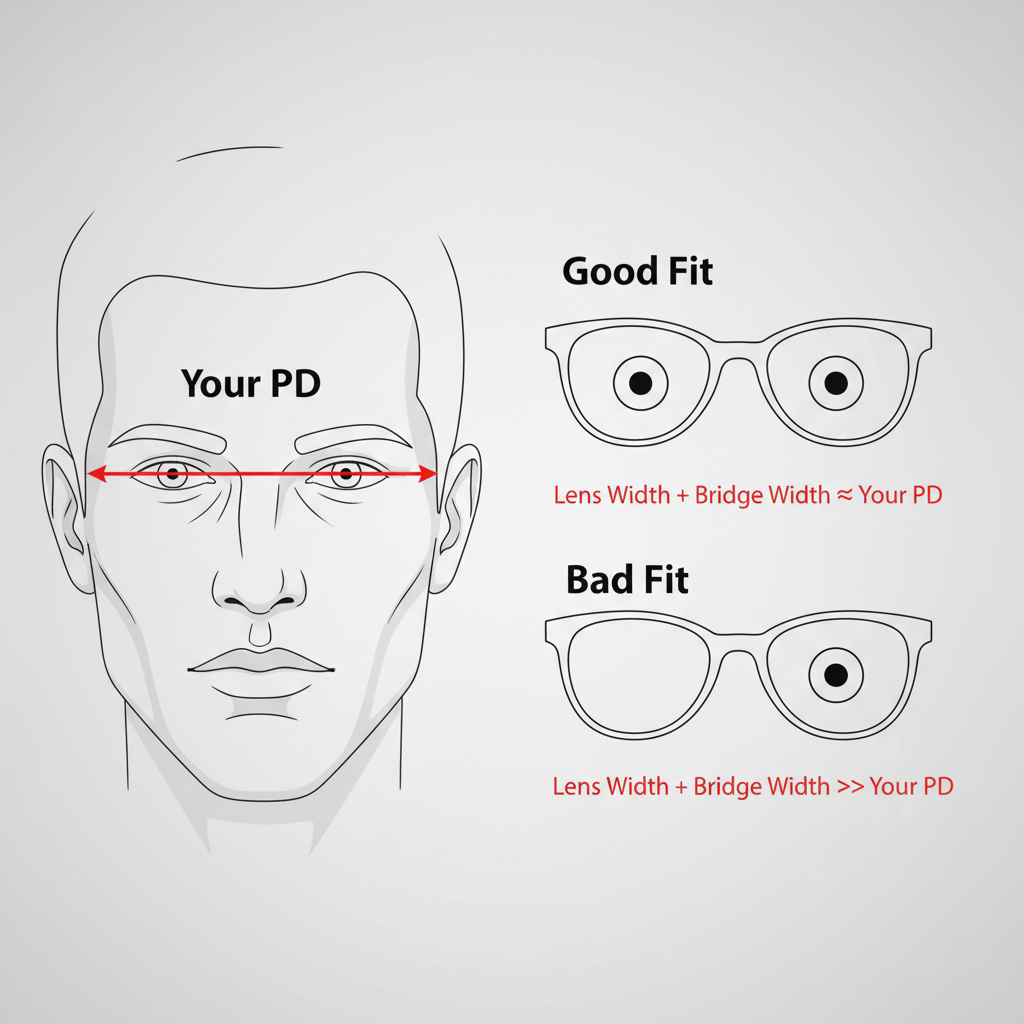
Your Pupillary Distance (PD) is the measurement between the centers of your pupils. For non-prescription sunglasses, you want your PD to be within a few millimeters of the "frame's PD" (the lens width plus the bridge width). This ensures your eyes appear centered in the lenses, creating a natural, balanced look. You can get a reliable PD estimate at home with a mirror and a millimeter ruler. For high-wrap or prescription sunglasses, professional accuracy is non-negotiable.
Finding the perfect pair of sunglasses often feels like a purely stylistic choice. You focus on the frame shape, the color, and the overall vibe. But when you try them on, something feels... off. Even if the style is right, the fit can make or break the look. The secret to solving this puzzle often lies in a simple number you might have overlooked: your Pupillary Distance (PD).
While PD is an absolute necessity for accurate prescription eyewear, it also serves as a powerful tool for selecting non-prescription sunglasses that offer a superior cosmetic fit. Understanding your PD can be the difference between a pair of sunglasses that looks like it was made for you and one that makes you look slightly surprised or cross-eyed. This guide will walk you through what PD is, why it matters for every pair of glasses you own, and how to use it to find your best-fitting sunglasses online.
What is Pupillary Distance (PD) and Why Does It Matter?
Before we can apply PD to sunglass shopping, it's essential to understand what it is and its fundamental role in optics. It’s more than just a number on a prescription; it’s the blueprint for aligning lenses with your unique line of sight.
Defining Pupillary Distance
Your Pupillary Distance (PD) is the distance, measured in millimeters, between the centers of the pupils in each of your eyes. According to the Cleveland Clinic, this measurement ensures that you are looking through the ideal spot in your lenses. There are two primary types of PD measurement:
- Binocular PD: This is the total distance between the center of your left pupil and the center of your right pupil.
- Monocular PD: This is the distance from the center of each pupil to the center of the bridge of your nose. It is recorded as two separate numbers (e.g., 31/32).
For non-prescription sunglasses, a binocular PD is usually sufficient. However, monocular PD is the gold standard for accuracy. Facial asymmetry is extremely common, meaning one eye may be slightly farther from your nose than the other. For prescription lenses, especially those with higher powers or astigmatism correction, this sub-millimeter precision is critical to avoid visual distortion.
The Critical Role of PD in Prescription Glasses
In prescription glasses, every lens has an "optical center," the single point on the lens that provides the truest vision as prescribed by your doctor. For your glasses to work correctly, the optical center of the lens must be perfectly aligned with the center of your pupil.
A mismatch between your PD and the optical center of the lenses can induce what’s known as a "prismatic effect." This bends light incorrectly before it reaches your eye, forcing your eye muscles to work harder to merge the images from each eye into a single, clear picture. The results can range from annoying to debilitating, including:
- Headaches and migraines
- Persistent eye strain
- Nausea or a feeling of being off-balance
- Blurry or double vision
This is why the manufacturing of prescription eyewear is regulated. In the United States, all prescription eyewear must not only meet the prescribed optical parameters but also adhere to safety standards for impact resistance, as outlined in the FDA's 21 CFR 801.410 guidance. An incorrect PD can render an otherwise perfect prescription useless and uncomfortable. For wearers of stronger prescriptions, even minor fit issues can be magnified, which is why understanding how to minimize distortion in prescription sunglasses is so important.
Misconception Debunked: PD is Irrelevant for Non-Prescription Sunglasses
A common myth is that if sunglasses don't have a prescription, PD doesn't matter at all. While it's true that there is no optical center to worry about in "plano" (non-prescription) lenses, PD is still a crucial factor for achieving a balanced and flattering cosmetic fit.
Think of your eyes as the focal point of the sunglasses. If your PD is significantly narrower or wider than the optical centers of the frames, the aesthetic is thrown off:
- If your PD is much narrower than the frame's center, your eyes will appear too close together, creating an inset or "bug-eyed" look.
- If your PD is much wider than the frame's center, your eyes will be pushed toward the outer edges of the lenses, which can look awkward and unbalanced.
By choosing a frame where your pupils are horizontally centered within each lens, you create a look of natural symmetry. It ensures the sunglasses frame your face as the designer intended, enhancing your features rather than distracting from them.
How to Measure Your Pupillary Distance Accurately at Home
While the most accurate measurement will always come from a licensed optician, you can get a very reliable estimate at home that is perfectly suitable for choosing non-prescription sunglasses. The key is to be careful and measure more than once.
Step-by-Step Guide: The Mirror and Ruler Method
This is the most common and reliable at-home method. All you need is a mirror and a ruler with millimeter markings.
- Position Yourself: Stand about 8-10 inches away from a mirror. Keep your face straight.
- Position the Ruler: Hold the ruler flat against your brow line. Don't angle it.
- Align to Zero: Close your right eye and look directly into your left pupil in the mirror. Align the "0" mark of the ruler precisely with the center of your left pupil.
- Hold Steady: Be careful not to move your head or the ruler. This is the most common source of error.
- Take the Measurement: Now, close your left eye and open your right eye. Look directly at your right pupil. The millimeter mark that aligns with the center of your right pupil is your binocular PD.
Pro Tip: Measure yourself at least twice, or even three times, to ensure you get a consistent number. If you get readings that vary by more than 2mm, you are likely introducing movement (parallax error), so take a break and try again slowly.
Common Measurement Pitfalls and How to Avoid Them
Getting an accurate measurement requires avoiding a few common mistakes.
- Parallax Error: This occurs when you move your head or the ruler during the measurement, or if you view the measurement from an angle. Keeping your head perfectly still is crucial.
- Using an Incorrect Scale: Always use a ruler with millimeter (mm) markings. Do not use an inch ruler and try to convert, as this leads to inaccuracies.
- Relying on an Old Prescription: You might be tempted to use a PD from a previous pair of glasses, but this isn't always reliable. It could be a binocular PD when you need monocular, or it may have been measured specifically for a frame style that sits differently on your face.
Comparison of PD Measurement Methods
For context, here’s how at-home methods stack up against a professional measurement.
| Method | Pros | Cons | Best For |
|---|---|---|---|
| Optician Measurement | Highest accuracy; provides monocular PD; professionally verified. | Requires an appointment and may have an associated cost. | All prescription lenses, especially progressives and high powers. |
| Mirror & Ruler | Free, quick, and surprisingly accurate for binocular PD when done carefully. | Prone to parallax error; difficult to measure monocular PD on your own. | Estimating fit for non-prescription sunglasses and standard prescriptions. |
| Smartphone Apps | Highly convenient; often provide a guided process. | Accuracy can vary significantly based on the app's algorithm, camera quality, and lighting. | Getting a quick first estimate or for cross-referencing a ruler measurement. |

Applying Your PD to Sunglass Frame Dimensions
Once you have your PD, you can use it to decode frame measurements and find a pair that will center your eyes perfectly.
Deconstructing Frame Sizing: 52-18-140
When you look at sunglasses online, you’ll almost always see a series of three numbers. These represent:
- Lens Width (52mm): The horizontal diameter of one lens.
- Bridge Width (18mm): The distance between the two lenses, where the frame sits on your nose.
- Temple Length (140mm): The length of the arm from the hinge to the tip.
To find the "frame PD" or the distance between the centers of the two lenses, you simply add the lens width and the bridge width: Frame PD = Lens Width + Bridge Width.
In our example (52-18-140), the Frame PD is 52mm + 18mm = 70mm.
The "Centering" Rule of Thumb
The goal is to have your PD be very close to the Frame PD. A good rule of thumb is to find a frame where Your PD ≈ Frame PD ± 4mm.
Let's look at two scenarios for someone with a PD of 64mm:
-
Good Fit Scenario: You find a frame with the dimensions 51-18-140. The Frame PD is 51 + 18 = 69mm. The total distance between your PD and the frame's center is 5mm, meaning each eye is only displaced by 2.5mm from the center, which is excellent.
-
Bad Fit Scenario: You consider an oversized frame with dimensions 58-20-145. The Frame PD is 58 + 20 = 78mm. This is 14mm wider than your PD. Your eyes will be significantly inset, creating that awkward, unbalanced look.
Expert Warning: The Complication of Frame Wrap
One advanced factor that professionals consider is the "wrap angle" of the frame—how much it curves to follow the contour of your face. Sports sunglasses and some fashion styles have a high wrap.
As a frame wraps around your face, the effective horizontal distance that the lens covers changes. For high-wrap frames (those with more than a 10-degree curve), your at-home PD measurement may not be sufficient, especially for a prescription. A common adjustment practitioners make is to account for how this curvature affects the position of the optical center. This is a key reason why getting a prescription in a high-wrap frame requires expert consultation, as discussed in guides to wraparound high prescription sunglasses.
Beyond PD: Other Factors for a Perfect Sunglass Fit
PD is a critical piece of the puzzle, but it isn't the only one. For a truly perfect fit, combine your PD knowledge with these other factors:
- Total Frame Width: The entire width of the frame front should be slightly wider than your face. It shouldn't press into your temples or extend too far beyond the sides of your head.
- Bridge Fit: The bridge of the sunglasses should sit securely on your nose without pinching. If it's too tight, it will sit too high; if it's too loose, the glasses will constantly slide down.
- Temple Length: The arms should be long enough to hook comfortably over your ears. If they are too short, the glasses will feel insecure.
- Lens Style and Coverage: For maximum sun protection, the American Academy of Ophthalmology (AAO) recommends oversized or wraparound styles to block damaging UV rays from entering from the sides.
Key Takeaways for Smart Sunglass Shopping
By now, you should feel much more confident in using technical measurements to guide your stylistic choices. Here are the key points to remember:
- PD is for Everyone: While essential for prescriptions, your PD is also a key cosmetic tool for ensuring your eyes are centered in any frame.
- Measure with Care: Use the mirror-and-ruler method to get a reliable at-home PD measurement. Measure twice to confirm.
- Do the Math: Compare your PD to the frame's measurements by calculating the "Frame PD" (Lens Width + Bridge Width). Aim for a close match (±4mm).
- Consider the Wrap: Be aware that high-wrap frames have more complex fit requirements, especially for prescription lenses.
- See the Whole Picture: Combine your PD measurement with total frame width, bridge fit, and temple length for a comprehensively perfect fit.
Frequently Asked Questions (FAQ)
Q: Is an average PD measurement good enough to use for shopping?
A: It's not recommended. The average PD for adults can range from 54mm to 74mm. Using an "average" is a guess that will likely lead to a poor fit. Taking two minutes to measure your own is far more effective.
Q: What if my monocular PDs are different?
A: This is very normal and is the main reason opticians take monocular measurements for prescriptions. For non-prescription sunglasses, you can simply use your total (binocular) PD and you will still get a great cosmetic fit.
Q: Can I just use the PD from my old glasses?
A: You can use it as a starting point, but it's best to re-measure. The PD on your old prescription might be inaccurate, or it might have been compensated for a specific frame style that sits differently than the one you are now considering.
Q: Does PD matter for large styles like aviators or oversized frames?
A: Yes, arguably it matters even more. Because the lenses are so large, an offset between your eyes and the center of the lenses becomes much more obvious and can easily look "off." Centering is key for making these bold styles look intentional and well-fitted.
Disclaimer: This article is for informational purposes only and does not constitute professional medical advice. The information provided is intended to help you choose non-prescription eyewear. For prescription eyewear, always consult with a qualified optometrist or ophthalmologist to ensure your vision needs are met safely and accurately. If you experience any eye pain, strain, or changes in vision, seek professional medical care.
References
- Cleveland Clinic. (n.d.). How to Read Your Eye Prescription. Retrieved from https://health.clevelandclinic.org/how-to-read-your-eye-prescription
- U.S. Food and Drug Administration. (2021). Impact-Resistant Lenses: Questions and Answers. Retrieved from https://www.fda.gov/regulatory-information/search-fda-guidance-documents/impact-resistant-lenses-questions-and-answers
- American Academy of Ophthalmology. (2023). How to Choose the Best Sunglasses. Retrieved from https://www.aao.org/eye-health/glasses-contacts/sunglasses-3


