








Why You’ll Still Need Readers After 40, Even With LASIK.
The 20/20 Distance Dream Meets the 40+ Reality
You invested in LASIK surgery and enjoyed years of crystal-clear distance vision. It felt like a permanent solution to glasses or contacts. Yet, now in your 40s, you find yourself holding your phone at arm's length or squinting at menus in dimly lit restaurants. It’s a frustrating and common experience that leads many to wonder: Is my LASIK wearing off?
The short answer is no. Your LASIK correction is likely still intact. Instead, you are encountering a completely separate, universal, and natural part of aging called presbyopia. This article will explain why LASIK doesn’t prevent this change, why its arrival can feel so sudden for former nearsighted individuals, and what your best options are for maintaining sharp, comfortable vision at all distances.
LASIK and Presbyopia: Two Different Parts of the Eye
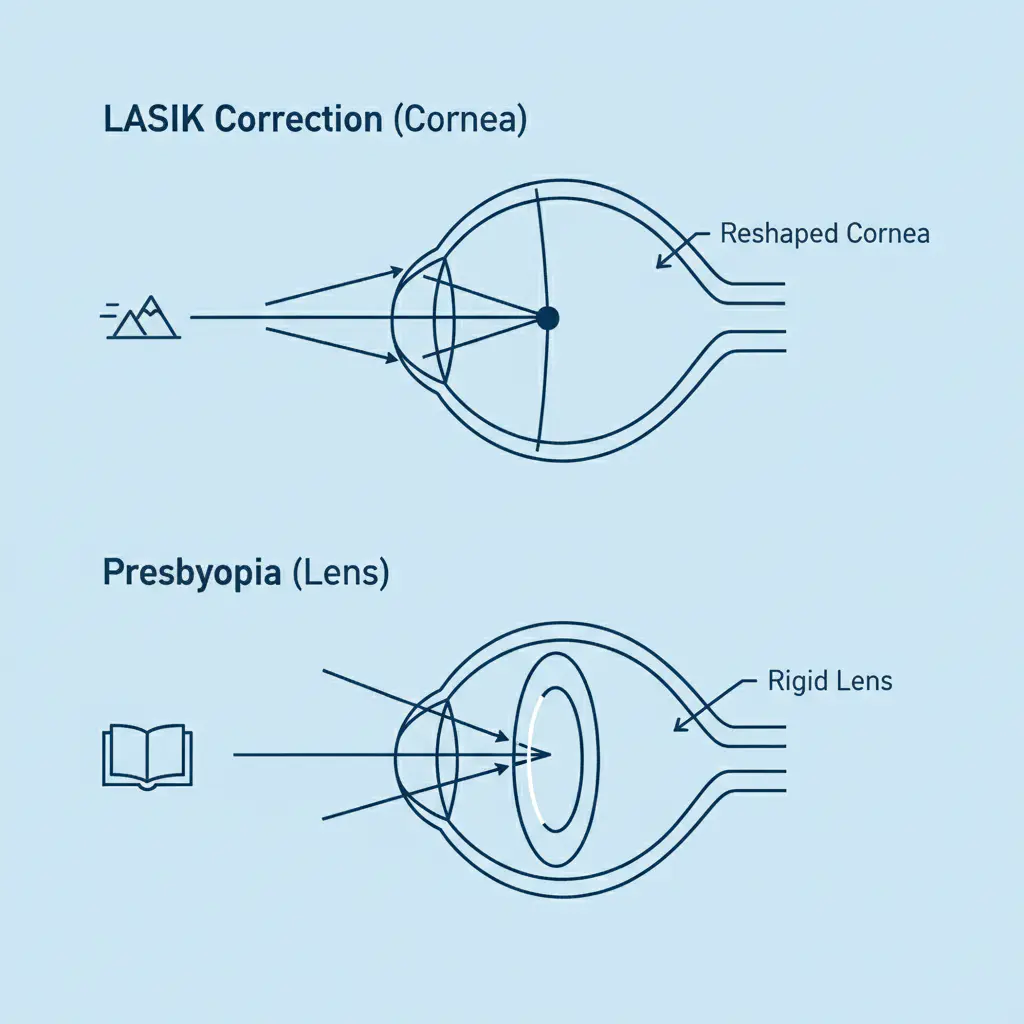
To understand why you still need reading glasses, it’s essential to know that your eye has two primary focusing structures: the cornea and the lens. LASIK treats one, while presbyopia affects the other.
How LASIK Works: Reshaping the Cornea
The cornea is the eye's transparent outer layer, like a fixed window. It provides most of the eye's focusing power. Refractive errors such as nearsightedness (myopia) or astigmatism occur when the cornea's shape is imperfect, causing light to focus in front of or at multiple points instead of directly on the retina.
LASIK (Laser-Assisted In Situ Keratomileusis) is a surgical procedure that permanently reshapes the cornea with a laser. According to the U.S. Food and Drug Administration (FDA), this correction allows light to focus precisely on the retina, providing clear distance vision. Think of it as permanently grinding a prescription into the front surface of your eye.
How Presbyopia Works: The Aging Inner Lens
Deep inside your eye, behind the cornea and iris, sits the crystalline lens. This structure functions like a camera’s autofocus system. When you’re young, this lens is soft and flexible, allowing tiny muscles to change its shape to shift focus from distant to near objects seamlessly. This process is called accommodation.
Starting around age 40, this lens naturally begins to harden and lose its flexibility. As documented by the Mayo Clinic, this age-related change, known as presbyopia, makes it progressively more difficult to focus on close-up objects. It is not a disease but a normal part of aging that affects everyone, regardless of their prior vision status.
The Camera Analogy: Think of your eye as a high-end camera. LASIK perfects your primary landscape lens (the cornea), giving you flawless distance shots. Presbyopia is when the camera’s internal autofocus motor (the crystalline lens) begins to wear out. The landscape lens is still perfect, but the camera can no longer automatically focus on close-up subjects.
The "Myopia Mask": Why Presbyopia Feels So Abrupt After LASIK
For individuals who were nearsighted before LASIK, the onset of presbyopia can feel particularly sudden and jarring. This isn’t because their eyes are aging faster; it’s because LASIK removed a lifelong, albeit unconscious, coping mechanism.
Before surgery, if you were nearsighted, you could simply take off your distance glasses to see things up close. Your natural myopia essentially acted as a built-in "reading power," allowing you to compensate for the gradual loss of your eye’s focusing ability. You had presbyopia, but it was masked by your refractive error.
After LASIK corrects your myopia and gives you crisp 20/20 distance vision, that "crutch" is gone. You no longer have the option to remove your glasses to read. As a result, when presbyopia’s symptoms become noticeable, they appear without a familiar workaround, making the change feel abrupt and disruptive. This is a consistent observation among optometrists and post-LASIK patients.
Navigating Near Vision: Your Best Options After LASIK
Once you’ve had LASIK, regaining clear, comfortable near vision is straightforward. Your choices range from simple readers to advanced custom lenses.
1. Prescription Reading Glasses
While over-the-counter "cheaters" are available, they are a one-size-fits-all solution. Cleveland Clinic experts note that these glasses have the same power in both lenses and do not correct for astigmatism, which is a common residual element even after LASIK. If you have any astigmatism or a difference in prescription between your eyes, custom prescription readers are the superior choice for preventing headaches and eye strain.
2. Progressive Lenses: The All-in-One Solution
For many post-LASIK individuals, life isn’t just about distance and near. You need clear intermediate vision for computer screens, dashboards, and interacting with people. Progressive lenses offer a seamless, line-free visual experience by incorporating distance, intermediate, and near vision into a single lens.
This is an excellent option if you’ve developed a minor residual prescription for distance or experience night-driving glare (a known side effect for about 19.7% of patients, according to one major analysis of FDA trials). A pair of progressives can correct these minor distance issues while providing the reading power you need.
A Note for Post-LASIK Patients: The corneal reshaping from LASIK can sometimes increase sensitivity to the peripheral distortions found in progressive lenses. Optometrists often find that modern, "soft" progressive designs with wider intermediate zones offer better comfort and easier adaptation for post-surgical eyes. If you're struggling with swimmy or distorted peripheral vision, you may want to read more on why that peripheral blur is normal and how to adapt.

3. Occupational (Computer) Lenses
If your work is primarily screen-based, you might be the perfect candidate for occupational, or "computer," progressive lenses. These lenses are specifically designed to maximize your field of view at intermediate and near distances, reducing the neck strain that comes from tilting your head to find the "sweet spot" in regular progressives. They are a powerful tool for combating digital eye strain, a topic you can explore further in our guide to maximizing the 20-20-20 rule.
Your Long-Term Vision Health Plan
LASIK was an excellent step in your vision journey, but eye health is a lifelong commitment.
- Maintain Regular Eye Exams: It is critical to continue with annual eye exams. LASIK does not prevent age-related conditions like glaucoma, cataracts, or macular degeneration. Furthermore, the change in corneal thickness from LASIK can lead to artificially low intraocular pressure (IOP) readings, potentially masking early signs of glaucoma. Always inform your eye doctor of your LASIK history so they can use appropriate testing methods.
- Wait for Stability: Before investing in new glasses, it’s standard practice to wait at least 3-6 months after LASIK surgery. This allows your eyes to heal completely and your prescription to stabilize, ensuring your new lenses are as accurate as possible.
- Protect Your Eyes: Your eyes are still susceptible to UV damage. Always wear high-quality sunglasses that block 100% of UVA and UVB rays to protect your long-term eye health.
Frequently Asked Questions (FAQ)
Q: Did LASIK make my presbyopia happen sooner? A: No. LASIK did not accelerate the natural aging process of your eye's lens. It simply unmasked the symptoms of presbyopia by removing the nearsightedness you previously used to compensate for it.
Q: How do I know what power reading glasses I need? A: The "arm's length test" is a good indicator. If you have to hold things farther away to see them clearly, you need reading power. However, for the most accurate and comfortable vision, a comprehensive eye exam is essential to determine the precise power for each eye, including any astigmatism correction.
Q: Can I get another laser procedure to fix my reading vision? A: Some procedures, like Monovision LASIK (one eye corrected for distance, one for near) or PresbyLASIK, are options but involve significant trade-offs in distance clarity or contrast. They are complex decisions that should be discussed at length with your surgeon. For most, glasses remain the safest and most flexible solution.
Q: Are drugstore reading glasses good enough after LASIK? A: While they can work for some, they are often a source of eye strain and headaches if your eyes have different needs or residual astigmatism. For a detailed comparison, see our article on the safety of drugstore reading glasses.
Ultimately, needing reading glasses in your 40s and beyond is not a sign that your LASIK has failed. It’s a sign of a normal, healthy life unfolding. By understanding the distinction between the cornea and the lens, you can appreciate that your LASIK investment is still providing clear distance vision, while a new tool—like reading or progressive glasses—is now needed to handle the new task of near focus. Embracing this next step allows you to continue enjoying sharp, effortless vision in every aspect of your life.
This article is for informational purposes only and does not constitute professional medical advice. Always consult with a qualified eye care professional for any health concerns or before making any decisions related to your vision.
References
- U.S. Food and Drug Administration (FDA). (n.d.). What Are the Risks and How Can I Find the Right Doctor for Me? Retrieved from https://www.fda.gov/medical-devices/lasik/what-are-risks-and-how-can-i-find-right-doctor-me
- Mayo Clinic. (n.d.). Presbyopia - Symptoms and Causes. Retrieved from https://www.mayoclinic.org/diseases-conditions/presbyopia/symptoms-causes/syc-20363328
- Cleveland Clinic. (2021, March 29). Are Drugstore ‘Cheaters’ as Good as Prescription Reading Glasses? Retrieved from https://health.clevelandclinic.org/are-drugstore-cheaters-as-good-as-prescription-reading-glasses
- Bailey, M. D., & Zadnik, K. (2007). Outcomes of LASIK for myopia with FDA-approved lasers. Cornea, 26(3), 246–254.
- National Eye Institute. (2023). Presbyopia. Retrieved from https://www.nei.nih.gov/learn-about-eye-health/eye-conditions-and-diseases/presbyopia


